
Currency
 The Austrian School of economics has a concept called a “crack-up boom” in which a critical mass of people conclude that their government is actively trying to devalue its currency.
Consumers respond by front-running the government, spending their paychecks immediately in order to convert their soon-to-be-less-valuable money into real things. Merchants, not happy about the sudden influx of suspect currency (and sensing the panic of their customers) hold out for ever-higher prices, causing inflation to spike. But it’s a special kind of inflation, driven not by a sudden increase in the money supply but by collapsing confidence among holders of the currency.
In a very short time, so goes the theory, the supply of stuff available for purchase dries up, prices hyperinflate, and the economy collapses.
Welcome, in other words, to Greece:
Greeks spend in droves, afraid of losing savings to a bailout
(CNBC) – Business has been so brisk in the giant Kotsovolos appliance and electronics store in this upper-middle-class suburb of Athens that you might think a sale was on.
But, no. It is panic buying, those who work here say. Increasingly concerned that greater economic trouble lies ahead of them, and limited in how much cash they can take out of banks, Greeks have been using their debit cards to buy ovens, refrigerators, dishwashers — anything tangible that can hold its value in troubled times.
“We have sold so much,” said Despina Drisi, who has worked in the store for 12 years. “We even sold display models. People have been pulling at my sleeves. We’re spacing things out now to cover the holes on the shelves.
To the casual observer, the bustle of everyday life looks unchanged here. Greeks, many of whom long ago traded in their cars for cheaper motor scooters, clog the streets at rush hour on their way to and from work. Tourists pack the Acropolis. Friends meet, greet and sit in cafes, looking for shady spots against the heat.
But beneath the surface, Greeks are struggling with growing fear, the strange ramifications of closed banks and the mounting potential for much worse. They could face the unknown consequences of being pushed out of the eurozone within the next week if Greece and its creditors cannot come to an agreement.
Some are watching television and checking their smartphones constantly. Others refuse to follow what is going on in Brussels at all. But either way, many are doing what they can to protect themselves financially, buying appliances and jewelry or even prepaying their taxes so they will have taken care of one financial obligation if they end up losing some of their savings to a bank failure, as happened to depositors in Cyprusunder a bank rescue plan there in 2013.
“Panicked doesn’t begin to describe how people feel,” said Antonis Mouzakis, an Athens accountant. “I have a huge number of customers wanting to file their taxes right here, right now, to have the tax calculated and paid instantly before a possible haircut. Even if the tax is 40 to 50 thousand euros, they pay it off in one go.”
A Greek jeweler, George Papalexis, said a customer had approached him on Wednesday wanting to buy a million euros — about $1.1 million — worth of merchandise. But Mr. Papalexis, the chief operating officer of Zolotas, said he had refused because he was more comfortable holding on to the jewels than having money in Greek banks.
“I can’t believe that there I was, turning away a million-dollar offer,” he said. “But I had to turn down the deal. It’s a measure of the risk we face.”
Mr. Mouzakis said that many companies were also trying to settle their debts quickly, not wanting to owe money if their deposits are hit in a deal to rescue Greek banks. Others do not want to accept payments for the same reason. When banks in Cyprus had to be bailed out in 2013, depositors with more than €100,000 lost about 40 percent of their money.
A contractor at a Greek energy company, who spoke on the condition of anonymity, said his firm had paid all its taxes for the year last week to whittle down the funds that could be subject to a deposit tax.
“I’m even thinking about buying a car, although I don’t need one, to get my cash balance lower,” he said. “People want their money in physical assets, not in the bank.”
But some who are unlikely to be troubled by losing a percentage of their bank deposits are spending, too. Vassilis Bekiaris, 29, said he knew two brothers who had gone on what was probably an ill-advised spending spree, fearing a cut to their savings. One who had just €1,000 in his account bought an iPhone. The other had €10,000 euros but, thinking he could lose 20 percent, bought €2,000 worth of clothes. “All they managed to do was prop up the economy a bit,” Mr. Bekiaris said.
While pensioners and others in need of cash struggled, some employers who were behind in paying their employees surprised them by digging into their safes and producing cash rather than risk losing money to the terms of a bank bailout.
A few companies, prepared for the bank closings, were ready to pay cash to their grateful employees. The family-owned Petsas group, which manufactures a range of products from biodiesel to cotton clothing, paid all of its workers, about 130 people, in cash.
When Greeks start clamoring to pre-pay their taxes, you know the end is near.
But viewed through a Keynesian rather than Austrian lens, this process actually looks kind of positive, like really effective stimulus. The Greeks appear to have discovered the secret to convincing an over-indebted people to keep borrowing and spending: Just telegraph the destruction of their savings and watch the little folks consume.
In an era when new and wild economic theories are being tested on a weekly basis, Greece is perhaps the most interesting laboratory of all. If this sudden burst of consumption and tax compliance results in “growth” and “a balanced budget” then don’t be surprised if the people running the eurozone, Japan and maybe the US come to the comical but from their point of view logical conclusion that far from screwing up, Germany actually did something right in Greece. And that maybe the rest of the world should pre-announce capital controls and bank bail-ins to get their citizens off their butts and into the mall.
Which, when you think about it, might be exactly what the war on cash is setting up.

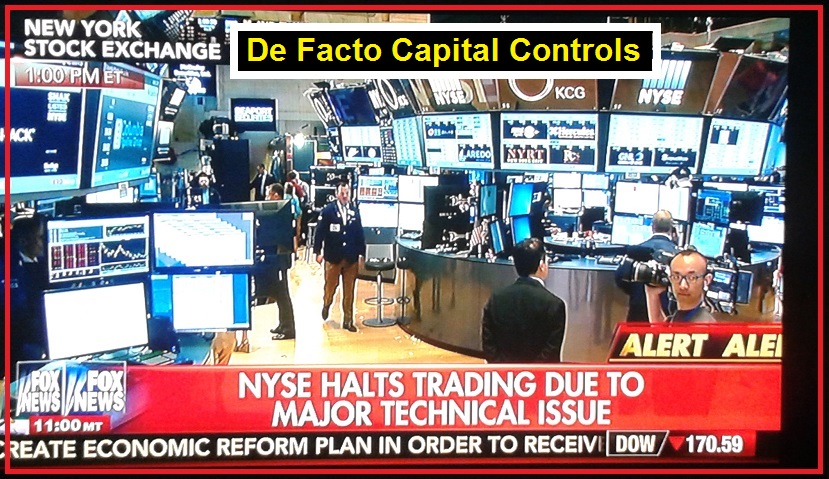
¥esterday the news hits that all trading on the NYSE is “suspended” due to a “technical glitch.” Just overlook the fact that the trading halt occurred just as the the entire stock market was about do an “elevator shaft” plunge. Funny that – the market never seems to “break” or incur a “technical glitch” when the stock market is spiking higher in inexorable parabolic fashion on some bogus economic report.
The day before the US Mint runs out of silver eagles. Of course, the US Mint/Govt was the last one to announce the news. Everyone in the alternative media/blogosphere heard about it through silver eagle dealers who heard about it from their US mint approved participant supplies (A-mark, etc).
If you want to see what an elevator shaft plunge looks like when a “breakage” or “glitch” is not imposed on a market, look no further than what happened to silver yesterday:

This is what selective capital controls look like. A colleague asked me just now if the NYSE had resumed trading yet (2:15 p.m. EST). I replied: “Does it really matter? It’s irrelevant. The fuse has been lit. This is the start of capital controls. It’s no different from what China is doing. Just wait till they start lowering the gate on mutual funds…then banks….”
I warned last summer that it was time to get your money out of all fixed income mutual funds. I’m sure no one listened. Now it’s time to get your money out of ALL mutual funds. In fact, anyone with half a brain would get their money entirely out of the retirement fund system.
They are in the process of looting retirement funds, only they are using a method that did not occur to me until I applied the same methodology being used on Greece: impose an amount of leverage on the entity in a manner which enables the elitists to “gut” the entity from the inside out.
Most large pension funds – Public and Private – are severely to catastrophically underfunded. This means that the net worth of the fund is below 50%. What’s amusing is that many big pension funds are still throwing money hand over fist at Private Equity firms. These PE firms are paying retarded valuation multiples to invest in businesses, especially tech start-ups. When the stock market crashes despite attempts to “break” the market, PE investments will be wiped out and pension fund net worths will be wiped out. That’s how they are gutting the retirement system.
The Fuse has been lit – it’s only a matter of time before there’s a huge financial mushroom nuclear cloud – to be followed by nuclear mushroom clouds…

via SilverSeek.com

World’s oldest global finance organization thinks central banks could be causing a crisis all over again
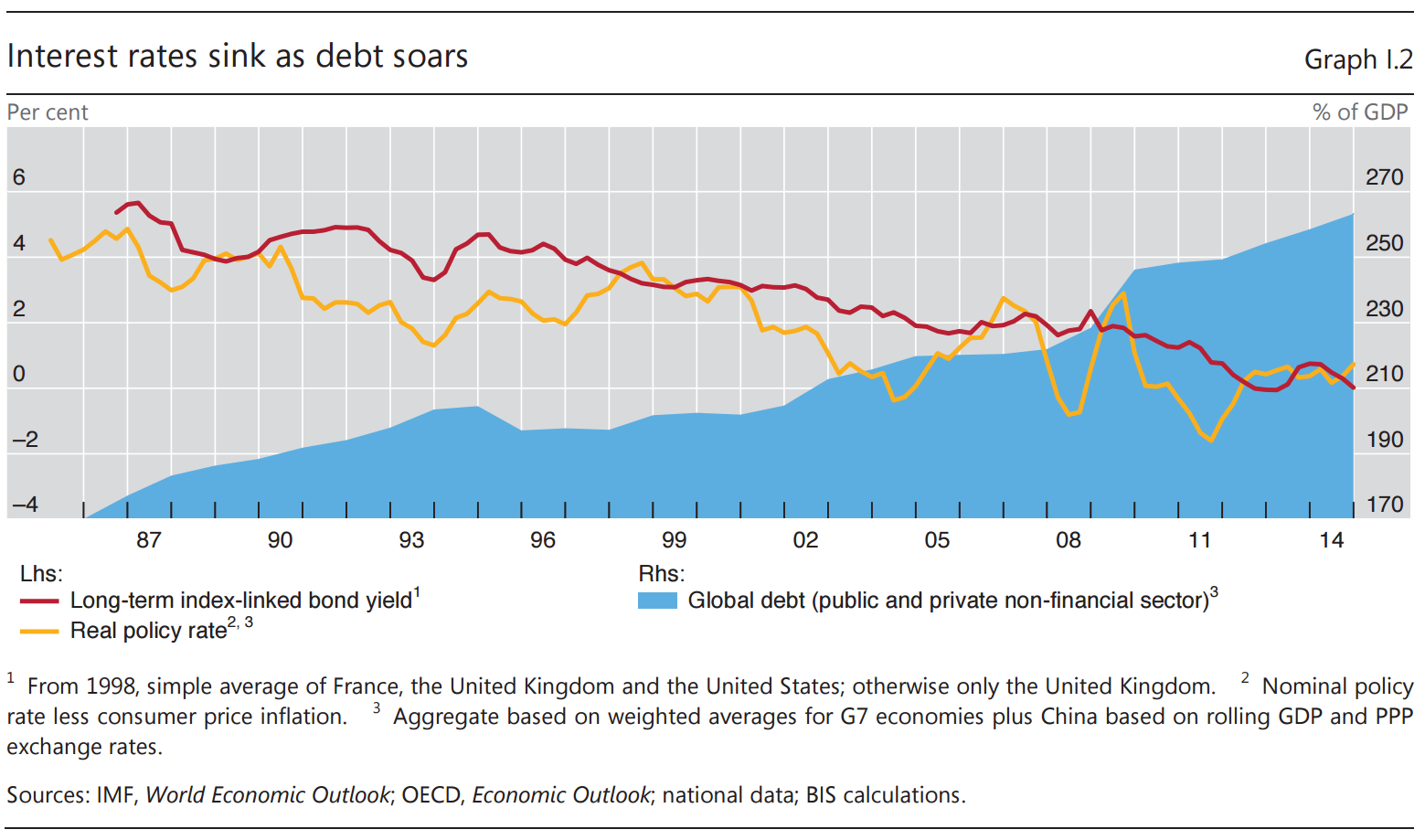
“We argue that the current malaise may to a considerable extent reflect a failure to come to grips with how financial developments interact with output and inflation in a globalised economy. For some time now, policies have proved ineffective in preventing the build-up and collapse of hugely damaging financial imbalances, whether in advanced or in emerging market economies (EMEs). These have left long-lasting scars in the economic tissue, as they have sapped productivity and misallocated real resources across sectors and over time.” – From the Bank For International Settlements report:

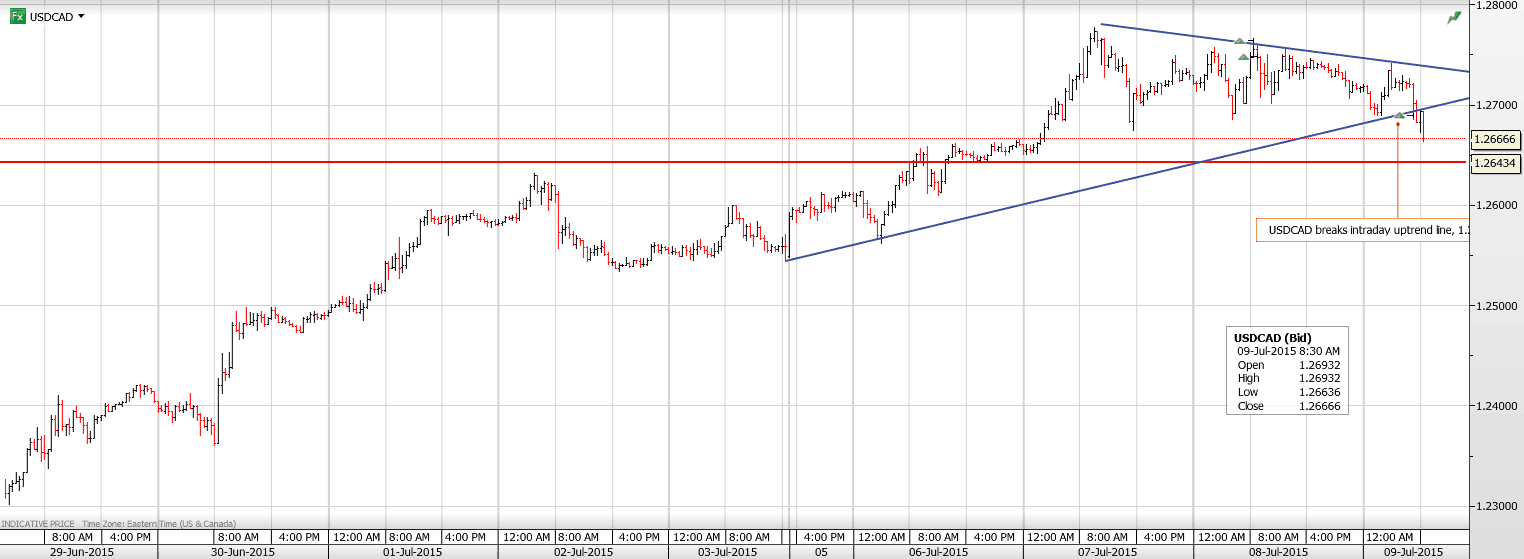
USDCAD Overnight Range 1.2690-1.2745
This morning’s higher US Jobless claims data (297k vs. forecast of 285K) and modestly better Canadian Housing data (which is expected in June) has taken the wind out of the sails for recent USDCAD bulls. The break of intraday support at 1.2690 sets up a test of 1.2660 support which we may see today.
USDCAD traded in a fairly narrow range overnight. In Asia, it hovered around the New York close (1.2730) but that wasn’t the case in early European trading. USDCAD headed lower to just below 1.2700 before bouncing, in part due to the rebound in China equity markets.
It was a fairly active session overnight, beginning in Asia. The much-better-than-expected Australian employment data gave AUDUSD a brief boost prior to renewed weakness in Chinese equity markets, crushing that rally. The China CSI 300 dropped initially and then quickly reversed, posting a 5.7% gain on the day. There may have been some “official” support for the rally but no one is saying.
European traders took their cue from the Asian markets and sold US dollars, helping to drive EURUSD to 1.1125. That momentum didn’t last. A number of ECB officials sounded pessimistic on Greece developments and the earlier gains were erased.
Yesterday’s release of the FOMC minutes proved to be a non-event although some tried to make a doveish case because the Committee acknowledged risks from China and Greece. It would have bee news if they didn’t acknowledge the risks.
Technical Outlook
The intraday technicals are modestly bearish following the failure to extend gains above the 1.2750-70 area todays move below 1.2690 likely to extend to the 1.2640-60 area. A break below 1.2640 would indicate that a short term top is in place at 1.2760 and suggest further downside to 1.2530. A move above 1.2780 will extend gains to the 1.2820-50 zone.
Today’s Range 1.2660-1.2730
Chart: USDCAD 30 minute with break of uptrend shown Larger Chart

The situation in the silver market seems to point to the beginning stages of a GLOBAL RUN ON SILVER. I say, “it seems to point to a RUN on silver” due to several indicators I am looking at. This also may force the global silver market to suffer shortage.


-
I know Mike is a very solid investor and respect his opinions very much. So if he says pay attention to this or that - I will.
~ Dale G.
-
I've started managing my own investments so view Michael's site as a one-stop shop from which to get information and perspectives.
~ Dave E.
-
Michael offers easy reading, honest, common sense information that anyone can use in a practical manner.
~ der_al.
-
A sane voice in a scrambled investment world.
~ Ed R.
Inside Edge Pro Contributors

Greg Weldon

Josef Schachter

Tyler Bollhorn

Ryan Irvine

Paul Beattie

Martin Straith

Patrick Ceresna

Mark Leibovit

James Thorne

Victor Adair