
Real Estate

Canada Poised For Biggest Housing Crash in History

Housing crashCanadian home prices are about to fall by nearly 50 per cent, leading to the biggest housing crash the country has ever seen – but this could present an opportunity for well-financed investors.

“Investors who own properties with substantial equity can hang on without any trouble and they will see a new supply of renters who will be looking to rent after being burned as owners,” MacBeth, a portfolio manager at Richardson GMP in Edmonton told CREW.

…..read more HERE

Brick-Laying Robots: Full Sized House in 2 Days

No Amount of Money Printing Will Spark Inflation …

t’s amazing to me how many pundits out there still think that inflation is coming back. That money printing can solve the world’s massive debt problems.

Why can’t they see reality? Why can’t they see the facts?

Combined, the world’s major central banks have printed some $10 trillion of new money since 2008. Yet …

Fact #1: There’s no inflation in sight. According to the Organization for Economic Cooperation and Development (OECD), the annual rate of inflation in its 36 members is a meager 0.56 percent.

In the European Union, overall inflation is running at half the OECD rate at just 0.28 percent.


chart1s
Click HERE for larger view

But that disguises the problem. Why?


Because in many European countries, like Greece, Italy, Poland, Ireland and even Finland — there’s no inflation at all — and instead, there’s outright deflation, with Greece leading the pack of course, with prices now falling at a -2.14 percent annual rate.

Heck, even prices in Switzerland, known historically for price stability, are falling at a -1.03 percent annual rate.

Fact #2: There’s no wage inflation. To have consistent across the board inflation, one must also have wage inflation. Indeed, historically, some of the highest inflation rates are caused largely by wage inflation. Yet today, there is none.

According to the International Labor Organization, based on latest data wage inflation (globally but excluding China) is running at a mere 1.1 percent. Hardly the stuff that can stoke inflation.

Fact #3: There’s no commodity inflation. As I’ve been documenting for you all along, there’s no commodity inflation. We’re in the opposite: Commodity DEFLATIION. Just consider this chart of the Global Commodity ETF (CRBQ) — a basket of equity securities that mimic the performance of the world’s biggest, global commodity producers. Companies like Monsanto, ExxonMobil, Archer Daniels Midland, Chevron and more.


chart2s
Click HERE for larger view

Despite all the money printing, commodity prices — and the shares of companies that produce them — have been sliding for four years now.

Worse, the plunge is now accelerating!

Fact #4: The supposed leading indicator for inflation, gold, is in a bear market. If gold is such a great leading indicator of inflation, then why is it still in a bear market?

Why has it lost 40 percent of its value since its high in September 2011? Since all that money printing occurred?

It’s simple …

A. There is no inflation. And …

B. Gold is NOT the inflation hedge that you think it is!

Indeed, as I have said all along, gold’s best role is as a hedge against collapsing governments. That time is coming — in the not-too-distant future — and then gold will finally shine again. But that time is not yet here.

Fact #5: Despite all the money printing, the U.S. dollar is soaring. The Fed has printed roughly $4 trillion since 2008 and yet the dollar is 34.4 percent stronger than it was when the printing began!

If you’re like most investors, or you listened to most pundits, this one really has your head spinning. After all, almost everyone told you that when the Fed prints money, the dollar loses purchasing power and goes down in value in international markets. Right?

Wrong. The fact of the matter is this. The value of the U.S. dollar isn’t solely dependent upon how many dollars are circulating or how many new ones are being printed.

The dollar’s value also isn’t dependent upon interest rates, per se. Instead, the dollar’s value is more a reflection of …
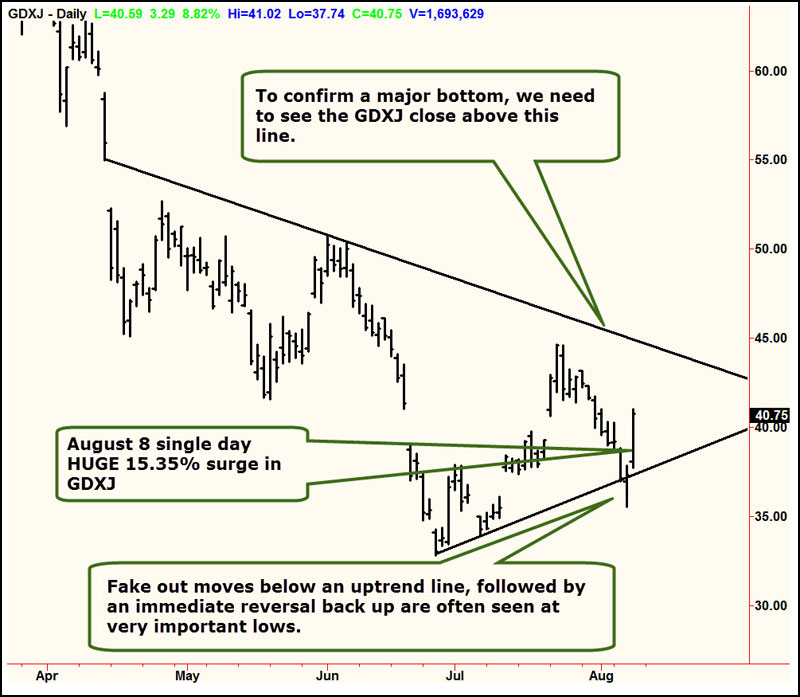

chart3s
Click HERE for larger view

A. What’s happening in the rest of the world.

In a nutshell, if a major portion of the world, like Europe, is in worse shape than the U.S. — then the dollar will get a boost.

B. Capital flows. Part and parcel of the above, but also geo-political in nature.

When there’s rising troubles in other parts of the world — as we have been seeing ever since I warned you that the war cycles were turning up — that benefits the dollar. Period.

And …

C. Inflation and/or deflation. Inflation erodes the purchasing power of the dollar. But there is no widespread inflation in the U.S. There isn’t even wage inflation. So forces A and B above are bolstering the dollar, dramatically — and in spite of the money the Fed printed!

So what then, you ask, is the
driving force behind all this today?

It’s this: There’s simply too much debt in the world!

All told — counting both official and unofficial government debts (contingent IOUs that governments around the world don’t like to talk about) —

Global government debt reaches as high as $500 trillion …

While global gross domestic product (GDP) is merely $75 trillion.

That’s a debt-to-GDP ratio of more than 600 percent.

And that debt mountain, the biggest the world has ever seen, is starting to crumble.

Europe is ground zero for the collapse. Soon, it will leapfrog to other super-indebted Western governments, namely Japan and then the USA …

In a debt and deflation spiral that will knock your socks off and change everything you thought you knew about economics and markets.

Best wishes, stay safe and stay tuned …

Larry

Larry Edelson

Larry Edelson, one of the world’s foremost experts on gold and precious metals, is the editor of Real Wealth Report, Power Portfolio and Gold and Silver Trader.

Larry has called the ups and downs in the gold market time and again. As a result, he is often called upon by the media for his investing views. Larry has been featured on Bloomberg, Reuters and CNBC as well as The New York Times and New York Sun.

The investment strategy and opinions expressed in this article are those of the author and do not necessarily reflect those of any other editor at Weiss Research or the company as a whole.

Jul 14, 2015  

  1. Most gold analysts think that gold is in a bull market, or a bear market. They use charts and US economic reports to try to prove that the gold price is ready to move substantially higher or lower.
  2. In contrast, I’ve argued that the world gold market is in a state of transition. It’s transitioning from a Western fear trade orientation, to an Eastern love trade orientation, and thus gold is on the cusp of a “bull era”.
  3. The last century was dominated by the America. During America’s “heyday”, companies like Xerox and General Motors staged relentless increases in quarterly earnings, and this was consistently followed by massive increases in their stock prices.
  4. That’s because institutional money managers base their liquidity flows on earnings reports. They don’t care if a chart looks bullish or bearish.
  5. They care about earnings growth and cash flow growth.
  6. Even more importantly, mainstream money managers look for consistency of earnings growth, and consistency of cash flow growth. 
  7. Price drivers like QE, Greece, and OTC derivatives don’t create cash flow and earnings growth consistency for gold stocks. They create volatility, and that’s not something that an institutional money manager likes to see. 
  8. I don’t think most investors realize what kind of sea change is taking place in the gold stocks sector right now. It’s a process that can turn gold stocks into one of the most stable cash flow cows… in the history of investing.
  9. In China and India, good economic news is a reason to buy gold, and bad economic news is also a reason to buy gold. The steady rise in demand created by industrialization in these countries, coupled with static mine supply, is poised to turn the gold stocks sector into an institutional darling.
  10. Please  click here now. Double-click to enlarge. That’s a snapshot of recent quarterly earnings for Newmont.
  11. Once a company starts to show sizable increases in quarterly earnings and cash flow, institutional money managers of size begin to pay serious attention to that company.
  12. Newmont is a gold stock sector leader, and it’s staged some phenomenal and consistent growth in quarterly earnings. That has stunned institutional money managers, and brought them to the investment table.
  13. The next Newmont earnings report is scheduled for July 22. If there’s another upside surprise, institutional money is going to pour into Newmont, and the stock should begin a new leg to the upside.
  14. Please  click here now. That’s another look at Newmont, using the weekly chart. Chindian demand can realistically add about $100 – $200 to the gold price floor, over the next 18 months. It can do it in a very stable manner.
  15. To most amateur investors living in the legacy of fear trade era, that might not seem like much of a price spike. To an institutional money manager following earnings reports from companies like Newmont, Barrick, Agnico Eagle, and Goldcorp, it turns those companies into consistent cash cows.
  16. Gold stock charts can’t be used in isolation from earnings reports. The reason that most investors were so negative about gold stocks at the end of 2014 was because they were focused on things like QE and rate hikes, rather than corporate earnings.
  17. That’s why they missed the boat with Newmont, and it’s why they may miss the entire gold stocks sector boat, as it sails up the chart, in 2016!
  18. Newmont is probably going to move steadily towards the $40 area in 2016. Investors who waste time waiting for some magical “chart breakout” will never make any serious money in the market, and certainly not with a key stock like Newmont.
  19. As Newmont moves towards $40, I expect GDX will rise towards $38. On that note, please  click here now. That’s the weekly chart for GDX. 
  20. No chart formation is going to move GDX higher or lower. It’s institutional liquidity flows that matter, and as mining costs stabilize, and Chindian demand is already quantified by top bank economists as steadily rising, good earnings reports will make the entire Western gold community happy, and GDX will move towards $38!
  21. When the fear trade dominated gold price discovery, it was very difficult for money managers to make long term projections about the gold price. That’s changed with the rise of the love trade, and the rise in oil supply. 
  22. As Iran is welcomed back into the international community, even more oil supply will make its way onto the market. Also, China may have large reserves of oil and gas that can be tapped by the use of fracking. Fuel prices for gold mining are becoming incredibly stable, and the love trade is creating stable and consistently growing demand. 
  23. The bottom line is that here’s never been a better time in history to confidently invest in gold stocks, than right now! On that note, please click here now. That’s the daily chart for GDXJ. Junior and intermediate gold stocks that have decent AISC (all-in sustaining costs) can do extremely well in the bull era.
  24. Yesterday’s price, volume, and oscillator action was impressive. Note the beautiful position of the 14,7,7 Stochastics oscillator, at the bottom of the chart. The traditional summer rally for gold stocks may now be in play! 

Jul 14, 2015  
Stewart Thomson  
Graceland Updates
website: www.gracelandupdates.com
email for questions: stewart@gracelandupdates.com 
email to request the free reports: freereports@gracelandupdates.com

Tuesday Jul 14, 2015
Special Offer for Money Talks readers
: Send an email to freereports@gracelandupdates.comand I’ll send you my free “Golden Sweet Spot!” report. I highlight gold and silver stocks in the $3 – $6 price range, that could be catapulted higher over the next 18 months, as institutional money managers pour earnings-oriented liquidity into them!

Graceland Updates Subscription Service: Note we are privacy oriented. We accept cheques. And credit cards thru PayPal only on our website. For your protection we don’t see your credit card information. Only PayPal does.

Subscribe via major credit cards at Graceland Updates – or make checks payable to: “Stewart Thomson” Mail to: Stewart Thomson / 1276 Lakeview Drive / Oakville, Ontario L6H 2M8 / Canada

Stewart Thomson is a retired Merrill Lynch broker. Stewart writes the Graceland Updates daily between 4am-7am. They are sent out around 8am. The newsletter is attractively priced and the format is a unique numbered point form; giving clarity to each point and saving valuable reading time.

Risks, Disclaimers, Legal
Stewart Thomson is no longer an investment advisor. The information provided by Stewart and Graceland Updates is for general information purposes only. Before taking any action on any investment, it is imperative that you consult with multiple properly licensed, experienced and qualifed investment advisors and get numerous opinions before taking any action. Your minimum risk on any investment in the world is 100% loss of all your money. You may be taking or preparing to take leveraged positions in investments and not know it, exposing yourself to unlimited risks. This is highly concerning if you are an invetor in any derivatives products. There is an approx $700 trillion OTC Derivatives Iceberg with a tiny portion written off officially. The bottom line:

Martin Armstrong: Market Talk

282x179xTrading-Community.jpg.pagespeed.ic.srRYIRu7HUPosted on 
 
The markets were relatively well behaved today with little geopolitical excitement to unnerve trading but we did see weaker economic data in the States. Retail Sales was expected +0.2% but failed to deliver showing at -0.3%, ex-autos -0.1% verses 0.5%. Also, May Business Inventories broadly in-line at 0.3%.
 
Despite the less optimistic showing the US Stocks put in a reasonable performance gaining between 0.45 and 0.66% DJI and NASDAQ.
 
We did see an impressive performance from the US Treasury market (guess to be expected with such a weak Retail Sales) and that managed to tighten some of the spread differential lost over the Bund yesterday. Today that spread (TY/RX) tightened 5bp to trade late at 144bp.
 
The benchmark Greek indicator, we show daily is the GGB (Greek Government Bond), was a little weaker and marked at 25.5%  in late trade. Traders normally detest quiet days but after the torrent of storms we have had to endure recently – today was a breath of fresh air.
 
Don’t expect it to last!
 
…more from Martin Armstrong:
 

test-php-789