
Gold & Precious Metals
 “The first form of culture,” wrote historian Will Durant, “is agriculture.”
And he was right. When human beings discovered 10,000 years ago that the soil would provide more food than they could possibly eat, this changed everything.
For the first time ever, early humans could actually work WITH nature and reliably control their food production.
They were no longer dependent on unpredictable wildlife or the dangers of the hunt.
Nor were they resigned to devouring an entire beast in one sitting, only to end up right back where they started– in search of their next meal.
Agriculture gave them the opportunity to produce far more than they could consume. And to easily save the surplus for a later time.
To save like this is completely natural. And by that I mean saving is part of nature.
Dogs bury their bones. Squirrels hoard nuts. Even plants set aside some excess solar energy for a rainy day by producing and storing sugar.
For us humans, agriculture was our earliest form of savings. And it was the key ingredient to civilization.
With a vast pool of food savings at his disposal, early man could put down roots and build societies without having to worry about where the next meal would come from.
It was this sense of savings that formed the dividing line between primitive man and civilized man.
This reminds me of that old criticism about gold being a “barbarous relic”……continue reading HERE

I won’t keep you in suspense. The biggest trade ever is in demographics. In particular, our rapidly increasing life expectancy.
Quick story. My Coast Guard friends are retiring now. You get to retire after 20 years of service, but some of them have been taking advantage of early retirement and are leaving the service as young as age 40.
Oh my God, what a deal: At age 40, you can bring home about $50K a year and then start a whole new career on the side!
In the old days, you could offer that deal because military folks would die at 47. Now they will live to 100.
Paying out benefits for 60 years to retired military personnel doesn’t sound like a great deal for the taxpayer.
Of course, the military pensions are just the tip of the iceberg. To receive Social Security, you can retire at age 62 (or 67 for full benefits). Again, that’s fine when most people die before 62. The blended life expectancy (for both men and women) is almost 79 years and trending higher.

Or my favorite chart on life expectancy ever, also a rebuttal to those who don’t like capitalism.

If you pay attention to Silicon Valley stuff, you know that Google and Ray Kurzweil and some other folks are working on projects that will allow us to live to 150 or even beyond. That would involve doing a couple of things, first
- Curing cancer
- Curing heart disease
- Curing Alzheimer’s disease
You do these three things, it increases life expectancy by another 10 years or more. And we are actually doing those things!
Once you have a cure for all known diseases (attainable in my lifetime), then you have a different problem. Cells get old and die. The Silicon Valley folks are working on that too.
Funny, if you don’t smoke, eat right, and get a little exercise, you will pretty much live to 80, no matter what. What happens beyond that is up to genetics, which we will solve one day.
So what will the world look like if people live to 100, 150, or more?
It Looks Like Greece
Greece’s retirement age (to receive benefits) used to be 55 years. Again: retiring at 55, what a deal! I would only have 14 more years to go. People are pretty healthy at 55 (though maybe not the Greeks—they have the highest rate of tobacco use in the developed world).
So if people live way longer than the retirement age, the Social Security system goes kablooey. It just does. And yet people resist all attempts to reform it.
We know Social Security is in trouble. George W. Bush tried to tackle it. For all his faults, it was the right thing to do. But he got laughed at.
The first thing we will do is to means-test the benefits, which will just make it more progressive but won’t solve the actual problem. You need to push back the retirement age, like, to 80.
But wait a minute. There aren’t even enough jobs for people to work until age 80.
I know…
The World Was a Lot Simpler When People Just Died When They Were Supposed To
We’re going to look back at the 1940s-2000s as an exceptional period in economic history—with high, virtually straight-line, uninterrupted economic growth. We had debt problems before, but biology has made them intractable.
In fact, the whole profession of economics is based on the very idea that there is population growth and inflation. What happens if birth rates decline? They are. Population growth rates will peak very soon. (By the way, the old Malthusian idea of overpopulation is being discredited.) What does the profession of economics look like with declining populations, people living longer, a dearth of unskilled jobs?
Is it nonstop deflation?
Many economists predict years of global deflation based on this premise. They say that you should buy bonds at any price. It’s a compelling argument. I think we’re going to learn a lot of really interesting things about money velocity in the coming years.
The Trade
Like tech in the ‘90s and energy in the 2000s, health care has been and will be the trade of the 2010s. You have the happy accident of huge technological advances and a government that seems willing, for the time being, to pay for it all. You hear some squawking about the cost of some treatments, but seriously, if you can cure cancer for $250,000, who is going to say no? Especially when that person’s chemotherapy, radiation, and hospital bills could easily exceed $2,000,000.
Lots of folks thought that Obamacare would tomahawk the health care sector. In classic market fashion, it has done the exact opposite. The insurers in particular have been the biggest beneficiary. You probably saw the recent Aetna/Humana merger.
People have tried for years to short biotech. Hasn’t been fun for them.
People have funny attitudes about death, you know. You ask someone if they’d like to live to 100, 120. “Noooooo,” they say. “I wouldn’t want to just sit in a chair.”
Me, personally, I’d be okay with sitting in a chair. But the point of these treatments is that you can be active into your 100s. What then?
“I don’t know…” they say.
Are you kidding me? Forever young, my man. I’m 41, and I look a lot younger than my parents at the same age (sorry, Mom and Dad). I’m still DJing parties, for crying out loud.
Still don’t get the point of Snapchat, though.
Jared Dillian
Editor, The 10th Man

 While Greece is now dominating the debt default stage, the real tragedy is playing out much closer to home, with the downward spiral of Puerto Rico. As in Greece, the Puerto Rican economy has been destroyed by its participation in an unrealistic monetary system that it does not control and the failure of domestic politicians to confront their own insolvency. But the damage done to the Puerto Rican economy by the United States has been far more debilitating than whatever damage the European Union has inflicted on Greece. In fact, the lessons we should be learning in Puerto Rico, most notably how socialistic labor and tax policies can devastate an economy, should serve as a wake up call to those advocating prescribing the same for the mainland.
The U.S. has bombed the territory of Puerto Rico with five supposedly well-meaning, but economically devastating policies. It has:
1. Exempted the Island’s government debt from all U.S. taxes in the Jones-Shaforth Act.
2. Eliminated U.S. tax breaks for private sector investment with the expiration of section 936 of the U.S. Internal Revenue Code.
3. Required the nation to abide by a restrictive trade arrangement.
4. Made the Island subject to the U.S. minimum wage.
5. Enabled Puerto Rico to offer generous welfare benefits relative to income.
While passage of such politically popular laws seems benign on the surface (and have allowed politicians to claim that their efforts have helped the poorest Puerto Ricans), in reality they have deepened the poverty of the very people the laws were supposedly designed to help. The lessons here are so obvious that only the most ardent supporters of government economic control can fail to comprehend them
Tax-Free Debt
By exempting U.S. citizens from taxes on interest paid on Puerto Rican sovereign debt, Washington sought to help the Puerto Rican economy by making it easier and cheaper for the Island’s government to borrow from the mainland. As a result, Puerto Rican government bonds became a staple holding of many U.S. municipal bond funds. As with Fannie Mae and Freddie Mac bonds a decade ago, many investors believed that these Puerto Rican bonds had an implied U.S. government guarantee. This meant that the Puerto Rican government could borrow for far less than it could have without such a belief. However, this subsidy did not grow the Puerto Rican economy, but simply the size of the government, which had the perverse effect of stifling private sector growth.
In contrast to the tax-free income earned by Americans who buy Puerto Rican government bonds, those with the bad sense to lend to Puerto Rican businesses were taxed on the interest payments that they received. Businesses could have used the funds for actual capital investment (that could have increased the Island’s productivity), but instead the money flowed to the Government which used it to buy votes with generous public sector benefits that did nothing to grow the Island’s economy or put it in a better position to repay. That problem was left for future taxpayers who no politician seeking votes in the present cared about.
This dynamic is almost identical to what happened in Greece, where low borrowing costs, made possible by the strong euro currency and the implied backstop of the European Central Bank and the more solvent northern European nations, permitted the Greek government to borrow at far lower rates than its strained finances would have otherwise allowed.
Taxing Private Investment
Perversely, as the U.S. government made it easier for the Puerto Rican government to borrow, it made it harder for the private sector to do so. In 2006 the government ended a tax break that exempted corporate profits earned on private sector investment in Puerto Rico from U.S. taxes. As a result, U.S. businesses that had been making investments and hiring workers on the Island pulled up stakes and moved to more tax-friendly jurisdictions. The result was an erosion of the Island’s local tax base, just as more borrowing (made possible by triple tax-free government debt) obligated the remaining Puerto Rican taxpayers to greater future liabilities.
The Jones Act
The Jones Act, a 1920 law designed to protect the U.S. merchant marine from foreign competition, has had a devastating effect on Puerto Rico, and should be used as a cautionary tale to illustrate the dangers of trade barriers. Under the terms of this horrible law, foreign-flagged ships are prevented from carrying cargo between two U.S. ports. According to the law, Puerto Rico counts as a U.S. port. So a container ship bringing goods from China to the U.S. mainland is prevented from stopping in Puerto Rico on the way. Instead, the cargo must be dropped off at a mainland port, then reloaded onto an expensive U.S.-flagged ship, and transported back to Puerto Rico. As a result, shipping costs to and from Puerto Rico are the highest in the Caribbean. This reduces trade between Puerto Rico and the rest of the world. Since a large percentage of the finished goods used by Puerto Ricans are imported, the result is much higher consumer prices and fewer private sector jobs. Even though median incomes in Puerto Rico are only 63% of the poorest U.S. state, thanks to the Jones Act, the cost of living is actually higher than the average state.
The Federal Minimum Wage
In 1938 the Fair Labor Standards Act subjected Puerto Rico to a federal minimum wage, but it was not until 1983 that a 1974 act, which required that the Island match the mainland’s minimum wage, was fully phased in. The current Federal minimum wage of $7.25 per hour is 77% of Puerto Rico’s current median wage of $9.42. In contrast, the Federal minimum is only 43% of the U.S. median wage of almost $17 per hour (Bureau of Labor Statistics (BLS), May 2014). The U.S. minimum wage would have to be more than $13 per hour to match that Puerto Rico proportion. The disparity is greater when comparing minimum wage income to per capita income.
The imposition of an insupportably high minimum wage has meant that entry level jobs simply don’t exist in Puerto Rico. Unemployment is over 12% (BLS), and the labor force participation rate is about 43% (as opposed to 63% on the mainland) (The World Bank). A “success” by the Obama administration in raising the Federal minimum to $10 per hour would mean that the minimum wage in Puerto Rico would be higher than the current medium wage. Such a move would result in layoffs on the Island and another step down into the economic pit. I predict that it could bring on a crisis similar to the one created in the last decade in American Somoa when that island’s economy was devastated by an unsustainable increase in the minimum wage.
It will be interesting to see if our progressive politicians will have enough forethought and mercy to exempt Puerto Rico from minimum wage increases. But to do so would force them to acknowledge the destructive nature of the law, an admission that they would take great pains to avoid.
Welfare
In 2013 median income in Puerto Rico was just over half that of the poorest state in the union (Mississippi) but welfare benefits are very similar. This means that the incentive to forgo public assistance in favor of a job is greatly reduced in Puerto Rico, as a larger percentage of those on public assistance would do better financially by turning down a low paying job. Because of these perverse incentives not to work, fewer than half of working age males are employed and 45% of the Island’s population lived below the federal poverty line (U.S. Census Bureau, American Community Survey Briefs issued Sep. 2014). According to a 2012 report by the New York Federal Reserve Bank, 40% of Island income consists of transfer payments, and 35% of the Island’s residents receive food stamps (Fox News Latino, 3/11/14).
In other words, Puerto Rico’s problems are strikingly similar to those of Greece. Its government spends chronically more than it raises in taxes, its economy is trapped in a regulatory morass, and its economic destiny is largely in the hands of others.
The solutions to Puerto Rico’s problems are simple, but politically toxic for mainland politicians to acknowledge. Puerto Rico must be allowed to declare bankruptcy, the Federal incentive for the Puerto Rican government to borrow money must be eliminated, Puerto Rico must be exempted from both the Jones Act and the Federal Minimum wage, and Federal welfare requirements must be reduced. Puerto Rico already has the huge advantages of being exempt from both the Federal Income Tax and Obamacare, so with a fresh start, free from oppressive debt and federal regulations, capitalism could quickly restore the prosperity socialism destroyed. With the current incentives provided by Acts 20 and 22 (which basically exempt Puerto Rico-sourced income for new arrivals from local as well as federal income tax – see my report on America’s Tax Free Zone) and with some additional local free market labor reforms, in a generation it’s possible that Puerto Ricans could enjoy higher per capita incomes than citizens of any U.S. state.
If Washington really wanted to accelerate the process, it should exempt mainland residents from all income taxes, including the AMT, on Puerto Rico-sourced investment income, including dividends, capital gains, and interest related to capital investment.
Read the original article at Euro Pacific Capital.
Best Selling author Peter Schiff is the CEO and Chief Global Strategist of Euro Pacific Capital. His podcasts are available on The Peter Schiff Channel on Youtube
Credit Markets
As the old saying goes, “Credit is suspicion asleep”. Jim Grant calls it “Money of the mind”. While the total outstanding amounts to a much bigger market cap than for global equities, credit can be rather ephemeral in price and even existence.
Global credit markets seem to be in the early stages of another “Ephemeral Event”. The term “another” is a deliberate attempt to point out that it will not be a “Black Swan” event. Taleb’s thesis implies that magnificent financial collapses are “improbable” and therefore unpredictable. It’s strange that he did not observe that great financial collapses have had similar setups.
From 1720 until 2007, there has been six great financial bubbles. Each had similar characteristics on the climax and collapse. Including action in the credit markets and utterances by governments and/or government institutions.
US credit spreads were expected to narrow into “around May-June” and because credit markets have become so speculative the expected reversal could be the one that ends the global bubble.
In real time this worked for us in 1998 (LTCM), 2000, and 2007.
Our special study “Widows and Orphans Short” sent out yesterday had charts covering the subject. Spreads have reversed to widening.
Long-dated Treasuries (TLT) were expected to rally as various speculations stalled out and then collapsed. This was noted two weeks ago and last week we thought that 120 was possible.

Chart above is updated from the Pivotal Events that was published for our subscribers July 8, 2015.
The Daily RSI got down to 28 and this week’s advance takes the TLT above the 50-Day ma, which is constructive. The target now becomes the resistance level at 123.
Junk (JNK) rallied with narrowing spreads to 31.10 in May and on the decline took out the 50-Day ma in early June. The 200-Day was violated in the middle of June and the latest rally stalled at said moving average. The downtrend is established and the panic lows of December seems not improbable.
Listen to the Bob Hoye Podcast every Friday afternoon at TalkDigitalNetwork.com

The sheer size and importance of China’s equity markets cannot be overstated. Second in size only to the New York Stock Exchange, the combined value of the Asian country’s stock markets is $14 trillion and change. Or at least it was, before they fell 30 percent, wiping away nearly $2 trillion in value. To put this in perspective, the gross domestic product (GDP) of debt-troubled Greece is around $200 billion.
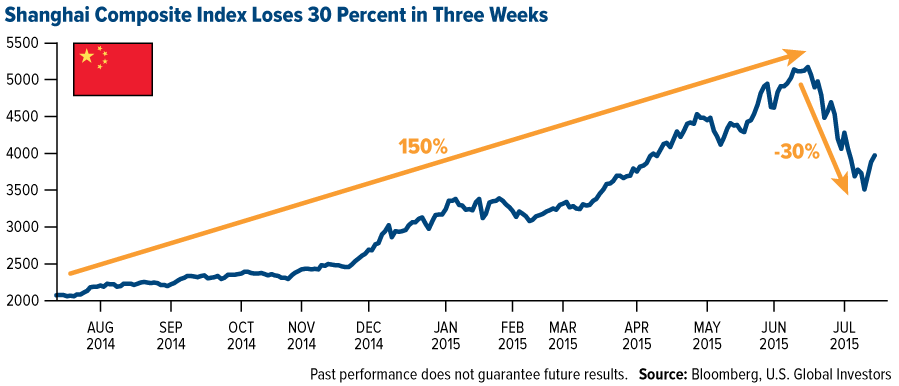
So how did this happen? The answer has a lot to do with the quantity and quality of investors.
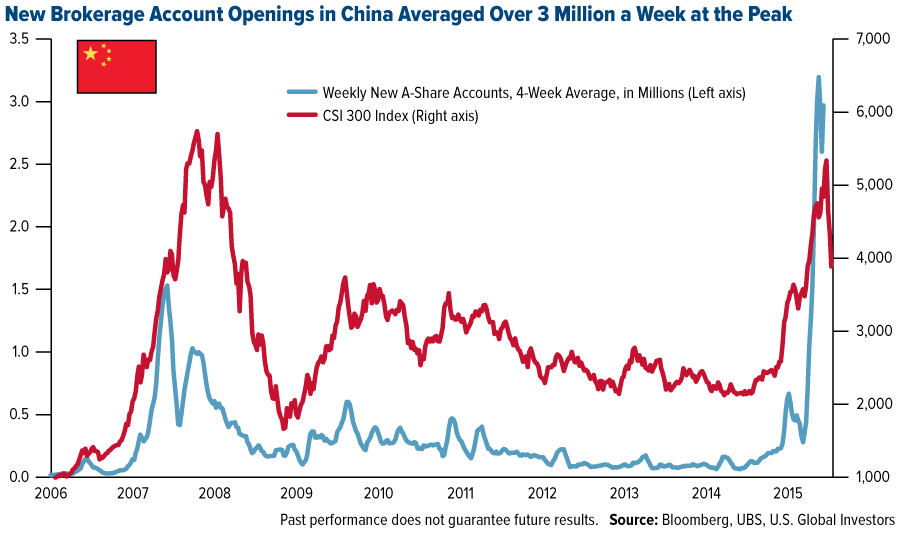
In most major economies, stock markets trading is dominated by professional money managers. But in China, between 80 and 90 percent of the domestic A-share market is made up of retail investors, many of them novices who sought to participate in the yearlong bull run. An eye-popping 40 million new brokerage accounts were created in the one-year period ended in May. The Communist Party, by comparison, gained only a little over one million new members in the same period. At the peak, accounts were being added at a rate of over three million per week.
For many of these first-time or relatively inexperienced investors, the price of entry was margin lending. Cosmic amounts of it. Near the end of June, 2.08 trillion yuan ($335 billion) worth of borrowed funds flooded the Shanghai and Shenzhen markets. Margin lending as a percentage of total market cap rose to as high as 20 percent. In the U.S., it’s about 2.5 percent.
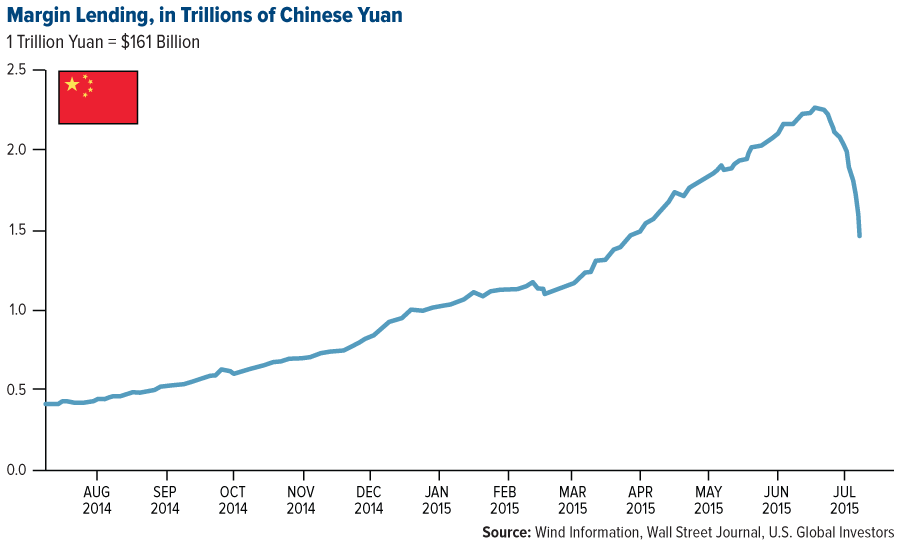
This combination—millions of new accounts mixed with unprecedented leveraging—greatly contributed to the selloff. As you can see above, this leverage is now unraveling as investors are forced to sell in order to meet margin calls.
Beijing has responded with a host of measures to prevent the market from sliding any further, one of the most significant being a ban on huge institutional shareholders from selling until the Shanghai Composite rises above 4500. As of this writing, it’s just above 3800 after breaking a three-day rally.
The good news is that some analysts believe the worst might be behind us. Financial services firm UBS takes the position that, as massive as the correction was, it shouldn’t have a “major” economic impact.
In the meantime, we have raised the cash level in our China Region Fund (USCOX) and are ready to deploy it when the right opportunity arises.
Please consider carefully a fund’s investment objectives, risks, charges and expenses. For this and other important information, obtain a fund prospectus by visiting www.usfunds.com or by calling 1-800-US-FUNDS (1-800-873-8637). Read it carefully before investing. Distributed by U.S. Global Brokerage, Inc.
Foreign and emerging market investing involves special risks such as currency fluctuation and less public disclosure, as well as economic and political risk. By investing in a specific geographic region, a regional fund’s returns and share price may be more volatile than those of a less concentrated portfolio.
The Shanghai Composite Index (SSE) is an index of all stocks that trade on the Shanghai Stock Exchange. The CSI 300 is a capitalization-weighted stock market index designed to replicate the performance of 300 A-share stocks traded in the Shanghai and Shenzhen stock exchanges.
All opinions expressed and data provided are subject to change without notice. Some of these opinions may not be appropriate to every investor.

-
I know Mike is a very solid investor and respect his opinions very much. So if he says pay attention to this or that - I will.
~ Dale G.
-
I've started managing my own investments so view Michael's site as a one-stop shop from which to get information and perspectives.
~ Dave E.
-
Michael offers easy reading, honest, common sense information that anyone can use in a practical manner.
~ der_al.
-
A sane voice in a scrambled investment world.
~ Ed R.
Inside Edge Pro Contributors

Greg Weldon

Josef Schachter

Tyler Bollhorn

Ryan Irvine

Paul Beattie

Martin Straith

Patrick Ceresna

Mark Leibovit

James Thorne

Victor Adair