Gold & Precious Metals

Monetary Metals Supply and Demand Report

The prices of the monetary metals cascaded downward this week, and the ratio of the gold price to the silver price rose accordingly.

Many analysts and speculators are puzzled. With everything going on in the world, gold should go up. After all, China released its new gold holdings and the banking system in parts of the world (e.g. Greece) is a mess, and many central banks are printing money, etc.

We don’t know if China’s published number (1658 tonnes, up from 1054 in April 2009) is true or not. We don’t care to speculate, as some have, about this topic (though since we’re linking the article, we want to point out that the Chinese economy is not bigger than the US economy, unless one adjusts the measurement).

We do know that credit stresses are mounting, and it’s not just Greece. There are signs of problems all over the world, including in China. It is important to keep in mind how credit stress works. Let’s compare and contrast two players, we’ll call them Beavis and Butthead.

Beavis owns gold. He is not happy about the falling price. However, being unleveraged, he can think about it at his leisure. He may decide to sell or to keep it, but the point is that his hand is not forced and he is under no pressure. Many readers of this Report may be in this position (we hope).

Butthead has borrowed to buy assets, including gold. With each drop in price, the pressure mounts. He has to look at his leverage ratio — and so does his bank. If he gets a margin call, then his consideration occurs under circumstances that are anything but leisure. Of all his assets, he may choose to dump gold because its price is dropping. This is appropriate for two reasons. One, he hopes to cut losses and hold winners such as stocks. Two, his leverage may be tied to gold specifically, and not to his whole portfolio.

In any case, it leads to the situation we have now. Even gold’s biggest fans — those who expect the biggest profits from a rising gold price — are puzzled. At best. And of course many turn to conspiracy theories about who is whacking gold, and what the motive may be (regardless, we have repeatedly documented that the alleged gold whacking cabal does not have the means).

So here we are. Gold closed the week, broken down, below $1140. Silver is well under $15.

Our view is that breakouts and breakdowns cannot be determined from price charts. We want to know the fundamentals of supply and demand. If the price drops based on heavy selling of metal — as has happened in silver since we began publicly documenting it 2013 — then that’s a fundamental move. We do not predict that fundamental moves should just causelessly reverse themselves, for the price to recover its previous high.

On the other hand, if the price drops based on selling of futures by leveraged speculators, that’s a different story. Then we expect the price is likely to rise. This is because buyers of metal were already hungry at the higher price, and are incentivized even more at the lower price.

How do we measure this balance, this dynamic of changing equilibria in the futures and metal markets? Based on our theory of carry and decarry arbitrage, and using our proprietary model, we analyze the spreads between the spot and futures markets. This is the basis (pun intended) of our Supply and Demand Report.

Read on, for the only accurate picture of the supply and demand conditions in the gold and silver markets, based on the basis and cobasis.

First, here is the graph of the metals’ prices.

The Prices of Gold and Silver

38331 a

We are interested in the changing equilibrium created when some market participants are accumulating hoards and others are dishoarding. Of course, what makes it exciting is that speculators can (temporarily) exaggerate or fight against the trend. The speculators are often acting on rumors, technical analysis, or partial data about flows into or out of one corner of the market. That kind of information can’t tell them whether the globe, on net, is hoarding or dishoarding.

One could point out that gold does not, on net, go into or out of anything. Yes, that is true. But it can come out of hoards and into carry trades. That is what we study. The gold basis tells us about this dynamic.

Conventional techniques for analyzing supply and demand are inapplicable to gold and silver, because the monetary metals have such high inventories. In normal commodities, inventories divided by annual production (stocks to flows) can be measured in months. The world just does not keep much inventory in wheat or oil.

With gold and silver, stocks to flows is measured in decades. Every ounce of those massive stockpiles is potential supply. Everyone on the planet is potential demand. At the right price, and under the right conditions. Looking at incremental changes in mine output or electronic manufacturing is not helpful to predict the future prices of the metals. For an introduction and guide to our concepts and theory,click here.

Next, this is a graph of the gold price measured in silver, otherwise known as the gold to silver ratio. The ratio moved up 2.2% this week.

The Ratio of the Gold Price to the Silver Price

38331 b

For each metal, we will look at a graph of the basis and cobasis overlaid with the price of the dollar in terms of the respective metal. It will make it easier to provide brief commentary. The dollar will be represented in green, the basis in blue and cobasis in red.

Here is the gold graph.

The Gold Basis and Cobasis and the Dollar Price

38331 c

The fact is that the price of gold dropped another $29 (i.e. the price of the dollar went up to another 0.67mg gold). The question is: why?

This graph shows a glaring picture of the action. Notice the red and green lines? Red is the cobasis (i.e. gold scarcity). Green is the price of the dollar (inverse to the conventional price of gold, measured in dollars). When the red and green lines move together like this, it means the price change is caused by speculators in the futures markets, who are repositioning. In this case, obviously, they’re selling.

It is of note that the fundamental price of gold moved up $5 this week. It’s now $65 over the market price.

Is this a good time to bet on gold? While other events could continue to dominate the fundamentals (temporarily), we can think of worse times for this trade.

Now let’s look at silver.

The Silver Basis and Cobasis and the Dollar Price

38331 d

The silver price dropped even more as a percentage, down -$0.71.

As with gold, look at the correlation of the scarcity measure and the dollar price. Silver, too, saw more selling of futures than of metal.

However, the silver cobasis didn’t keep up with the gold cobasis. Our calculated fundamental price dropped from last week. It’s still above the market price, but only 20 cents or so.

We don’t normally comment on the market open, as we go to print Sunday evening (sometimes we wrap up this Report before the market opens). However, today it is noteworthy that the gold price has had a flash crash, hitting a spike low of $1073 (not a typo!) before settling at around $1106. The silver price did not flash crash, but it did drop, and now sits at $14.55.

There may be interesting buying opportunities coming up. Especially if you’re not leveraged, not subject to margin calls, and have a longer time horizon than Butthead.

Stock Trading Alert: Positive Expectations Following Last Week’s Rally – Will It Continue?

Briefly: In our opinion, speculative short positions are favored (with stop-loss at 2,140, and profit target at 1,980, S&P 500 index)

Our intraday outlook is bearish, and our short-term outlook is bearish:

Intraday outlook (next 24 hours): bearish
Short-term outlook (next 1-2 weeks): bearish
Medium-term outlook (next 1-3 months): neutral
Long-term outlook (next year): bullish

The U.S. stock market indexes were mixed between -0.2% and 1.5% on Friday, as investors reacted to quarterly corporate earnings releases, economic data announcements. The S&P 500 index remains close to its late May all-time high of 2,134.72. The nearest important level of resistance is at around 2,130-2,135. On the other hand, support level is at 2,115-2,120, marked by previous resistance level. There have been no confirmed negative signals so far, however, we can see negative technical divergences:

38330 a
Larger Image

Expectations before the opening of today’s trading session are slightly positive, with index futures currently up 0.2%. The main European stock market indexes have gained 0.4-1.1% so far. Investors will now wait for further corporate earnings releases. The S&P 500 futures contract (CFD) trades within an intraday uptrend, as it breaks above the level of 2,120. The nearest important level of support is at around 2,115-2,120, marked by last week’s consolidation, as the 15-minute chart shows:

S&P500 Futures 15-Minute Chart
Larger Image

The technology Nasdaq 100 futures contract (CFD) follows a similar path, as it reaches new all-time highs. The nearest important level of support is at around 4,650, as we can see on the 15-minute chart:

NASDAQ100 Futures 15-Minute Chart
Larger Image

Concluding, the broad stock market extended its short-term fluctuations on Friday, as investors reacted to quarterly earnings releases. There have been no confirmed negative signals so far. However, we continue to maintain our speculative short position (2,098.27, S&P 500 index), as we expect a medium-term downward correction or an uptrend reversal. Stop-loss is at 2,140, and potential profit target is at 1,980. You can trade S&P 500 index using futures contracts (S&P 500 futures contract – SP, E-mini S&P 500 futures contract – ES) or an ETF like the SPDR S&P 500 ETF – SPY. It is always important to set some exit price level in case some events cause the price to move in the unlikely direction. Having safety measures in place helps limit potential losses while letting the gains grow.

Thank you.

Why Most of the World’s Banks Are Headed for Collapse

Screen Shot 2015-07-20 at 6.38.51 AMYou’re likely thinking that a discussion of “sound banking” will be a bit boring. Well, banking should be boring. And we’re sure officials at central banks all over the world today—many of whom have trouble sleeping—wish it were.

This brief article will explain why the world’s banking system is unsound, and what differentiates a sound from an unsound bank. I suspect not one person in 1,000 actually understands the difference. As a result, the world’s economy is now based upon unsound banks dealing in unsound currencies. Both have degenerated considerably from their origins.

Modern banking emerged from the goldsmithing trade of the Middle Ages. Being a goldsmith required a working inventory of precious metal, and managing that inventory profitably required expertise in buying and selling metal and storing it securely. Those capacities segued easily into the business of lending and borrowing gold, which is to say the business of lending and borrowing money.

Most people today are only dimly aware that until the early 1930s, gold coins were used in everyday commerce by the general public. In addition, gold backed most national currencies at a fixed rate of convertibility. Banks were just another business—nothing special. They were distinguished from other enterprises only by the fact they stored, lent, and borrowed gold coins, not as a sideline but as a primary business. Bankers had become goldsmiths without the hammers.

Bank deposits, until quite recently, fell strictly into two classes, depending on the preference of the depositor and the terms offered by banks: time deposits, and demand deposits. Although the distinction between them has been lost in recent years, respecting the difference is a critical element of sound banking practice.

Time Deposits. With a time deposit—a savings account, in essence—a customer contracts to leave his money with the banker for a specified period. In return, he receives a specified fee (interest) for his risk, for his inconvenience, and as consideration for allowing the banker the use of the depositor’s money. The banker, secure in knowing he has a specific amount of gold for a specific amount of time, is able to lend it; he’ll do so at an interest rate high enough to cover expenses (including the interest promised to the depositor), fund a loan-loss reserve, and if all goes according to plan, make a profit.

A time deposit entails a commitment by both parties. The depositor is locked in until the due date. How could a sound banker promise to give a time depositor his money back on demand and without penalty when he’s planning to lend it out?

In the business of accepting time deposits, a banker is a dealer in credit, acting as an intermediary between lenders and borrowers. To avoid loss, bankers customarily preferred to lend on productive assets, whose earnings offered assurance that the borrower could cover the interest as it came due. And they were willing to lend only a fraction of the value of a pledged asset, to ensure a margin of safety for the principal. And only for a limited time—such as against the harvest of a crop or the sale of an inventory. And finally, only to people of known good character—the first line of defense against fraud. Long-term loans were the province of bond syndicators.

That’s time deposits. Demand deposits were a completely different matter.

Demand Deposits. Demand deposits were so called because, unlike time deposits, they were payable to the customer on demand. These are the basis of checking accounts. The banker doesn’t pay interest on the money, because he supposedly never has the use of it; to the contrary, he necessarily charged the depositor a fee for:

  1. Assuming the responsibility of keeping the money safe, available for immediate withdrawal, and
  1. Administering the transfer of the money if the depositor so chooses by either writing a check or passing along a warehouse receipt that represents the gold on deposit.

An honest banker should no more lend out demand deposit money than Allied Van and Storage should lend out the furniture you’ve paid it to store. The warehouse receipts for gold were called banknotes. When a government issued them, they were called currency. Gold bullion, gold coinage, banknotes, and currency together constituted the society’s supply of transaction media. But its amount was strictly limited by the amount of gold actually available to people.

Sound principles of banking are identical to sound principles of warehousing any kind of merchandise, whether it’s autos, potatoes, or books. Or money. There’s nothing mysterious about sound banking. But banking all over the world has been fundamentally unsound since government-sponsored central banks came to dominate the financial system.

Central banks are a linchpin of today’s world financial system. By purchasing government debt, banks can allow the state—for a while—to finance its activities without taxation. On the surface, this appears to be a “free lunch.” But it’s actually quite pernicious and is the engine of currency debasement.

Central banks may seem like a permanent part of the cosmic landscape, but in fact they are a recent invention. The US Federal Reserve, for instance, didn’t exist before 1913.

Unsound Banking

Fraud can creep into any business. A banker, seeing other people’s gold sitting idle in his vault, might think, “What is the point of taking gold out of the ground from a mine, only to put it back into the ground in a vault?” People are writing checks against it and using his banknotes. But the gold itself seldom moves. A restless banker might conclude that, even though it might be a fraud on depositors (depending on exactly what the bank has promised them), he could easily create lots more banknotes and lend them out, and keep 100% of the interest for himself.

Left solely to their own devices, some bankers would try that. But most would be careful not to go too far, since the game would end abruptly if any doubt emerged about the bank’s ability to hand over gold on demand. The arrival of central banks eased that fear by introducing a lender of last resort. Because the central bank is always standing by with credit, bankers are free to make promises they know they might not be able to keep on their own.

How Banking Works Today

In the past, when a bank created too much currency out of nothing, people eventually would notice, and a “bank run” would materialize. But when a central bank authorizes all banks to do the same thing, that’s less likely—unless it becomes known that an individual bank has made some really foolish loans.

Central banks were originally justified—especially the creation of the Federal Reserve in the US—as a device for economic stability. The occasional chastisement of imprudent bankers and their foolish customers was an excuse to get government into the banking business. As has happened in so many cases, an occasional and local problem was “solved” by making it systemic and housing it in a national institution. It’s loosely analogous to the way the government handles the problem of forest fires: extinguishing them quickly provides an immediate and visible benefit. But the delayed and forgotten consequence of doing so is that it allows decades of deadwood to accumulate. Now when a fire starts, it can be a once-in-a-century conflagration.

Banking all over the world now operates on a “fractional reserve” system. In our earlier example, our sound banker kept a 100% reserve against demand deposits: he held one ounce of gold in his vault for every one-ounce banknote he issued. And he could only lend the proceeds of time deposits, not demand deposits. A “fractional reserve” system can’t work in a free market; it has to be legislated. And it can’t work where banknotes are redeemable in a commodity, such as gold; the banknotes have to be “legal tender” or strictly paper money that can be created by fiat.

The fractional reserve system is why banking is more profitable than normal businesses. In any industry, rich average returns attract competition, which reduces returns. A banker can lend out a dollar, which a businessman might use to buy a widget. When that seller of the widget re-deposits the dollar, a banker can lend it out at interest again. The good news for the banker is that his earnings are compounded several times over. The bad news is that, because of the pyramided leverage, a default can cascade. In each country, the central bank periodically changes the percentage reserve (theoretically, from 100% down to 0% of deposits) that banks must keep with it, according to how the bureaucrats in charge perceive the state of the economy.

In any event, in the US (and actually most everywhere in the world), protection against runs on banks isn’t provided by sound practices, but by laws. In 1934, to restore confidence in commercial banks, the US government instituted the Federal Deposit Insurance Corporation (FDIC) deposit insurance in the amount of $2,500 per depositor per bank, eventually raising coverage to today’s $250,000. In Europe, €100,000 is the amount guaranteed by the state.

FDIC insurance covers about $9.3 trillion of deposits, but the institution has assets of only $25 billion. That’s less than one cent on the dollar. I’ll be surprised if the FDIC doesn’t go bust and need to be recapitalized by the government. That money—many billions—will likely be created out of thin air by selling Treasury debt to the Fed.

The fractional reserve banking system, with all of its unfortunate attributes, is critical to the world’s financial system as it is currently structured. You can plan your life around the fact the world’s governments and central banks will do everything they can to maintain confidence in the financial system. To do so, they must prevent a deflation at all costs. And to do that, they will continue printing up more dollars, pounds, euros, yen, and what-have-you.

Regards,

Doug Casey
for The Daily Reckoning

P.S. I originally posted this at the International Man, right here.

Editor’s Note: Be sure to sign up for The Daily Reckoning — a free and entertaining look at the world of finance and politics. The articles you find here on our website are only a snippet of what you receive in The Daily Reckoning email edition. Click here now to sign up for FREE to see what you’re missing.


Lies, Damned Lies and Statistics

The government released their monthly CPI report this week. Even though it came in at an annualized rate of 3.6%, they and their mouthpieces in the corporate mainstream media dutifully downplayed the uptrend. They can’t let the plebs know the truth. That might upend their economic recovery storyline and put a crimp into their artificial free money, zero interest rate, stock market rally. If they were to admit inflation is rising, the Fed would be forced to raise rates. That is unacceptable in our rigged .01% economy. There are banker bonuses, CEO stock options, corporate stock buyback earnings per share goals and captured politician elections at stake.

The corporate MSM immediately shifted the focus to the annual CPI figure of 0.1%. That’s right. Your government keepers expect you to believe the prices you pay to live your everyday life have been essentially flat in the last year. Anyone who lives in the real world, not the BLS Bizarro world of models, seasonal adjustments, hedonic adjustments, and substitution adjustments, knows this is a lie. The original concept of CPI was to measure the true cost of maintaining a constant standard of living. It should reflect your true inflation of out of pocket costs to live a daily existence in this country.

Instead, it has become a manipulated statistic using academic theories as a cover to systematically under-report the true level of inflation. The purpose has been to cut annual cost of living adjustments to Social Security and other government benefits, while over-estimating the true level of GDP. Artificially low inflation figures allow the mega-corporations who control the country to keep wage increases to workers low. Under-reporting the true level of inflation also allows the Federal Reserve to keep their discount rate far lower than it would be in an honest free market. The Wall Street banks, who own and control the Federal Reserve, are free to charge 18% on credit card balances while paying .25% to savers. The manipulation of the CPI benefits the vested interests, impoverishes the masses, and slowly but surely contributes to the destruction of our economic system.

A deep dive into Table 2 from the BLS reveals some truth and uncovers more lies. Their weighting of everyday living expenditures is warped and purposefully misleading. Let’s look at the annual increases in some food items we might consume in the course of a month, living in this empire of lies:

  • Ground Beef – 10.1%
  • Roast Beef – 11.8%
  • Steak – 11.1%
  • Eggs – 21.8%
  • Chicken – 3.7%
  • Coffee – 3.4%
  • Sugar – 4.2%
  • Candy – 4.6%
  • Snacks – 3.5%
  • Salt & Seasonings – 5.3%
  • Food Away From Home – 3.0%

Despite these documented increases, the BLS says food inflation only ran at 1.8% in the last year. They show large decreases in pork, seafood, dairy, and vegetable prices. I grocery shop every week. I buy milk, fish, and vegetables and the prices have not fallen. The price of pork products has decreased from all-time highs, but is still well above prices from a few years ago. The BLS fraudulently keeps the food price increase lower by assuming you switch from beef to pork when the price of beef soars. That assumption does not lower the price of food. The assumption essentially builds in a lower standard of living for you in their model of the world. The other ridiculous assumption is the weighting for food eaten away from home. Giving this a weighting of 5.8% is outrageous when everyone knows obese Americans are chowing down at Taco Bell and the millions of other purveyors of toxic food sludge multiple times per day.

If you are like me, you probably need to live someplace. Food and shelter are the most basic of needs in a society. But according to the BLS they account for less than 50% of your expenses. Let’s examine some shelter related costs to see how badly the BLS is lying in this area:

  • Rent – 3.5%
  • Owner’s Equivalent Rent – 3.0%
  • Insurance – 3.1%
  • Water, Sewer, Trash – 4.7%
  • Household Operations – 3.6%

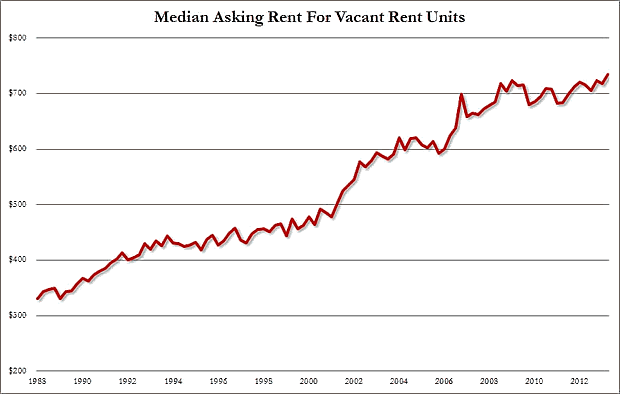
There is so much wrong with the BLS data, I don’t know where to start. The rental market has been on fire since 2012. Builders are erecting apartments at a breakneck pace. Independent, non-captured, neutral real estate organizations show rents surging to all time highs, growing by 5.1% on an annual basis. Real rents in the real world have grown by 14% since 2012. The BLS says they’ve grown by 9%. Who do you believe?

38322 a

It’s funny how the mysterious owner’s equivalent rent calculation spits out a 3% increase in the last year. National home prices, based on

Case Shiller data and NAR data shows prices up between 5% and 10% in the last year and up by 25% since 2012. Mortgage rates have risen to 4% from the low 3% range. Property taxes are soaring across the country as indebted localities rape taxpayers to pay for their gold plated government benefits and pensions. Evidently the BLS just ignores prices, mortgage payments, and real estate taxes when calculating their lies.


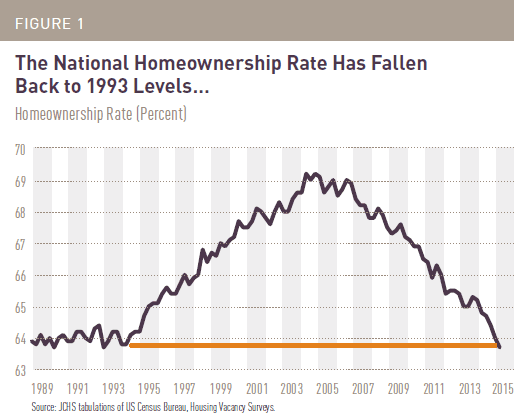
The final outrage is the weighting applied by the BLS to the owners equivalent rent. It accounts for 24% of the CPI calculation, virtually the same as it did in 2007. In case you haven’t noticed, the home ownership rate has plunged to 22 year lows since 2007, as millions of foreclosures booted people out of homes and millions of millennials are so loaded with student loan debt and stuck with low paying Obama jobs that home ownership is a distant dream. How can the BLS continue to weight home ownership at the same level when the percentage of rental units has soared?

38322 b

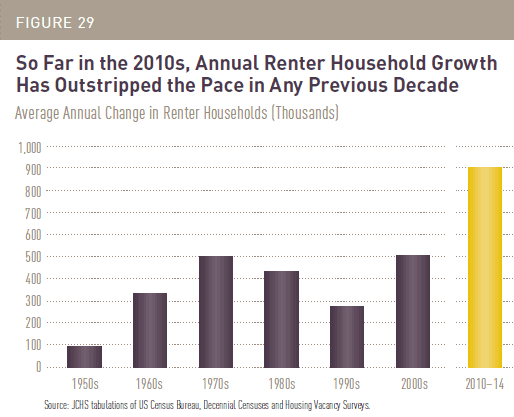
There is no question the BLS should have dramatically increased the weighting of rental housing. In reality, the large increases in rental rates and the surge of rental households reflects a much higher inflation rate than is being reported by the government. The BLS figure is a blatant lie. The recent report from the Center for Housing Studies reveals the falsity of the government reported propaganda. Over 20.7 million renter households (49.0%) pay more than 30% of their income on housing. More than a quarter of all renter households, or 11.2 million, spend more than 50% of their income on housing. The median US renter household earned $32,700 in 2013 and spent $900 per month on housing costs. Renter housing costs are gross rents, which include contract rents and utilities. If the median renter household spends 33% of their income on housing costs how can the BLS give it only a 7.2% weighting in the CPI calculation?

38322 c

The Center for Housing Studies report drives a stake into the heart of the manipulated, politically massaged, false data put out by the BLS to keep the masses sedated and their bosses fat, happy and rich:

Over the span of just 10 years, the share of renters aged 25–34 with cost burdens (paying more than 30 percent of their incomes for housing) increased from 40 percent to 46 percent, while the share with severe burdens (paying more than 50 percent of income) rose from 19 percent to 23 percent. During roughly the same period, the share of renters aged 25–34 with student loan debt jumped from 30 percent in 2004 to 41 percent in 2013, with the average amount of debt up 50 percent, to $30,700.

The faux journalists in the dying legacy media act baffled by the continued real decline in retail sales when the answer is staring them right in the face. True inflation in essential living expenses combined with declining real wages and increasing debt burdens has left the average household with little or no money to spend.

The next blatantly manipulated false data is related to healthcare. Let’s peruse some this detailed inflation data:

  • Prescription Drugs – 4.8%
  • Non-Prescription Drugs – Negative 1.6%
  • Medical Equipment – 0.0%
  • Medical Care Services – 2.3%
  • Hospital Services – 3.5%
  • Health Insurance – 0.7%

Anyone living in the real world knows Obamacare has resulted in a tremendous increase in demand for drugs, medical services, and medical equipment. Health insurance companies, drug companies, drug wholesalers, hospital corporations, and drug stores are reporting record profits as their stock prices hit all-time highs. When was the last time you saw prices drop or stay flat in the healthcare arena?

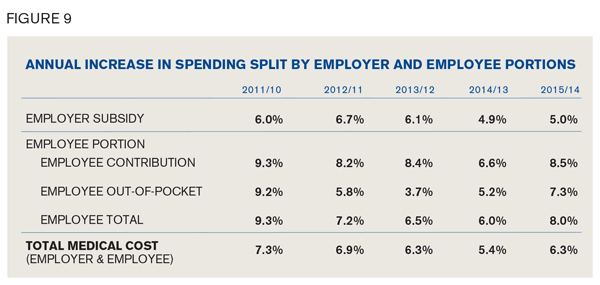
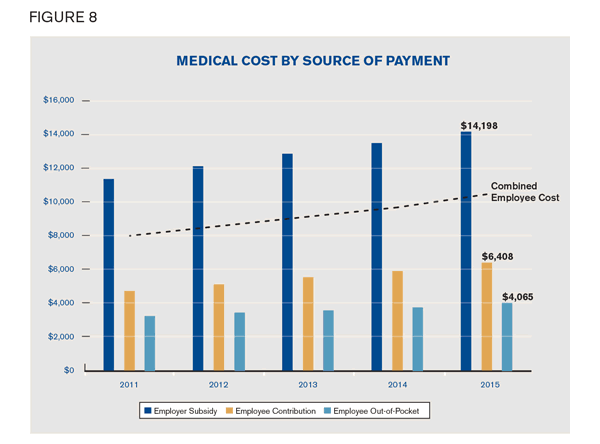
It is patently outrageous for the BLS to report an annual health insurance cost increase of a mere 0.7%. The annual cost of employee sponsored health insurance is 6.3% higher than last year, with the employee portion skyrocketing by 8.0% based on real data in the real world. I work for the largest employer in Philadelphia, with the most negotiating clout against insurers, and my portion has gone up by 10% to 20% annually for the last five years. Everyone working for a company has experienced the same or higher increases.

38322 d

Even the Obamacare exchanges are seeing double digit premium increases in many states. Studies from Price Waterhouse Coopers and McKinsey found increases in average premiums between 6% and 10% across the country. It takes major cajones for the BLS to report 0.7% health insurance inflation, but their job is not to report factual information. Their job is to keep the ignorant masses ignorant of their plight. The bigger the lie, the more likely it is to be believed. The even more ridiculous aspect to the BLS data is that health insurance is weighted at .75% in the CPI calculation. The median household income in this country is $52,000. Employees are paying approximately $4,000 in health insurance per year on average. That is 7.7% of their income. The BLS weighting is absurd. Using a true inflation rate and true weighting would add at least 2% to the CPI figure.

38322 e

Another area that impacts every American every day is transportation. People need to drive or take public transportation in order to live their lives. Here are some more crucial inflation data points from the BLS:

  • New Cars – 1.2%
  • Used Cars – Negative 0.7%
  • Gasoline – Negative 23.3%
  • Vehicle Leasing – Negative 1.1%
  • Vehicle Insurance – 5.1%
  • Parking & Tolls – 2.4%
  • Public Transportation – Negative 3.2%

So we have near record levels of new auto sales, driven by subprime auto debt and 7 year 0% financing, with average vehicle prices at all-time highs, and the BLS reports prices only went up 1.2% in the last year. Edmunds, the authority in auto data, says prices went up 2.6% in the last year. Do you believe the BLS model or real data from the real world, broken down by automaker and vehicle? The even more ridiculous contention is that used car prices fell. I’ve bought two used cars in the last year and I can attest that prices are not falling. Edmunds reported that used car prices have risen by 7.1% in the last year. Leases as a percentage of total auto sales is also at record levels. Does this really jive with a decrease in leasing expenses? I think not.

There are 254 million passenger vehicles registered in the United States. We have a record level of auto loan debt totaling $1 trillion and a record level of auto leases. According to Edmunds, the average monthly car payment is $479. That is $5,748 per year. That equals 11% of the median household income. Why would the BLS only give this category a 5.7% weighting? Bankrupt states across the country have been jacking up tolls. The BLS says they went up by 2.4%. My beloved state of Pennsylvania has increased them by 10% per year for the last three years. The BLS says the cost of public transportation is plummeting. Has a Amtrak or any municipal public transportation system EVER reduced fares? Not a chance. They need more revenue to fund the government pensions of their union employees.

There are a few other categories that might be of interest to you:

  • Banking Fees – 5.9%
  • College Tuition – 3.4%
  • Childcare – 4.3%
  • Sporting Events – 8.8%
  • Pet Care – 3.5%
  • Cigarettes – 2.5%
  • Alcohol Served Away from Home – 4.0%

Isn’t it delightful that your friendly neighborhood Wall Street bank gets free money from the Fed, charges you 18% on your credit card balance, pays you nothing for your deposits, and then jacks up your bank fees? The relentless inflation in college tuition is being driven by the relentless doling out of student loans by the Federal Government to people who aren’t intellectually capable of completing college level material. The $1.4 trillion of student loans will never be repaid. The taxpayer will be on the hook for hundreds of billions in write-offs.

To celebrate the near zero inflation reported by your friendly government drones at the BLS take your family of four to a baseball game, spending $160 for tickets, $25 to park your car, $20 for two warm beers, $10 for two sodas, $24 for four hot dogs, and $10 for an order of cheese fries. Make sure you toast Greenspan, Bernanke, Yellen and the rest of the Federal Reserve governors who have purposefully reduced the purchasing power of your dollar by 96% over the last century.

You know your true level of inflation. You know it’s not 0.1%. You know it’s somewhere between 4% and 10%. You know your government is lying to you. You know the captured corporate media perpetuates the lies. You know those in control of the government must lie to keep their Ponzi scheme going. You know they are just following the Edward Bernays playbook. They want you to believe it’s for your own good. Do you think it’s for your own good?

“The conscious and intelligent manipulation of the organized habits and opinions of the masses is an important element in democratic society. Those who manipulate this unseen mechanism of society constitute an invisible government which is the true ruling power of our country. …We are governed, our minds are molded, our tastes formed, our ideas suggested, largely by men we have never heard of. This is a logical result of the way in which our democratic society is organized. Vast numbers of human beings must cooperate in this manner if they are to live together as a smoothly functioning society. …In almost every act of our daily lives, whether in the sphere of politics or business, in our social conduct or our ethical thinking, we are dominated by the relatively small number of persons…who understand the mental processes and social patterns of the masses. It is they who pull the wires which control the public mind.” – Edward Bernays – Propaganda – 1928

Via The Burning Platform

Faber : US Market Rebounding but we won’t see any new Highs

Unknown“As of a week ago, the U.S. market became very oversold,” Faber said. “It’s rebounding, but in my view, we’re not going to see any new highs.”

Chinese Economy hardly Growing , Do Not Buy any Chinese Stocks at The moment

We have now hard evidence that the Chinese economy is hardly growing at the present time,””If China slows down, the demand for industrial commodities goes down. It affects all the resource producers: Argentina, Brazil, the Middle East, Central Asia, Africa, Australia,” Faber said Monday. “That can have a huge impact on the global economy.””It’s still a fragile situation,” he added, urging Americans to avoid the temptation to buy Chinese stocks despite government measures to bolster investor confidence. “I don’t think that Chinese stocks are attractive and I would just stand aside.” “We just heard from the Australian treasurer that growth this year in China will be 6.75 percent. It’s a pipe dream that will never materialize. Maybe that will be published by the government but the reality is that Chinese growth has slowed down to trickle,” he said.

More from Marc Faber HERE

test-php-789