You Need to Get Your Head Examined If You Own HP or Intel Shares
Do any of these names ring a bell? Amiga, Commodore, Wang, Kaypro, Tandy, Gateway, DEC, Packard Bell, and Sperry.
Those were pioneers of the personal-computer industry, and all of them are now defunct.

My first computer was a Commodore 64. I don’t remember how much I paid for it (it wasn’t cheap, and I didn’t have a lot of money at the time), but I do remember that I thought it was the most amazing piece of technology I’d ever seen.
The personal-computer industry has gone through a lot of changes and while PCs still are amazing pieces of technology, the economics of the PC industry are again going through a dynamic change that may fill up the PC graveyard with some new casualties.
What am I talking about? Connect these dots and tell me what you think they say about the PC business.
- June 25: Micron misses forecasts and issues weak forward guidance.
- July 6: Advanced Micro Devices hits multi-year low after issuing warning.
- July 9: QLogic warns Wall Street to expect disappointing Q2 results.
All those companies are part of the PC food chain, and all of them are suffering from a protracted sales slump because the Internet and the ascent of the smartphone have made the PC largely obsolete.

The real proof is in the numbers. Market research firm International Data Corporation (IDC) just released its Worldwide Quarterly PC Tracker report, which showed that the world bought 66.1 million PCs, a 11.8% decline over the last year.
That was, by the way, about 1% worse than Wall Street was expecting.

Another computer watchdog, Gartner Inc., was slightly more optimistic by reporting a 9.5% year-over-year decline.
By the way, Apple shareholders will be happy to hear that Apple was the onlypersonal computer in the world that showed improving sales with a 16.1% year-over-year increase.
Apple can thank me; I bought three MacBooks in the last year for college-aged children.

Even with that increase, Apple is only the fourth-largest PC maker in the world. What about the rest of the PC club?
- Would it surprise you to learn that Lenovo—not Dell or Hewlett Packard—is the largest computer company in the world? Lenovo sold 13.4 million computers in the last year, largely because of its booming business in Asia.
- Hewlett Packard is number two for market share, but it has suffered a 10.4% year-over-year sales drop. US sales were down by 7%.
- Dell is #3 at 9.5 million computers and saw its sales fall by 8.7%.
- Acer and ASUS were tied for fifth at approximately 4.3 million computer sales each.
What you have is a handful of formerly powerful and profitable computer companies beating the crap out of each other for an ever-shrinking pie.
The reason is the switch to mobile devices as the dominant computing platform.
I’ve been warning about the PC’s slow demise for years, but I was far from the first.
Just a couple of months after the release of the iPad, Steve Jobs predicted that tablets would overtake PCs.
He was dead on. Gartner estimates that 2015 will be the first year that tablets outsell PCs: 320 million tablets versus 316 million PCs (desktops and laptops).


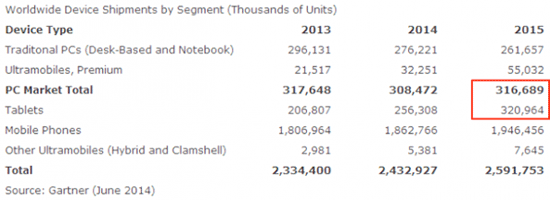
All the major Internet players—like Google, Amazon, and Facebook—are adjusting their business plans to focus on mobile computing. Google, for example, has tweaked its search engine to prioritize mobile-friendly sites.
And that’s why the other parts of the PC food chain are reporting disappointing results.

Source: PC World
Micron, the big PC memory maker, just reported quarterly sales of $3.85 billion, way short of Wall Street’s overly optimistic expectations for $3.9 billion.
Micron’s profits came in at $0.43 per share, woefully short of the $0.57 Wall Street pipe dream.
Worse yet, Micron lowered revenue forecasts for the next quarter to between $3.45 and $3.7 billion, way below previous estimates for $4.16 billion.
No wonder that Micron shares were down 31% for the first half of 2015 and down 24% over the last 12 months.
The most PC-dependent company of them all is Intel, which has already confessed that weakening demand for PCs caused it to lower its forward guidance.
I shouldn’t pick on Intel because lots of other parts of the PC food chain are in big trouble, but I believe it is the biggest ticking time bomb in the computer world.
And if you own it… you should get your head examined because it is headed a lot lower.
Instead of letting dying technologies bleed your portfolio dry, I recommend you focus on up-and-coming blockbusters in the tech sector. Like lithium-ion batteries, without which smartphones, tablets, electric cars, and many other new breakthroughs wouldn’t exist. I expect one lithium producer in particular to do great for our Yield Shark portfolio.

Tony Sagami
30-year market expert Tony Sagami leads the Yield Shark and Rational Bear advisories at Mauldin Economics. To learn more about Yield Shark and how it helps you maximize dividend income, click here. To learn more about Rational Bear and how you can use it to benefit from falling stocks and sectors, click here.
subscribers@mauldineconomics.com





 Legendary investor Jim Rogers says he is waiting for gold to go below US$1000 before buying more.

 HAD stockmarkets fallen more than 40% from their peak, the national news bulletins and the mainstream papers would be full of headlines about collapse and calamity. As it is, the FT did make commodities the splash today (plus a
 We can’t count how many articles we saw today, bemoaning gold going down. The price action is bad for gold (whatever that means). China underreported their gold holdings. No, China doesn’t care about gold. No they want the price to go down so they can buy it cheap. No, they want to convince the IMF to include the yuan (which has capital controls, by the way) into the SDR basket. No, China really intends to revalue gold (whatever that means).