
Asset protection
Governments have largely always despised cash. It’s almost impossible to trace, and therefore, tax. And it sustains an underground economy for drug dealers and terrorists.
Never mind that there are plenty of good people in the underground economy. The government doesn’t care. They see a rat in the barn, and governments, as they are, are all too ready to burn down the barn to catch the few rats.
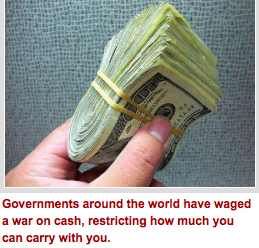
For years now, that’s largely how governments around the world have waged a war on cash. They’ve implemented restrictions on how much you can carry with you. How much cash you have on you that you have to report when you go through customs. How much you can withdraw from the bank at any one point in time. And more.
The thing is, government wars on cash are now on steroids. The reason: The looming sovereign-debt collapse that will soon cascade from Europe, then to Japan, and finally, to the US of A.
As I have said all along, when governments’ backs are up against the wall, they act like caged animals, lashing out at anything and anyone that restricts their ability to stay alive.
 One of the chief proponents of eliminating cash from the system is Ken Rogoff of Harvard University. But along with him are other economists who agree, and who also have major clout with governments and central banks around the world. Larry Summers and Citigroup Chief Economist Willem Buiter, for instance.
Their thinking is this: Cash is, yes, difficult to track and tax, but it also makes it difficult, if not impossible, for negative interest rates to stimulate the economy.
That’s critical now because deflation is surrounding the globe. In Europe, for instance, the European Central Bank (ECB) has had negative interest rates in effect since June of last year. Currently at -0.2%, if you’re a bank in the eurozone, your “reserves” at the ECB gradually lose value if you don’t lend them out.
The Danish and Swiss national banks have steeper negative interest rates of -0.75%. After a year, 1 million Danish krone or Swiss francs would be worth only DKK/CHF992,500, respectively.
Sounds logical from an economic management point of view, right? After all, if banks aren’t lending, then the right thing to do is to force them to lend by charging them if they don’t.
Problem is, it doesn’t work that way. Instead, the banks are largely turning around and charging their customers who deposit funds with them the same or steeper negative rates. That way, whatever the bank loses at the central bank, it gets it back from you, its depositing customer.
So now we have negative deposit rates for customers in much of Europe. And what is the customers’ reaction to negative interest rates?
Simple — they pull their money out of the banks, in cash, and hoard it, or send it offshore to better lands and opportunities.
Along comes Ken Rogoff and gang. Their answer: Eliminate cash and …
A. Less cash will be withdrawn from banks.
B. Banks will therefore lend more readily. And …
C. Bank runs, if they occur, can be ended immediately — by simply shutting down the system with an “internet-type kill switch.”
Mark my words: Elimination of cash is where the governments of developed economies are headed. Toward fully electronic currencies instead.
If you don’t believe me, then consider the steps that have already been taken that are leading in that very same direction:
 In France, cash transactions over 1,000 euros are now illegal. It’s also a crime to send any amount of cash by mail.
In Spain, the limit is 2,500 euros. Break that law and the government will confiscate 25% of your cash.
Italy has banned all cash transactions over 999.99 euros. To pay 1,000 euros or more, you must use a debit card, credit card, a “non-transferrable check,” or pay by bank transfer. Violate the law, and the government will confiscate 40% of the amount paid.
Similar restrictions on cash are in place in Belgium, Bulgaria, Greece, Mexico, Russia, Uruguay and a number of other countries.
Here in the U.S. we don’t (yet) have any restrictions onspending cash. But there are strict reporting rules. If you deposit or withdraw more than $10,000 from a bank or other financial institution (either by cash or electronically), the bank must file a “currency transaction report” with the U.S. Treasury.
In some parts of the country, there are “geographic targeting orders” in place — a fancy term for locations where the government feels there are drug or terrorist activities going on. Instead of the $10,000 limit, it’s a $3,000 limit.
And then there are the “civil forfeiture” laws in place across the country, which gives the police the ability to confiscate any amounts of cash you may have in your pocket or in your car if they suspect you’re a dealer or a terrorist. Problem is, scores of innocent citizens are being stopped and have their cash confiscated.
It’s all going to get a heck of a lot worse for us in the months and years ahead. Bankrupt destitute governments are the cause. They will hunt you and your wealth down like never before.
And the problem is, they are simply too dumb to realize that in the end, they will still collapse, taking you — if you don’t prepare — right along with them.
Stay safe and stay tuned …
Larry


In this week’s issue:
- Weekly Commentary
- Strategy of the Week
- Stocks That Meet The Featured Strategy

n This Week’s Issue:
– Stockscores’ Market Minutes Video – Are You Expecting
– Stockscores Trader Training – The Plain Fool
– Stock Features of the Week – The Oversold Bounce
Stockscores Market Minutes Video – Are You Expecting
Traders who focus on the process instead of having expectations for profit are more effective because their emotion is reduced. That plus this week’s market analysis.Click Here to Watch To get instant updates when I upload a new video, subscribe to the Stockscores Youtube Channel.
Trader Training – The Plain Fool
It’s better to miss a good trade than to take a bad one. Missing a good trade doesn’t deplete your capital-it only fails to add to it. A bad trade will not only reduce the size of your trading account, it will eat up emotional capital and your confidence. A losing trade is not a bad trade because a bad trade is the one that you make despite it not meeting your requirements. Bad trades come from working hard to see something that’s not there, guided by your need to trade rather than the market offering a good opportunity.
I have read very few books about the stock market, but one that I’ve read more than once and that I think is a must-read for every investor is Reminiscences of a Stock Operator by Edwin Lefevre. Here is a wonderful quote from that book that captures the essence of what this chapter is about:
What beat me was not having brains enough to stick to my own game-that is, to play the market only when I was satisfied that precedents favored my play. There is the plain fool, who does the wrong thing at all times everywhere, but there is also the Wall Street fool, who thinks he must trade all the time. No man can have adequate reasons for buying or selling stocks daily-or sufficient knowledge to make his play an intelligent play.
-Reminiscences of a Stock Operator
I advise all my students that they will make more money by trading less, at least so long as trading less is the result of having a high standard for what they trade. If you tell yourself you’re limited to only making 20 trades a year, you’re probably going to be very fussy about what trades you take. With less than two trades to be made each month, only the very best opportunities will pass your analysis. All of the “maybes” or “pretty goods” will get thrown out.
We take the pretty good trades because we’re afraid of missing out. It’s painful to watch a stock you considered buying but passed on go up. You remember this pain and the next time you see something that looks pretty good, you take it with little regard for the expected value of trading pretty good opportunities. Pretty good means the trade will make money some of the time and lose some of the time, and the average over a large number of trades may be close to breaking even. The fact that one pretty good trade did well is reasonable and expected. In the context of expected value, taking those pretty good trades many times will lead to less than stellar results when the losers offset the winners.
You shouldn’t judge your trading success one trade at a time. You must look at your results over a large number of trades. To maximize overall profitability requires you to have a high standard for what trades you make. Maintaining that standard will be easier if you take the trades that stand out as an ideal fit to your strategy, not by taking those that are marginal and require a lot of hard work to uncover.

Oil and energy stocks have been really beat up over the past month and that sets up for a short term trade that savvy traders can take advantage of. With the sentiment overwhelmingly negative, it is likely that the sellers are getting exhausted in the short term and that will bring a bounce in both Oil and Energy stocks.
We should never try to buy the bottom, it ends up being the most expensive way to take a position because trying to catch a falling knife is rarely successful.
It is also important to stress that Oil and Energy stocks are in long term downward trends and I don’t see any reason to change the bearish view. I simply think that there will a short term bounce back, much like we saw in late January and mid March that is very tradeable.
What you want to look for is a show of buyer support on the short term chart. I recommend watching the 30 minute chart of the index ETF, like T.XEG or XLE. Look for the three phases of a turn around; break of the downward trend, formation of a rising bottom and then a break higher from a rising bottom. When that happens, you can either trade an ETF or pick a couple of stocks to benefit from the bounce back.
These bounces occur because those who are short want to take their profits and bargain hunters act on the lower prices. It is only when the perception of fundamentals starts to turn that the long term trend can reverse. These bounces typically just take prices back up to the longer term downward trend line before the sellers get motivated to act again.
If you have the time to watch the market closely through the day, look for the signs of an oversold bounce in Energy sometime in the next week or two.

1. T.XEG

2. XLE

References
- Get the Stockscore on any of over 20,000 North American stocks.
- Background on the theories used by Stockscores.
- Strategies that can help you find new opportunities.
- Scan the market using extensive filter criteria.
- Build a portfolio of stocks and view a slide show of their charts.
- See which sectors are leading the market, and their components.
Disclaimer
This is not an investment advisory, and should not be used to make investment decisions. Information in Stockscores Perspectives is often opinionated and should be considered for information purposes only. No stock exchange anywhere has approved or disapproved of the information contained herein. There is no express or implied solicitation to buy or sell securities. The writers and editors of Perspectives may have positions in the stocks discussed above and may trade in the stocks mentioned. Don’t consider buying or selling any stock without conducting your own due diligenc

 If you are, put your money where your mouth is and buy put options
OK, gold haters. It’s time to put your money where your mouth is.
You think gold could be going down to $350 an ounce? That’s great. Then go out there and buy some put options on the yellow metal. They will pay out, but huge, if your prediction comes anywhere close to being right.
We’re talking very little money down, and a profit of more than 3,000% if you’re right. Cha-ching!

 I wrote a story about poor Clarence who retired in 1979, and even poorer Larry who retired last year. I created these characters to challenge the notion of calculating a real interest rate by subtracting inflation. The idea is that the decline of a currency can be measured by the rate of price increases. This price-centric view leads to the concept of purchasing power—the amount of stuff that a dollar can buy. It’s the flip side of prices. When prices rise, purchasing power falls.
Recall in the story, Clarence retired in 1979. At the time, inflation was running at 14% but he could only get 11% interest. Real interest was -3%, and Clarence had a problem. He was losing his purchasing power.
Suppose Clarence bought gold. The purchasing power of gold held steady for the rest of his life (see this chart of oil priced in gold). Gold does solve this problem. However, gold has no yield. Clarence is only jumping out of the frying pan and into the fire. Sure, he escapes dollar debasement, but then he gets zero interest.
Let’s look at how zero interest impacts Larry. He makes $25/month on his million dollars. Obviously he can’t live on that. So he gives up his nest egg, for eggs. For a year, he feasts on omelets. Since inflation was slightly negative, the same swap in 2015 nets him the same plus a few additional quiches.
Through the lens of purchasing power, we don’t focus on the liquidation of Larry’s wealth. We ignore—or take it for granted—that he’s trading his life savings for bread. We only ask how many loaves he got.
If you had a farm, would you consider trading it away, to feed your family for a year? I hope not. A farm should grow food forever. Its true worth is its crop yield, not the pile of bacon from a one-time deal.
How perverse is that? It’s nothing more than what zero interest is forcing Larry to do.
A dollar still buys about as much as it did last year. Larry’s purchasing power didn’t change much. However, debasement continues to wreak its destruction. Steady purchasing power does not mean that the dollar is holding its value.
It means that prices are wholly inadequate for measuring monetary decay.
Our monetary disaster becomes clear when we look at the collapse in yield purchasing power. This new concept does not tell you how many groceries you can get by liquidating your capital. It tells how much you can buy with the return on it.
In 1979, Clarence’s $100,000 savings earned enough to support his middle class lifestyle. In 2014, Larry’s million dollars didn’t earn enough to pay his phone bill. To live in the middle class, Larry would need over a hundred million bucks. That’s a pitiful income to make on such a massive pile of cash. It reveals a hyperinflation in the price of capital, which has gone up 1100X in 35 years.
It also shows that the productivity of capital is collapsing. Back in Clarence’s day, businesses earned a high return on capital. It was high enough for Clarence to get 11% interest in a short-term CD. Unfortunately, the dollar rot is in the advanced stage now. There is scant interest to be earned. Return on capital is low, and so borrowers can’t pay much.
Retirees suffer first, because they can’t earn wages. Normally they would depend on interest, but now they’re forced to live like the Prodigal Son. They consume their wealth, leave nothing for the next generation, and hope they don’t live too long. Zero interest rates has reversed the tradition of centuries of capital accumulation.
Purchasing power may look fine, but yield purchasing power shows the true picture of monetary collapse.
This article is from Keith Weiner’s weekly column, called The Gold Standard, at the Swiss National Bank and Swiss Franc Blog SNBCHF.com.

-
I know Mike is a very solid investor and respect his opinions very much. So if he says pay attention to this or that - I will.
~ Dale G.
-
I've started managing my own investments so view Michael's site as a one-stop shop from which to get information and perspectives.
~ Dave E.
-
Michael offers easy reading, honest, common sense information that anyone can use in a practical manner.
~ der_al.
-
A sane voice in a scrambled investment world.
~ Ed R.
Inside Edge Pro Contributors

Greg Weldon

Josef Schachter

Tyler Bollhorn

Ryan Irvine

Paul Beattie

Martin Straith

Patrick Ceresna

Mark Leibovit

James Thorne

Victor Adair