
Stocks & Equities

Summary
- The biotech sector has been extremely weak to begin this week and a lot of investors are asking whether this is the start of a larger swoon in this space.
- I don’t have a definitive answer to that question but there are a couple of things I am watching to determine the near-term direction of this sector.
- Below is my game plan as the biotech sector seems to be entering a period of escalating volatility.

Wind Turbines 1980s: Admired

Oil Wells 1930s, California: No Longer Admired

Wind Turbines Recent: Greatly Admired

U.S. solar developers are luring cash at record rates from investors ranging from Warren Buffett to Google Inc. (GOOG) and KKR & Co. by offering returns on projects four times those available for Treasury securities.
Buffett’s Berkshire Hathaway Inc. (BRK/A) together with the biggest Internet search company, the private equity company and insurers MetLife Inc. (MET) and John Hancock Life Insurance Co. poured more than $500 million into renewable energy in the last year. That’s the most ever for companies outside the club of banks and specialist lenders that traditionally back solar energy, according to Bloomberg New Energy Finance data.
Wind Turbine Bird Kills:
In 2011 the Los Angeles Times reported such bird kills amounted to 440,000 annually.
Not Widely Published

Oil-Coated Birds:
Widely Published


Lenin Finally Topples
Pipeline Right Of Way, Pennsylvania:
Very unpopular

Permitted Way of Transporting Crude Oil

Train Wreck Alabama

Train Wreck February 2015: New, Stronger Oil Tanker Cars

“Crude oil hauled by rail needs to be shipped in stronger tanker cars and on safer routes, transportation investigators in the U.S. and Canada said following a series of accidents in North America.”
– Bloomberg, January 23, 2014.
Pipelines
2,500,000 Miles Can’t All Be Wrong

By way of perspective, the length of proposed Keystone pipeline amounts to 1,179 miles.
That works out to an increase in total mileage of 0.0047 percent.

 I believe in putting my money where my mouth is, so this week I am sharing with you my own personal productivity tips: the actions that have helped me stay on top of my game, manage my business, wealth, family and life in general.
I developed these three ideas as the result of countless iterations, experiments and improvements I have made over my 25+ years in business. They represent the best systems I have discovered to keep me focused, productive and fully engaged in those critical few activities that create value, while avoiding the trivial many that distract and deplete my precious resources.
Tip 1 – My Goals: I have one long-term, overarching lifetime goal for each of the following areas of my life: Health, Family and Wealth. Each year I break each of those long-term goals into an annual goal which supports its achievement. Each day I set up a single action, in each of those three areas, that will help me achieve my annual goals and then schedule it into my day. These are the “must hit” actions for the day and everything else is subordinated to them. Big goals produce big actions which produce big results.
Tip 2 – My Schedule: I live by my schedule and use it to rule my day. If it’s not on the schedule, it gets ignored! I use a paper based, week-at-a-glance planning diary called the Quo Vadis Trinote (7″ x 93/8″). I know it sounds strange in a digital world, but I love the convenience of seeing my entire week laid out in front of me, and the ease of being able to quickly modify appointments or update actions. In addition, I write my top three goals into a box at the top of each day, and then my minor to-do items into space below the day. At the end of each day, I write down my biggest accomplishments for that day, in order to reinforce my own work ethic and traction.
Tip 3 – My Week In Review: 100% of the credit for this idea goes to David Allen’s great book, “Getting Things Done”. Buy a copy today. Each week (Friday mornings 8 – 10 am) I review and organize my entire week just past, and prepare for the week coming up. I review every goal, project, and update all my actions. I file every scrap of paper (even empty receipts from my wallet weekly) and they are actioned, filed or thrown away. I review all email, VM and correspondence for follow up (scheduled) and periodically review what worked, and what did not. I can then finish the week well organized and set to go for the following week. I keep a file for everything.
My key point is to take productivity seriously, by having a system that is simple and works for you. I hope you enjoyed this note and if you have any questions, let me know.
By Eamonn Percy
More articles HERE

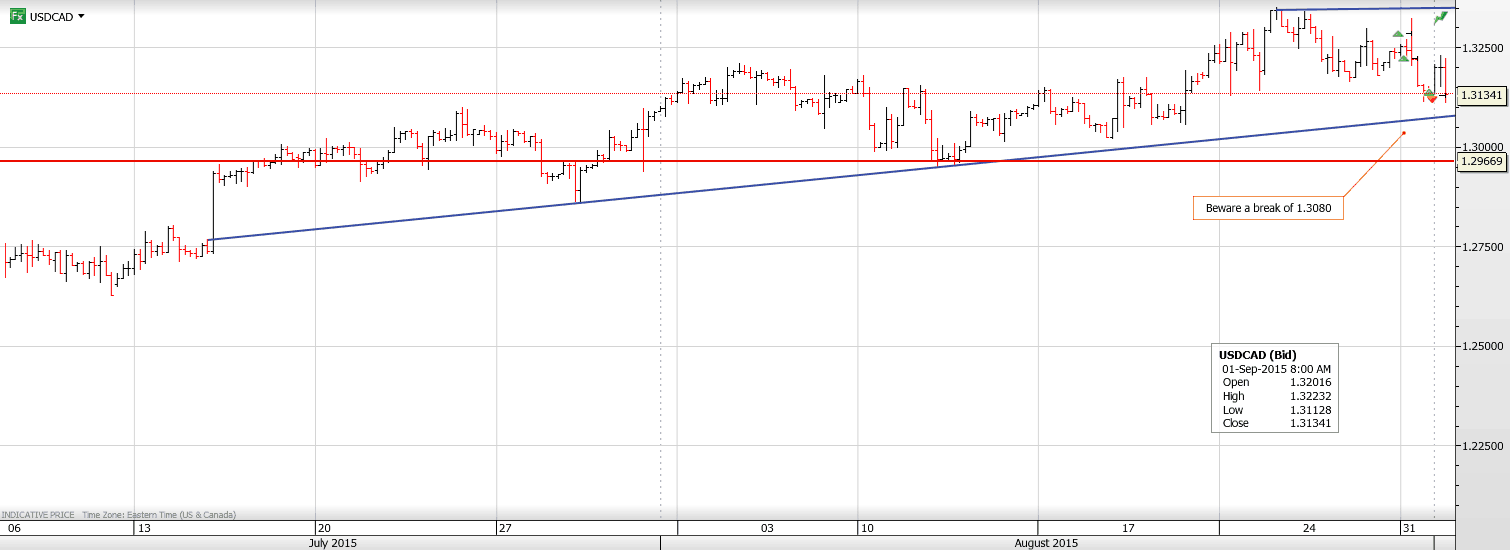
USDCAD Range 1.3120-1.3220
Canadian Q2 GDP posted a negative 0.5%. It is the second consecutive negative quarter, so for many, Canada is in a technical recession. While it’s not good news, it wasn’t unexpected. What was unexpected was that glimmer of hope, a 0.5% rise in real GDP for June that like the first buds in spring, says growth may be on the way.
USDCAD traders agreed, sort of. The initial reaction saw the currency pair collapse from 1.3210 to 1.3120 in the blink of an eye. It has subsequently bounced, but in a disinterested way as traders wrestle with concerns over China and whether the oil rally is sustainable. Today’s data has also managed to whet the appetite for the prospect of a stronger than expected Canadian employment report.
Overnight, FX markets were startled by news that both China PMI releases (NBS and Caixin) were below 50, renewing concerns of a deeper economic slowdown. Then, FX markets nearly soiled themselves when the weak PMI data was followed by news from the Peoples Bank of China (PBoC) that effective October 15, banks would be required to hold 20% reserve on FX forwards. (no interest would be paid). Taken together, the news was seen as further evidence of China’s economic woes.
Meanwhile, in Australia, the RBA left rates and the statement unchanged. London came back from a three-day weekend, looked at the weak global equity markets and the China stories then decided that cutting risk was an appropriate strategy. EURUSD is also vulnerable to doveish speculation ahead of Thursday’s ECB meeting.
Today’s ISM manufacturing report (forecast 52.6) may give the US dollar a boost if it is higher than expected.
Technical Outlook
The intraday technicals are bearish while trading below 1.3230 risking and looking for a test of 1.3080 which represents the rising trendline from the July BoC rate cut. A move below 1.3080 warns of a deeper setback to 1.2950-1.3000. For today, USDCAD support is at 1.3120 and 1.3080. Resistance is at 1.3180 and 1.3230
Today’s Range 1.3250-1.3350
Chart: USDCAD 4 hour chart with uptrend support noted Larger Chart
Are you worried about the stock market? You should be; at least according to your local Starbucks barista.
Starbucks CEO Howard Schultz told his 190,000 employees in his daily “Message from Howard” email communication: “Today’s financial market volatility, combined with great political uncertainty both at home and abroad, will undoubtedly have an effect on consumer confidence and … our customers are likely to experience an increased level of anxiety and concern. Let’s be very sensitive to the pressures our customers may be feeling.”
You can’t make this stuff up!
Hey, maybe I shouldn’t be too harsh on Mr. Schultz, because the stock market is in a lot of trouble… and not for the reasons the mass media and Wall Street experts are telling you.
The know-it-alls on CNBC are pointing their fingers at the Chinese stock market meltdown as the reason for our stock market turmoil, but that is just the catalyst… not the root problem.
The source of the meltdown is deeper, more problematic, and more painful. What I’m talking about is that the Federal Reserve—from Greenspan to Bernanke, to Yellen—thought they possessed Wizard of Oz powers to fix whatever ails the economy with their menu of monetary tools.
In 2000, the Fed thought it could solve the bursting of the dot-com bubble with massive interest rate cuts and repeated that playbook again for the 2008-09 Financial Crisis.
And when they ran out of room by cutting interest rates to zero, they trotted out Operation Twist and QE 1, 2, and 3.
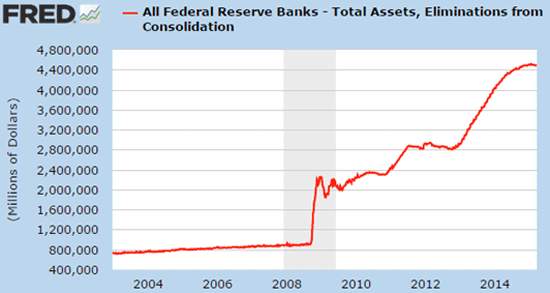
Those three rounds of QE added about $3.7 trillion to the Federal Reserve’s balance sheet since 2008, which now totals a mind-boggling
$4.5 trillion.
The problem is not China; the problem is Janet Yellen and her Federal Reserve buddies.

The Fed—beginning with the original monetary Mr. Magoo of Alan Greenspan—created a bubble, then rolled out more of the same to deal with the bursting of the bubble, and like the shampoo bottle says: Rinse, Lather, Repeat.
Zero interest rates plus QE1, QE2, and QE3 created a massive misallocation of capital that has affected everything from home supply, ocean-going freighters, the US dollar, and wages, and pushed stock prices to a bigger-than-ever bubble.
The recent weakness is the painful process of deflating that bubble, but the Federal Reserve refuses to learn from its mistakes. It won’t be long until we hear about QE4 and/or a delay to the overpromised interest rate liftoff.
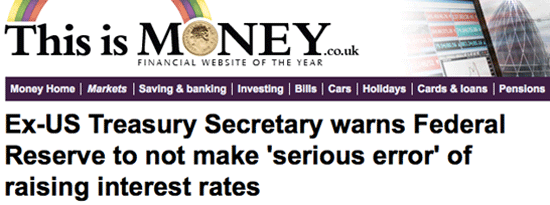
Former US Treasury Secretary Larry Summers had this to say yesterday: “A reasonable assessment of current conditions suggests that raising rates in the near future would be a serious error that would threaten all three of the Fed’s major objectives; price stability, full employment and financial stability.”
Honestly, I don’t know what the Federal Reserve will do next. Heck, I bet they don’t know what to do either… but they will do something.
Central bankers are arrogant know-it-alls who think they can fix the world’s financial problems with a couple of pulls of a monetary lever.
So pull they will.
And so the stock market damage will continue, albeit with some powerful up moves along the way.
Bulls, whether in a Spanish bull-fighting arena or roaming the floor of the NYSE, are a tough animal to kill. They won’t surrender until they make a few more desperate attempts to push the market higher.
Look at what happened last Tuesday after the 588-point Monday meltdown. The Dow Jones Industrial Average shot up by as much as 441 points before ending the day with a 204-point loss.
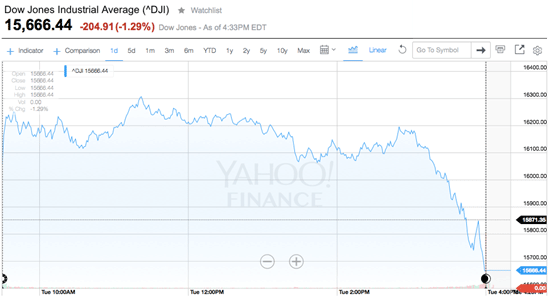
My point is that you’re going to see a lot of powerful up moves in the coming months… but I’m telling you, these are nothing more than bear market traps to lure you into buying at the wrong time.
The stock market is falling into a bear market, and that means big swings both up and down, similar to 2000–2003.
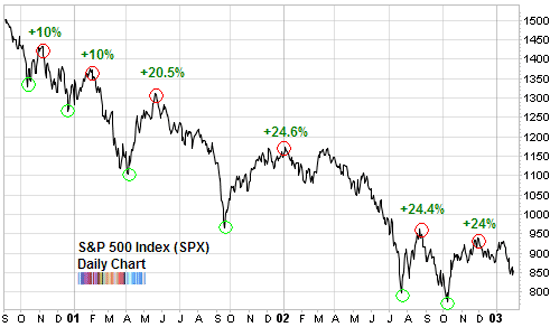
The Federal Reserve, along with the rest of the world’s central bankers, has puffed stock valuations into an epic bubble, and the stock market has a long, long ways yet to fall… just not in a straight line.
That’s heart attack material for both buy-hold-and-pray and buy-the-dip investors, but it is a goldmine if you adapt your strategy.

Instead of buying the dip, the right strategy going forward is SELL THE RIP.
When the stock market gives you a big rally, the right move will be to sell into strength.
And if you have some risk capital, that will be the time to load up on inverse ETFs and put options, like my Rational Bear subscribers did in July.
The biggest short-selling opportunity of our lifetimes is knocking on your door.
Tony Sagami
30-year market expert Tony Sagami leads the Yield Shark and Rational Bear advisories at Mauldin Economics. To learn more about Yield Shark and how it helps you maximize dividend income, click here. To learn more about Rational Bear and how you can use it to benefit from falling stocks and sectors, click here.

-
I know Mike is a very solid investor and respect his opinions very much. So if he says pay attention to this or that - I will.
~ Dale G.
-
I've started managing my own investments so view Michael's site as a one-stop shop from which to get information and perspectives.
~ Dave E.
-
Michael offers easy reading, honest, common sense information that anyone can use in a practical manner.
~ der_al.
-
A sane voice in a scrambled investment world.
~ Ed R.
Inside Edge Pro Contributors

Greg Weldon

Josef Schachter

Tyler Bollhorn

Ryan Irvine

Paul Beattie

Martin Straith

Patrick Ceresna

Mark Leibovit

James Thorne

Victor Adair