
Wealth Building Strategies
 If you’ve ever dabbled in graphic design, you’re familiar with the concept of white space. When viewing an illustration, we typically pay the most attention to the visible ink on the page, such as a paragraph of text, a bar chart or an entertaining illustration. White space is the essential empty areas in between that are hidden in plain sight. We barely notice them … until they’re not there:
When making investment decisions, most people likewise assume that the most eye-catching ink matters the most: an alarming economic forecast, an exciting Initial Public Offering, hot trading tips. But there’s a catch. This evident assumption does not hold up under evidence-based scrutiny. In reality, you have little or no control over how the most obvious news impacts your investments. The most exciting action has already been priced into any trade you might make well before you decide to make it.
Stop fixating on headlines
Instead of fixating on the headline news, consider that liberating financial white space. There, hidden in plain sight, you’ll find… CLICK HERE for the complete article

Two points on a short of S&P 500 here:
-
We know the risk and it isn’t far away…new highs
-
The Fed will now likely raise interest rates—the market loses some juice at the margin..
Take a look….

Regards,
Jack
Black Swan Capital’s Black Swan Forex is strictly an informational publication and does not provide personalized or individualized investment or trading advice. Commodity futures and forex trading involves substantial risk of loss and may not be suitable for you. The money you allocate to futures or forex trading should be money that you can afford to lose. www.blackswantrading.com

Many gold market analysts focus on irrelevant, but catchy factors, such as mining production or jewelry demand. Others think gold is a simple inflation or stock market hedge. It is a bit strange that the relationship between the bond and gold markets is not commonly examined, given that bond market is much bigger than stock market, while real interest rates are one of the main drivers of the price of gold. The negative relationship between gold and interest rates imply positive correlations with bond prices, since the price of bonds is negatively related to the yields they offer.
Why should the price of gold rise in tandem with bond prices? Well, think of gold as a substitute for Treasuries, especially when yields are near zero. In such an environment, investors may simply prefer to buy gold rather than bonds (that practically pays zero). Yeah, the precious metals do not yield any income at all, but at least they are not made of paper and U.S. government cannot issue them. Hence, there may be a positive relationship between gold and bonds due to the opportunity costs and capital flow from bonds to gold, when prices of bonds become too high (yields become too low). There may be also capital flows in the opposite direction (from gold to bonds) when bond yields increase (bond prices decrease) and provide a better alternative than gold. This is especially true in the case of U.S. Treasuries. They are considered as a safe-haven – but one which pays a yield. In other words, “fear trade” may increase demand for both gold and bonds. The latter are generally anti-cyclical, while gold is noncyclical, but both asset classes may sometimes move in tandem responding to changes in the stock market, as a non-confidence vote in the U.S. economy (this is why people invested in gold and bonds during the last financial crisis). Moreover, the Fed typically increases the money supply by purchasing government bonds and pushing their prices higher. If such purchases are considered as a signal that the U.S. economy is weak (e.g. as in the case of first quantitative easing), the price of gold may rise simultaneously with bond prices.
There is one problem with this reasoning: the data does not confirm the positive relationship between gold and the bond market. The chart below presents the price of gold and the 10-Year Treasury constant maturity rate (the 10-Year Treasury is considered as a benchmark in the bond market, or at least in the long-term part of it, as it is one of the most widely held fixed income securities in the world). The rates are in reverse order to show the trend in bond prices (which are inversely related to yields).
Chart 1: 10-Year Treasury Constant Maturity Rate (in percent, green line, left scale, values in reverse order) and the price of gold (yellow line, right scale, London P.M. Fixing)

As one can see, the price of gold was rising in the 70s, despite the fact that bond prices were falling and rates were surging. Since the 1980s, there has been a long upward trend in bond prices, seemingly not related to changes in the gold market, as the shiny metal was in a bear market during the 1980s, the 1990s and in the last few years, and in a bull market during the 2000s. This visual analysis is confirmed by more sophisticated research conducted by Baur and Lucey in their academic paper “Is Gold a Hedge or a Safe Haven? An Analysis of Stocks, Bonds and Gold”, where they found that gold is neither a hedge nor a safe haven for bonds.
Why is there no clear relationship between bond prices and the shiny metal? First, high and accelerating inflation rate affects gold and bonds differently. Usually, when inflation was considered a threat, long-term bonds rates rose and their prices fell. Conversely, many investors buy gold to hedge against inflation. This explains the behavior of bonds and gold in the 1970s. The high and accelerating inflation rate hit the bond market and undermined the confidence in the U.S. dollar, whilst gold was boosted.
Investors should remember that what really matters for gold are real interest rates, not nominal yields. The chart below shows a significant positive correlation between the price of 10-year inflation-indexed Treasury and the price of gold, or negative relationship with real interest rates (10-year inflation indexed Treasury rate is a proxy of U.S. long-term real interest rate). The rates in the chart are in reverse order to show the trend in bond prices (which are inversely related to yields).
Chart 2: 10-Year Inflation-Indexed Treasury Rate (in percent, green line, left scale, values in reverse order) and the price of gold (yellow line, right scale, London P.M. Fixing)

Second, the rise in demand for the U.S. bonds from foreigners (e.g. due to the global woes) would increase not only bond prices, but also the U.S. dollar exchange rate. If the greenback gets stronger, the price of gold should decline. This is probably why gold was in a bear market in the 1980s and 1990s, while bond prices were rising. Third, if investors fear that U.S. debts become unsustainable, they will sell bonds and buy gold. Given the probable bubble in the bond market, its burst could lead to declines in bond prices and a rising price of gold. In other words, gold and Treasury bonds are often substitutable safe-haven assets (this is why gold prices move more in tandem with bond prices more than they do with stocks). Except the situations when investors lose faith in the U.S. economy – then gold is superior to Treasuries (like in the 1970s or the 2000s, when the ratio of gold to bond prices significantly increased).
To sum up, as in the case of stocks and gold, there is no simple causal link between bond and gold prices. The sometimes observed positive correlation between bond prices and the shiny metal results from substituting bonds with gold and vice versa due to opportunity costs. Another reason is changes in confidence in the fiat dollar-denominated system, which prompts investors to switch funds from the stock market to gold and bonds. The fact that the yellow metal price is not driven by stocks or bonds confirms the thesis that gold is a good portfolio diversifier, and that it should be considered not as an asset class, but rather as a special non-fiat currency – a non-confidence vote in the U.S. economy.
If you enjoyed the above analysis and would you like to know more about the most important factors influencing the price of gold, we invite you to read the November Market Overview report. If you’re interested in the detailed price analysis and price projections with targets, we invite you to sign up for our Gold & Silver Trading Alerts. If you’re not ready to subscribe at this time, we invite you to sign up for our gold newsletter and stay up-to-date with our latest free articles. It’s free and you can unsubscribe anytime.
Thank you.
Arkadiusz Sieron
Sunshine Profits‘ Gold News Monitor and Market Overview Editor
Gold News Monitor
Gold Trading Alerts
Gold Market Overview

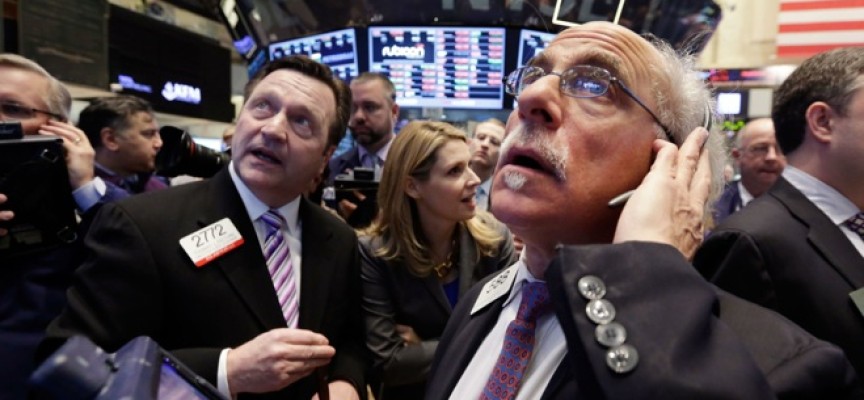 With bond markets continuing to slide, today one of the greats in the business sent King World News a powerful piece warning that a critical decision will have major ramifications for everything financial.
“At this point, I see the US economy as performing well. Domestic spending has been growing at a solid pace. [A December rate hike] is a live possibility.” — Fed Chairman Janet Yellen, 11/4/15
November 5 (King World News) – From Jeff Saut’s note today: While most people probably find the topic of interest rates to be…well, not very interesting, the impact they have on the global markets and our own personal financial situations is tremendous when you really stop to think about it.

 Being ignorant is not so much a shame as being unwilling to learn.
Benjamin Franklin
Fear sells, and like misery it demands company. The so-called crash in August triggered dozens of hibernating bears to emerge from the woodwork. Rested from the last severe beating they took, they are ready for another healthy dose of pain. In their quest to push the fear factor a notch higher, celebrity perma-bears such as David Tice are brought out confirm that all is not well. If the markets were destined to sink into the gutter, David Tice would not have sold his Prudent Bear fund at the peak of the 2008-2009 financial crisis. Then you have many others taking out expensive ads calling for the end of the world. A close look will reveal that these same chaps were bullish once an upon a time and have now jumped ship. Then you will have those who came out when the markets were pulling back, 2003 and 2008 come to mind. On each occasion, these chaps were right for a brief period. The better option would have been to open long positions in top companies and let your profits soar. Something so simple, is not easy to sell, so the spin doctors to sensationalize the event. If you something sounds too bad to be true, then it probably is and vice versa.
Even though the markets pulled very strongly in August, these fear mongers are still pushing the same old theme. Avoid these individuals like the plague. From a contrarian perspective, the only role they play is to inform you of what you should not be doing. We find it quite amusing that even though the markets have virtually recouped all their losses, these guys keep stating that a crash is in the works.
A recent report illustrated that roughly 90% of all articles published in the Washington post have a negative connotation. With the election cycle underway and as the candidates jockey for the head position of Jackass, the airwaves will be blasted with even more negativity. Negativity attracts even more negativity; expect every negative story to be blown out of contextwhile positive events will be marginalized. As far as we are concerned, this is a great development, for negativity is a precursor to panic and panic is the precursor to opportunity.
We believe the markets will trend upwards for the following reasons:
- Markets do not top off without Fed intervention. While the Fed has been hinting forever that they are going to raise rates, so far they have done nothing. Even if they do muster the courage to raise it by a paltry 0.25%, it will be treated as a non-event. History illustrates that markets trend upwards, for more than two years after the Fed’s start hiking rates.
- Our trend indicator is bullish, we have never seen a market crash when this indicator is bullish. This indicator blends technical analysis with Psychological indicators and has not flashed any signs that a bear market is about to emerge.
- The crowd has to be euphoric and currently the sentiment is not even close to Euphoric. The crowd is far from Euphoric at present. In fact, the number of individuals sitting in the bullish camp and the neutral camp are dangerously close. Clearly, a lot of individuals are still sitting on the sidelines; this is one of the most hated bull markets in history.
- In case you missed it, the stock market just emerged from a strong correction. From peak to low, the Dow shed over 14%. Hence, speculative forces were purged, and the markets are ready to trend upwards.
- Markets also tend to top due to overvaluation and a hawkish Fed. Both of these factors are a non-issue. While the markets are not cheap, they are certainly not overvalued. When the markets collapsed in 2000, valuations were absurd, we are nowhere next to those levels right now.
- In this ultra low rate environment, speculators are rewarded, and savers are punished. There are not too many choices out there for investors. You can park your money in 10-year treasuries and walk away with a paltry 2.23%, or you could put that money into many blue chip stocks that yield over 2% and offer you the option of walking away with capital gains. In fact, we warned our subscribers in July before the markets collapsed to view all strong pullbacks as buying opportunities. Those that used the correction to open new positions are already holding onto gains more than 10% and some cases as much as 30%.
- Corporations are plowing enormous amounts of money into share buybacks. In fact, it is estimated that stock buybacks and dividend payments could top $1 trillion for the first time. Additionally a slew of corporations that have not purchased their shares over the past few years are joining the share buyback bandwagon.
- At the Tactical Investor Mass Psychology plays a central role in all our analysis. From where we stand, sentiment levels are going to take some time to hit the euphoric stage. This market has a lot more room to run. This market will run a lot higher than even the most zealous bear could ever dream off. Every strong pullback should be viewed through a bullish lens; the stronger the pull back, the more willing you should be to jump in.
What’s next for the Dow Industrials?
The markets have covered a lot of ground over a very short period of time. Thus, we feel that it’s time for another bloodletting stage. Ideally the Dow would come close to testing its lows again, and put in a higher low. This will set the stage for a nice strong year-end rally, that should continue well into the first quarter.
Markets climb a wall of worry and plunge down an abyss of joy. As masses are far from joyful, treat every strong pullback as a buying opportunity.
He was so learned that he could name a horse in nine languages; so ignorant that he bought a cow to ride on.
Benjamin Franklin


-
I know Mike is a very solid investor and respect his opinions very much. So if he says pay attention to this or that - I will.
~ Dale G.
-
I've started managing my own investments so view Michael's site as a one-stop shop from which to get information and perspectives.
~ Dave E.
-
Michael offers easy reading, honest, common sense information that anyone can use in a practical manner.
~ der_al.
-
A sane voice in a scrambled investment world.
~ Ed R.
Inside Edge Pro Contributors

Greg Weldon

Josef Schachter

Tyler Bollhorn

Ryan Irvine

Paul Beattie

Martin Straith

Patrick Ceresna

Mark Leibovit

James Thorne

Victor Adair