
Energy & Commodities
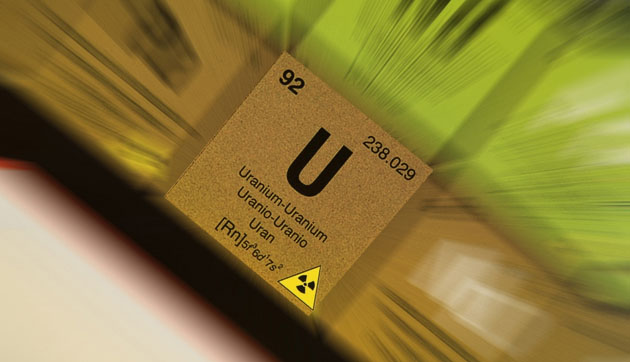 The price of uranium is still in the doldrums, but that will change soon—and violently, says Rob Chang of Cantor Fitzgerald Canada. In this interview with The Energy Report, he explains that electric utilities will begin to run short of fuel even before 2020, when 33 additional reactors are expected to come on line. With that in mind, Chang predicts that prices could triple in the next few years, and highlights a half-dozen equities that will likely supply the increased demand and thereby deliver multiples to investors.
The Energy Report: Does cheap oil depress uranium demand?
Rob Chang: It shouldn’t, because uranium is feed for nuclear power, whereas oil is more of a transportation energy source. Oil isn’t commonly used as a source of base-load power supply. However, we have noticed that uranium equities seem to be greatly influenced by the oil price. For some reason or another, it does occur. But I wouldn’t attribute the decline in uranium equities entirely to the decline in the oil price. There has been of late a flight from all commodities.
TER: Would you say the price of oil serves as an index of the strength of the world economy?
RC: Oh, absolutely. As global activity picks up, we see more construction and a greater use of transportation. And you need oil to make that happen.
TER: Do you expect nuclear power usage to grow despite the global economic lull?
RC: I do. China is moving forward with determination on nuclear power. Not so much for the power it needs now, but for the power it will need to accommodate future growth. We could be seeing an economic slowdown in China, but it remains robust compared to other countries. China will have a voracious demand for uranium as the number of its nuclear reactors increases from 36 today to 52 by 2020. It was also recently reported that the draft version of the 13th five-year plan for China calls for eight reactor approvals a year from 2016 to 2020. That’s a far cry higher than our estimate of about three per year.
“Fission Uranium Corp. will continue to explore and add pounds to what is already a world-class project.“
In addition, the global push toward cleaner and greener energy is good for nuclear power and uranium. Nuclear is the only form of base load energy that emits zero carbon.
TER: Anti-nuclear sentiment remains high in North America and Western Europe. Will the growth of nuclear power come entirely from Asia?
RC: The picture is more complicated than that. Public opinion in Japan is still mostly anti-nuclear due to the Fukushima disaster. However, the Japanese government appears very committed to restarting nuclear power, as the country needs cheaper electricity than what it is importing to use now due to the shutdown of nuclear to begin with. On the other hand, France, Great Britain and Canada are still pro-nuclear, despite media agitation. And keep in mind that the United States remains the premier consumer of nuclear power in the world.
TER: The uranium spot price has fallen to $36 per pound ($36/lb). Is this significant?
RC: Well, it’s actually risen from $28/lb, if you want to look at it from a different vantage point. We believe the current spot price is not economic for most producers. The only reason producers continue to produce is because they have long-term contracts that pay more than $50/lb. Those contracts are scheduled to start rolling off in the next few years. That will be the catalyst for greatly increased prices.
When utilities come looking for new contracts, the producers are not going to reload at the $36–44/lb range because many are still probably losing money, or at best breaking even, at $50/lb. Prices will probably move violently higher within 6–12 months.
TER: If the contracts start rolling off in the next few years, why should we expect price increases beginning six months from now?
RC: The uncovered requirements of the utilities. We recently took a look at this issue again, and it seems the needs of utilities will become about 20% uncovered sometime between 2017 and 2018. That means a significant amount of material needs to be secured before then, otherwise their reactors will be forced to operate below capacity, which is not ideal since there still is strong demand for electricity globally. Utilities are currently buying in the spot market, but that supply will be whittled down.
“NexGen Energy Ltd. is our top pick across all commodities.“
Uranium prices peaked a decade ago because many utilities saw a spiking uranium price and were worried about security of supply, so they contracted en masse, which pushed the price even higher. This led to a global synchronization of contract timelines since many utilities contracted on similar terms. As contracts start rolling off in bunches, utilities will be buying on spot and aggressively contracting to shore up their needs. This will coincide with very low production levels from producers, who have been weathering a tough period of low prices. In addition to an environment with little production growth, there has been relatively little exploration and development work done in the uranium space over the past few years, since low uranium prices provided little incentive.
TER: When you say “violently,” how high do you think the price will go?
RC: Utility demand is pretty easy to figure out because a nuclear reactor is not something you can erect overnight. Reactors require long-term planning, huge capital budgeting, and face long permitting processes. We believe that most reactors currently in the development and construction stage will become operational. We can foresee the demand, and the fact is that a significant increase in uranium supply will be required for those reactors to generate power.
The breakeven costs for planned uranium mines are $70–80/lb. Those mines will not begin production until the price is north of that range. Mines won’t be built so they can break even; an incentive price is needed. We conservatively predict that a price of $80/lb is the breakeven required for global supply and demand to meet over the long term, and with incentive pricing, that range will likely rise to $90–100/lb.
TER: Nuclear power plants are exceedingly expensive. How much does the uranium price affect the total price?
RC: Uranium costs are probably somewhere between 1–3% of a utility’s total cost. For a utility, that’s almost meaningless.
TER: How many nuclear reactors are operating now, and how many do you expect by 2020?
RC: There are now 439 worldwide; by 2020 we expect 472.
TER: Is Japan fully committed to recommissioning its nuclear fleet?
RC: No. The federal government is, but approvals from the prefectures (state governments) are still required. We recently chatted with several nuclear experts and industry participants, and in their opinions, the large majority of Japan’s reactors will easily meet the required safety protocols. After that, it’s up to public opinion in the relevant prefectures, which is a mix of those who want them restarted for economic reasons and those who fear nuclear power. In our opinion, two-thirds of Japan’s reactors will be recommissioned.
TER: Let’s talk about specific uranium companies. Why did the merger of Denison Mines Corp. (DML:TSX; DNN:NYSE.MKT) and Fission Uranium Corp. (FCU:TSX) fail?
RC: They are two different types of companies. Fission is more of an exploration upside story, while Denison is more of a near-term development story. I believe the merger failed because Fission’s shareholders preferred a big takeout and weren’t happy with the dilution that a merger with Denison would entail.
TER: Does this failure hurt the reputations of the respective managements?
RC: There will always be questions whenever a merger fails, and we’re seeing that play out for both companies now. All I can say is that I’m certain both management teams thought the merger was in their shareholders’ best interests.
TER: Let’s discuss the prospects for both companies in the wake of the failed merger. Fission shares hit a 52-week low Nov. 30, but are up 13% since then.
RC: We still like the Patterson Lake South (PLS) property in Saskatchewan. Fission management may need to do some public relations work to get investors back on the company’s side. That said, facts are facts. Fission will continue to explore and add pounds to what is already a world-class project: 105.5 million pounds (105.5 Mlb) with a projected operating cost of $14.02/lb. Fission and NexGen Energy Ltd. (NXE:TSX.V; NXGEF:OTCQX) are the two best uranium stories we’ve seen in quite a while.
TER: How do you rate Fission?
RC: A Buy rating with a 12-month, $1.55/share price target.
[Editor’s Note: On Dec. 21, Fission announced an agreement with CGN Mining Company Ltd., which will acquire a 19.99% ownership stake in Fission. In a research note Chang issued on Dec. 21, he wrote, “We view CGN’s first foray into Canadian uranium as a positive for Fission Uranium and the Canadian uranium industry in particular as the Chinese have finally pulled the trigger in investing in a uranium project in Canada.]
TER: What are Denison’s prospects?
RC: The company has made the very interesting decision to push its Wheeler River project in Saskatchewan to production. Denison owns 60% of Wheeler River, with Cameco owning 30% and Japan-Canada Uranium Co. Ltd. (JCU) owning 10%. Denison’s share of this project’s indicated resource is 42.1 Mlb. I think Denison has chosen well, as it has added shareholder value by no longer being a pure-play exploration company.
Denison’s decision has put it in Cameco’s viewfinder. Cameco has been sitting on the Athabasca Basin with the knowledge that it will likely be the ultimate buyer of many of the local projects because of economies of scale and synergies. Cameco has been rewarded for its caution as prices have fallen, but now the landscape has changed. Wheeler River could add 7–10 Mlb annually into the market once it begins production. That will force Cameco to make a decision: Allow Denison to proceed on its own or take it out and hold on to it.
TER: When would you expect Denison to go into production?
RC: Probably in six to seven years.
TER: Would Wheeler River production coincide with the “violent” uranium price increases you expect?
RC: It should. I believe, however, that Denison expects the project to be economic even under current prices. We do know that Wheeler River’s location signals a low-cost mine because of the grade. Cameco’s costs are probably in the high teens to twenties per pound. Given that Denison is in the same area, it’s possible it would achieve the same low cost. In that scenario, the current $36/lb is profitable even considering a large capital expenditure (capex) and the discounted cash flow and time value.
TER: How do you rate Denison?
RC: A Buy rating with a $1.60/share price target.
TER: Would it be safe to say you have a high opinion of Cameco?
RC: Indeed. It is the juggernaut in the space. It is high grade and low cost. It is one of the largest producers in the world, and it effectively owns the Athabasca Basin, easily the best jurisdiction in the world for uranium production. Cameco also is easy to invest in. Some of my larger clients tell me their multibillion-dollar funds can’t reach down to the hundred-million-dollar equities, because a meaningful position by the funds would result in control positions in the smaller companies.
Read Rob Chang’s Investment Ideas in The Gold Report
Cameco is the only uranium-focused equity with a market cap that is over a billion dollars and is very liquid, and for that reason alone it will be the frontrunner when the uranium price shoots upward. It has a great management team. Usually, the best people in the smaller companies come from Cameco, so it must be doing something right.
TER: How do you rate Cameco?
RC: A Buy rating with a target price of $26.05/share. Right now, it is trading at $16.80/share, so I expect a $9/share upside. We’ve tracked this company for quite a while. Cameco has historically traded from a forward price-to-cash-flow basis of about 13x. It’s currently trading in the 5–6x range, which is a level that we have never seen. That’s significant, and reflects investors’ general dislike of the commodities sector, as well as the current disdain for uranium.
We believe that Cameco is greatly oversold and will be worth much, much more. Also, in a higher-price environment, Cameco will probably deserve a higher multiple because it’s the preeminent company in the space. A $30 target price, perhaps.
TER: Given that Cameco is the 800-pound gorilla in Saskatchewan, could the company become a monopoly in the province?
RC: Well, it effectively does have a monopoly because it already owns pretty much everything that’s notable except for the McClean Lake mill, which AREVA SA (AREVA:EPA) and Denison own the majority of. Beyond that, Cameco has all the notable, high-quality assets in the Athabasca Basin except those owned by Denison, Fission and NexGen.
TER: Which other uranium juniors do you like and why?
RC: I’ll name four. The first is NexGen Energy. This is our top pick across all commodities, and we believe investors have the opportunity to buy an emerging world-class deposit in Arrow in its early stages of being discovered. Based on released assay results to date, we already estimate a resource size of 149 Mlb U3O8 with significant upside available. In fact, based on the length of the intercepts we have seen, the grade of these intercepts and the size of the potential mineralized areas, Arrow has the potential to rival some of the largest uranium deposits in the world. We have a Buy (Speculative) rating on NexGen with no target price since it does not have an official resource yet. But we expect to see a maiden resource estimate by mid-2016.
TER: What else?
RC: The second is Energy Fuels Inc. (EFR:TSX; UUUU:NYSE.MKT; EFRFF:OTCQX). It is the only conventional uranium producer in the U.S. and the second-largest producer overall. It has the potential to become #1, given the projects and mines it has on standby or that are close to being in development. At full ramp-up we expect the company to be able to produce 5–7 Mlb/year, in a country currently producing 4–5 Mlb/year.
The U.S. consumes 55 Mlb/year, but only about 10% is supplied domestically. U.S. utilities seeking security of supply will greatly prefer U.S. producers over those from Kazakhstan, Russia or Africa. This company is well positioned to benefit from higher uranium prices.
TER: How do you rate Energy Fuels?
RC: A Buy rating with a target price of $11.85/share.
TER: Do American producers have the advantage in the domestic market vis-á-vis Canadian producers?
RC: That hasn’t materialized yet, but they could enjoy a premium at some point and I believe they should. Security of supply is of paramount importance, especially when the alternative to not having uranium for a utility is an idle reactor generating zero revenue.
TER: And the third uranium junior you like is?
RC: Azarga Uranium Corp. (AZZ:TSE), which is underfollowed. It owns the Dewey Burdock project in South Dakota, which used to be owned by Powertech Uranium Corp. It is located in a region that has several producing, past producing, and developing in-situ recovery (ISR) uranium assets, and we expect this project to start producing ~1 Mlb/year by 2018–19. Because it is the highest-grade ISR deposit in the U.S., we believe it can attain all-in sustaining costs (AISC) of $30–40/lb. That’s not a sexy number now, but we believe it soon will be.
Dewey Burdock has a current resource of 8.58 Mlb attributed and 3.53 Mlb Inferred, and there is still a lot of exploration upside in the area. We believe that Azarga can easily add many more pounds.
TER: Azarga also has projects in Colorado and Kyrgyzstan. Are they significant?
RC: We expect that Centennial in Colorado will be the company’s next project to go into production after Dewey Burdock. By the beginning of 2020, we expect 700 Klb/year from that source. We haven’t modeled any of Azarga’s other projects, because Dewey Burdock and Centennial are the ones that have the best chance of going online and creating value for shareholders.
TER: How do you rate Azarga?
RC: A Buy rating with a target price of $1.20/share.
TER: And the final uranium junior you wanted to mention?
RC: Ur-Energy Inc. (URG:NYSE.MKT; URE:TSX) has been producing at Lost Creek via ISR in Wyoming for two years, and also has the Shirley Basin project. This company has outperformed from both cost and production standpoints almost since the start. We’re pretty excited by what we see. The company can also ramp up production. It will be producing more than 1 Mlb/year with AISC in the $20s. This is a proven low-cost producer that will look even better when prices rise.
TER: How do you rate Ur-Energy?
RC: A Buy rating with a $2.15/share target price.
TER: Many uranium juniors have recently seen 52-week lows. Have we reached the bottom? Should investors be getting into junior uranium stocks now, or should they wait for uranium prices to rise?
RC: I find it difficult to imagine why uranium prices would make a significant move downward, but I see many obvious reasons why uranium prices would make a significant move upward. At the current spot price of $36/lb, many, if not most, uranium producers are probably losing money. Should uranium prices fall below $36/lb for a significant period of time, producers would shut down, and then we’d have even less production relative to demand.
Beginning in 2017–18, the utilities will become increasingly uncovered, and that problem will only worsen as more reactors come online. Unless new contracts at much higher prices are signed, I expect utilities’ uncovered positions will rise to one-half to two-thirds of requirements. As I said earlier, uranium is a tiny part of total expenditures, so it makes little sense for them to drive hard bargains at the risk of not getting the material. There might be a little more short-term pain for uranium due to inventory levels and secondary supplies, but a violent price increase is coming soon.
TER: Rob, thank you for your time and your insights.
Cantor Fitzgerald Canada’s Senior Analyst, Managing Director and Head of Metals and Mining Rob Chang has covered the metals and mining space for over nine years for the sellside and the buyside. Prior to Cantor, Chang served on the equity research teams at Versant Partners, Octagon Capital and BMO Capital Markets. His buyside experience includes managing $3 billion in assets as a director of research/portfolio manager at Middlefield Capital, where his primary resource portfolio outperformed its direct peer and benchmark by more than 28% and 18%, respectively. He was also on a five-person multistrategy hedge fund team, where he specialized in equity and derivative investments. He completed his master’s degree in business administration at the University of Toronto’s Rotman School of Management.
Read what other experts are saying about:
DISCLOSURE:
1) Kevin Michael Grace conducted this interview for Streetwise Reports LLC, publisher of The Gold Report, The Energy Report and The Life Sciences Report, and provides services to Streetwise Reports as an independent contractor. He owns, or his family owns, shares of the following companies mentioned in this interview: None.
2) The following companies mentioned in the interview are sponsors of Streetwise Reports: NexGen Energy Ltd., Energy Fuels Inc. and Fission Uranium Corp. The companies mentioned in this interview were not involved in any aspect of the interview preparation or post-interview editing so the expert could speak independently about the sector. Streetwise Reports does not accept stock in exchange for its services.
3) Rob Chang: I own, or my family owns, shares of the following companies mentioned in this interview: Fission Uranium Corp., Energy Fuels Inc. and Denison Mines Corp. I personally am, or my family is, paid by the following companies mentioned in this interview: None. My company has a financial relationship with the following companies mentioned in this interview: NexGen Energy and Energy Fuels. I was not paid by Streetwise Reports for participating in this interview. Comments and opinions expressed are my own comments and opinions. I determined and had final say over which companies would be included in the interview based on my research, understanding of the sector and interview theme. I had the opportunity to review the interview for accuracy as of the date of the interview and am responsible for the content of the interview.
4) Interviews are edited for clarity. Streetwise Reports does not make editorial comments or change experts’ statements without their consent.
5) The interview does not constitute investment advice. Each reader is encouraged to consult with his or her individual financial professional and any action a reader takes as a result of information presented here is his or her own responsibility. By opening this page, each reader accepts and agrees to Streetwise Reports’ terms of use and full legal disclaimer.
6) From time to time, Streetwise Reports LLC and its directors, officers, employees or members of their families, as well as persons interviewed for articles and interviews on the site, may have a long or short position in securities mentioned. Directors, officers, employees or members of their families are prohibited from making purchases and/or sales of those securities in the open market or otherwise during the up-to-four-week interval from the time of the interview until after it publishes.

 In case it weren’t completely obvious how completely screwed up the financial system is, please allow me to introduce Exhibit A: the Federal Reserve’s own balance sheet.
First we need a quick accounting background. And, stay with me, because this is important.
Think about your own finances. You, me, everyone… we all have assets and liabilities.
Your assets might be things like cash, your house, car, baseball card collection, etc.
And your liabilities are loans, credit card debt, etc.
The difference between the two can be thought of as your ‘net worth’. And hopefully it’s positive, i.e. your assets exceed your liabilities.
In accounting, this concept of net worth is known as ‘equity’. A company like Apple that has a lot of assets but not a lot of debt has substantial equity.
(As an investor, I typically look for opportunities where I can buy a great business or its shares for less than its equity. But we’ll save that for another time.)
Banks, too, have assets and liabilities.
But while the balance of your savings account may be an asset for you, or the mortgage balance you owe to the bank is your liability, for the bank it’s actually reversed.
Your savings account balance is actually money that they OWE you.
So while your savings is an asset for you, for the bank it’s a liability.
Similarly, your loan balance might be your liability.
But for banks, the loans they make to customers are actually assets because they’re on the receiving end of the loan payments.
For a bank, net worth (known as a bank’s ‘capital’) is a massively important indication of its financial health.
Think about it– if a bank has a negative net worth, this means that it doesn’t have enough assets to repay its customer deposits.
This is how banking crises start. It’s precisely why Lehman Brothers (and a whole lot of other banks) went bust in 2008/2009. The banks’ liabilities exceeded their assets.
Conservative banks hold vast amounts of capital, i.e. have substantial a net worth where the value of their assets drastically exceeds liabilities and customer deposits.
One way of looking at this is by measuring a bank’s capital as a percentage of its total assets. (Conservative banks have a high percentage.)
Let’s say a bank has $1000 in assets like cash and loans, and $200 in liabilities (customer deposits).
This means that the bank has $800 in capital, which constitutes 80% of its total assets.
In other words, the value of the bank’s assets can fall by 80%, and the bank would still be able to repay its depositors.
This is a huge margin of safety that is unfortunately almost unheard of in banking.
Right before the crisis, in fact, Lehman Brother’s capital was just 3% of its total assets.
And that leads me to central banks.
Just like regular banks and businesses, central banks also have assets and liabilities.
In the US, the Federal Reserve’s assets total $4.486 trillion, including more than $2 TRILLION in US government debt.
The Fed also has total capital (i.e. net worth) of $39.5 billion.
That sounds like a lot. Until you realize that it constitutes just 0.88% of its total assets. Not even 1%!
This is a tiny, almost nonexistent level of capital at the Federal Reserve.
Put another way, the issuer of the United States dollar, the most widely used currency on the planet, and the central bank of the largest economy in the world, has almost no margin of safety.
This puts the entire global financial system at a tremendous level of risk.
Central banks can and do go bankrupt. It happened most notably in Iceland back in 2008, causing an epic currency crisis in that country.
So running the Fed’s balance sheet down to the nub like this is not exactly a consequence-free course of action.
But what’s really astonishing about all of this is how quickly the Fed’s balance sheet deteriorated. And why.
Just two weeks ago, the Fed’s total capital was nearly $59 billion. And even that wasn’t very much given the size of its balance sheet.
Today it’s $39.5. This is an incredible 33% drop in just two weeks!
Imagine your net worth collapsing by 33% in two weeks; it would probably be a huge personal crisis. Yet the Fed seems completely cool about it.
I did some digging and found out why this happened.
It turns out that Congress and the President passed a law last month called the Fixing America’s Surface Transportation (FAST) Act.
We’ve talked about this one before– the FAST Act is supposed to provide funding for America’s highway system.
But one of the provisions is that a US citizen can have his passport revoked if the government believes in its sole discretion that he owes too much tax. Crazy.
And, buried deep within the nearly 500 pages of legislation is a neat little section demanding that Federal Reserve bank surpluses above a certain amount must be turned over to the United States Department of Treasury.
In other words, the US government is so broke that they’re now confiscating assets from the Fed, putting the entire global financial system at even more risk.
It’s genius!
You just can’t make this stuff up. It’s so absurd it would be comical if it weren’t true.
So, yes, it should be completely obvious by now that there is a tremendous amount of risk in the system.
Governments are completely bankrupt. And even central banks now are being pushed into insolvency by the bankrupt governments they support.
This is not a story that has a happy ending. And whether the consequences arise today, tomorrow, or five years from now is irrelevant.
This is a major risk. And for any thinking, rational person paying attention, it’s imperative to have a Plan B.
Enjoy the weekend,
Simon Black
Founder, SovereignMan.com
Neither this email nor content posted on the website SovereignMan.com is intended to provide personal tax or financial advice. Before undertaking any action described in this letter, financial or otherwise, you should discuss your options with a qualified advisor– tax accountant, financial planner, attorney, priest, IRS auditor, Bernie Madoff, etc.
If you’d like to update your email address or no longer wish to receive our daily emails, click the link below: Update email or unsubscribe
Publisher of Sovereign Man
30 Cecil Street #19-08
Singapore, Singapore – No State 049712
Singapore

Today’s videos and charts (double click to enlarge):
Bonds, Dollar, & US Stock Market Video Analysis
Gold & Silver Bullion Video Analysis
Key Precious Metal ETFs Video Analysis
Trader Time Swing Trades Video Analysis
Individual Precious Metal Stocks Video Analysis
Thanks,
Morris

…related:
We have a Colossal Credit Bubble in China
The Chinese economy may be headed for a “hard landing” as borrowers are taking on record amounts of debt to repay interest on their existing obligations, said Marc Faber. “We had a hard landing in the stock market already and we had a hard landing in commodities and we might have a hard landing in the economy,” Mr Faber, the publisher of the Gloom, Boom & Doom Report, said in an interview with Bloomberg Television
“We have a colossal credit bubble in China.”

 China’s stock drop rocked oil raising concerns of a global market meltdown.
When China went limit down hitting its new circuit breaker in the first 13 minutes of trading, it drove global equity and commodity markets into a tailspin. It drove Hong Kong’s Hang Seng index down 4.2% to the lowest level since Oct. 6, 2011. This took oil below the levels seen in the depths of the great recession and the comparison is making many folks feel that we are in a new great recession (see chart below). Yet what is real and what is imagined is hard to determine when China does not allow its market to do what it needs to do.
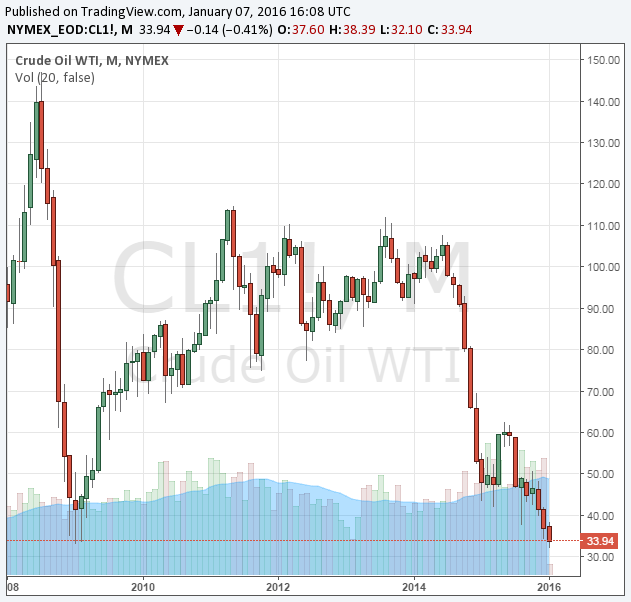
The record in U.S. overall energy stockpiles look even more ominous after the weakness in China. Yesterday the Energy Information Administration reported record petroleum stockpiles led by a 10.5-million-barrel surge in U.S. gasoline supply.
Crude oil saw a 5.1 million barrel drop but the lack of diesel demand due to warm weather still pressures the market. Strong refining margins are keeping refineries going and was helped by low crude prices. Stockpiles at Cushing, OK increased by 917,000 barrels last week.
But if history is a guide, oil prices will spike later this year as bankruptcies and low price inspired demand will start to kick in. Bloomberg News reported that the drop in crude to start the year has wiped off more than 100 billion off its Bloomberg World Oil and Gas index, the worst start since 2004.
Last year, oil and gas bankruptcies totaled $13 billion in North America, 42 companies with $17 billion in debt filed in 2015, the highest level since the financial crisis in 2008. Of these filings, 36 companies with $16.7 billion in debt filed in the United States. There are many companies in the space they call the walking dead that will file, especially if prices don’t rebound soon.
About the Author

Senior energy analyst at The PRICE Futures Group and a Fox Business Network contributor. He is one of the world’s leading market analysts, providing individual investors, professional traders, and institutions with up-to-the-minute investment and risk management insight into global petroleum, gasoline, and energy markets. His precise and timely forecasts have come to be in great demand by industry and media worldwide and his impressive career goes back almost three decades, gaining attention with his market calls and energetic personality as writer of The Energy Report. You can contact Phil by phone at (888) 264-5665 or by email at pflynn@pricegroup.com. Learn even more on our website at www.pricegroup.com.

-
I know Mike is a very solid investor and respect his opinions very much. So if he says pay attention to this or that - I will.
~ Dale G.
-
I've started managing my own investments so view Michael's site as a one-stop shop from which to get information and perspectives.
~ Dave E.
-
Michael offers easy reading, honest, common sense information that anyone can use in a practical manner.
~ der_al.
-
A sane voice in a scrambled investment world.
~ Ed R.
Inside Edge Pro Contributors

Greg Weldon

Josef Schachter

Tyler Bollhorn

Ryan Irvine

Paul Beattie

Martin Straith

Patrick Ceresna

Mark Leibovit

James Thorne

Victor Adair