
Wealth Building Strategies
 HOPE: It’s human nature to be optimistic. It’s human nature to hope. Furthermore, hope is a component of a healthy state of mind. Hope is the opposite of negativity. Negativity in life can lead to anger, disappointment and depression. After all, if the world is a negative place, what’s the point of living in it? To be negative is to be anti-life.
Ironically, it doesn’t work that way in the stock market. In the stock market hope is a hindrence, not a help. Once you take a position in a stock, you obviously want that stock to advance. But if the stock that you bought is a real value, and you bought it right — you should be content to sit with that stock in the knowledge that over time its value will out without your help, without your hoping.
So in the case of this stock, you have value on your side — and all you need is patience. In the end, your patience will pay off with a higher price for your stock. Hope shouldn’t play any part in this process. You don’t need hope, because you bought the stock when it was a great value, and you bought it at the right time.
Any time you find yourself hoping in this business, the odds are that you are on the wrong path — or that you did something stupid that should be corrected.
Unfortuneately hope is a money-loser in the investment business. This is counter-intuitive but true. Hope will keep you riding a stock that is headed down. Hope will keep you from taking a small loss and instead, allowing that small loss to develop into a large loss.
In the stock market hope get in the way of reality, hope gets in the way of common sense. One of the first rules in investing is “Don’t take the big loss.” In order to do that, you’ve got to be willing to take a small loss.
If the stock market turns bearish, and you’re staying put with your whole position. and you’re HOPING that what you see is not really happening – then welcome to poverty city. In this situation, all your hoping isn’t going to save you or make you a penny. In fact, in this situation hoping is the devil that bids you to sit — while your portfolio of stocks goes down the drain.
In the investing business my suggestion is that you avoid hope. Forget the siren, hope — instead embrace cold, clear reality.

Watch the banks.
For once, aggrieved investors can’t blame China. Markets in China are closed for the New Year’s holidays.
After a very ugly week, we expected stock markets to rise this week on the simple principle that nothing goes to heck in a straight line. But we’ve been wrong on this before, and that line could be straighter than we’d expect. So, the US and Europe are starting out the week with a rout.
Last week in the US was particularly ugly for momentum stocks, and for companies that had announced lousy earnings or given squishy forecasts, and even for startups with recent IPOs that were once highfliers and have now crashed. Not even the promise of share buybacks works anymore. Financial engineering has lost its effectiveness. Central-Bank imposed negative interest rates aren’t propping up stocks anymore. None of these tricks works anymore. That’s what markets are learning.


On the heels of the Nikkei plunging a jaw-dropping 11 percent in just 3 days, and the world banking system entering another round of panic, this is how frightening the global collapse has now become.
But first, a short-term note of caution…
From Investor’s Intelligence: “(The) BULL/BEAR ratio is (now) at multi-year lows and lower than September/October, 2015” (see remarkable 10-year chart below).


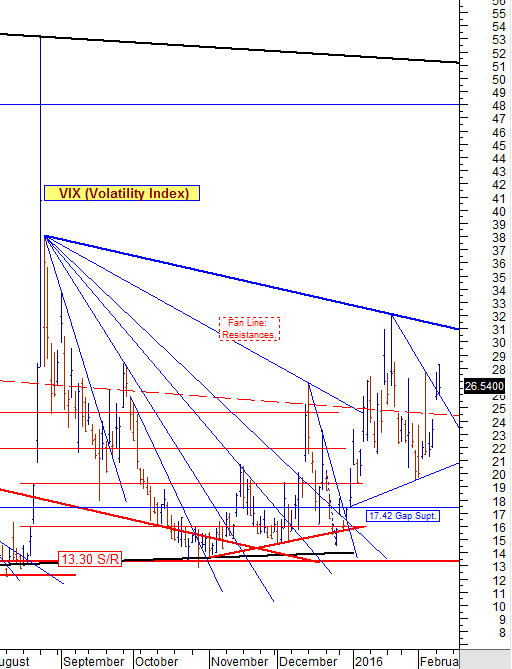
The VIX is derived from the S&P 500 options for the next 30 days. So, it is a representation of the market expectations during the next 30 day period.
Note that it is derived from the S&P 500 options That is important because the S&P 500 is a favored index used by Institutional Investors. The reason for this is because the S&P 500 is the most representative index of the economy’s health due to its wide sector representation.
So, the VIX is an important index to be watched which is why we are posting its chart today.
The first observation to make (on the chart) are the “fan lines” since the peak high made last August.
Correlating with that are the VIX peaks made since August. (Now is a good time to remember that the VIX moves in the opposite direction of the stock market.)
Yesterday, the VIX closed at 26.54. What was significant, was that it closed above its 2016 triangular formation seen on the chart.
Since the VIX has made a series of three higher peaks since last November, the risk now is that it makes another higher peak in the coming days. That would be a real negative for the market and therefore the risk levels are elevated.

A look back at stock market performance in two major bear market years of 2000 & 2008 reveals some interesting findings:
First lets look at the S&P500 Chart in 2000:
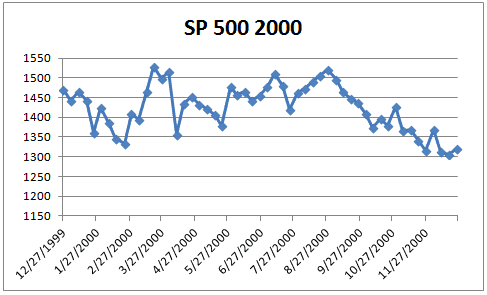
The market dropped 10% to start the year. It proceeded to recover most of its losses by late March failing at prior highs eventually falling over 15% further post August.
Next lets look at the S&P500 Chart in 2008:
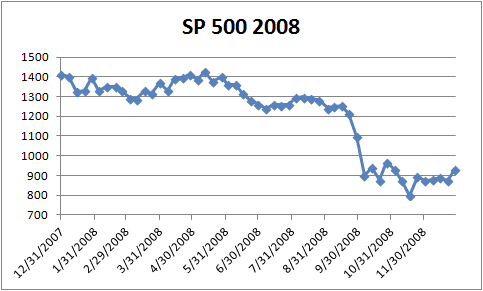
The market again dropped 10% to start the year. It proceeded to recover most of its losses by early May and then collapsing over 50% into October.
That brings us to Today’s market:
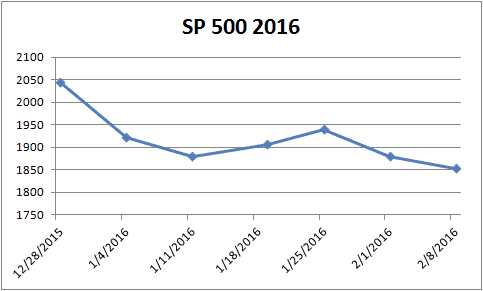
We have again dropped 10% to start the year. If we go by what the market did in 2000 and 2008 we should recover most of these losses by May and then begin a major collapse into August and September following an oversold bounce out of the March 2016 lows.


-
I know Mike is a very solid investor and respect his opinions very much. So if he says pay attention to this or that - I will.
~ Dale G.
-
I've started managing my own investments so view Michael's site as a one-stop shop from which to get information and perspectives.
~ Dave E.
-
Michael offers easy reading, honest, common sense information that anyone can use in a practical manner.
~ der_al.
-
A sane voice in a scrambled investment world.
~ Ed R.
Inside Edge Pro Contributors

Greg Weldon

Josef Schachter

Tyler Bollhorn

Ryan Irvine

Paul Beattie

Martin Straith

Patrick Ceresna

Mark Leibovit

James Thorne

Victor Adair