
Energy & Commodities
 With lithium prices skyrocketing beyond wildest expectations, talk heating up about acquisitions and mergers in this space and a fast-brewing war among electric car rivals, it’s no wonder everyone’s bullish on this golden commodity that promises to become the “new gasoline.”
Moreover, land grabs, rising price predictions, and expectations of a major demand spike are leaping out of the shadows of a pending energy revolution and a new technology-driven resource era.

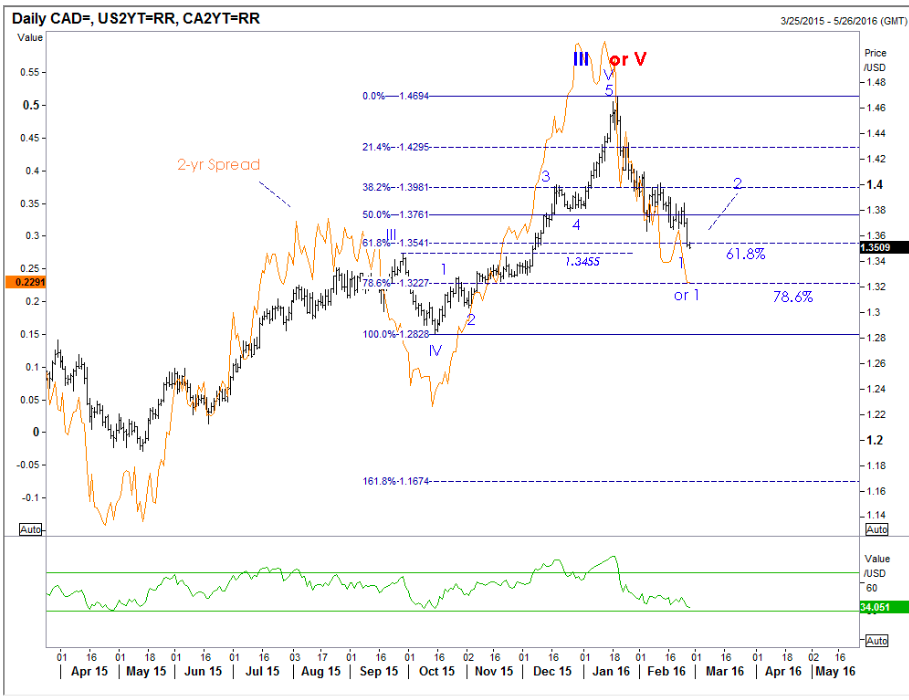
The Canadian dollar has recovered nicely against the US dollar. It continues to move in line with yield spread which is moving now back in favor of Canada. But is it time for a rest before continuing on this path? If we look at the retracement of Wave V into the high, 1.3541 represents a 61.8% retracement; with swing high support coming in at 1.3455. So, not a bad place for some consolidation, recovery, before lower; scope back to 1.4000-level shown as wave 2…that being said, we are getting some risk on again today and oil prices are moving higher…so not something we want to get in front of just yet…next key support level daily basis comes in at 1.3227…
Jack Crooks
Black Swan Capital www.blackswantrading.com
Black Swan Capital’s Black Swan Forex is strictly an informational publication and does not provide personalized or individualized investment or trading advice. Commodity futures and forex trading involves substantial risk of loss and may not be suitable for you. The money you allocate to futures or forex trading should be money that you can afford to lose. www.blackswantrading.com

AH PERFECTION: Strange, but the most popular, the most widely-requested, and the most widely quoted piece I’ve ever written was not about the stock market — it was about business, and specifically about what I call the theoretical “ideal business.” I first published this piece in the early-1970s. I repeated it in Letter 881 and then again in Letter 982. I’ve added a few thoughts in each successive edition. But seldom does a month go by when I don’t get requests from subscribers or from some publication or corporation to republish “the ideal business.” So here it is again — with a few added comments.
I once asked a friend, a prominent New York corporate lawyer, “Dave, in all your years of experience, what was the single best business you’ve ever come across?” Without hesitation, Dave answered, “I have a client whose sole business is manufacturing a chemical that is critical in making synthetic rubber. This chemical is used in very small quantities in rubber manufacturing, but it is absolutely essential and can be used in only super-refined form.
“My client is the only one who manufactures this chemical. He therefore owns a virtual monopoly since this chemical is extremely difficult to manufacture and not enough of it is used to warrant another company competing with him. Furthermore, since the rubber companies need only small quantities of this chemical, they don’t particularly care what they pay for it — as long as it meets their very demanding specifications. My client is a millionaire many times over, and his business is the best I’ve ever come across.” I was fascinated by the lawyer’s story, and I never forgot it.
When I was a young man and just out of college my father gave me a few words of advice. Dad had loads of experience; he had been in the paper manufacturing business; he had been assistant to Mr. Sam Bloomingdale (of Bloomingdale’s Department store); he had been in construction (he was a civil engineer); and he was also an expert in real estate management.
Here’s what my dad told me: “Richard, stay out of the retail business. The hours are too long, and you’re dealing with every darn variable under the sun. Stay out of real estate; when hard times arrive real estate comes to a dead stop and then it collapses. Furthermore, real estate is illiquid. When the collapse comes, you can’t unload. Get into manufacturing; make something people can use. And make something that you can sell to the world. But Richard, my boy, if you’re really serious about making money, get into the money business. It’s clean, you can use your brains, you can get rid of your inventory and your mistakes in 30 seconds, and your product, money, never goes out of fashion.”
So much for my father’s wisdom (which was obviously tainted by the Great Depression). But Dad was a very wise man. For my own part, I’ve been in a number of businesses — from textile designing to advertising to book publishing to owning a night club to the investment advisory business.
It’s said that every business needs (1) a dreamer, (2) a businessman, and (3) a S.O.B. Well, I don’t know about number 3, but most successful businesses do have a number 3 or all too often they seem to have a combined number 2 and number 3.
Bill Gates is known as “America’s richest man.” Bully for Billy. But do you know what Gates’ biggest coup was? When Gates was dealing with IBM, Big Blue needed an operating system for their computer. Gates didn’t have one, but he knew where to find one. A little outfit in Seattle had one. Gates bought the system for a mere $50,000 and presented it to IBM. That was the beginning of Microsoft’s rise to power. Lesson: It’s not enough to have the product, you have to know and understand your market. Gates didn’t have the product, but he knew the market — and he knew where to acquire the product.
Apple had by far the best product in the Mac. But Apple made a monumental mistake. They refused to license ALL PC manufacturers to use the Mac operating system. If they had, Apple today could beMicrosoft, and Gates would still be trying to come out with something useful (the fact is Microsoft has been a follower and a great marketer, not an innovator). “Find a need and fill it,” runs the old adage. Maybe today they should change that to, “Dream up a need and fill it.” That’s what has happened in the world of computers. And it will happen again and again.
All right, let’s return to that wonderful world of perfection. I spent a lot of time and thought in working up the criteria for what I’ve termed the IDEAL BUSINESS. Now obviously, the ideal business doesn’t exist and probably never will. But if you’re about to start a business or join someone else’s business or if you want to buy a business, the following list may help you. The more of these criteria that you can apply to your new business or new job, the better off you’ll be.
(1) The ideal business sells the world, rather than a single neighborhood or even a single city or state. In other words, it has an unlimited global market (and today this is more important than ever, since world markets have now opened up to an extent unparalleled in my lifetime). By the way, how many times have you seen a retail store that has been doing well for years — then another bigger and better retail store moves nearby, and it’s kaput for the first store.
(2) The ideal business offers a product which enjoys an “inelastic” demand. Inelastic refers to a product that people need or desire — almost regardless of price.
(3) The ideal business sells a product which cannot be easily substituted or copied. This means that the product is an original or at least it’s something that can be copyrighted or patented.
(4) The ideal business has minimal labor requirements (the fewer personnel, the better). Today’s example of this is the much-talked about “virtual corporation.” The virtual corporation may consist of an office with three executives, where literally all manufacturing and services are farmed out to other companies.
(5) The ideal business enjoys low overhead. It does not need an expensive location; it does not need large amounts of electricity, advertising, legal advice, high-priced employees, large inventory, etc.
(6) The ideal business does not require big cash outlays or major investments in equipment. In other words, it does not tie up your capital (incidentally, one of the major reasons for new-business failure is under-capitalization).
(7) The ideal business enjoys cash billings. In other words, it does not tie up your capital with lengthy or complex credit terms.
(8) The ideal business is relatively free of all kinds of government and industry regulations and strictures (and if you’re now in your own business, you most definitely know what I mean with this one).
(9) The ideal business is portable or easily moveable. This means that you can take your business (and yourself) anywhere you want — Nevada, Florida, Texas, Washington, S. Dakota (none have state income taxes) or hey, maybe even Monte Carlo or Switzerland or the south of France.
(10) Here’s a crucial one that’s often overlooked; the ideal business satisfies your intellectual (and often emotional) needs. There’s nothing like being fascinated with what you’re doing. When that happens, you’re not working, you’re having fun.
(11) The ideal business leaves you with free time. In other words, it doesn’t require your labor and attention 12, 16 or 18 hours a day.
(12) Super-important: the ideal business is one in which your income is not limited by your personal output (lawyers and doctors have this problem). No, in the ideal business you can sell 10,000 customers as easily as you sell one (publishing is an example).
That’s it. If you use this list it may help you cut through a lot of nonsense and hypocrisy and wishes and dreams regarding what you are looking for in life and in your work. None of us own or work at the ideal business. But it’s helpful knowing what we’re looking for and dealing with. As a buddy of mine once put it, “I can’t lay an egg and I can’t cook, but I know what a great omelet looks like and tastes like.”

100,000 refugees have entered Greece since the beginning of the year compared to 5,000 a year ago.
Where can they go? On February 16, Austria announced it will take at most 80 a day. Just this week Macedonia reduced the number of refugees allowed to transit through its territory to about 1,000 a day.
At least 15,000 are trapped in Greece, a country without resources to deal with them. In response to the growing crisis, Greece Withdraws Ambassador to Austria.
Athens withdrew its ambassador to Austria on Thursday in a sign of the mounting acrimony between EU countries over the bloc’s failed refugee policies, a fight that increasingly risks destroying the continent’s passport-free travel zone.
In a statement announcing the decision, Greece’s foreign ministry accused the Austrian government of taking unilateral action outside of EU rules and recent agreements by capping the number of asylum seekers that it would accept across its southern border.
The move by Vienna has angered several member states, particularly Germany, which believe it was a direct violation of principles agreed by Werner Faymann, Austria’s chancellor, at recent EU summits.
While Vienna is capping the number of daily asylum applications it accepts at 80, it is freely allowing as many as 3,200 refugees a day to pass through Austria en route to Germany — even after agreeing not to do so at the most recent EU summit.
Despite anger in Athens and Berlin, Vienna has hastily put together a group of EU and non-EU allies along the so-called “Western Balkans route”, most of whom met in Vienna on Wednesday to agree policies that could constrict tens of thousands of refugees in Greece indefinitely. Neither Germany nor Greece was invited to the Vienna meeting.
The EU’s migration chief, Dimitris Avramopoulos, warned on Thursday that the bloc had 10 days to improve the situation “or else there is risk the whole system will completely break down“.
Even the French and the Belgians have engaged in verbal sparring after Belgium’s decision to impose border controls on its frontier with France. Belgium is concerned it could face an influx of refugees due to an imminent move by the French authorities to clear part of Calais’ so-called “jungle” migrant camp.
Mr Tsipras said Greece would block an agreement at a refugee summit on March 7 that “does not ringfence an obligatory sharing of the responsibility and burden [of the refugee issue] among the member states in a proportional way”.
Whole System Broken Down
I don’t need 10 days to report the obvious: The whole system has already broken down.
The biggest problem at the moment is actually Greece. By letting all refugees in, even though passages to the North are severed, Greece is the problem child, not Austria, nor Hungary, nor Macedonia.
At the expense of its own citizens, with money it dos not have, Greece bears the brunt of the refugee crisis. The smart thing for Greece to do would be to close its own border just as Hungary did.
Border Control Map

The above map is from the BBC on January 25. I added the blue anecdotes that show additional blockages since then.
Blockage Math
- In 56 days, starting January first, 100,000 have entered Greece primarily from Turkey. That’s 1,786 a day.
- As the temperatures climb, the count will rise if Greece does nothing to stop the flow.
- Macedonia reduced the number of refugees allowed to transit through its territory to about 1,000 a day.
- 15,000 are already trapped in Greece and that number will rise by at least 786 a day. In one month, that’s another 23,580.
- If Germany refuses the pass through from Austria, the maximum flow would decline to 80 per day, and the trapped rate would rise from 786 a day to 1,706 per day (51,180 a month).
Not Broken Yet Thesis Recap
Don’t worry. We are told the system is not broken yet. Greece says there’s still 10 days to fix the problem.
Meanwhile, Greece has vowed to veto any solution that does not spread the refugees around, while Austria has called a summit of countries sympathetic to more blockages.
Related Articles
February 16, 2016: “Just Say No”: Austria Announces Daily Quotas on Refugees: Yearly Flow Reduced to 37,500 from 1,000,000.
February 18, 2016: Pass Thru Politics: EU Says Austria’s Refugee Quotas Violate Geneva Convention; In Praise of Austria.

It appears that Great Britain might actually do the until-recently-unthinkable, and leave the European Union. The reasons for this dramatic break-up are many, and can be Googled easily enough. For our purposes, suffice to say that traders are scrambling to figure out what this means for the British pound, and they’re not liking the answers. Here’s a quick look at the recent foreign exchange action:


-
I know Mike is a very solid investor and respect his opinions very much. So if he says pay attention to this or that - I will.
~ Dale G.
-
I've started managing my own investments so view Michael's site as a one-stop shop from which to get information and perspectives.
~ Dave E.
-
Michael offers easy reading, honest, common sense information that anyone can use in a practical manner.
~ der_al.
-
A sane voice in a scrambled investment world.
~ Ed R.
Inside Edge Pro Contributors

Greg Weldon

Josef Schachter

Tyler Bollhorn

Ryan Irvine

Paul Beattie

Martin Straith

Patrick Ceresna

Mark Leibovit

James Thorne

Victor Adair