
Economic Outlook
 To say that Saudi Arabia is on the verge of its most significant change in decades is not an exaggeration.
Inside Saudi Arabia—a Failing Kingdom you will learn:
- How the House of Saud could collapse in four years… and what it means to the region and the globe.
- Why the Saudi government is considering an IPO of its crown jewel—after it helped drive oil prices down.
- Why OPEC is defunct and may never return to its glory days.
- How the Saudis’ policies are empowering ISIS.
- What Middle Eastern oil policies mean for the future of the US shale industry… and why it matters to you.


| Mon. | Tue. | Wed. | Thu. | Fri. | Mon. | Evaluation | |
| Monetary conditions | 0 | 0 | 0 | 0 | 0 | 0 | 0 |
| 5 day RSI S&P 500 | 76 | 57 | 62 | 71 | 67 | 54 | 0 |
| 5 day RSI NASDAQ | 73 | 56 | 63 | 68 | 70 | 59 | 0 |
|
McCl-
lAN OSC.
|
+226 | +148 | +168 | +210 | +214 | +199 |
–
|
| Composite Gauge | 4 | 16 | 9 | 5 | 10 | 12 | 0 |
| Comp. Gauge, 5 day m.a. | 7.0 | 9.4 | 10.2 | 8.8 | 8.8 | 10.4 | 0 |
| CBOE Put Call Ratio | .95 | 1.12 | 1.04 | .92 | .99 | 1.20 |
+
|
| VIX | 19.38 | 20.28 | 20.72 | 19.11 | 19.81 | 20.55 | 0 |
| VIX % change | -6 | +8 | -1 | -8 | +4 | +4 | 0 |
| VIX % change 5 day m.a. | -4.4 | -1.8 | -0.6 | -1.6 | -0.6 | +1.4 | 0 |
| Adv – Dec 3 day m.a. | +502 | +143 | +380 | +239 | +822 | +715 | – |
| Supply Demand 5 day m.a. | .79 | .61 | .62 | .78 | .62 | .43 | + |
| Trading Index (TRIN) | .37 | 1.96 | 1.06 | .84 | .96 | 1.41 |
+
|
|
S&P 500
|
1946 | 1921 | 1930 | 1952 | 1948 | 1932 | Plurality +1 |

At one time, tax havens took great pride in calling themselves just that, since low-tax jurisdictions provide people with freedom from oppressive taxation.
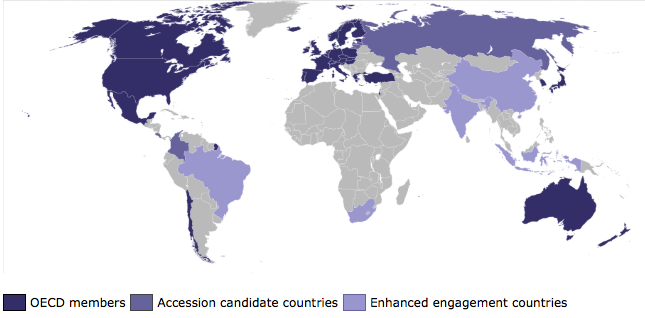
But, in recent decades, the Organisation for Economic Cooperation and Development (OECD, based in France, but largely funded and controlled by the US) has been on a rampage to crush tax havens. The attacks have been regular and forceful and, although tax havens still exist around the world, every one of them has caved to a greater or lesser degree to ever more stringent OECD “international practices.” Presently, all tax havens live in fear of the OECD and its powerful enforcer, the US.
No measure has been more devastating to freedom from taxation than the US Foreign Account Tax Compliance Act (FATCA). The secret of its success is that the US fines banking institutions for not following the arbitrary FATCA guidelines. How can one country fine a bank in another country if that bank is following the laws of the country in which it’s located? Well, failure to pay the fine may result in the US cutting the bank out of international transfers in the SWIFT system, which would collapse the bank.
Essentially, this is a “shakedown” operation, purported to focus on tax evasion, but, in fact, focused primarily on demanding protection money from international banks. (More than eighty Swiss banks have been subject to roughly five billion dollars in penalties and fines imposed by the US.)
Not surprisingly, the OECD has spent decades castigating the very existence of tax havens, declaring them to exist solely for the purposes of money laundering, terrorism funding, tax evasion and even “international prostitution” (no kidding).
In spite of the OECD’s condemnation of tax havens, the US has, in recent years, created tax havens in several states, and is being dubbed “the new Switzerland.” Of particular interest here, is that the US itself has not signed on to the OECD’s “international standards.” The US is therefore imposing more stringent restrictions on others than it is willing to comply with itself. (Had Attila the Hun gotten into banking, this is the approach he might have used.)
Recently, the US has lifted the veil on their ambitions by announcing further, more dramatic inroads into becoming a tax haven. In September of 2015, Andrew Penney, a managing Director of Rothschild & Co. in San Francisco, announced that the world’s wealthy can avoid paying tax by moving their wealth to the US. As the US banks will not be subject to the draconian limitations that the US/OECD have forced on the world’s other tax havens, the US will (presumably) take over the tax haven business.
In one fell swoop, the sanctimonious position taken by the US, portraying tax avoidance as unpatriotic and even criminal, has been turned on its head.
Rothschild, a dominant banking name worldwide, since the eighteenth Century, has opened a company in Reno Nevada, just down the road from casinos such as Harrah’s and the Eldorado, placing their new tax haven where “high rollers” might be found. Mister Penney has described the US as “effectively, the biggest tax haven in the world,” although Rothschild & Co. have cautioned him not to publicise this view.
Now, it’s important in assessing this development not to point any undeserved criticism at the US. They should not be criticised because:
- They offer client privacy
- They offer freedom from US taxation for non-US citizens
- They offer a haven for those who are subjected to excessive taxation elsewhere
These are laudable practices. However, criticism may justifiably be made because the US has spent decades vilifying these very practices, as practiced by other tax havens. Further, the US has then done all it could to destroy those freedoms in the existing tax havens, even to the point of endangering the economies of those countries, then hypocritically offering the very same opportunities itself.
So…will the US be “the new Switzerland?” it’s claiming to be? I think not.
First, Americans cannot make use of the haven. That will mean that the US government will be providing tax advantages to non-US nationals that it does not provide to its own citizens. (The Isle of Jersey has a similar tax structure, which has allowed the OECD to come down heavily on them, crippling Jersey’s economy.)
In addition, this fact will not sit well with Americans, who will resent foreigners being more greatly advantaged in America than Americans themselves. The great majority of Americans have declared in polls that they already distrust their own politicians across the board. “Tax discrimination” will most certainly aggravate that existing resentment.
Second, the OECD have been fairly successful in their campaign to remove privacy from tax havens, through the characterisation of tax havens as centres for money laundering, terrorism-funding and tax evasion. For the US-led OECD to accept the US adopting the very same business practices that are the model for tax havens, the OECD loses its one effective weapon – the concept of tax avoidance as shameful.
More and more, the existing legitimate tax havens of the world have been bristling at the ever-increasing “international standards” demanded by the OECD. Many have outright refused to adopt standards that have not been adopted by OECD member-countries. With the Americans jumping into the tax haven pool at the deep end, the tax havens of the world are likely to refuse to honour existing agreements, let alone take on more stringent trumped-up standards.
Third, with the US going full-blown into the tax haven business, it can be expected that they’ll welcome clients from France, Germany, the UK, etc. – countries whose wealthier citizens are the primary clients of existing tax havens. In doing so, the US’s allies in the OECD will cry foul. It’s likely that they’d create their own tax havens in order to compete. This would mean that Germans would be making deposits in the US, whilst Americans would be making deposits in Germany. (The US would end up as the greater loser, and the once-allied countries would be like a group of cats fighting over the same bone.)
Finally, there’s the question as to whether those who possess wealth would be attracted to the US haven. To be sure, some would reason, “What could be safer? They’re the world’s most powerful country.” Others, though, would think it through more carefully. Already, many of them view the US as though it has a sign at its entry, reading:
DANGER! Depositing your wealth in a US financial institution will subject you to the whims of the US government, which has recently passed considerable legislation for capital controls and confiscation of bank deposits.
They regard the US as being deeply suspect, as the US has been the world’s foremost danger to the retention of wealth in recent years. To them, the deposit of any wealth in a US institution is paramount to placing their heads in the lion’s mouth.
The US has fined the banks in the world’s tax havens of billions of dollars under a bogus premise, thereby endangering depositors . Will those same depositors now trust the US to honour their deposits in the same way as the victim-banks did?
Historically, tax havens have been smaller countries, whose economies were based largely on the success of their tax haven services. This simple fact is critical to trust. It means that they would collapse if they failed to honour their commitment to depositors. Those who have held wealth for generations understand that larger countries cannot be trusted as holders of their wealth, as they can pull out the rug at any time.
As long as taxation exists, there will be tax havens. The wealth will flow to those that are most likely to honour their commitments over the long term.
Jeff Thomas is British and resides in the Caribbean. The son of an economist and historian, he learned early to be distrustful of governments as a general principle. Although he spent his career creating and developing businesses, for eight years, he penned a weekly newspaper column on the theme of limiting government. He began his study of economics around 1990, learning initially from Sir John Templeton, then Harry Schulz and Doug Casey and later others of an Austrian persuasion. He is now a regular feature writer for Casey Research’s International Man and Strategic Wealth Preservation in the Cayman Islands.

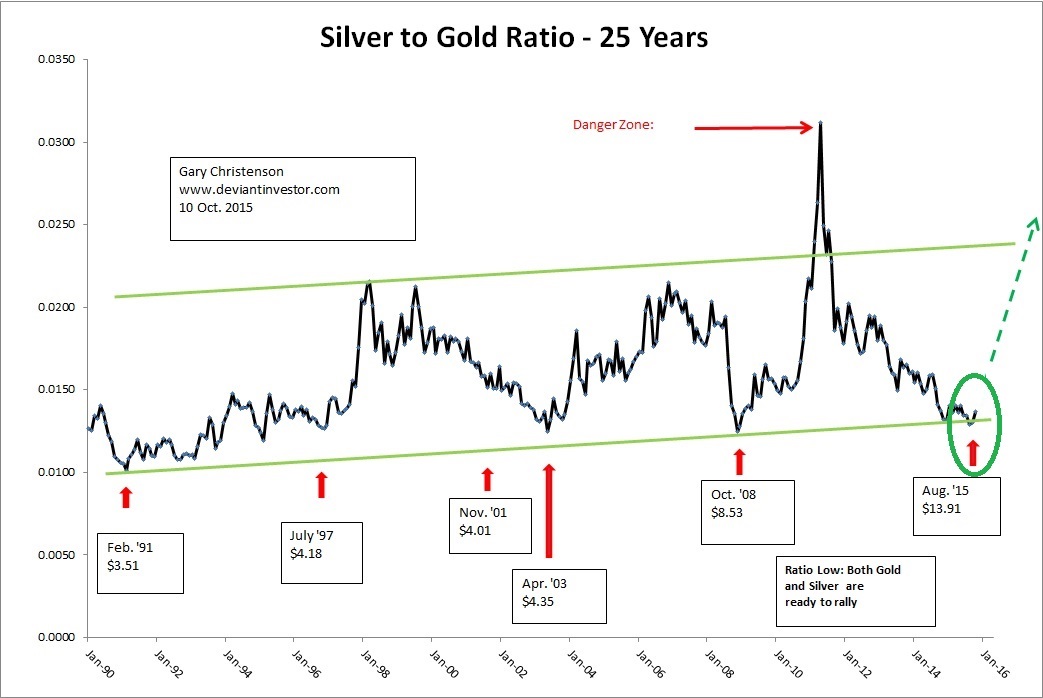
Silver looks like it has bottomed and will move substantially higher. Why?
Long Term – 25+ years: Examine the silver to gold ratio since 1990. The ratio is currently low and appears to have bottomed. Silver bottoms when the ratio bottoms. Expect a multi-year rally.
Medium Term – 15+ years.

Eventually the market is just going to say to these central bankers, ‘enough is enough – we don’t want your garbage paper anymore.’
Then we’re going to have the real crisis.
…
In 2015 in the United States, twice as many stocks were down as were up… They were disguised by the fact that a few big companies went up all the time – you know the names, Amazon, Microsoft – those stocks went up. And they hid the fact that the markets were deteriorating underneath.
This year everything is going down…nearly everything. So, we know that the market knows and the market is telling us it’s getting closer and closer.


-
I know Mike is a very solid investor and respect his opinions very much. So if he says pay attention to this or that - I will.
~ Dale G.
-
I've started managing my own investments so view Michael's site as a one-stop shop from which to get information and perspectives.
~ Dave E.
-
Michael offers easy reading, honest, common sense information that anyone can use in a practical manner.
~ der_al.
-
A sane voice in a scrambled investment world.
~ Ed R.
Inside Edge Pro Contributors

Greg Weldon

Josef Schachter

Tyler Bollhorn

Ryan Irvine

Paul Beattie

Martin Straith

Patrick Ceresna

Mark Leibovit

James Thorne

Victor Adair