
Stocks & Equities
Published on April 4, 2016, 6:39 AM:
Our intraday outlook is neutral, and our short-term outlook is neutral. Our medium-term outlook remains bearish, as the S&P 500 index extends its lower highs, lower lows sequence:
Briefly: In our opinion, no speculative positions are justified.
Intraday outlook (next 24 hours): neutral
Short-term outlook (next 1-2 weeks): neutral
Medium-term outlook (next 1-3 months): bearish
Long-term outlook (next year): neutral
The main U.S. stock market indexes gained 0.6-1.1% on Friday, extending their short-term uptrend, as investors reacted to monthly jobs report release. The S&P 500 index got close to its late December high of 2,081.56. The nearest important level of resistance is at around 2,080. The next resistance level is at 2,100-2,120, marked by previous medium-term highs. On the other hand, support level remains at 2,055-2,060, marked by last week’s Wednesday’s daily gap up of 2,055.91-2,058.27. The next support level remains at 2,000, marked by previous level of resistance. There have been no confirmed negative signals so far. However, we can see technical overbought conditions. The index continues to trade within a slightly descending medium-term trading channel, as the daily chart shows:

Expectations before the opening of today’s trading session are positive, with index futures currently up %. The European stock market indexes have gained % so far. Investors will now wait the Factory orders data release at 10:00 a.m. The S&P 500 futures contract trades within an intraday uptrend, as it reaches new short-term highs. The nearest important level of resistance is at around 2,075-2,080, marked by some previous medium-term local highs. The nearest important level of support is at 2,050, and the next support level is at 2,030, marked by recent local low, as the 15-minute chart shows:

The technology Nasdaq 100 futures contract follows a similar path, as it extends its short-term uptrend. The nearest important level of support is at around 4,500, marked by previous resistance level. On the other hand, potential resistance level is at 4,600. There have been no confirmed negative signals so far. However, we can see short-term overbought conditions:

Concluding, the broad stock market continued its short-term uptrend on Friday, as investors reacted to monthly jobs data announcement, among others. The S&P 500 index is getting closer to its last year’s medium-term highs. Will it break above the crucial long-term resistance level of 2,100-2,150 this time? Or is this just an upward move within a slightly descending medium-term trading channel? We can see some short-term technical overbought conditions. However, there have been no confirmed negative signals. We still prefer to be out of the market, avoiding low risk/reward ratio trades. We will let you know when we think it is safe to get back in the market.
Thank you.

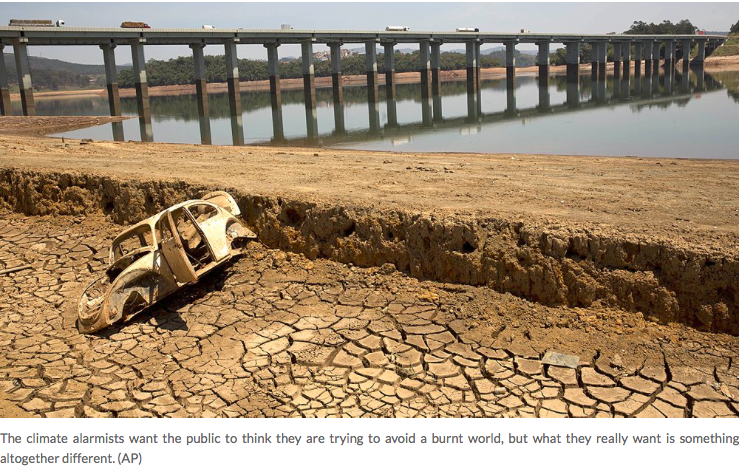
It is such a big issue, and so expensive it pays to ask what is it all about, and what effect on the markets and economy can you expect. Starting off with a quote – Money Talks Editor:
In the words of former United Nations climate official Ottmar Edenhofer:
“One has to free oneself from the illusion that international climate policy is environmental policy. This has almost nothing to do with the environmental policy anymore, with problems such as deforestation or the ozone hole,” said Edenhofer, who co-chaired the U.N.’s Intergovernmental Panel on Climate Change working group on Mitigation of Climate Change from 2008 to 2015.
So what is the goal of environmental policy?
“We redistribute de facto the world’s wealth by climate policy,” said Edenhofer.
Another Climate Alarmist Admits Real Motive Behind Warming Scare
Fraud: While the global warming alarmists have done a good job of spreading fright, they haven’t been so good at hiding their real motivation. Yet another one has slipped up and revealed the catalyst driving the climate scare.
We have been told now for almost three decades that man has to change his ways or his fossil-fuel emissions will scorch Earth with catastrophic warming. Scientists, politicians and activists have maintained the narrative that their concern is only about caring for our planet and its inhabitants. But this is simply not true. The narrative is a ruse. They are after something entirely different.
If they were honest, the climate alarmists would admit that they are not working feverishly to hold down global temperatures — they would acknowledge that they are instead consumed with the goal of holding down capitalism and establishing a global welfare state.
Have doubts? Then listen to the words of former United Nations climate official Ottmar Edenhofer:
“One has to free oneself from the illusion that international climate policy is environmental policy. This has almost nothing to do with the environmental policy anymore, with problems such as deforestation or the ozone hole,” said Edenhofer, who co-chaired the U.N.’s Intergovernmental Panel on Climate Change working group on Mitigation of Climate Change from 2008 to 2015.
So what is the goal of environmental policy?
“We redistribute de facto the world’s wealth by climate policy,” said Edenhofer.
For those who want to believe that maybe Edenhofer just misspoke and doesn’t really mean that, consider that a little more than five years ago he also said that “the next world climate summit in Cancun is actually an economy summit during which the distribution of the world’s resources will be negotiated.”
Mad as they are, Edenhofer’s comments are nevertheless consistent with other alarmists who have spilled the movement’s dirty secret. Last year, Christiana Figueres, executive secretary of U.N.’s Framework Convention on Climate Change, made a similar statement.
“This is the first time in the history of mankind that we are setting ourselves the task of intentionally, within a defined period of time, to change the economic development model that has been reigning for at least 150 years, since the Industrial Revolution,” she said in anticipation of last year’s Paris climate summit.
“This is probably the most difficult task we have ever given ourselves, which is to intentionally transform the economic development model for the first time in human history.”
The plan is to allow Third World countries to emit as much carbon dioxide as they wish — because, as Edenhofer said, “in order to get rich one has to burn coal, oil or gas” — while at the same time restricting emissions in advanced nations. This will, of course, choke economic growth in developed nations, but they deserve that fate as they “have basically expropriated the atmosphere of the world community,” he said. The fanaticism runs so deep that one professor has even suggested that we need to plunge ourselves into a depression to fight global warming.
Perhaps Naomi Klein summed up best what the warming the fuss is all about in her book “This Changes Everything: Capitalism vs. the Climate.”
“What if global warming isn’t only a crisis?” Klein asks in a preview of a documentary inspired by her book. “What if it’s the best chance we’re ever going to get to build a better world?”
In her mind, the world has to “change, or be changed” because an “economic system” — meaning free-market capitalism — has caused environmental “wreckage.”
This is how the global warming alarmist community thinks. It wants to frighten, intimidate and then assume command. It needs a “crisis” to take advantage of, a hobgoblin to menace the people, so that they will beg for protection from the imaginary threat. The alarmists’ “better world” is one in which they rule a global welfare state. They’ve admitted this themselves.

The Good, the Bad, the Ugly and the Silver Bullet Award goes to a researcher on the Economic Effects of Lower Oil Prices – M/T Ed
The calendar continues in something of an alternating mode. Last week had plenty of important data; this week has little. Instead we get multiple speeches from Fed Presidents and Governors and the release of the last FOMC minutes. Little data plus lots of Fed news is a natural draw for the punditry. This week they will be asking:
Is the Fed too optimistic?
Prior Theme Recap
In my last WTWA I predicted a week chock-full of data with a focus on the market reaction. Would good news finally be treated as good? That was a popular topic throughout the week, from Chair Yellen’s speech to Friday’s employment report. Before the opening on Friday, pundits were observing that the solid data was sending stocks lower. By day’s end the market had reversed course, despite weakness in oil prices. The answer to last week’s question is a very tentative “yes.” Doug Short has the full story with an emphasis on April Fool’s Day in his excellent weekly chart. (With the ever-increasing effects from foreign markets, you should also add Doug’s World Markets Weekend Update to your reading list).

Doug’s update also provides multi-year context. See his full post for more excellent charts and analysis.
We would all like to know the direction of the market in advance. Good luck with that! Second best is planning what to look for and how to react. That is the purpose of considering possible themes for the week ahead. You can make your own predictions in the comments.
This Week’s Theme


 1. Time to Sell the Family Home?
Last year, more than one-third of the houses sold in Vancouver went to Chinese buyers.
All over Canada, the story was similar… though not as extreme. Houses are being sold to people who may or may not intend to live in them.
2. A Collapse In Government Is Incoming, Markets Are Going To Start Responding!
Martin Armstrong began his studies into market behavior when first becoming fascinated by the events during the Crash of 1966. He pursued his studies of economics searching for answers behind the cycle of boom and busts that plagued society both in Princeton and in London.
3. Yellen Drops the “C” Word
Yesterday, we’ve discovered yet again that the stock market is a casino where the house always wins. Janet Yellen, the chief of the Federal Reserve, has yet again shown us that “price discovery” is meaningless and the advantages are for the well connected.


-
I know Mike is a very solid investor and respect his opinions very much. So if he says pay attention to this or that - I will.
~ Dale G.
-
I've started managing my own investments so view Michael's site as a one-stop shop from which to get information and perspectives.
~ Dave E.
-
Michael offers easy reading, honest, common sense information that anyone can use in a practical manner.
~ der_al.
-
A sane voice in a scrambled investment world.
~ Ed R.
Inside Edge Pro Contributors

Greg Weldon

Josef Schachter

Tyler Bollhorn

Ryan Irvine

Paul Beattie

Martin Straith

Patrick Ceresna

Mark Leibovit

James Thorne

Victor Adair