
Currency
Druckenmiller also agreed that negative rates are “absurd”, said that he is bearish stocks, and concluded by revealing what his biggest currency allocation is. “Some regard it as a metal, we regard it as a currency and it remains our largest currency allocation” he said, without naming the metal.
We know what he was talking about. Gold.

Everyone wants to see my head on a silver platter. Or make it a gold platter. Why? Because they think I’ve completely missed the gold rally and if I don’t tell them to get on board now, they will forever have lost their chance to get in as gold ultimately works its way to over $5,000 an ounce.
Well, sorry everyone. Gold isn’t going to $5,000 an ounce tomorrow. So let’s get things straight about the gold market right now.
First things first. Gold has recently rallied up to its point of maximum resistance at the $1,306 level basis the June futures contract. While it did yield a minor buy signal last Friday, Monday’s almost perfect test of weekly and monthly overhead resistance at $1,306 so far continues to look like a major failure is being set up.

Moreover, it appears that gold and other precious metals are still poised to turn violently down.Here is my latest neural net chart of gold. As you can clearly see, the called-for April 29 high, which came exactly on cue, is indicating the model is still calling the shots.
So as of right now, all we have seen is a test of maximum weekly resistance at the $1,306 – $1,307 level.
Therefore, what we are facing is either:
A) A major collapse heading into late May, or …
B) A soon-to-be revealed “cycle inversion.”
If gold can start trading lower here and generate some intraday sell signals, then it will continue to follow the model into a late May low which could be even lower than I originally expected.
If, on the other hand, gold holds in this region and then closes above the $1,307 level, we will most likely see gold continue higher into late June or even mid-July reaching as high as the $1,450 level.
If you are a long-term bull on gold, you do not want to see that happen. The most bullish pattern for gold to form now is to pull back on time into a late May low and then begin its next rally.
If gold instead inverts and produces a June/July high between $1,400 and $1,450, then the second half of the year for gold will be absolutely devastating. Ditto for mining shares.
Let’s pause for a moment and think about what is really driving gold. It’s not inflation. There is none to be seen virtually anywhere on the globe. It is not outrageous demand from central banks as so many seem to be touting now as all my sources indicate that central bank purchases of gold are muted at this time.
In my opinion, what is driving this rally from a fundamental point of view is what I have been telling you all along, the main force that will be responsible for gold’s new long-term bull market.
That force is the rising tide of the cycles of war and geopolitical instability and discontent rising all over the world. Europe we know is a basket case — its economy is in the gutter. Its leadership is totally lacking.
In the Middle East, the region is in its worst shape ever, both economically speaking and ethnically speaking. Saudi Arabia is in financial straits. ISIS has rolled over the entire Middle East. Sunnis and Shiites are at each other’s throats. ISIS is expanding into Europe and Western Africa.
Further north, Russia is clearly claiming the Baltic region with its latest maneuvering of the MIG barrel rolls within 25 feet of U.S. aircraft.
And then there’s China clearly taking control of the South China Sea, standing squarely against not just Vietnam, Cambodia, Malaysia, Brunei, and the Philippines but also the United States of America.
Right here at home in the U.S., we have perhaps the most divisive nasty political primary process seen in the history of this country.
This is, as I warned a long time ago, the single major force that is going to drive gold’s new bull market, ultimately taking it to over $5,000 an ounce by 2020. I have no doubt about it.
But that does not mean that gold and other precious metals are going to go straight up. And if you think that way, I guarantee you that you will lose your shirt. Buying the wrong rallies, and selling into the lows.
You must remain focused and disciplined. That means sticking with the neural net models and the two alternative forecasts that are available at this time. The top alternative is that gold and the other precious metals remain on track for a sharp decline into the end of May.
The second alternative — lower probability — is a cycle inversion as noted previously that could take gold up into the mid-$1,400 level before a much more prolonged and probably steeper correction begins.
Stay tuned and best wishes,
Larry
Also from Larry: What’s Up With Gold and Mining Shares?
P.S. How Rich Will You Be? As the Dow doubles, some stocks will see explosive gains of 300%, 400%, 500% and more. Savvy investors who make the right moves will become very rich! Click here for my free report and to find out how it could make you rich beyond your dreams.

Larry Edelson, one of the world’s foremost experts on gold and precious metals, is the editor of Real Wealth Report and Supercycle Trader.
Larry has called the ups and downs in the gold market time and again. As a result, he is often called upon by the media for his investing views. Larry has been featured on Bloomberg, Reuters and CNBC as well as The New York Times and New York Sun.

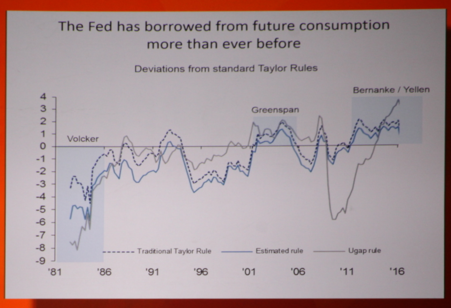
Federal Reserve officials hinted at a rate hike as soon as next month, but that prospect did little to support the U.S. dollar or hinder precious metals. Gold and silver prices have surged to new highs for the year while the dollar made a new low.
Perhaps markets have already priced in another modest rate hike. Or maybe the markets simply aren’t taking the hint! Fed officials’ constant posturing and innuendo have long been contradictory and unreliable – and the Fed’s economic forecasts have usually been wrong.

One thing is for certain – the metals are getting lots of renewed speculative interest and support from some good looking technical charts. Silver gained more than 16% in April, outperforming gold’s rise of close to 5% – all of which came in the final week of the month.
And both metals closed above key overhead resistance on Friday and are looking strong so far this week. Open interest in silver futures made a new record in last week’s Commitment of Traders (CoT) report. Gold open interest isn’t far behind with more than 500,000 open contracts.
Some speculate the bullion banks, who are increasingly short, would like to orchestrate a price correction. Thus far, however, large sell orders have been sopped up by an overwhelming number of buyers. Anyone selling heavily short into this impressive rally certainly has to be nervous. It’ll be worth watching the CoT report this week to see if there is evidence of the shorts beginning to cover.
Gold/Silver Ratio Confirming Upturn in Metals Markets
Silver started a bit slow out of the gate in 2016, but it hit its stride in April. The white metal is now up 29% (or $4/oz) since January 1, eclipsing gold’s 22% gain.
Silver outpacing gold is good news for metals bulls, and not just for the obvious reasons. The move is an important signal that we can expect sustained higher prices for both metals.
The gold/silver ratio is calculated simply by dividing the gold price by the silver price to see how many ounces of silver it takes to buy one ounce of gold. This ratio has been a good indicator of market turning points. Why? Because silver historically leads the way, either up or down. Some investors questioned the recent rally in metals prices until silver confirmed the move higher by heading to the forefront.

After peaking at 83 in February, the gold/silver ratio has fallen sharply. The good news for metals investors is that the move may be just getting started. The ratio currently sits at just over 72, still in extreme territory.
Furthermore, the last time we saw the ratio as high as we saw it just two months ago was at the end of 2008. That marked the beginning of a spectacular run for the metals, especially silver. Silver went from under $10 an ounce all the way to $48 in less than 30 months, and the gold/silver ratio fell from the low 80s down to 32 by the spring of 2011.

So if history repeats, the ratio could be headed back below 40. In fact, a powerful bull move could drive the ratio well below 40. If markets revert to the long-term average set over the course of centuries, as many expect, we could easily see fewer than 20 ounces of silver needed to buy an ounce of gold.
related: “Precious Metals: Profit Booking Delight”
About the Author:
Clint Siegner is a Director at Money Metals Exchange, the national precious metals company named 2015 “Dealer of the Year” in the United States by an independent global ratings group. A graduate of Linfield College in Oregon, Siegner puts his experience in business management along with his passion for personal liberty, limited government, and honest money into the development of Money Metals’ brand and reach. This includes writing extensively on the bullion markets and their intersection with policy and world affairs.

 The stock price of Tesla Motors (TSLA) has soared along with the recent announcement that pre-orders (i.e. a fully-refundable $1k deposit) for its Model 3 are approaching 400,000 units. The Model 3 is purported to sell eventually for an estimated $35,000; and is Silicon Valley’s inexpensive electric vehicle (EV) offering that appears to be affordable for everyone; except Tesla that is.
After all, Tesla loses more than $4,000 on each of its high-end Model S electric sedans; and that model’s cost is between $70 and $108k. With margins like that one has to assume a $35k Model 3 can’t be the answer to solving Tesla’s red ink.
Tesla’s income statement reveals the company is hemorrhaging cash at a robust clip. Furthermore, according to “The Street Ratings”, their net profit margin of -26.38% is significantly below that of the industry average. The company has a quick ratio of 0.49, which means they have .49 cents in available cash to pay every $1 of current liabilities.
Worse than its lousy earnings and cash flow, Tesla is grossly overvalued compared to its peers. Tesla’s market cap is $33 billion, compared to Fiat Chrysler (FCAU) at just $10 billion and Ferrari at $8 billion. Being valued at 3x more than FCAU–an established and profitable company–looks especially absurd when considering FCAU produces annual sales of over $120 billion while TSLA produces revenue of only $4 billion.
Furthermore, Tesla’s market cap is 66% of General Motors market cap. This is despite the fact that General Motors has a history of selling ten million cars at a profit each year and Tesla sold less than one hundred thousand cars last year at a loss. They would have to sell 6.6 million cars this year to justify its current valuation. With less than 400,000 cars on pre-order that doesn’t appear likely anytime soon. And those orders for the Model 3 are fading fast. During the first week of reservations Mr. Musk indicated there were 325k pre-orders. In week two the company claimed it received pre-orders that were “approaching” 400k. And in week number three, Tesla reported the total number of orders were “almost” 400k. At that rate it will be hard to imagine it could reach that 6.6 million vehicles sold benchmark.
But perhaps Tesla isn’t about current profitability or cash flow; Tesla is all about the man and the company’s future… after all, Elan Musk landed a rocket on a barge.
But those who actually know the auto industry are not so sure. In a February interview with CNBC’s Squawk Box, Former GM executive Bob Lutz notes that “[TSLA] costs have always been higher than their revenue…They always have to get more capital. Then they burn through it.”
First, he notes that on the back of falling oil prices demand for electric vehicles (EVs) is slowing. Second, there is growing competition that will cut into Tesla’s margins as prices for EVs fall. Tesla has a lot of competition over the next few years. The industry is already awaiting the Apple car with baited breath that is set to launch in four years. And GM’s Chevy Bolt is similarly priced with a similar range and is set to come out this year. And then we have the Nissan Leaf expected to more competitive in the coming months and years. And add to that first generation vehicles like the BMW i3.
And in China, they have the EV Company LeEco, which recently unveiled its very first electric car that includes self-driving and self-parking capability using voice commands via a mobile app. Besides LeEco, there is another Chinese EV automaker that sold more electric cars last year than Tesla, Nissan or GM, it’s called BYD Co. and is now targeting the U.S. market.
Lutz believes that competition from industry heavyweights like these could “kill” Tesla in the future. “The major OEMs like GM, Ford, Toyota, Volkswagen, etc…they have to build electric cars, a certain number, in order to satisfy the requirements in about half of the states. Those have to be jammed into the marketplace, otherwise they can no longer sell SUVs and full-size pickups and the stuff that they really make money on. So that is going to generically depress the prices of electric vehicles,” Lutz warns.
Lutz also explains that companies such as General Motors will not be making any money on their “Tesla killer”. They are making these vehicles to appease Washington. Luz notes, “The majors are going to accept the losses on the electric vehicles as a necessary cost of doing business in order to sell the big gasoline stuff that people really want. Well, Tesla does not have that option,”
But Musk has a strategy for driving down the cost of his electric car that hinges on achieving economies of scale, bringing down the production cost of the battery pack by 30%. This hinges on the success of their future Nevada home called the “Gigafactory”.
The Gigafactory is a one-stop shopping in battery pack production. The company currently buys battery packs through a deal with Panasonic and has partnered with Panasonic in this venture. Production volume at the Gigafactory is anticipated be the equivalent of 30 gigawatt-hours per year; this would mean the Gigafactory would produce more storage than all the lithium battery factories in the world combined. The $5 billion dollar plant is as big as the Pentagon Tesla, and Tesla is hoping to produce 500,000 lithium ion batteries annually.
Musk recently laid out his Energy-branded battery ambition in rock star glory. At the event spectacle, Musk declared that his batteries would someday render the world’s energy grid obsolete. “We are talking about trying to change the fundamental energy infrastructure of the world,” he said.
Musk envisions his affordable, clean energy will one day power the remote villages of underdeveloped countries as well as allowing the average homeowner in industrial nations to go off the grid.
But before you sever your ties with your electrical company, it’s worth noting that not everyone thinks Musk’s plans are achievable – at least not in the time frame he envisions.
Panasonic, the supplier of the lithium-ion cells that form the foundation of Tesla’s batteries, and partner on the company’s forthcoming battery factory – calls Musk’s claims a lot of hyperbole.
Phil Hermann, chief energy engineer at Panasonic Eco Solutions, notes: “We are at the very beginning in energy storage in general.” “Most of the projects currently going on are either demo projects or learning experiences for the utilities. There is very little direct commercial stuff going on.” “Elon Musk is out there saying you can do things now that the rest of us are hearing and going, ‘really?’ We wish we could, but it’s not really possible yet.”
And far from the grand stage with little fanfare buried in their November 10Q Tesla also sought to tamper investor’s expectations: “Given the size and complexity of this undertaking, the cost of building and operating the Gigafactory could exceed our current expectations, we may have difficulty signing up additional partners, and the Gigafactory may take longer to bring online than we anticipate.”
With a company saddled with debt and cash-strapped, who is going to shoulder the burden of a delay in the Gigafactory realizing its full potential? That would be shareholders through stock dilution or the American tax payer – but most likely a combination of both. There are those who believe that Musk’s real genius is in following government subsidies.
According to the Los Angeles Times, all of Musk’s ventures: Tesla Motors Inc., SolarCity Corp. and Space Exploration Technologies Corp., known as SpaceX, together have benefited from an estimated $4.9 billion in government support. The figure underscores a common theme running through his emerging empire: a public-private financing model underpinning long-shot start-ups.
Tesla’s model relies strongly on a “green” administration. In a recent filing they note:” We currently benefit from certain government and economic incentives supporting the development and adoption of electric vehicles. In the United States and abroad, such incentives include, among other things, tax credits or rebates that encourage the purchase of electric vehicles. Nevertheless, even the limited benefits from such programs could be reduced, eliminated or exhausted…” In certain circumstances, there is pressure from the oil and gas lobby or related special interests to bring about such developments, which could have some negative impact on demand for our vehicles.”
The promise is that the Tesla stockholders and the tax subsidizing public will greatly benefit from major pollution reductions as electric cars break through as viable alternative and gain access to mass-market production.
But are electric cars really good for the environment?
First, it’s important to note that at this time, these cars don’t power themselves – they are plugged into an outlet in your garage that connects to an electric power plant, and there is a good chance that you may be one of the 33% of Americans whose power plant is burning the dirtiest fossil fuel of all…coal. So in effect, you may as well be filling up your gas tank with coal, and coal-burning power plants emit not only CO2 but also other venomous gases such as nitrogen oxides and sulfur dioxide in greater quantities than traditional gas-powered cars.
Furthermore, there are a lot of environmental questions about the lithium battery itself. In a 2012 study titled “Science for Environment Policy” published by the European Union, a comparison was made of the lithium ion batteries to other types of batteries available such as; lead-acid, nickel-cadmium, nickel-metal-hydride and sodium Sulphur. They concluded that the lithium ion batteries have the largest impact on metal depletion, making recycling more complicated. Lithium ion batteries are also the most energy consuming technologies requiring an equivalent of 1.6kg of oil per kg of battery produced. Furthermore, they ranked the worst in greenhouse gas emissions with up to 12.5kg of CO2 equivalent emitted per kg of battery.
Next, you need to understand how lithium is mined. Lithium, in its purest form, must be mined through hard rock or salar brines. According to Friends of the Earth, an environmental group, salar brines, the most economical way of obtaining lithium, destroys the environment. They state: “The extraction of lithium has significant environmental and social impacts, especially due to water pollution and depletion. In addition, toxic chemicals are needed to process lithium. The release of such chemicals through leaching, spills or air emissions can harm communities, ecosystems and food production. Moreover, lithium extraction inevitably harms the soil and also causes air contamination.”
Simply stated, batteries such as Panasonic’s automotive grade li-ion batteries that are developed jointly by Panasonic and Tesla and are in the Model S have a substantially negative effect on health and the environment.
The plain truth is owning a Tesla is not as green as Elon Musk would like you to believe. And for environmentalists to put all of their faith on Evs to cut down on greenhouse gases could end up diverting attention from greener alternatives to power autos. And although Musk is a genius and a visionary; it is also true that Tesla has an unproven business model and a stock that is massively overpriced. According to industry experts, Musk will find it improbable ever to turn a profit with its mass-produced Model 3. Even if some year in the distant future there exists the charging infrastructure and pricing available to make Electric Vehicles conducive to supplant the internal combustion engine, Tesla faces an onslaught of competition that will most likely drive its profit margins further into the red for years to come. Avoiding TSLA stock at the current mindless valuation could not only benefit the environment…but also end up saving your retirement as well.
also: Be sure to listen to Mark Leibovit on Fabulous Opportunities & “Unprecedented in Potential Demand”

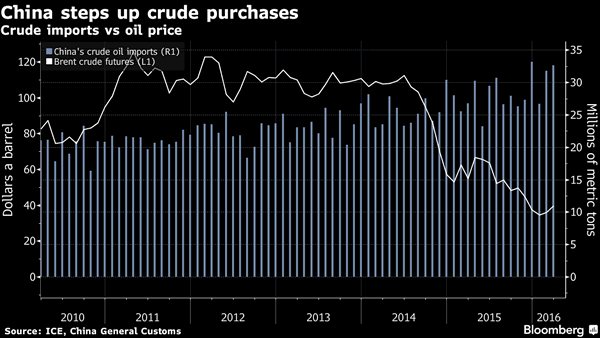
Ship tracking data from Bloomberg shows that 83 supertankers carrying around 166 million barrels of oil are headed to China, which has stockpiled an impressive 787,000 barrels a day in the first quarter of 2016 — the highest stockpiling rate since 2014.
While the world was speculating about oil prices plunging to $20 and $10 per barrel, China was busy stockpiling its reserves.
The chart below shows an increase in imports as crude prices collapsed. Since the beginning of this year, China has imported a record quantity of oil.
Back in January 2015, Reuters had reported that China planned to increase its strategic petroleum reserves (SPR) from 30 days to 90 days. In January 2016, it was revealed that China was building underground storage to complement its above-ground storage tanks.
The Chinese urgency points to two things. China believes that crude oil prices will not remain at the current levels for long, and that a disruption is possible due to geopolitical reasons, which can propel oil prices higher.
As a net importer of crude, it is protecting itself against a black swan event and using the current low prices to fill its tanks. The filled up tanks will ensure a steady supply of crude for at least three months in case of a disruption.
Does the record buying spree by the Chinese indicate a bottom in crude oil prices?
That is difficult to conclude, but it does put a floor beneath the current lows, because in all likelihood, China will resume its record buying and top up its SPR if prices tank.
The total Chinese imports in March via the very large crude carriers was 7.7 million barrels a day. Other than the supertankers, China also imports oil through pipelines and small tankers.
The Chinese demand doesn’t show a huge uptick corresponding to the rise in imports. JP Morganestimates that in March, the total demand for oil in China was 10.3 million b/d, down 2.5 percent over the previous year and down 2.3 percent month on month, whereas the chart shows that imports are higher compared to the same period last year.
Crude oil prices have been on an upswing this month. The import data coming out of China for April will give a clue as to whether the Chinese demand remains intact at higher crude prices or the imports drop when prices rise.
If the demand drops following a rise in prices, we can assume that China doesn’t believe that the price rally will be sustained. At lower levels, Chinese buying might become a factor in deciding the bottom, as their increased imports will reduce the glut.
Similar to Saudi Arabia, which is a swing producer, China is acting like a swing consumer. However, as China doesn’t report its storage data, it is difficult to estimate how long this trend will continue.
Though other factors were involved in encouraging the bulls to buy at lower levels, the increased demand from China also helped in lapping up the excess production. If their imports drop, the world will return to the supply glut and oil prices will retrace back to the lower $30 s/b.

-
I know Mike is a very solid investor and respect his opinions very much. So if he says pay attention to this or that - I will.
~ Dale G.
-
I've started managing my own investments so view Michael's site as a one-stop shop from which to get information and perspectives.
~ Dave E.
-
Michael offers easy reading, honest, common sense information that anyone can use in a practical manner.
~ der_al.
-
A sane voice in a scrambled investment world.
~ Ed R.
Inside Edge Pro Contributors

Greg Weldon

Josef Schachter

Tyler Bollhorn

Ryan Irvine

Paul Beattie

Martin Straith

Patrick Ceresna

Mark Leibovit

James Thorne

Victor Adair