
Market Opinion
Risk taking back on the table to start the week: most equity markets around the globe in the green column (MSCI World index up about 1.0% so far today); the U.S. dollar slumping again (DXY index barely above 75); commodity prices firming (copper and oil both up over 2.0% in overnight trade) with gold hitting yet another fresh record high (touching $1,167.88/oz); resource-based high- beta currencies back on the rise (first time in six days, led by a 1.5% spurt in the South African Rand……read more HERE
I spent the past few days at the Trader’s Expo in Las Vegas. This is an exhibition for traders, showcasing new trading technologies, brokerages, education and other trading related products. I attend every year to stay in touch with the trading community and changes that are occurring in it.
Stockscores.com Perspectives for the week beginning Nov 22nd, 2009

I spent the past few days at the Trader’s Expo in Las Vegas. This is an exhibition for traders, showcasing new trading technologies, brokerages, education and other trading related products. I attend every year to stay in touch with the trading community and changes that are occurring in it.
This year, I found that the show seemed busier than it has in the past. There were more speakers and more attendees, perhaps indicating that more and more people are joining the ranks of traders.
I sat in on a few presentations and was mostly impressed with the quality of the questions that came from audience members. There are a lot of individual traders who take their business very seriously and know what they are doing. Despite my cynicism about late night infomercials targeted at aspiring traders, there are many regular folks making trading their career and who are able to make it happen.
Attending shows like this will make any attendee realize that there are a lot of different ways to trade. Each speaker that I listened to had their own unique method for taking money out of the market. As a result, there are a lot of contradictions between what different speakers say. It would be easy for someone starting out in trading to walk away from the Traders’ Expo more confused than before.
- Get the StockSchool Pro Free

- DisnatDirect named the number one Canadian brokerage for Traders by Surviscor! Open and Fund a brokerage account with DisnatDirect and receive the StockSchool Pro home study course free, including special Pro level access through the DisnatDirect client website. Offer only available to Canadian residents. For information, click here
However, I think that there are common principles that the best experts all share. While the rules they use to trade will differ wildly, it is these core principles that provide a common ground for the aspiring trader to build on.
1. Trade a Proven Strategy
While trading is an art, the foundation of all trading methods is a set of rules that can be tested and applied methodically. There are some successful traders who will say that they don’t have hard rules but I expect that they each have repetitive procedures that they apply over and over. You can not succeed at trading if you are doing a set of rules that does not provide a positive expected value over time.
2. Manage Your Capital
All good trading systems have a method for controlling risk; anyone who fails to limit the downside will probably not last very long. Great stock pickers will only be profitable traders if they limit their losses when they are wrong and maximize their profits when they are right.
3. Avoid Emotion
This is probably the most preached criteria for trading successfully but it is also the most difficult to do. The markets can take normally even keeled people and have them blubbering like a baby. Trading without emotion requires confidence in your rules, without confidence you won’t have the fortitude to ride out the hard times and follow your strategy.
4. Keep it Simple
As someone who trades and teaches, I have an easy time spotting the “experts” who probably have not made a whole lot of real money in the market. They typically have presentations that are difficult to follow and often contradict themselves. Trading systems that are so complicated that they can not be easily explained in a 15 minute presentation will probably not work. Their creator is probably a back tester and not a trader.
5. Nothing Works All the Time
The markets are much too complex and massive to allow for a set of rules that always yields a profit. Uncertainty is what all traders must deal with; those who are best at dealing with ambiguity will have a good chance of succeeding as a trader. Many rookie traders are looking for certainty and there are a lot of companies trying to sell systems that claim very high rates of success. Be suspicious of these and take seriously those who recognize that losing is a part of making.
I think it is also important for people to realize that they need to really like trading if they expect to be good at it. It is the passion for trading that will make you work hard at it.
“The harder I work, the luckier I get.”

When deciding what strategy to apply each week, I first look at the market indexes. From these charts I can determine what is the most likely direction for the market to take in the near term. That will determine my strategy.
For the past couple of weeks, I have been looking for short selling set ups because the market was coming in to resistance and had run away from its upward trend line. Toward the end of last week, the market rolled over and started to head lower.
For the week ahead, I think the market probably continues lower as prices are still well above the upward trend line of support. However, we are not talking about a move downward that is significant enough for the long term short seller. Once prices are down to the upward trend line, there should be a bounce and a resumption of the long term upward trend.
So, traders should look to short strength this week, playing off of the intraday charts to pick your entry points. Longer term traders should wait for the pull back to be done and buy the bounce off of the upward trend line.
For this week, I show a chart of the SPY to help everyone visualize the cycles of pull backs to the upward trendline. You can see that this cycle has repeated a number of times over the past four months. That cycle could end anytime, but it has been pretty reliable.

1. SPY
V.MMC is not trading with great liquidity but it has made a noticeable increase in trading volume over the past two months. That tells me that something is happening with the stock to get people’s attention. I don’t really care what that something is, but it is a good sign.
The chart shows rising bottoms indicating investors are optimistic in the stock and the buyers are in control. Over the past few weeks price has been trading sideways indicating the stock is stable and has a good base. The sellers have not found much motivation to act yet.
What I would like to see is for this stock to break out of this trading range with a jump in volume. That would be a good entry signal for those comfortable with these kinds of stocks. Right now, support is at $0.16.
Click HERE for the Speaker Lineup and to Purchase the video if you want to learn from some of the worlds best traders including Tyler Bollhorn.

Tyler Bollhorn started trading the stock market with $3,000 in capital, some borrowed from his credit card, when he was just 19 years old. As he worked through the Business program at the University of Calgary, he constantly followed the market and traded stocks. Upon graduation, he could not shake his addiction to the market, and so he continued to trade and study the market by day, while working as a DJ at night. From his 600 square foot basement suite that he shared with his brother, Mr. Bollhorn pursued his dream of making his living buying and selling stocks.
Slowly, he began to learn how the market works, and more importantly, how to consistently make money from it. He realized that the stock market is not fair, and that a small group of people make most of the money while the general public suffers. Eventually, he found some of the key ingredients to success, and turned $30,000 in to half a million dollars in only 3 months. His career as a stock trader had finally flourished.
Much of Mr Bollhorn’s work was pioneering, so he had to create his own tools to identify opportunities. With a vision of making the research process simpler and more effective, he created the Stockscores Approach to trading, and partnered with Stockgroup in the creation of the Stockscores.com web site. He found that he enjoyed teaching others how the market works almost as much as trading it, and he has since taught hundreds of traders how to apply the Stockscores Approach to the market.
References
Get the Stockscore on any of over 20,000 North American stocks.
Background on the theories used by Stockscores.
Strategies that can help you find new opportunities.
Scan the market using extensive filter criteria.
Build a portfolio of stocks and view a slide show of their charts.
See which sectors are leading the market, and their components.
Disclaimer
This is not an investment advisory, and should not be used to make investment decisions. Information in Stockscores Perspectives is often opinionated and should be considered for information purposes only. No stock exchange anywhere has approved or disapproved of the information contained herein. There is no express or implied solicitation to buy or sell securities. The writers and editors of Perspectives may have positions in the stocks discussed above and may trade in the stocks mentioned. Don’t consider buying or selling any stock without conducting your own due diligence.
We believe there is room for more gold price gain, near term. A “true” gold market in which the yellow metal is being treated as an asset class in its own right is building around the uncertainties in other markets. That is different from recent warehousing cycles when gold moved most strongly during the final up stage of a resource/economic cycle. This time around gold is being treated as a market and currency hedge, not as a goody bag being handed out at the end of a party. The most interesting note on that score of late is news from India that October saw a large uptick for buying gold in forms such as bars that are used to invest. This is rather than as jewellery (which often has a low manufacturing premium in India by western standards at any rate) that is bought this time of year for the festival season. India’s gold and silver traders are amongst the world’s best and it is prudent to note when they stop buying or selling as sign of a top or bottom. However, India’s is also the world’s biggest physical market for precious metals, so they do come back in to buy if they appear to have misjudged a top. The early year buyer’s strike in India was quite real as its jewellery market was damaged like others by the credit crunch. In fact Indians were big sellers early year as should be expected of a hedge during a crisis, so there was no misjudgement. We nonetheless view a large uptick of buying from India at historic high prices (in both $ and Rupee terms) as positive, with the caveat that we need to watch for a reversal of that trade.
While there is a real enough scent of change in the air, this doesn’t have to be viewed as a large shift from the norm. A subject we rarely deal with is whether gold is a “commodity” or “money”, for the simple reason that doing so sharpens our sense of the market very little. In fact, we have little problem with either concept since we view copper and most other metals as a bit of both too, and focus on which is the better choice to deal with at a given moment. Certainly copper is acting the part of money these days. The inverse relationship between gold and the US$ can never be worked out of the equation, and should be borne in mind both for holders of the metal and for shareholders. The two most important off-site variables for a gold mine, or any mine, are energy costs and the interplay between the Dollar and the mine’s local currency and the company’s accounting currency in which operating costs are borne and recorded.
In a rising price environment almost all producers will see gains, but the better choices will be companies undergoing expansion and those in friendlier cost environments. Asset holding companies with large deposits of low grade should also being doing well in this environment, and it’s wise to consider why they aren’t if they appear to be going nowhere. Asset expansion companies still in exploration phase have been seeing mixed results, with some darlings bounding ahead while others seemed fixed in place. So long as the latter group are relatively undervalued based on current data, they should have their day again as profit-takings take place for the darlings. Now through the year end, and especially into next year, is typically when that takes place. Our top producer pick from the Gold Mining Stock Report list has had a +25% uptick since we noted it as such in last month’s Dispatch. Now that most Q3 reporting is now out, it’s time to update it and some others. It’s also important to keep in mind that a portfolio winnowing process can and often should also get underway in a rising market.
(Famous in the sector, the Gold Mining Stock Report (“GMSR”) was published by Robert Bishop until 2007. When Bob decided to retire from newsletter publishing he honoured us by passing his subscribers on to HRA with the agreement that we would continue to follow his active company list and update his former readers for at least a year. We added GMSR subscribers to the HRA list at the SD Alert level and continue to send them periodic updates on GMSR companies, along with the full compliment of HRA news services. – Editors)
(Famous in the sector, the Gold Mining Stock Report (“GMSR”) was published by Robert Bishop until 2007. When Bob decided to retire from newsletter publishing he honoured us by passing his subscribers on to HRA with the agreement that we would continue to follow his active company list and update his former readers for at least a year. We added GMSR subscribers to the HRA list at the SD Alert level and continue to send them periodic updates on GMSR companies, along with the full compliment of HRA news services. – Editors)
Ω
Gain access to potential gains of hundreds or even thousands of percent! From March to June, HRA introduced four new gold explorers to subscribers. Those four companies have generated an average gain of 205%, to date! SPECIAL HRA OFFER: For a limited time only, HRA is offering free reports when you sign up using your email address! Click here for more information: http://www.hraadvisory.com/sh2009.html
The Daily Reckoning PRESENTS: Jim Chanos is bearish on China…as in “China is Dubai times 1,000, if not a million,” bearish. Jim Rogers is bullish, as in, “China is going to be the most important country of the 21st century,” bullish.
Who will be proven right?
Time will tell, of course…but in the meantime, we’ve got a few essays covering both sides of the argument that you might be interested in. In today’s column, Co-manager of the China Region Fund, Romeo Dator, argues the Rogers case. His thoughts below…
Five Reasons China Is Not a Bubble
By Romeo Dator, Co-manager, China Region Fund (USCOX)
San Antonio, Texas
A year ago, nobody thought China could manage 8 percent GDP growth in 2009. With year-to-date growth coming in at 7.7 percent through the first three quarters and getting stronger, China is poised to break that 8 percent mark rather easily.
The success of the Chinese government’s stimulus efforts, evidenced by the lofty economic numbers China has managed to produce amidst a global crisis, has led many to claim China is the next great bubble.
We see five reasons China is not a bubble and believe that its prospects remain strong the next decade or two.
1) Consumption Continues to be Strong
China is transitioning to a consumption-based workforce. Retail sales rose 16.2 percent in nominal terms during October and have been accelerating. The retail sales figure isn’t a perfect proxy, but it is the best available indicator of overall consumption because it includes sales to consumers and not just purchases made by the government.
We also saw strong growth in industrial production (IP) and power generation – both were up more than 16 percent on a year-over-year basis in October. Housing starts were up more than 50 percent (yoy) for the second straight month.
2) Structural Changes to Domestic Economy
We’re seeing a transition to a service-related economy. The service industry is the fastest-growing sector (roughly 20 percent faster than construction) and now accounts for one-third of China’s workforce.
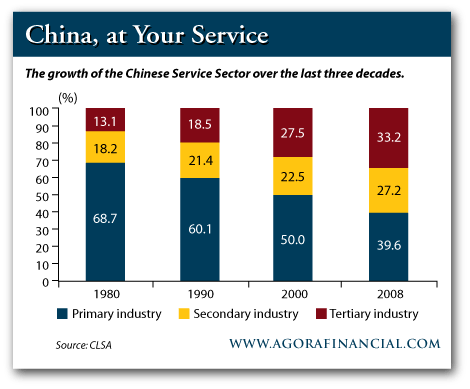
In general, the size of the service sector is directly correlated to the amount of goods and services an economy consumes. This is why the government has spent such a large amount of the stimulus on areas that benefit the domestic market – that’s where it thinks the economy is headed.
3) Stimulus Exit Strategy in Place
China’s stimulus exit strategy is simple – create a strong economic base that the private sector can launch from. After private investment surpassed that of state-owned enterprises in September, the two flip- flopped during October.
Given the environment, month-to-month fluctuations like this are to be expected since private investment is dependent on how willing Chinese citizens are to put their own money at risk. Even though Beijing is determined to wean China’s economy off of government stimulus, the government will not hesitate to ramp up activity should the private investors become risk-averse.
4) Government Controls on Flow of Money
After lending more money over the first five months of 2009 than all of 2008, we’ve seen loan numbers come down. There’s a longstanding pattern of new loans slowing down during the second part of the year, as banks have historically rushed to meet government-mandated loan quotas.
The magnitude this year’s slowdown – trillions of yuan – is evidence of Beijing’s dedication to prevent a bubble from forming. Once the figures grew too large, the government moved quickly to hit the brakes.
While US regulators have many holes to plug in order to keep the economy afloat, the limited number of investment options available to Chinese citizens – basically stocks, bank savings and property – makes it easier for the government to institute controls.
This is what happened in 2007 when the government forced a slowdown in the housing market before it overheated. After its economy grew 12.6 percent in the second quarter of 2007, China took more aggressive actions to cool its economic growth. The government raised lending rates and also raised reserve requirements to shrink the pool of money available for lending.
5) China’s Long-Term Goals Match Up With Short-Term Goals
In the US, the Federal Reserve and policymakers are faced with conflicting goals. They need people to spend in order to get the economy rolling again, but their end game is to have the American people spend less and save more.
It’s the opposite for China.
The problem in China is excess savings and not enough spending. The short-term and long-term challenges are the same – to get people to spend more.
Recent signals that China will begin letting the yuan appreciate against the US dollar are not new. For several years, Beijing has stated a gradual appreciation of the yuan will benefit the economy, and CLSA expects Beijing to resume a 5 to 7 percent annualized appreciation process about midway through 2010.
Rapid economic growth may be common in emerging economies, but there’s only one China. Already the world’s third-largest economy on a nominal GDP basis and second-largest based on purchasing power parity, the Chinese aren’t making a break from the back of the pack – they’re leading it.
Domestic consumption, the rise of the service sector and increased private investment won’t make China immune to economic bubbles, but these strengths will provide some protection from external forces.
Regards,
Romeo Dator,
for The Daily Reckoning
Disclaimer: Please consider carefully a fund’s investment objectives, risks, charges and expenses. For this and other important information, obtain a fund prospectus by visiting www.usfunds.com or by calling 1- 800-US-FUNDS (1-800-873-8637). Read it carefully before investing. Distributed by US Global Brokerage, Inc.
All opinions expressed and data provided are subject to change without notice. Some of these opinions may not be appropriate to every investor. Foreign and emerging market investing involves special risks such as currency fluctuation and less public disclosure, as well as economic and political risk. By investing in a specific geographic region, a regional fund’s returns and share price may be more volatile than those of a less concentrated portfolio.
Silence Is Golden…
Good day… And a Wonderful Wednesday to you! We’re stuck in the mud with the rain again, but according to the weather people it should end tomorrow… Geez Louise, I guess it could be snow, which would have crippled this city by now!
Well… The currencies gave back all that ground they gained the day before on Mr. Toad’s Wild Ride, yesterday… But, have turned around this morning in the European session as Eurozone stocks are up, and whenever equities trade with some zip in their step, it has been good for the Big Dog, euro…
Someone asked me yesterday a question about the euro… He said, “Chuck, I know you like the euro, but couldn’t the Aussie dollar be a better choice going forward?” And I answered like this… The euro is the offset currency to the dollar… But that doesn’t mean it is the best performer when the dollar moves down. The Aussie dollar (A$) has outperformed the euro since 2002, and will probably continue outperform the euro… But so has the Norwegian krone, and the New Zealand dollar, and the South African rand, and the Canadian dollar… Hmmm… Does that list ring a bell?
Why, yes, Chuck, it does! For these are all “Commodity Currencies”… You’ve Gotta Love ‘Em!
Countries that have “stuff” to sell to other countries, that either don’t have the “stuff” or are too lazy to deal with it!
Hey! Did you see my bit on Bernanke that I wrote yesterday made the “5-Minute Forecast”? WOW! My friend Ian Mathias, does such a great job on the “5”, and I get a HUGE kick out of him putting stuff I write in his great letter! You should see the two of us standing side by side in Vancouver, where we meet up each year… The old kids song about fat and skinny went to bed, fat rolled over and skinny was dead… HAHAHAHAHAHAHA!
OK… Chuck, quit the back slapping of yourself, and get back to the task at hand!
Yesterday, my fat fingers made an appearance in the Pfennig, as I mis-typed the price of Gold, in the currency round-up… I had just talked about how those people waiting for a pull-back of Gold’s price, might still be waiting when the cows come home… And then I type the price of Gold $100 cheaper than it was selling for! What a fat fingered dolt! Oh well, not many people pointed it out to me, as always letting me know that “Chuck made a mistake”…
Speaking of Gold… Well, you had a 1-day window to buy it cheaper, for the overnight sessions has the shiny metal hitting on all 8, and soaring once again to $1,148!!!!! Don’t you just hate those 1-day windows? I mean, you wanted to pull the trigger and buy, but thought, what if Gold drops more today, that would mean I could buy it cheaper tomorrow… Don’t be fooled! It’s like this folks… If you want to buy something, buy it! Trying to time a purchase will leave you sitting the sidelines with a baseball cap turned backward on your head and holding a clipboard!
I used to tell people that if you’re standing at the bus stop waiting for the bust to take you downtown, and the bus pulls up, but it’s an old bus, and the rumor is going around that a brand spankin’ new bus is on the way, you decide to not get on the old bus, but wait for the new bus… Then the new bus arrives, and there’s a rumor that an even newer, updated bus is on the way, and you decide to wait for that one… If you never get on the freakin’ bus, you’ll never get downtown!
OK… So… Remember when I questioned the current administration’s claims that instead of “creating jobs” they were “saving jobs”? I pointed out that claiming that jobs were saved, would be difficult to prove… Well, guess what? Proving that the jobs saved don’t exist, has been pretty easy… And the people claiming that the stimulus “saved jobs” have egg all over their collective faces…
Speaking of Jobs… One of my fave economists, Nouriel Roubini, had this to say about jobs…
“Think the worst is over? Wrong. Conditions in the U.S. labor markets are awful and worsening. While the official unemployment rate is already 10.2% and another 200,000 jobs were lost in October, when you include discouraged workers and partially employed workers the figure is a whopping 17.5%.
While losing 200,000 jobs per month is better than the 700,000 jobs lost in January, current job losses still average more than the per month rate of 150,000 during the last recession.
Also, remember: The last recession ended in November 2001, but job losses continued for more than a year and half until June of 2003; ditto for the 1990-91 recession.
So we can expect that job losses will continue until the end of 2010 at the earliest. In other words, if you are unemployed and looking for work and just waiting for the economy to turn the corner, you had better hunker down. All the economic numbers suggest this will take a while. The jobs just are not coming back.”
Chuck again… And you think the recession / depression is going to end with the unemployment problem in this country? Not when the consumer is needed to generate nearly 70% of the GDP…
And all that tells me that the cartel / Fed (Fartel!) is going to believe that they need to keep rates near zero for some time to come…
So… It’s Risk On today! It was Risk Off yesterday! Don’t ask me why… Tell me why, you cry, and no wait! Don’t go singing songs, Chuck! This is serious stuff!
Yesterday’s data cupboard was a mixed bag of economic data for the U.S. PPI wasn’t as strong as forecast, Industrial Production slowed in October, but Capacity Utilization bumped higher, and the TIC Flows for September were $40.7 Billion, which was more than the $34.2 Billion in August. The report showed that Japan, China and the U.K. all increased their holdings of Treasuries. September’s TIC Flows were probably the best report of the day, and the best report that this series has printed in a long, long time… Does this mean that the all-clear horn is blaring, telling us not to worry any more about whether we finance our deficit or not? Well… It might be, but I’m not listening to it!
Well… The President ended his visit to China, with a call for a more flexible Chinese currency (renminbi)… And… The Chinese said… Nothing! They met the President’s words with silence… I used to date a girl that would say to me when I wasn’t talking… “Silence is Golden, Chuck” and I would say… “Then shut up and we’ll make a million!” HA!
Now, while it would nice if the Chinese played ball with us… I understand their dilemma… The IMF still believes that China’s currency is about 25-40% undervalued… China could not deal with a floating currency that went up 40% overnight!
Did you know that America’s trade deficit with China widened to a 10-month high in September? Well… It did, thus raising concern that the combination of a recovering U.S. economy and a fixed renminbi exchange rate against the dollar will worsen global imbalances. But… As I’ve said at least 100 times before this… The Chinese will do what they believe is best for their country, and that’s not floating the renminbi at this time, no matter who the U.S. sends to visit them to persuade them to do so!
Moving further south in the Pacific, we land in Australia… I thought about this next Reserve Bank of Australia (RBA) quite a bit the past couple of days… And have come to the conclusion that the Dec 1st meeting of the RBA will net another 25 BPS rate hike… The reason I think this, is the fact that there will be no meeting in January, thus leaving a 2-month gap, which in these economic times could be devastating… So… Look for another rate hike in Australia on December 1st… Which would be their 3rd consecutive meeting rate hike, and could be the harbinger to parity for the A$… Could be… I didn’t say it “would be”!
I know that yesterday morning, I talked about how the RBA meeting minutes had been perceived as “dovish”, and that spooked the markets into thinking that the RBA would NOT hike rates in December… But upon further review, the meeting minutes were really pretty vague, and while they didn’t sound outright hawkish, they also didn’t sound “dovish” either… After reading the minutes, I got the feeling that overall, the minutes support the idea of “steady rate hikes”… I don’t think the RBA will stop until they reach an internal rate of 4.25% early next year…
I was giving an interview last week with a writer from Business Week… And he asked me when this dollar weakness all started… I told him that, “Over the past nine years congress and two administrations have instituted fiscal policies that have undermined the value of the U.S. dollar, and the deficit spending has gone from $350 Billion Budget Deficits to $2 Trillion (annualized) Budget Deficits in a wink of an eye… So… The dollar made brief comebacks in 2005 and in the financial meltdown of August 2008 through Feb 2009, but other than that, the dollar continues to decline, and I just don’t see anything on the horizon that will stop this decline.”
Well… As I look across the desk, where the light only comes from the computer screens, yes, I like it dark here while I’m writing, it keeps me focused! HA! Any way, as I look across the desk at the currency screens, I notice that every currency that supposed to lighting up green (going up) is doing so, and every currency that supposed to be lighting up red (going down, but that’s what you want in a European style currency) is doing so… We’ve got it all going on today… One of these days, we’ll quit this stupid game of street hockey, you know, Risk On, Risk Off… Or the Mr. Myagi, with the wax on, wax off, bit! But until then we have to deal with this stupid game of street hockey, or karate training!
OK… To recap… The currencies have gained back the ground they lost in yesterday’s Risk Off trading sessions. Gold is back to soaring after a 1-day stall… Data yesterday in the U.S. was a mixed bag. Chuck expects the RBA to hike rates in December, and China responds to the U.S. President’s request to allow greater flexibility in the renminbi, with… Silence…
Currencies today 11/18/09: American Style: A$ .9325, kiwi .7490, C$ .9550, euro 1.4960, sterling 1.6810, Swiss .99, European Style: rand 7.4290, krone 5.58, SEK 6.8275, forint 177.50, zloty 2.7370, koruna 17.0130, RUB 28.67, yen 89.10, sing 1.3830, HKD 7.75, INR 46.22, China 6.8270, pesos 12.99, BRL 1.7080, dollar index 74.97, Oil $80.03, 10-year 3.34%, Silver $18.75, and Gold… $1,148.30
That’s it for today… Chris will have the conn on the Pfennig tomorrow morning, as I report to the retina institute at the Center for Advanced Medicine. God willing, I’ll be back on Friday morning! My younger sister, Terri, was just diagnosed with breast cancer. I’m waiting to hear what the game plan is for her… I picked up my son Alex’s electric guitar last night, and played it a little… I’ve played acoustic guitars for so long, that his electric guitar felt very strange.. I played a song, and little Delaney Grace, who had sat still listening to me play, cheered, and then got up and left… Cracked me up! Every day it’s something with her! Time to get this out the door, folks… I hope you have a Wonderful Wednesday!
Chuck Butler
President
EverBank World Markets
1-800-926-4922
1-314-647-3837
www.everbank.com
Daily Pfennig
Two decades ago, Chuck Butler embarked on his extensive career in foreign investments as the Director of Operations for the Fixed Income Division of the Mark Twain Bank. He oversaw the clearing and custody of all bond department trades and Mark Twain portfolio transactions.
In 1992, he became the Chief International Bond Trader and Director of Risk Management for the Mark Twain Bank, and was responsible for trading global bonds and currencies, as well and overall risk management. In that same year, Mr. Butler began composing his now decade-old daily currency market commentary, A Pfennig for Your Thoughts-a play on the American aphorism “a penny for your thoughts”(the pfennig is the Germany equivalent of a penny). The Pfennig started as some handwritten market notes and witty anecdotes circulated every morning to help traders stay on top of the economic, currency, and market happenings. Butler’s “Daily Pfennig,” as it is more commonly called today, has become a popular resource for currency investors and traders alike.
In 1999, Mr. Butler joined the team that launched EverBank as the Senior Vice President of EverBank World Markets. He oversees the trading desk and operations for over 12,000 individual and corporate clients, both in the United States and abroad, who look to EverBank for FDIC-insured World Currency Deposit Accounts, and Single Currency and Index CDs . Chuck is also a frequently quoted and respected analyst of the currency market; in 2003 and 2004, he has appeared on, was featured or quoted in, or referenced by: the Wall Street Journal, US News and World Report, CBS Market Watch, USA Today, CNNfn, the Chicago Tribune and many other publications.
-
I know Mike is a very solid investor and respect his opinions very much. So if he says pay attention to this or that - I will.
~ Dale G.
-
I've started managing my own investments so view Michael's site as a one-stop shop from which to get information and perspectives.
~ Dave E.
-
Michael offers easy reading, honest, common sense information that anyone can use in a practical manner.
~ der_al.
-
A sane voice in a scrambled investment world.
~ Ed R.
Inside Edge Pro Contributors

Greg Weldon

Josef Schachter

Tyler Bollhorn

Ryan Irvine

Paul Beattie

Martin Straith

Patrick Ceresna

Mark Leibovit

James Thorne

Victor Adair