
Market Opinion
The failure of EU leaders to cobble together a plausible bail-out (Greece) – if that is what occurs at this week’s Brussels summit – is a ‘game-changer’ in market parlance. Eurogroup chair Jean-Claude Juncker said last month that such an outcome would shatter the credibility of monetary union. It certainly shatters many assumptions.
From John Mauldin: While the US was focused on the health care drama over the weekend, over across the pond events are rapidly deteriorating in euro land. For this week’s Outside the Box I offer two columns, one from the Financial Times and another from the London Telegraph. Both describe the problems that the eurozone faces. It is not pretty.
I was sent this note from a Steve Stough who translated this from a German TV news show’ It is a nice set-up for the two short columns.
I was reading an interview with Germany’s most-quoted economist and then, all of a sudden, his face pops up on a TV show (a panel discussion on Germany’s version of Fox Business News) at the same time, so I paid close attention. Hans-Werner Sinn’s remarks are apparently listened to as closely as are the Federal Reserve Chairman’s remarks in the US. He said:
- The Greek drama will have a ‘frightful’ (‘schreklich’) ending no matter which course of action is taken. The objective is to avoid having a Greek default trigger another banking crisis across the EU.
- The EU member states are too financially fragile to take on any flaky Greek debt. The actual Greek deficit is running at 16% of GDP, not 12% as previously reported. Greece is in a deepening retraction, not a recovery, as previously claimed. [Germany’s social security, welfare, unemployment, and health care entitlement programs are all running cash-negative or soon will be, but that is another subject entirely. Angela Merkel has a committee established to work on tax reform, meaning tax rate reductions – Steve].
- There are three bad alternatives. He recommends #3 (effectively, default):
- A Franco-German bailout. Dr. Sinn believes this is impractical and the worst of the three alternatives because the amounts required for an effective bailout are so large that it would trigger a jump in yields on French and German sovereign debt which would result in a Euro-wide financial crisis. In addition, Angela Merkel said ‘no,’ and so did Guido Westerwelle (her coalition partner and foreign minister).
- IMF loans. Dr. Sinn believes that this would accelerate the Greek economic contraction with a dramatic deflation of wages and prices, which could lead to civil war, revolution and a political destabilization of the area.
- Exit the Euro zone, revive the Drachma, re-denominate the sovereign bonds in Drachma, let the Drachma collapse, and rebuild after the collapse, largely on tourist remittances Assuming a small amount of domestic (internal) default, this would be the least-painful to the Greek populace, but German banks and investors would lose approximately $38 Bn in bond investments +/- what can be recovered after the Greek economy recovers. Eventually, Greece would be allowed to re-join the EU.
- Formation of an EU monetary fund is out of the question, he believes, because it requires treaty modifications that might take many years to pass.
- As an aside, he said that if German tax rates are not lowered, that Germany will slide back into recession.
Steve Stough
As a quick aside, I know I said two weeks ago that I would do an assessment of the affect of taxes on the US economy. I decided to hold off until we can see what the health care taxes rally look like, rather than guessing. I will get to it, as I am quite curious as to the total level of the tax increases.
Now, to this week’s OTB.
John Mauldin, Editor
Outside the Box
Has Germany just killed the dream of a European superstate?
By Ambrose Evans-Pritchard from the Telegraph
German Chancellor Angela Merkel has little hope of selling a bail-out of Greece to German voters
German and Dutch leaders have concluded in the nick of time that they cannot defy the will of their sovereign parliaments by propping up a country that lied about its deficits, or risk court defeats by breaching the no-bail-out clause in Article 125 of the EU Treaties.
Chancellor Angela Merkel has halted at the Rubicon. So has Dutch premier Jan Peter Balkenende, as well he might in charge of a broken government facing elections in a country where far-right leader Geert Wilders is the second political force, and where the Tweede Kamer has categorically blocked loans for Greece.
The failure of EU leaders to cobble together a plausible bail-out – if that is what occurs at this week’s Brussels summit – is a ‘game-changer’ in market parlance. Eurogroup chair Jean-Claude Juncker said last month that such an outcome would shatter the credibility of monetary union. It certainly shatters many assumptions.
There will be no inevitable move to fiscal federalism; no EU treasury or economic government; no debt union. It is Stalingrad for the federalist camp and the institutions of the permanent EU government.
I remember hearing Joschka Fischer, then German Vice-Chancellor, telling Euro-MPs a decade ago that EMU was “a quantum leap … creating an inexorable federal logic”. Such views were in vogue then.
Any euro crisis would force Europe to create the necessary machinery to make it work, acting as a catalyst for full-fledged union. Yet the moment of truth has come. There is no quantum leap. We have a Merkel pirouette.
Paris is watching nervously. As Le Monde put it last week, “behind the question of aid to Greece is a France-Germany match that pitches two conceptions of Europe against each other.” The game is not going well for ‘Les Bleus’. The whole point of the euro for the Quai D’Orsay was to lock Germany into economic fusion. Instead we have fission.
EU leaders may yet rustle up a rescue package that keeps the IMF at bay, but alliances are shifting fast. Even Italy has slipped into the pro-IMF camp, knowing that rescue costs can be shifted on to the US, Japan, Britain, Russia, China, and the Saudis, lessening the burden for Rome.
Besides, too much has been said over the last week that cannot be unsaid. Mrs Merkel’s speech to the Bundestag was epochal, a defiant warning that henceforth Germany would pursue the German national interest in EU affairs, capped by her call for treaty changes to allow the expulsion of fiscal sinners from Euroland. Nothing seems so permanent about the euro any more.
Days later, Thilo Sarrazin from the Bundesbank blurted out that if Greece cannot pay its bills “it should do what every debtor has to do and file for insolvency. This would be a suitably frightening example for every other potentially unsound state,” he said, pointedly excluding France from the list of sound countries.
Dr Sarrazin should be locked up in a Frankfurt Sanatorium. It was such flippancy that led to the Lehman disaster, requiring state rescues of half the world’s financial system. A Greek default would alone be twice the size of the combined defaults by Argentina and Russia. Contagion across Club Med would instantly set off a second banking crisis.
Some suspect that ultra-hawks in Germany want to bring the EMU crisis to a head, deeming delay to be the greater danger. How else to interpret last week’s speech by Jürgen Stark, Germany’s man at the European Central Bank, calling for tightening to head off inflation.
This is alarming. Core inflation in Euroland was 0.9pc in February, the lowest since the data series began. It is certain to fall further as the doubling of oil prices fades from the base effect. M3 money has been contracting for a year. Business credit is shrinking at a 2.7pc rate.
So, it is not enough for the EU to impose a fiscal squeeze of 10pc of GDP on Greece, 8pc on Spain, and 6pc on Portugal, and 5pc on France over three years, we need a dose of 1930s monetary policy as well to make sure life is Hell for everybody.
Be that as it may, Greece’s George Papandreou says his country is in the worst of both worlds, suffering IMF-style austerity without receiving IMF money – which comes cheap at around 3.25pc. So why allow his country to be used as a “guinea pig” – as he put it – by EU factions pursuing conflicting agendas?
The IMF option has its limits too. The maximum ever lent by the Fund is 12 times quota, or €15bn for Greece, not enough to nurse the country through to June. The standard IMF cure of devaluation is blocked by euro membership. So Greece will have to sweat it out with a public debt spiralling to 135pc of GDP next year, stuck in slump with no exit route.
The deeper truth that few care to face is that under the current EMU structure Berlin will have to do for Greece and Club Med what it has done for East Germany, pay vast subsidies for decades. Events of the last week have made it clear that no such money will ever be forthcoming.
Let me be clear. I do not blame Greece, Ireland, Italy, or Spain for what has happened. No central bank could have tried more heroically than the Banco d’España to counter the effects of negative real interest rates, but the macro-policy error of monetary union washed over its efforts.
Nor do I blame Germany, which generously agreed to give up the D-Mark to keep the political peace. It was the price that France demanded in exchange for tolerating reunification after the Berlin Wall came down.
I blame the EU elites that charged ahead with this project for the wrong reasons – some cynically, mostly out of Hegelian absolutism – ignoring the economic anthropology of Europe and the rules of basic common sense. They must answer for a depression.
Gaps in the eurozone ‘football league’
By Wolfgang Münchau from the Financial Times
At last we are heading towards a resolution, albeit a bad one. After weeks of pledges of political and financial support, Angela Merkel appears ready to send Greece crawling to the International Monetary Fund.
Germany cites legal reasons for its position. In past rulings, its constitutional court has interpreted the stability clauses in European law in the strictest possible sense. These rulings have left a deep impression among government officials. It is hard to say whether this argument is for real or is just an excuse not to sanction a bail-out that would be politically unpopular. It is probably a combination of the two.
I have heard suggestions that a deal may still be possible at this week’s European summit, but only if everybody were to agree to Germany’s gruesome agenda to reform the stability pact. That would have to include stricter rules and the dreaded exit clause, under which a country could be forced to leave the eurozone against its will. I am not holding my breath.
But either outcome will mark the beginning of the end of Europe’s economic and monetary union as we know it. This is the true historical significance of Ms Merkel’s decision.
While Greece faces the most acute difficulties, it is not the only member in trouble. There are at least four – Greece, Spain, Portugal and Ireland – that are probably not in a position to maintain a monetary union with Germany under current policies indefinitely. There may be several more, where the problems are not yet quite so evident. In the presence of extreme current account imbalances and a lack of bail-out or fiscal redistribution mechanisms, a monetary union among such a diverse group of countries is probably not sustainable.
In a column several weeks ago I put forward three conditions necessary for the eurozone to survive in the long run: a crisis resolution mechanism, a procedure to deal with internal imbalances, and a common banking supervisor. Since then, things have been moving in the wrong direction on all three counts.
For a start, we have come from a situation in which the “no bail-out” clause of the Maastricht treaty, having been almost universally disbelieved for 10 years, is suddenly 100 per cent credible. The minute the IMF marches into Greece, all ambiguity will end.
The debate on imbalances is also regressing. It would be unreasonable to ask Germany to raise wages or cut exports, but there is a legitimate complaint about Germany’s lack of domestic demand. Berlin should accept it needs to develop a strategy. But the opposite is happening. Rainer Brüderle, economics minister, said last week there was nothing the government could do about demand because consumption was a decision by private individuals. A senior Bundesbank official even compared the eurozone to a football league, in which Germany proudly held the number one slot. The long-term direction of fiscal policy is even more alarming, as the gap between Germany and the others will widen.
On banking supervision, the main reason for a common European system is macroeconomic. In a monetary union, imbalances would matter a lot less if the banking system were truly anchored at the level of the union, not the member state. As banks can obtain liquidity from the European Central Bank, even extreme and persistent current account deficits should not matter in good times. But they matter in times of crisis. For as long as bank failures remain a national liability, persistent imbalances could ultimately lead to a national insolvency. If the banking sector were genuinely European, imbalances would still be an important metric of relative competitiveness but we would need to worry a lot less, just as we do not worry about the current account deficit of a city relative to its state.
The lack of a bail-out system, of an agenda to reduce imbalances and of a common banking system are realities that investors should take into account when making long-term decisions, as should policy-makers when they make important choices for citizens. The reality is that the eurozone, as it works today, is not a monetary union but a souped-up fixed exchange rate system.
In the past, global investors have placed a lot of trust in European politicians. They believed Peer Steinbrück, the former German finance minister, in February 2009 when he ended a speculative attack on Ireland, Greece and others with a simple statement of support. They also believed, as I did myself, that political leaders would ultimately do the right thing to save the system, having first explored all the alternatives. As I follow the political debate in Berlin, I am no longer certain that is the case.
Ms Merkel is not a politician driven by a strong historical destiny, unlike Helmut Kohl, her predecessor but one as chancellor. However real the constitutional problems may be, I suspect Mr Kohl would never have hidden behind a technical or legal argument on such a crucial issue.
Europe’s current generation of leaders lacks this accident-avoiding instinct. So when Ms Merkel and her colleagues in the European Council see the iceberg coming, they will tend to rush not to the helm but to the nearest constitutional judge.
I am not predicting a catastrophe. I am merely pointing out that the present policy choices are inconsistent with the survival of the eurozone in its current form.
John F. Mauldin
johnmauldin@investorsinsight.com
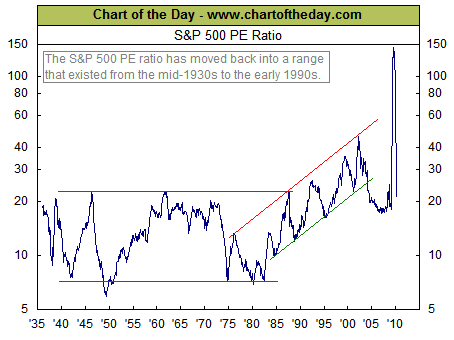
Today’s chart illustrates how the recent rise in earnings has impacted the current valuation of the stock market as measured by the price to earnings ratio (PE ratio). Generally speaking, when the PE ratio is high, stocks are considered to be expensive. When the PE ratio is low, stocks are considered to be inexpensive. From 1936 into the early 1990s, the PE ratio tended to peak in the low 20s (red line) and trough somewhere around seven (green line). The price investors were willing to pay for a dollar of earnings increased during the dot-com boom (late 1990s), surged even higher during the dot-com bust (early 2000s), and spiked to nosebleed levels during the financial crisis (late 2000s). Currently, with 99% of US corporations having reported for Q4 2009, the PE ratio stands at 22 which is at the high end of a range that existed from the mid-1930s up until the early 1990s.
Sign up for the Chart of the Day HERE or at http://www.chartoftheday.com/
Why will the euro eventually go to par or beyond? Basic macroeconomics!
Quotable – Sums up European Government Propaganda on Greece (PIGS) Crisis
“I had therefore to remove knowledge, in order to make room for belief.” – Immanuel Kant
FX Trading – Why will the euro eventually goes to par or beyond? Basic macroeconomics!
Remember, macroeconomics is like working with Playdough. When you push on one spot, there is a similar or equal reaction in another…

…..read more HERE
Fracking Fluids Part I: A Controversy Coming to an Energy Investment Near You
The controversy surrounding fracking fluids is getting louder. Websites and media savvy organizations are getting more press on this issue, using a very simple and powerful pitch – are the chemicals used in fracking fluids in oil and gas wells contaminating our drinking water?
North American investors have not been directly hit by this issue yet, meaning that a company’s stock hasn’t plummeted because they had to stop drilling over these concerns – yet.
“Fracking” is sending a specially designed fluid down an oil or gas well at ultra-high pressure. The fluid, usually water – but can contain some chemicals with very long names – gets blown out into the reservoir rock, creating cracks and channels to allow the oil & gas to get to the well.
The technologies of horizontal drilling and fracking has allowed the industry to access huge untapped resources of oil and gas in shale rock, which is called “tight” because shale is more dense, or tight, than the sand formations which has produced almost all the oil & gas in the world. All the shale gas plays in the US and Canada, and the Bakken oil shale play in North Dakota and Saskatchewan have created billions of dollars of shareholder wealth and given North America self sufficiency and independence in natural gas. (Ed Note: Estimate of reserves run as high as 503 billion barrels – Saudi Arabia comes in at 276 Billion)
Fracking and horizontal drilling ended the big bull run of natural gas prices from 2002-2008, where prices went from under $2/mcf to over $14/mcf. And many industry experts are now saying so much natural gas has been discovered because of newly developed fracking ability that prices won’t see double digit prices for many years.
(I wrote a story on the growing importance of fracking – to the industry and to investors – which you can read here: http://tinyurl.com/yjxexl6)
But the fracking-fluids-potentially-contaminating-water issue has legs – which really surprises me that I haven’t heard more pro-active PR from the industry about their side of this story. Investors ought to be aware of this issue, especially in shale gas/oil plays close to large population centres, such as the Marcellus Shale Gas play in New York state (where one gas stock in particular has me very, very intrigued….). I fear this could be a PR disaster for the industry if they don’t handle this properly.
(Of course, this would be bullish for natural gas prices across North America….there’s a silver lining everywhere. A cynic might even say this issue – which is mostly heard in the US – could be one of the saviours of the Western Canadian gas industry.)
I asked a friend of mine at a Canadian fracking company – who for obvious reasons wants to stay anonymous – to explain this issue for me in simple terms. He says sometimes there are some “nasty” chemicals used in fracking, but he estimated that 70% of frack jobs use ingredients you buy at a grocery store.
In my next story – Fracking Fluids Part II, he will share his “secret” recipe, outlining how he makes homemade frac sand from ingredients at the grocery store.
“I make a frac gel using household items – MacGyver style,” he told me. “I am literally using items my wife buys regularly and can in a few moments generate a stable frac gel that the kids can hold and play with. For less than 20 bucks you can whip this together and cover frack gels for ~70+% of all work done in fracturing.”
Stay tuned; MacGyver will tell all in Part II.
——–WHAT DO SUBSCRIBERS SAY?——————————————
- “Keith, I have paid for my annual subscription on my purchase of Vero Energy within two days! Thank you.”- Bill G., British Columbia
- “Thank-you for helping turn my portfolio around in the short few months I’ve been with you.” – Mario D., Ontario Canada
——–WHAT DO SUBSCRIBERS SAY?——————————————
About Oil & Gas Investments Bulletin
Keith Schaefer, Editor and Publisher of Oil & Gas Investments Bulletin, writes on oil and natural gas markets – and stocks – in a simple, easy to read manner. He uses research reports and trade magazines, interviews industry experts and executives to identify trends in the oil and gas industry – and writes about them in a public blog. He then finds investments that make money based on that information. Company information is shared only with Oil & Gas Investments subscribers in the Bulletin – they see what he’s buying, when he buys it, and why.
The Oil & Gas Investments Bulletin subscription service finds, researches and profiles growing oil and gas companies. The Oil and Gas Investments Bulletin is a completely independent service, written to build subscriber loyalty. Companies do not pay in any way to be profiled. For more information about the Bulletin or to subscribe, please visit: www.oilandgas-investments.com.
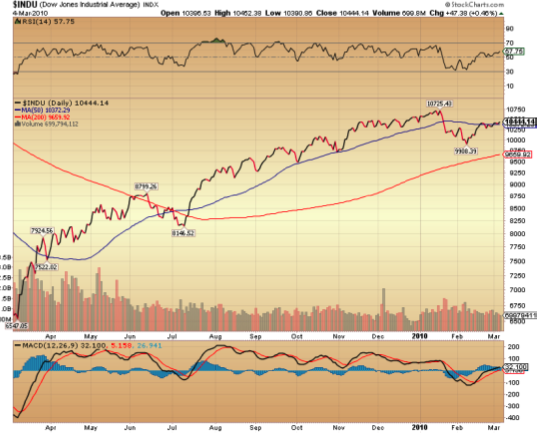
Most will not recognize this fact. One year ago today Citigroup CEO Vikram Pandit leaked an internal memo suggesting that its fourth quarter would show a profit. At that point the world was disintegrating. The Dow Industrials had declined to 6547. There was little in the economy or the markets that looked positive. However the singular internal report set the Street on fire. The graph shows the equity (Dow Industrials) revival or the past year. It has been a very volatile ride. More HERE
-
I know Mike is a very solid investor and respect his opinions very much. So if he says pay attention to this or that - I will.
~ Dale G.
-
I've started managing my own investments so view Michael's site as a one-stop shop from which to get information and perspectives.
~ Dave E.
-
Michael offers easy reading, honest, common sense information that anyone can use in a practical manner.
~ der_al.
-
A sane voice in a scrambled investment world.
~ Ed R.
Inside Edge Pro Contributors

Greg Weldon

Josef Schachter

Tyler Bollhorn

Ryan Irvine

Paul Beattie

Martin Straith

Patrick Ceresna

Mark Leibovit

James Thorne

Victor Adair