
Market Opinion
In October of 2007, Bob Hoye of Institutional Advisors was on Money Talks when he made it very clear, crystal clear to get out of the markets. He said a credit tsunami was about to absolutely overwhelm us.. Obviously a very, very valuable call. He also declared publicly to get back into the market at the end of the 1st quarter of ’09. That’s why I’m really pleased to get his perspective. – Michael Campbell
Bob Hoye’s Top 3 Market Themes
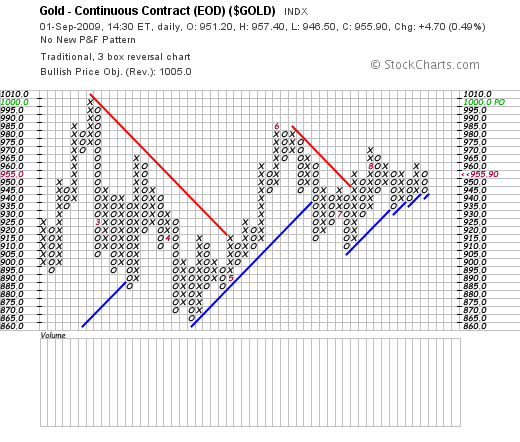
Bond Market Top
“I’m the bond market is going to be heading south. On the ten year note we got upside exhaustion readings, which means the best is in. The dynamics are there for an important top in bond prices and they are about to head down. “
“In the last few months has been the only game in town and there’s been a lot of speculation. Still, there’s no shortage of supply of bonds from that crazy White house administration. I think this is the move where the bond vigilantes come in and say “No Mr. Treasury you’re not going to flog any more of these bonds to the market.” I’m looking for a real serious convulsion in the bond market.”
Gold & Gold/Silver Ratio
“Another indicator we find reliable is the gold silver ratio. It has a tendency when it turns up to signal a wave of credit concerns. The gold silver ratio is now about 65, if it goes right through 68 we’ll say watch out, we’ve got a liquidity problem coming.“
So one trade you can do is the gold-Silver ratio. If it breaks through 68, it might run to 75. In the crash in ’08 it got out to 84. Also while you can sell some of your gold stocks, we’re always interested in the junior exploration stocks. You can’t move around too quickly so you can hedge yourself with the new junior-gold-stock ETF symbol GDSJ in the states. One of the other ways would be to most certainly sell your silver stocks and also play the short side on silver stocks. It will make you some money and protect your core positions and gold.
The Stock Market
There was a very good top for the US stock markets in April and May. Through the summer it’s just been a sort of a choppy market favoring slightly the down side but then we typically get a nice rally going into the turn from August to September and it’s happening. We had a good day Friday and this is likely to continue into next week but this is just the seasonal sort of little lift in the markets that will be followed by further decline.
For the Entire Article & the background to the positions above read more HERE
Market Buzz – Jobs Data Paints Picture of a Fragile Recovery
This past week, Toronto’s main index closed the holiday shortened week up 0.7 per cent as gold stocks moved higher after a resurgence concern about the strength of the North American economy and the sustainability of the recovery.
The major economic news on Friday was focused squarely where it should be for once – directly jobs or the lack thereof. Statistics Canada said the economy shed 139,000 full-time jobs in July and unemployment rose for the first time in nearly a year. Though part-time jobs grew almost as much, the net loss was still a greater than expected 9,300 jobs.
Unemployment crept up 0.1 per cent to 8 per cent last month, raising fears Canada’s remarkable recovery may have stalled. Stepping back a bit, from a Canadian perspective, after one of the strongest quarters on record for Canadian job gains (Q1 2010), the labour market was due for a cool down.
South of the border, the U.S. Labor Department said the news was not much better as U.S. non-farm payrolls fell by 131,000 last month, more than twice economists’ projections. The department also revised its June data downward to 221,000 job losses from the previously reported 125,000 loss.
For its part, the U.S. unemployment rate remained steady at 9.5 per cent, though many fear that may be due to more discouraged workers leaving the workforce.
Broadly speaking, the job numbers confirm what we have been saying for some time now, the global recovery remains fragile.
Looking ahead to next week, we expect a flurry of earnings releases from our Canadian Small-Cap Universe (www.keystocks.com) and updated reports and ratings in light of the results.
Of note, we expect our top pick from January 2010, Fortress Paper Ltd. (FTP:TSX), to report its second quarter financial results for the period ended June 30th, 2010, after the close of the market on Monday, August 9th, 2010. In connection with the release of its results, Fortress Paper will host a conference call Tuesday, August 10th, 2010 at 9:30 a.m. (PST) to discuss the financial results and the corporation’s operations.
Shares in Fortress Paper, which KeyStone Financial upgraded to a Focus BUY in January of this year at $11.01, have jumped 164 per cent to close at $29.05 in just seven short months.
Looniversity – Value Investing and the Bargain Hunter
Dating back to the dirty 30s, value investing and looking for a bargain is one of the oldest ways to pick stocks. The concept is similar to shopping for the product that is most reasonably priced for its quality. Unfortunately, for value investors, they often take a back seat to emerging trends in the market. As the market moves through boom and bust periods, value stocks come in and out of favour.
Background
A value company is one that is relatively cheap compared to its earnings and book value. In most cases, value stocks tend to outperform during bear markets and are therefore considered a defensive investment. Value stocks tend to have a low P/E ratio and their book value (or tangible assets) is much closer to the stock price. Value investing is founded on looking for companies with a solid history of earnings and sales, so there is less uncertainty about their operations or future performance.
Things to Remember:
- Value is relative. Manias exist from time to time, whether they are over tulips, gold, or Internet stocks. You usually only get a bargain when something is out of favour.
- Enormously under-valued stocks are usually that way for a reason – they stink. Be wary!
- Avoid investing in a stock that has significant uncertainty. It could go from a value stock to a bankruptcy stock faster than you think.
- Value stocks may take some time to prove their worth, sometimes over 15 years! Be patient.
Put it to Us?
Q. Ok, this may sound like a dumb question, but what is a stock?
– May Sandberg; Edmonton, Alberta
A. First off, May, like I always say, there are no stupid questions. A common stock is a security that represents your (as a shareholder) ownership stake within a particular company, subject to the right of preferred shareholders. Typically, a common share gives the holder the right to vote on the selection of management and directors and entitles him/her to a proportionate, but undefined, claim on company profits. Indeed, many established companies pay what are known as dividends (usually quarterly cash payments on a per share basis) out of earnings to common shareholders, subject to the discretion of the company’s Board of Directors.
Having said this, the vast majority of today’s investors purchase common shares because of their potential for capital appreciation.
For many years, common shareholders were issued a share certificate. Today, the certificates are in theory held by your brokerage.
Below are some of the rights and benefits of owning common shares:
- The right to receive common share dividends paid by the company
- Potential for capital appreciation (capital gains)
- Voting privileges
- Favourable tax treatment of dividend income and capital gains
- Relatively liquid (common shares in most public companies can be sold within a reasonably short period of time)
KeyStone’s Latest Reports Section
A couple of weeks ago I was standing on 5.75 million ounces of gold and gold equivalent at the Whistler deposit in Alaska, northwest of Anchorage about 100 miles.
I ran into the nice people at Kiska (KSK-V) last March at the PDAC and wrote about them here. The stock was $.85 a share then and is $.82 now.
The Whistler property was originally found in 1986 by Cominco Alaska who later dropped it. It was picked up by Kent Turner and optioned to Kennecott. Rio Tinto bought out Kennecott and Rio optioned the project to what is now called Kiska Metals. The Whistler portion of the overall project has 30 million tones of .87 g/t Au, 2.46 g/t Ag and .24% Cu in the indicated category with an additional 134 million tones at .64 g/t Au, 2.18 g/t Ag and .20% Cu in the inferred category. In my view, in Alaska way out in the hinterlands, those grades aren’t going to be economic.
For Whistler to be economic, Kiska needs to add a lot of tonnage. Power is an issue but that may be solved as Novagold advances Donlin Creek to the west and runs power near where Kiska is located.
But having a 5.75 million ounce resource, even if uneconomic today, tends to give investors higher confidence in the project. That will tend to put a floor under the shares.
Kiska under the leadership of Jason Weber as President and CEO is in the midst of a major drill program on a series of porphyry targets on the 527 square km property. They have completed 23 holes, spending over $8.5 million for their earn-in.
Rio Tinto has a back-in right to the property to regain 60% of the project by repaying KSK 200% of what they have spent on exploration and advancing the project to production. So in either case, KSK wins. But Rio is a copper company and this is a gold project with some silver and copper values. In my view and that of KSK, when the 90-day period that Rio has to make up their minds, the property will be Kiska’s with a 2% NSR to Rio.
Kiska has to provide a report to Rio, probably in August and that will trigger the 90-day period for Rio to make a decision. That decision will remove a lot of investor unease about the project and probably help the stock.
Like all big projects, the Whistler project has issues. There is a power issue, there is a grade and tonnage issue and there is a technical issue of iron pyrites and acid rock. All these issues are real and are being addressed. I was very impressed by the technical data supporting the new drill areas and I think the company will be a success.
Kiska is an advertiser and we are biased. The stock is a lottery ticket on gold and I think that’s the best sort of lottery ticket to own. All of the people we talked to were easy to understand and I encourage all potential investors to feel free to contact management or the technical team with more questions. Drill results will be coming out for months and I think there will be some barn burners in there.
Ed Note: My favorite quote about Bob Moriarity: On 31 March 1984 at 11:20, Robert Moriarty flew between the pillars of the Eiffel tower aboard a Beechcraft Bonanza aircraft. When asked why he had done it, he replied: “Just for fun
In 1996 he began an online computer business on the internet with his wife Barbara becoming one of the early adopters of the internet. Convinced gold/silver were at a bottom in 2001, Bob and Barbara started one of the first websites devoted to teaching readers what they need to know about investing in resource stocks. Bob and Barb now operate two resource sites, 321Gold.com and 321Energy.com where up to 100,000 people a day visit. Bob travels to dozens of mining projects a year and then writes about them. He was one of the first analysts to write about NovaGold, Northern Dynasty, Silver Standard, Running Fox and YGC Resources among many, many others. He claims with some justification that all of his readers are financially better off since they have been coming to his site. www.321Gold.com
Bob Moriarty was a Marine F-4B pilot at the age of twenty and a veteran of over 820 missions in Viet Nam. Becoming a Captain in the Marines at 22, he was one of the most highly decorated pilots in the war. He went on to ferry General Aviation aircraft all over the world for 15 years with over 240 over the water deliveries. He holds 14 International Aviation records including Lindbergh’s record for time between New York to Paris in two different categories.
Stockscores.com Perspectives for the week ending July 25, 2010
Wait for the Right Trade
In this week’s issue:
Weekly Commentary
Strategy of the Week
Stocks That Meet The Featured Strategy

There are approximately 15,000 actively traded stocks on the major North American stock markets. That gives investors looking for a stock to trade a lot of choices. Good traders respond to these varied alternatives by being selective and taking the best of the best. Struggling traders end up taking marginal opportunities that may not have a high probability of success. What causes traders to trade marginal opportunities?
Most trading mistakes come down to one of three things:
- lack of trading knowledge
- succumbing to fear
- succumbing to greed
An experienced, well trained trader should know how to trade and identify good opportunities. Despite their knowledge and skill, many of these traders still take marginal trades because of one of the other two mistakes. Simply put, they are afraid that they will miss out on something good.
Most traders can remember a time when they thought about entering a trade but decided not to because the set up was less than ideal. What makes the memory stick is when that trade turns out to be a great money maker. Being left on the curb as the bus is leaving the station on its way to Profit City is frustrating.
The next time a marginal trading opportunity comes along, we decide to take the trade. Essentially, we are reacting to our painful memory of missing out on the previous marginal trade that proved to be successful.
We are afraid of missing out, and are eager to make money. Blinded by fear and greed.
A marginal trade is marginal because it has a lower probability of success. Keep in mind that the nature of probability is that there will be instances when the low probability outcome occurs rather than the high probability outcome. Otherwise, we would be talking about certainty and not probability.
If you are looking at a marginal trade, it probably means that the expected potential for profit is less than 60%. That means that the trade will work some of the time. The problem is that we remember those times that it did work and take the trade the next time a similar set up occurs. But, because probability is not on our side, that reactionary trading decision often leads to a loss.
The real problem comes when our losses affect our confidence. With the losing trade fresh in our mind we tend to shy away from high probability trades because we are afraid of losing again. The problem is not the quality of the trade that we are considering but our conditioned response to risk as a result of taking a marginal trade.
(continued below)
- Get the StockSchool Pro Free

Open and Fund a brokerage account with DisnatDirect and receive the StockSchool Pro home study course free, including special Pro level access through the DisnatDirect client website. Offer only available to Canadian residents. For information, click HERE
Any time I have a streak of losers I find that I almost always have taken some marginal trades, those that do not quite fit my trading criteria. When I go back and analyze these trades I realize that the problem is not in my rules but the undisciplined application of my trading rules. By getting back to disciplined trading I almost always reverse my losing streak.
Our brains are wired to remember pain. The pain of missing out on a good trade can lead us to take a marginal trade. What good traders remember is that there are a lot of busses leaving the station. By sticking to their disciplined trading approach, good traders will find the high probability trades that provide some nice rides and for those marginal money makers that we miss, remember that there is always another bus.

This past week, the US stock markets broke their downward trend line, doing so from a rising bottom. This is a chart pattern that represents a turn around in the market so I expect that we will see stocks make a summer rally over the next few weeks. The reversal signal is not a really strong one so I would not jump in to the market with both feet, however I do think it is worth nibbling on stocks here as they show good chart pattern set ups.
This week, I ran the Stockscores Simple Market Scan to find some stocks that are showing breaks from optimistic chart patterns. Here are a couple of stocks that are worth checking out.

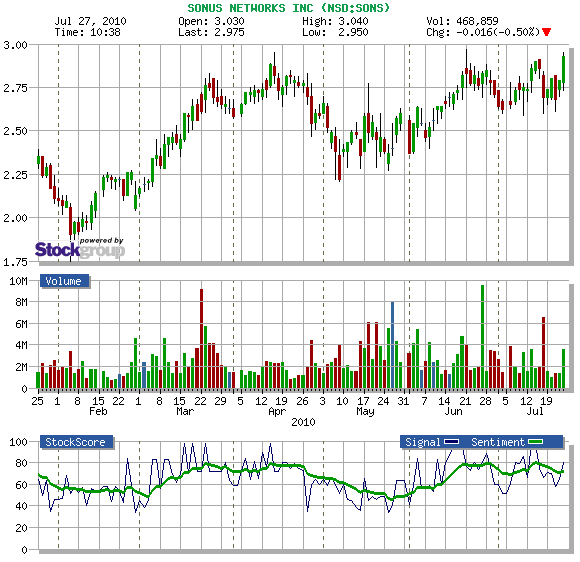
1. SONS
SONS made stronger than normal volume on Friday as it broke through a price ceiling at $2.80. If the market can continue to firm up, this stock should be a leader to the upside. Support at $2.60.
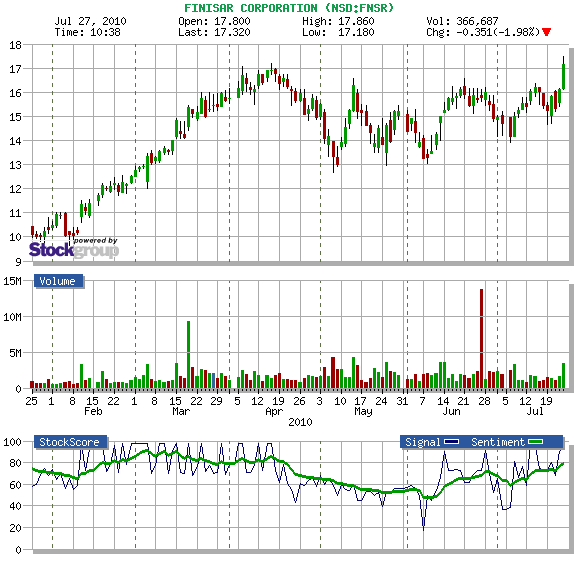
2. FNSR
FNSR breaks through resistance from a pattern of rising bottoms, a sign of optimism. Volume increasing on the break to the upside, should do well as long as it can hold above support at $15.20.
References
Get the Stockscore on any of over 20,000 North American stocks.
Background on the theories used by Stockscores.
Strategies that can help you find new opportunities.
Scan the market using extensive filter criteria.
Build a portfolio of stocks and view a slide show of their charts.
See which sectors are leading the market, and their components.
Click HERE for the Speaker Lineup and to Purchase the video if you want to learn from some of the worlds best traders including Tyler Bollhorn.

Tyler Bollhorn started trading the stock market with $3,000 in capital, some borrowed from his credit card, when he was just 19 years old. As he worked through the Business program at the University of Calgary, he constantly followed the market and traded stocks. Upon graduation, he could not shake his addiction to the market, and so he continued to trade and study the market by day, while working as a DJ at night. From his 600 square foot basement suite that he shared with his brother, Mr. Bollhorn pursued his dream of making his living buying and selling stocks.
Slowly, he began to learn how the market works, and more importantly, how to consistently make money from it. He realized that the stock market is not fair, and that a small group of people make most of the money while the general public suffers. Eventually, he found some of the key ingredients to success, and turned $30,000 in to half a million dollars in only 3 months. His career as a stock trader had finally flourished.
Much of Mr Bollhorn’s work was pioneering, so he had to create his own tools to identify opportunities. With a vision of making the research process simpler and more effective, he created the Stockscores Approach to trading, and partnered with Stockgroup in the creation of the Stockscores.com web site. He found that he enjoyed teaching others how the market works almost as much as trading it, and he has since taught hundreds of traders how to apply the Stockscores Approach to the market.
Disclaimer
This is not an investment advisory, and should not be used to make investment decisions. Information in Stockscores Perspectives is often opinionated and should be considered for information purposes only. No stock exchange anywhere has approved or disapproved of the information contained herein. There is no express or implied solicitation to buy or sell securities. The writers and editors of Perspectives may have positions in the stocks discussed above and may trade in the stocks mentioned. Don’t consider buying or selling any stock without conducting your own due diligence.
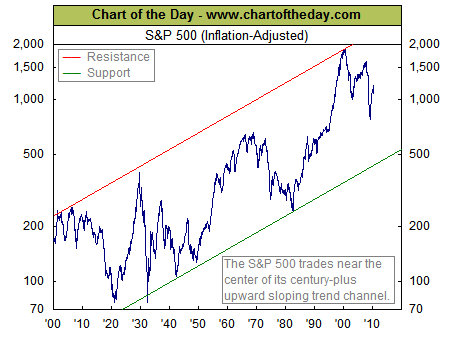
For some long-term stock market perspective, today’s chart illustrates the inflation-adjusted S&P 500 since 1900. It is of interest that, when adjusted for inflation, massive bear markets similar in magnitude to what occurred in the early stages of the Great Depression (i.e. early 1930s) are actually not all that uncommon. For example, the secular bear markets that concluded in the early 1920s and early 1980s were of similar magnitude. It is also of interest that the inflation-adjusted S&P 500 is up 550% since 1900. This equates to an average annual return of 1.7%. Currently, with the S&P 500 trading 41% off its inflation-adjusted year 2000 peak, the S&P 500 trades very much near the center of its century-plus upward sloping trend channel.
Notes:
– The market is at a critical juncture. Where we go from here may surprise you. Find out right now with the exclusive charts of Chart of the Day Plus.
Get your free Chart of the Day HERE or at http://www.chartoftheday.com/
-
I know Mike is a very solid investor and respect his opinions very much. So if he says pay attention to this or that - I will.
~ Dale G.
-
I've started managing my own investments so view Michael's site as a one-stop shop from which to get information and perspectives.
~ Dave E.
-
Michael offers easy reading, honest, common sense information that anyone can use in a practical manner.
~ der_al.
-
A sane voice in a scrambled investment world.
~ Ed R.
Inside Edge Pro Contributors

Greg Weldon

Josef Schachter

Tyler Bollhorn

Ryan Irvine

Paul Beattie

Martin Straith

Patrick Ceresna

Mark Leibovit

James Thorne

Victor Adair