
Market Opinion
With a resource of 4.77 billion pounds of copper
I’ve made a living out of exposing economic fallacies, but there’s one whale that I can’t seem to harpoon. Even top-flight Wall Street analysts seem to believe that the Fed’s doubling of the monetary base after the credit crunch has not had an inflationary impact on our economy. Their logic can be summed up like so: “The money the Fed created and dropped from helicopters has all been caught in the trees.” In other words, the Fed is creating money, but it is just being held as excess reserves by the banking system instead of being loaned to the public. Therefore, the money supply hasn’t truly increased, there is no money multiplier effect, and aggregate price levels are behaving themselves.
But this is only a half-truth. Yes, most of the money created by the Fed has been kept by commercial banks as excess reserves. However, the Fed doesn’t conjure reserves by magic. It first creates an electronic credit by fiat, then purchases an asset held by a financial institution. Those primary dealers then deposit that Federal Reserve check into their reserves. The act of creating money from nothing and buying an asset — be it a Treasury bond or Mortgage Backed Security (MBS) — drives up the price of that asset in the open market. Those price distortions send erroneous signals to private buyers and sellers, eventually creating gross economic imbalances.
Therefore, the inflation created by the Fed first gets concentrated in whatever asset it has chosen to purchase – before spreading throughout the economy.
In the latest example of the Fed’s monetary manipulations, Bernanke & Co. purchased $1.25 trillion in MBS. The prices of MBS were therefore driven up (and yields down). Before that, the Fed forced the entire yield curve lower by purchasing not only Treasury bills but also $300 billion in notes and bonds. The Fed has also recently indicated that it will be swapping maturing MBS for longer-dated Treasury securities in an effort to keep its balance sheet from shrinking.
While it is true that — for now at least — we have been spared from the imminent curse of skyrocketing consumer prices, thanks to the falling money multiplier, it is blatantly untrue that the trillion-plus dollars the Fed created have been rendered inconsequential.
Not only has the huge buildup in the monetary base put pressure on the US dollar and caused gold to soar, but it has also broadcast an egregious and distortive price signal for US debt securities. The 10-year note is now trading just above 2.5%. That yield is near its all time record low, nearly 5 percentage points below its 40-year average, and 13 percentage points below its record high of September 1981.
US sovereign debt should only enjoy such historically low yields due to an overabundance of savings, low inflation, and low debt. None of those preferable conditions currently exist. Hence, US Treasuries are the most over-supplied, over-owned, and over-priced asset in the history of the planet! Once the debt dam breaks, it will send the dollar and bond prices cascading lower, and consumer prices and bond yields through the roof.
While Wall Street and Washington are petrified of the deflation boogieman, the real menace lurking in the shadows is the Fed’s bond bubble – and it’s going to eat small investors alive.
Please note: Opinions expressed are those of the writer.
Also read Peter Schiff’s:
Carts and Horses
In a CNBC debate last week, former Labor Secretary Robert Reich presented a set of contradictory beliefs that unfortunately reflect the conventional wisdom of modern economists. In a discussion with Wall Street Journal columnist Stephen Moore, Reich correctly and comprehensively listed the reasons why American consumers could spend so lavishly before the crash of 2008 and why they can no longer keep up the pace. But instead of making the logical conclusion that former levels of spending were unsustainable and that spending should now reflect current conditions, he advocated that government take on additional debt so that tapped out consumers can spend like they used to.
To achieve this, Reich called for lowering taxes on working Americans and raising taxes on the rich. He argued that middle-income Americans are more likely to spend additional dollars while the rich are more likely to save and invest. As a “demand-side” economist, Reich made clear that spending is superior to savings and investing as a catalyst for growth.
To put it simply: Reich believes that the cart pushes the horse. In his worldview, businesses produce goods and services simply because consumers spend. Therefore, anything that increases spending fuels growth. Unfortunately, he fails to see what should be strikingly obvious: capital formation must precede production, which then allows for consumption.
In a complex society like ours, those relationships are hard to see. However, if we break it down to a simpler level, it becomes more obvious (as I try to accomplish in my new book: How an Economy Grows and Why it Crashes). For example, let’s take a look at a simple barter-based economy consisting of only three people: a butcher, a baker, and a candlestick maker.
If the candlestick maker wants cake, he can’t simply demand that the baker hand it over. The cake needs to be produced, and the baker has to expend labor and material to produce it. Unless the candlestick maker offers the baker something of value in exchange, the cakes won’t get baked. The ability of the candlestick maker to demand cake from the baker is a function of his ability to supply candles to trade. Without production, consumption can’t occur.
What if the candlestick maker gets sick and produces no candles? As the baker would be unwilling to give his cakes away, he would likely stop baking cakes for the candlestick maker. Economic activity would naturally contract until the candlestick maker recovers.
But according to Reich, if the candlestick maker doesn’t have anything to trade, the government should step in and give him candles. But where will the government get them? It could take them from the candlestick maker; but if he is not making candles, how will he pay the tax? Even if there were a few candles left to tax, any that the government took would simply transfer demand from the candlestick maker to the government. No new demand is created.
Alternatively,if the butcher is still healthy, the government could tax him, and give his steaks to the candlestick maker to buy cakes. However, this doesn’t create new demand either. It simply transfers demand from the butcher to the candlestick maker.
Some may feel that a barter-based metaphor doesn’t hold water because the ability to expand the money supply and create credit gives an economy far more flexibility. This is a deceptive argument. Although money is more efficient than barter, it doesn’t change the dynamic between production and consumption.
But Reich suggests that printed money can stimulate demand just as effectively as real candlesticks. But what good will the paper offer the baker if there are no candlesticks to buy? All the baker can do is bid up the prices of those goods, like steaks, that continue to be produced. Similarly, if the government simply prints money and gives it to people to spend, no new production occurs. Prices merely rise to reflect the increase in the supply of money relative to the supply of consumer goods.
In a more complex economy, the relationship between production (supply) and spending (demand) still holds. Every consumer either lives off his own productivity or the productivity of someone else. When individuals work, the wages earned result from the productivity of labor. The ability to consume is directly related to the production of goods or services that result from one’s efforts. However, if people waste their labor in unproductive jobs, little real demand is created.
In the Soviet Union, everyone had a job, yet workers had to stand in line for hours for basic necessities. Although everyone worked (for the government), production was too low. This lack of production meant wages delivered relativity little in the way of purchasing power.
Since production cannot be created by government stimulus, neither can demand. To the extent that there are savings, demand can be brought forward by stimulus – but only at the cost of future demand, plus interest. If stimulus could produce demand, then no nation would be poor. Taken to its logical end, Reich’s argument suggests that African poverty would be wiped out if African governments simply printed money more freely. In reality, Africans are not poor because they lack currency to spend; they are poor because their corrupt and inept governments inhibit production by soliciting bribes, denying property rights, abrogating contracts, preventing the accumulation of capital, and nationalizing profits.
Reich is correct about one thing: Americans are indeed broke. But rather than encouraging the country to spend itself deeper into debt, he should call for greater savings so that we have the means to invest in new businesses and new industries. That is the true road back to solvency, but it will only work if we have less government spending, fewer regulations, lower taxes (particularly on those with the highest propensity to save and invest), and higher interest rates.
Unfortunately, Reich and his allies are calling the shots in Washington. The country cannot recover until the only thing politicians stimulate is demand for new economic leadership.
Stockscores.com Perspectives for the week ending August 22, 2010
Avoid Problems to Make Profits
In this week’s issue:
Weekly Commentary
Strategy of the Week
Stocks That Meet The Featured Strategy

As investors, our natural inclination is to seek out stocks that have good qualities. We look for reasons to buy the stocks we are considering and often forget to look for the negatives. Since there are thousands of stocks to consider and almost all of them can have some reason for buying them, it may be better to reverse how we approach the analysis of stocks. Looking for reasons not to buy a stock will emphasize a higher standard for the stocks you do buy and will help to improve your overall market performance.
Here is a list of common reasons I use to throw a stock out of consideration:
Too Much Volatility
Volatility is uncertainty. Virtually every good chart pattern that I use to find winners demonstrates a break out from low volatility. The narrower the range before the breakout, the more important the breakout becomes. If the stock’s price is moving all over the place before it makes a break through resistance then there is a much greater chance that the breakout is false and will likely fall back. Ignore stocks that have a lot of price volatility before the break out.
Not Enough Reward for the Risk
A stock can go two ways, up or down, after you buy it. If the upside potential is not enough to justify the downside risk, then you should ignore the opportunity. I like stocks to have at least double the upside potential for the downside risk. That way, you don’t have to be right even half of the time to make money, provided you are disciplined of course.
Lack of Optimism
Fundamentals do not matter. It is the perception of Fundamentals that matter. If investors are not showing some optimism about a company’s prospects then it is likely that they are not paying any attention to the company’s fundamentals. Look for rising bottoms on the chart as an indication that investors are optimistic, if there aren’t any, leave the stock alone.
- Get the StockSchool Pro Free



Open and Fund a brokerage account with DisnatDirect and receive the StockSchool Pro home study course free, including special Pro level access through the DisnatDirect client website. Offer only available to Canadian residents. For information, click HERE
No Abnormal Behavior
The stock market is efficient most of the time. That means that you can not expect to consistently beat the stock market because all available information is priced in to the stock and your success at predicting new information can only be random. To beat the market, we have to look for break downs in market efficiency. I find that the best way to do this is look for abnormal behavior in the trading of a stock because it implies that there is significant new information playing a role in the stock’s performance. I don’t consider any stock that lacks abnormal behavior in its recent trading.
Too Far Up
The higher a stock goes, the riskier it becomes. I don’t like to chase stocks higher. If I look at a 6 month chart of a stock and it has made more than two steps up, I don’t consider it. A one day run of substantial gains is not a concern; I want to ignore stocks that have been in upward trends for some time. Look for stocks that are breaking from periods of sideways trading, not up trends.
Lack of Liquidity
The more often a stock trades, the easier it is to get in and out of it. Stocks that are not actively traded tend to have wider spreads between their bids and asks and it can be difficult to move in and out of the stock. Don’t consider stocks that don’t trade every day and they should trade at least 50 times a day but more is better.
Mixed Messages
I always try to look at a stock’s chart on more than one time frame. If the message is not the same on both charts, I leave them alone. When day trading, look at the daily and intraday charts. When position trading, look at the daily and weekly charts.
Any time you think a stock has great potential, give this list a look and see if any of these factors show up. If so, it may be a good idea to move on and look for something else.

A couple of recent features from the daily newsletter are still worth considering. Each showed some abnormal market action that tends to come early in upward trends. My focus with these picks was on lower priced stocks that have a greater tendency to be uncorrelated to the overall market, given the difficulty in predicting where the general market is likely to go in the future.
I found these stocks using the Stockscores Market Scan tool, seeking out stocks that were trading with abnormal volume and breaking through 15 day resistance. This is a scan that I like to do daily.

1. PEIX
PEIX broke to the upside from a rising bottom on Tuesday, trading abnormal volume in the process. Support is at $0.46.

2. ABAT
ABAT first broke to the upside on abnormal volume on August 10th but failed to hold its highs of the day and settled back toward support. A few days later, it bounced off of its support price and rallied higher again. For most of this past week, the stock has pulled back but started to show some buying interest again on Friday afternoon. Support at $3.45.

References
Get the Stockscore on any of over 20,000 North American stocks.
Background on the theories used by Stockscores.
Strategies that can help you find new opportunities.
Scan the market using extensive filter criteria.
Build a portfolio of stocks and view a slide show of their charts.
See which sectors are leading the market, and their components.
Click HERE for the Speaker Lineup and to Purchase the video if you want to learn from some of the worlds best traders including Tyler Bollhorn.

Tyler Bollhorn started trading the stock market with $3,000 in capital, some borrowed from his credit card, when he was just 19 years old. As he worked through the Business program at the University of Calgary, he constantly followed the market and traded stocks. Upon graduation, he could not shake his addiction to the market, and so he continued to trade and study the market by day, while working as a DJ at night. From his 600 square foot basement suite that he shared with his brother, Mr. Bollhorn pursued his dream of making his living buying and selling stocks.
Slowly, he began to learn how the market works, and more importantly, how to consistently make money from it. He realized that the stock market is not fair, and that a small group of people make most of the money while the general public suffers. Eventually, he found some of the key ingredients to success, and turned $30,000 in to half a million dollars in only 3 months. His career as a stock trader had finally flourished.
Much of Mr Bollhorn’s work was pioneering, so he had to create his own tools to identify opportunities. With a vision of making the research process simpler and more effective, he created the Stockscores Approach to trading, and partnered with Stockgroup in the creation of the Stockscores.com web site. He found that he enjoyed teaching others how the market works almost as much as trading it, and he has since taught hundreds of traders how to apply the Stockscores Approach to the market.
Disclaimer
This is not an investment advisory, and should not be used to make investment decisions. Information in Stockscores Perspectives is often opinionated and should be considered for information purposes only. No stock exchange anywhere has approved or disapproved of the information contained herein. There is no express or implied solicitation to buy or sell securities. The writers and editors of Perspectives may have positions in the stocks discussed above and may trade in the stocks mentioned. Don’t consider buying or selling any stock without conducting your own due diligence.
Quote of the Day
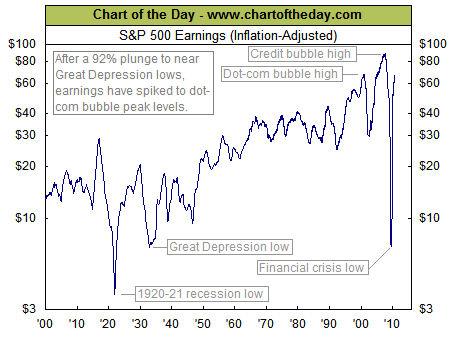
“There will always be bull markets followed by bear markets followed by bull markets.” – John Templeton With second-quarter earnings largely in the books (95% of S&P 500 companies have reported for Q2 2010), today’s chart provides some long-term perspective to the current earnings environment by focusing on 12-month, as reported S&P 500 earnings. Today’s chart illustrates how earnings declined over 92% from its Q3 2007 peak to Q1 2009 low which brought inflation-adjusted earnings to near Great Depression lows. Since its Q1 2009 low, S&P 500 earnings have surged (up over 800%) and currently come in at a level that occurred at the peak of the dot-com bubble. It is interesting to note that the original run-up in real earnings from Great Depression lows to dot-com highs took over 67 years. The current spike has taken 13 months.
Chart of the Day is FREE to anyone who subscribes HERE
Is gold gearing up for new highs? Rapturous radical bugs say yes.
Wednesday may prove to have been a very important day in gold. Gold broke early in the day, but then metal reversed, closing higher than Tuesday’s high. For technicians, this amounts to an outside reversal.
The Wednesday close put gold back to the level of June 30 and some $73 higher than the July 27 low.
Back then, almost the only cheerful group was what I have call the “radical gold bugs” mustered around Bill Murphy’s banner at LeMetropolecafe.
I quoted Murphy saying: “As long as the physical market holds up, it is only a matter of time before gold and silver go back up and make new highs”. See July 29 column.
Murphy’s prediction seems to be happening.
Sell strategies for popular gold ETFs
Gold ETFs are gaining in popularity among big investors, but it pays to have a sell strategy. Watch the 200-day moving average, Tom Lydon, editor of ETF Trends, tells MarketWatch’s Laura Mandaro.
On Wednesday night, Richard Russell commented:
…..read Richards comment HERE
-
I know Mike is a very solid investor and respect his opinions very much. So if he says pay attention to this or that - I will.
~ Dale G.
-
I've started managing my own investments so view Michael's site as a one-stop shop from which to get information and perspectives.
~ Dave E.
-
Michael offers easy reading, honest, common sense information that anyone can use in a practical manner.
~ der_al.
-
A sane voice in a scrambled investment world.
~ Ed R.
Inside Edge Pro Contributors

Greg Weldon

Josef Schachter

Tyler Bollhorn

Ryan Irvine

Paul Beattie

Martin Straith

Patrick Ceresna

Mark Leibovit

James Thorne

Victor Adair