
Investment/Finances
Today, a story about the need to restructure state-owned Dubai World created a bit of a frisson. Dubai is proposing to delay debt payments as it negotiates to extend maturities. According to Bloomberg:
Dubai World, with $59 billion of liabilities, is seeking to delay debt payments, sending contracts to protect the emirate against default surging by the most since they began trading in January.
The state-controlled company will ask creditors for a “standstill” agreement as it negotiates to extend maturities, including $3.52 billion of Islamic bonds due Dec. 14 from its property unit Nakheel PJSC, Dubai’s Department of Finance said in an e-mailed statement. Moody’s Investors Service and Standard & Poor’s cut the ratings on several state companies, saying they may consider the plan a default.
“Extending the maturity of Nakheel debt is feeding the market’s uncertainty on which debt Dubai will honor in full,” said Rachel Ziemba, a senior analyst covering sovereign wealth funds at New York-based Roubini Global Economics. “They look desperate and the market is concerned that in the long term Dubai’s indebtedness is rising not falling.”
Dubai accumulated $80 billion of debt by expanding in banking, real estate and transportation before credit markets seized up last year. Contracts protecting against default rose 116 basis points to 434 basis points yesterday, the most since they began trading in January, ranking it the sixth highest-risk government borrower, according to credit-default swap prices from CMA Datavision in London. The contracts, which increase as perceptions of credit quality deteriorate, are higher than Iceland’s after climbing 131 basis points in November, the biggest monthly increase since January….
Investor concern is growing because the emirate hasn’t disclosed how it will pay more than $9 billion of debt coming due in the next four months. Dubai said yesterday it borrowed $5 billion from Abu Dhabi government-controlled banks, half the $10 billion Dubai ruler Sheikh Mohammed Bin Rashid Al-Maktoum said he planned to raise by yearend.
“There is no clarity about what exactly is happening,” said Emad Mostaque, a London-based Middle East equity-fund manager for Pictet Asset Management Ltd., which oversees more than $100 billion globally. “They have to clarify if there is going to be a voluntary rollover or if there is going to be a forced rollover. If there is a forced rollover it will mean technical default. If they don’t clear this up then the whole market will want to sell.”
Dubai, the second biggest of seven sheikhdoms that make up the United Arab Emirates, and home to the world’s tallest tower and the biggest man-made islands, suffered the world’s steepest property slump in the global credit crisis as home prices fell 50 percent from their 2008 peak, according to Deutsche Bank. UBS AG predicted a further 30 percent drop in a report last week.
Yves here. On the one hand, there has been a reassuring announcement:
The Department of Finance said yesterday it raised an additional $5 billion from two Abu Dhabi lenders as part of its $20 billion Dubai support fund geared toward meeting its financial obligations.
However, Dubai is seeking a standstill on its debt while it renegotiates. I’m not a credit default swaps expert, but that sound like an event of default to me, and if so, that has the potential to have all sorts of repercussions. First, creditors who are not fully hedged who are subject to mark to market reporting will show significant losses. Second, the CDS protection sellers will also be showing losses and posting collateral.
One analyst has already deemed the risk to be overblown, and if the restructuring happens quickly and does not involve much in the way of losses to creditors, this indeed may not be a big deal.
But I got a message from someone who was on the conference call that suggested otherwise. Some European banks may be on the wrong side of this trade. As readers may know, EuroBanks went into the crisis with even lower capital levels than their US counterparts, and have taken fewer writedowns of their dodgy exposures:
The standstill announcement…was a massive surprise. One could sense the panic in those asking questions….this could be the turning point in spreads and could be viewed similar to the Russian debt crisis in 1998 or the Bear situation in 2007…based on companies and the accents of the people asking questions, it is obvious European institutions will be hit hard…Dubai made this announcement at the beginning of a four day holiday, so there will be little news until next week…There is another wave of pain out there. This information does not seem to be making its way to other markets. It will.
More on this topic
Weeks ago Barclays loved Dubai debt like a tonne of bricks... (Capital Chronicle, 11/26/09)
Dubai’s Infrastructure Opportunity (Penny Sleuth, 10/6/09)
Growing sense of optimism in Dubai — FT (tradeflow21.com, 11/4/09)
“Regardless of the dollar price involved, one ounce of gold would purchase a good-quality man’s suit at the conclusion of the Revolutionary War, the Civil War, the presidency of Franklin Roosevelt, and today.” – Peter A. Burshre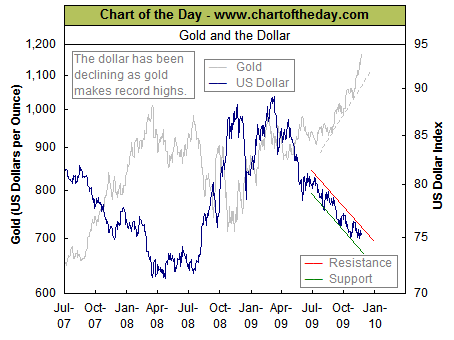
Thanks in part to mounting US deficits and a weak US economy, the US dollar continues to trend lower. After all, a virtual collapse of the banking sector does have its consequences. For some perspective, today’s chart illustrates the current trend in the US dollar (blue line) as well as that other world currency, gold (gray line). As today’s chart illustrates, the performance of the US dollar has varied inversely to that of gold since the latter stages of the credit bubble. It is worth noting that the US dollar is currently testing resistance of its downtrend (red line) while gold makes record highs.
To subscribe to the FREE ChartoftheDay go to http://www.chartoftheday.com/
About a decade ago I began to realize that there was a big hole in investing theory and practice. At the time I didn’t realize that my ideas would morph into a new approach that I have named Discovery Investing. The question you might ask is how this investing discipline is different and, more importantly; how is it better than strategies that academe has provided. 1. DISCOVERY INVESTING
First, though, we must define the technique. Discovery Investing is a discipline that seeks significant value creation through market recognition of a world class discovery. For example the discovery of a cure or effective treatment for cancer would be worth billions of dollars as in the recent case of Imclone and its pancreatic cancer treatment Erbitux. More recently we recommended Western Silver as a Discovery company. After 6 years of drilling in Zacatecas, Mexico the company, under current Quaterra Resources CEO, Dr. Thomas Patton had discovered millions ounces of gold and several hundred million ounces of silver.
Some of the most interesting discovery names today include companies such as MegaWest Energy, Revett Minerals (Mining silver and copper), Quaterra Resources (diversified world class metal discovery), Senesco Technologies (Cancer), Neuralstem (ALS), Silver Wheaton, Endeavour Silver, Ventana (Gold) and Antioquia (Gold).
…..continue reading HERE.
As the unemployment rate crossed the double digit barrier for the first time since Michael Jackson learned to moonwalk, President Obama announced that he will convene a “jobs summit” to finally bring the problem under control. Using all the analytic skill that his administration can muster, the President is determined to figure out why so many people are losing their jobs and then formulate a solution. That’s a relief; for a while there, I thought we were in real trouble! In fact, the absolute last thing our economy needs is more federal government interference. If Obama really wants to know what’s behind entrenched joblessness, he should start by looking at the man in the mirror.
Obama is pursuing, with unprecedented vigor, the same policies that have for decades undermined our industrial base and yoked us to an unsustainable consumer/credit driven economy. This doubling down on Washington’s past failures is destroying jobs at an alarming rate. Today we learned that the September trade deficit surged by 18.2%, the largest gain in ten years. Much of the deficit resulted from Americans spending Cash-for-Clunkers stimulus money on imported cars – or “American” cars loaded to the sunroof with imported parts. In exchange for more domestic debt, we have succeeded only in creating foreign jobs.
An article in this week’s New York Times by veteran writer Louis Uchitelle confirmed a fact that I have been alleging for years. Uchitelle pointed out that foreign outsourcing of component manufacturing has led to consistent overstatement of U.S. GDP and productivity. The connection goes a long way to explain why we keep losing jobs even as GDP is apparently expanding.
As our economy becomes less competitive due to higher taxes, burdensome and uncertain regulations, and capital flight, more manufacturing and services will be outsourced to foreign firms. However, the flaw in GDP calculation allows the output of those foreign workers to be included in our domestic tally. Since we count the output but not the worker responsible for it, government statisticians attribute the gains to rising labor productivity. To them, it looks like companies are producing more goods with fewer workers.
The reality is that we are producing less with fewer workers. The added “productivity” comes from higher unemployment and larger trade deficits. This is a toxic formula that will have lethal economic consequences.
Don’t expect the brain trust at the President’s job summit to fret much about these details. That public relations stunt will likely ignore the root cause of the economic imbalances and instead stress the need for government spending on training and education, i.e. more public debt. The unemployed do not need government theatrics, they need actual jobs. But as long as the government props up failed companies, soaks up all available investment capital, discourages savings, punishes employers, and chases capital out of the country, jobs will continue to be lost.
To really fix the unemployment problem, the President must look past his peers in government and academia to understand how jobs are actually created. In the private sector, all individuals have a choice to either work for themselves or someone else. Since labor is far more productive when combined with capital (office equipment, machinery, business models, and intellectual capital), those who lack these assets themselves often choose to work for others who have sacrificed to accumulate them. This increased productivity is shared between the worker and the owner of capital, and both are better off.
However, for one person or company to choose to offer a job to another, there must be an incentive to do so, and they must have the necessary capital. In the first place, employers must commit to paying wages and benefits, comply with government mandates and regulations, and subject themselves to potential lawsuits from disgruntled employees. All of these costs must be measured against the extra profits an employer hopes to earn by hiring an additional worker.
If profit opportunities exist, jobs will be created. Otherwise, they will not. Of course, anything the government does to raise the cost of employment, such as a higher minimum wage, mandated heath care, or greater regulatory burdens, not only prevents new jobs from being created but also causes many that already exist to be destroyed. Anything that diminishes the profit potential of extra hiring will diminish the number of job opportunities that are created. Also, since it is after-tax profits against which employers measure risk, the higher the marginal rate of income tax, the less likely employers will be able to hire.
Finally, in order to hire workers, employers must have access to capital to expand operations. Anything the government does to discourage capital formation automatically diminishes job creation. By running the largest federal deficits in history, Barack Obama is diverting all available capital to the Treasury, and is in effect waging a war against private capital formation.
If the President’s summit truly intends to find the root cause of unemployment, his advisers don’t need Bureau of Labor statistics or complex modeling software, just the courage to drop their dogmatic belief in central planning and embrace the laws of economics.
We cordially invite Money Talks readers to to join us at a meeting we hold occasionally for real estate investors.
The meeting is an opportunity for our existing investment partners to meet the executive team, enjoy some hors d’oeuvres and hear about the progress oftheir investments. We want you to attend because you have already shown aninterest in real estate investing and we think you will like the way we do business. A major component of the evening will be a presentation by our founder and CEO, Thomas Beyer on the most common mistakes people make when selecting a real estate syndication investment. It is our belief that we can offer you an opportunity of considerable value and that the best way to do so is with a direct and straightforward approach.
The topics for discussion during out investor appreciation event include:
. Are all real estate investments equal?
. What geographic locations make sense for real estate investment in today’s economy?
. Is bigger better? Is it better to own apartment buildings than single family homes?
. How do you invest your RRSP’s in real estate?
. Can I reduce my investment risk while increasing my returns?
. How can I protect my investments from inflation?
. How can I recession-proof my investment portfolio?
. Can I invest using a Line of Credit (LOC) and still cash flow?
Plus: Meet our executive team as they explore and analyze our latest property acquisition and shed some light on our current investment opportunity, PRISM A Limited Partnership.
Please review the enclosed introduction to our company and business model. If you find our approach interesting, have $26,250 or more to invest, kindly take the time to register at the event in your city:
On-line Webinar – Wednesday, November 18th – 7:30 pm to 9:00 pm MST….read all about it and register HERE
Join us for wine, cheese and hors d’oeuvres before and during the live events. Please RSVP to Christa at 1-877-434-4345 or christa@prestprop.com to learn the location of the event in your city.
Calgary – Monday, November 23 – 6:30 pm to 8:30 pm
Edmonton – Tuesday, November 24 – 6:30 pm to 8:30 pm
Vancouver – Thursday, November 26 – 6:30 pm to 8:30 pm
We look forward to welcoming you to our investor appreciation event.
Sincerely,
Scotty Grubb
COO & VP Business Development


-
I know Mike is a very solid investor and respect his opinions very much. So if he says pay attention to this or that - I will.
~ Dale G.
-
I've started managing my own investments so view Michael's site as a one-stop shop from which to get information and perspectives.
~ Dave E.
-
Michael offers easy reading, honest, common sense information that anyone can use in a practical manner.
~ der_al.
-
A sane voice in a scrambled investment world.
~ Ed R.
Inside Edge Pro Contributors

Greg Weldon

Josef Schachter

Tyler Bollhorn

Ryan Irvine

Paul Beattie

Martin Straith

Patrick Ceresna

Mark Leibovit

James Thorne

Victor Adair