
Investment/Finances
Confession — I’ve spent roughly 64 years studying the stock market on a daily, weekly and monthly basis. I’d say that 80 percent of that time I was perplexed or unsure of my stand. I know in the advisory business you are always expected to know exactly what’s going on and where to place your money. In my experience, the more cock-sure the advisor, the bigger the quack.
…..read more HERE
Greece has not had many good days in 2010, but Thursday was a particularly bad day. First, Europe’s statistical office (Eurostat) revised up the Greek 2009 budget deficit, which placed Athens’ accounting shenanigans in the spotlight again. The bottom line is that the situation is even worse than previously thought, and the budget deficit may very well be adjusted up as more Greek accounting malfeasance comes to light. Following the announcement, credit rating agency Moody’ s dropped Greece’s credit rating one notch, immediately prompting a rise in Greek government bond yields, thus increasing Athens’ borrowing costs.
The yield on a Greek 10-year bond shot above nine percent, while a two-year bond rose above 11 percent, both record highs since Greece joined the eurozone. Particularly daunting is the fact that short-term debt financing is now more expensive than long-term funding. This situation is referred to as an “inverted yield curve,” and it is generally considered a harbinger of financial doom. This means that investors are sensing that Athens is more likely to experience problems sooner rather than later.
Higher yields mean that Greece is facing increasingly larger interest payments on an increasingly larger stock of debt. This all but confirms that Athens’ claim that its stock of public debt will peak at 120 percent of gross domestic product (GDP) is simply wishful thinking. Worse still, Greece is also facing continued economic recession, induced in part by Athens’ austerity measures designed to reduce its budget deficit. Given this vicious dynamic, we cannot see how Greece’s debt level will stabilize at anything below 150 percent of GDP range.
The point is that the financial writing is now on the proverbial wall; some form of default is simply unavoidable. Exactly how the Greek default will unfold is unclear, but the bottom line is that the question now is not “if” but “when.” Under “normal” circumstances, when the IMF becomes involved with a country in a situation similar to Greece’s, the standard procedure is to devalue the local currency. By lowering the relative prices within the economy, the devaluation increases the competitiveness of the country’s export sector and helps to reorient the economy toward external demand. Devaluation is also politically expedient because regaining competitiveness does not require employers to slash employees’ wages, as the devaluation adjusts the relative costs silently and discreetly.
However, Greece does not have the option of devaluation because it is locked into a monetary union. The eurozone’s monetary policy is controlled by the Frankfurt-based European Central Bank. The fact that Greece is locked in the “euro straitjacket” raises two questions, the first being how the Greek debt crisis will play out.
Without the option of devaluation, the Greeks will have to implement and endure draconian austerity measures – in addition to the ones it has already enacted – similar to what Latvia and Argentina endured as part of their IMF programs. Argentina in 2000 and Latvia in 2008 also could not go the currency devaluation route because neither country controlled its monetary policy. In Argentina’ s case, the austerity measures were so severe that they caused considerable social unrest – including a brief period of outright anarchy in late 2001, which saw the country go through five heads of government in about two weeks – ultimately culminating in the country’s partial debt default in 2002. To this day, Argentina is still dealing with the fallout of that financial calamity.
Latvia is a case of more recent vintage. In late 2008, Latvia agreed to what the IMF itself has called one of the most severe austerity programs since the 1970s. To accomplish it, Latvia has done everything from slashing public sector wages by 25 to 40 percent, increasing taxes, reducing unemployment and maternity benefits and cutting the defense budget. The crisis has already cost the Latvian prime minister his job and stoked social unrest. Despite all of that, the budget deficit has not budged much, remaining around eight percent of the GDP mark. Spending has been cut to the bone, but Latvia is simply too small of an economy to emerge from recession on its own.
Since the broader European economic recovery remains moribund at best, less government spending has translated directly to less growth. Less growth means less tax income, and less tax income means that the country’ s budget deficit remains stubbornly high. Latvia has essentially become a ward of the IMF, and will remain so until either the broader European economic recovery is more robust or the Baltic state is fast-tracked into the eurozone itself.
An EU-IMF bailout of Greece would ultimately give Athens the choice of becoming either an Argentina or a Latvia. A financial assistance program that does not involve substantial structural reform on Greece’s part would lead to a default a la Argentina. A bailout that forces Greece to get serious about reforms would mean Greece becomes an IMF-ward like Latvia, with default still a serious possibility down the line. In either case, Greece will essentially lose control over its destiny.
The next question is what the rest of Europe will look like, and there is no shortage of impacts. Europe, and Germany in particular, must decide whether and to what extent it should “bail out” the Greeks. How that might happen is now the topic of the day in Europe. Driving the urgency is this simple fact: In the absence of substantial (and subsidized) financial assistance, Greece will inevitably default on its debts, thus generating write-downs for all those who hold Greek government debt (mostly European banks).
The Greek default therefore is no longer an isolated problem, but a problem that threatens to aggravate an already weakened European banking sector. One of the most misunderstood facts of the international financial world is that even at the peak of the U.S. subprime crisis, in the dark hours when American hedge funds seemed to be snapping like matchsticks, Europe’s banks were in even worse shape. As the Americans stabilized, so did their banks. But Europe never cleaned house, and now a Greek tsunami is poised to wash over the whole mess. [emphasis mine – JM]
The above was brought to you by:
John F. Mauldin
johnmauldin@investorsinsight.com
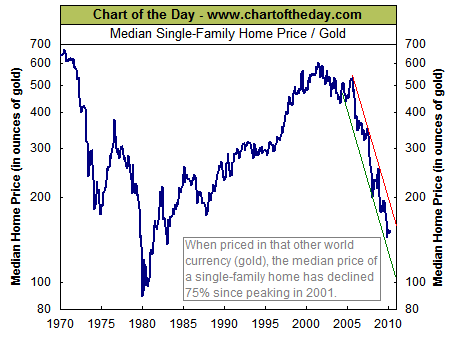
Today’s chart presents the median single-family home price divided by the price of one ounce of gold. This results in the home / gold ratio or the cost of the median single-family home in ounces of gold. For example, it currently takes 153 ounces of gold to buy the median single-family home. This is considerably less that the 601 ounces it took back in 2001. When priced in gold, the median single-family home is down 75% from its 2001 peak and remains well within the confines of its five-year accelerated downtrend.
Sign Up for the FREE Chart of the Day HERE
Simply enter and submit your email address (we won’t share it with anyone) and you will receive one free chart per week and instantly receive the latest free Chart of the Day.
Much to the relief of jittery global markets, Greece’s chronic debt problem has been papered over in a burst of European solidarity and apparent magnanimity. But this act of mercy may cost Germany its key position of financial dominance over the European Central Bank (ECB), which, in turn, could be detrimental to the long-term health of the euro. And so even though the euro stiffened once the immediate default fears abated, the price of gold was pushed to a new all-time high in euro terms (and a five-month high in dollar terms).
The euro is now second only to the U.S. dollar in importance to world commerce. It is held by most central banks and corporations as a legitimate diversification hedge against the U.S. dollar. Therefore, its stability is of key importance to international currency markets and global stability.
Increasingly, it is apparent that the Greek problem is a potential game changer for the euro. So far, the various rescue packages have failed to convince investors that Greek bonds are dependable over the long term. Despite Greece’s successful short-term debt auction on Tuesday, the premium demanded by investors to hold longer-dated Greek bonds continues to increase. Today, the yield spread between 10-year Greek and German government bonds widened to just a shade below 400 basis points. [ii]
It remains to be seen whether the latest support package offered by the EU – a three year loan of some €30 billion at around five percent interest [iii] – will suffice to cover the major economic, structural, and even attitudinal changes that are necessary. Furthermore, the potentially larger budgetary problems of many Eastern European countries and the remaining PIIGS (Spain, Portugal, Ireland and Italy) still remain to stalk the euro.
Still, there remains an even more significant threat to the euro. The eurozone finance ministers’ ‘soft’ Greek rescue package, when combined with ECB Chairman Jean-Claude Trichet’s preparedness to continue accepting Greek bonds as collateral, spells the possible demise of the Germanic sound money policies underpinning the euro.
In the original formation of the euro, the Germans were prepared to give up their widely respected Deutsche Mark only if the euro would be run on a prudent and stable basis. In addition, to ensure compliance with their wishes, they demanded that the European Central Bank be based in Germany. As a sop for French support, they tolerated a plan that would eventually install a French ECB president (though the Germans made sure that ECB’s first president, the Dutchman Wim Duisenberg, supported policies favored by Berlin.).
A Frenchman, Jean-Claude Trichet, did take over the ECB in 2003 and, much like our own Alan Greenspan, moved away from the hawkish tendencies that characterized his earlier reputation. Whereas Duisenberg was made famous for his “I hear you, but I don’t listen” retort to angry politicians demanding rate cuts, Trichet has been much more willing to bow to pressure. This is causing great consternation in Germany. According to the German newspaper Handelsblatt, a former Bundesbank President remarked that, “Those who flirt with inflation, marry her. Trichet yesterday, kissed her.”
In addition to raising eyebrows among German politicians, cracks in the sound money policy of the ECB should concern international investors as well. With the euro now threatened, where should international investors turn?
The budgetary and debt problems facing the U.S. government are so severe that, despite holding reserve currency status, America is now in danger of losing its triple-A credit rating. Last week, investors watched as U.S. Treasury Secretary Tim Geithner traveled to China, where he bowed, cap in hand, to beg the Chinese to revalue their currency. This raised the question as to whether the Chinese yuan is undervalued or the U.S. dollar is overvalued. Clearly, the U.S. dollar cannot be the safe haven for the world’s savings.
The UK’s pound sterling faces the same problems as the dollar. Stronger Western currencies, like the Swiss franc, are too small to absorb the bulk of funds fleeing the threatened euro without distorting their prices well beyond fair value. Gold seems to win by process of elimination.
Gold has hovered for some months in a tight range between $1,050 and $1,100 per ounce. It has held this level despite apparently low inflation and continued concerted efforts by central banks to de-monetize the metal. It seems many international investors, including the central banks of India, Russia and China, feel that, despite soothing words from politicians, all is not well with the paper world!
With a national debt now thirteen times larger than it was in 1980, [iv] investors in U.S. dollar assets are about to pay the inevitable price demanded by the profligate policies of Washington. Who can doubt that the spiking rates now on display in Greece will soon make an appearance on our shores?
As we have said before, we feel that the severe problems we face in America have yet to be fully realized. When they are, gold may be the surest footing in a world turned upside-down.
John Browne Senior Market Strategist
John Browne is the Senior Market Strategist for Euro Pacific Capital, Inc. Mr. Browne is a distinguished former member of Britain’s Parliament who served on the Treasury Select Committee, as Chairman of the Conservative Small Business Committee, and as a close associate of then-Prime Minister Margaret Thatcher. Among his many notable assignments, John served as a principal advisor to Mrs. Thatcher’s government on issues related to the Soviet Union, and was the first to convince Thatcher of the growing stature of then Agriculture Minister Mikhail Gorbachev. As a partial result of Browne’s advocacy, Thatcher famously pronounced that Gorbachev was a man the West “could do business with.” A graduate of the Royal Military Academy Sandhurst, Britain’s version of West Point and retired British army major, John served as a pilot, parachutist, and communications specialist in the elite Grenadiers of the Royal Guard.
In addition to careers in British politics and the military, John has a significant background, spanning some 37 years, in finance and business. After graduating from the Harvard Business School, John joined the New York firm of Morgan Stanley & Co as an investment banker. He has also worked with such firms as Barclays Bank and Citigroup. During his career he has served on the boards of numerous banks and international corporations, with a special interest in venture capital. He is a frequent guest on CNBC’s Kudlow & Co. and a former contributing editor and columnist of NewsMax Media’s Financial Intelligence Report and Moneynews.com. He holds FINRA series 7 license.
Company Profile
Founded in 1980 and headquartered in Westport, Connecticut, Euro Pacific is a full service, FINRA-registered broker/dealer that has historically been recognized for its expertise in foreign markets and securities. Through its direct relationships with countless foreign trading desks, the firm’s clients are able to avoid the large spreads often imposed by domestic market makers of foreign securities, thereby substantially reducing overall transaction costs. See The Euro Pacific Advantage
Though we offer access to all U.S. stocks and bonds, and are certainly knowledgeable in domestic investments, we specialize in international securities. By trading foreign stocks and bonds through Euro Pacific Capital, individual investors can benefit from our extensive experience in this highly specialized area. Euro Pacific Capital’s clients gain access to foreign markets which are out of reach for most individual investors trading through traditional brokerage firms. With Euro Pacific’s guidance, buying foreign stocks and bonds, and building a truly global portfolio, has never been easier. Let us put our experience to work for you.
Euro Pacific Capital does not engage in any market making activities, thus the firm’s individual and corporate clients can be assured that any recommendations given are free from the various conflicts of interest so prevalent among Wall Street brokerage firms.
Peter Schiff, the firm’s president, and a renowned pioneer in the field of international investing for individual investors, leads a team of investment professionals and support staff dedicated to the highest levels of customer service, a team literally searching the world over for valuable investment opportunities.
Commentary
The Bears Are Running for the Sidelines…
After a near-vertical one year rally in North American stocks one would think the “bears” would be licking their chops. Instead, the would-be short sellers, who seek to profit from falling stocks have moved to the sidelines in many cases.
….commentary continued below:
Market Summaries
S&P/TSX Composite up 0.02% to 12176 (up 3.60% year-to-date)
S&P/TSX Venture Composite up 4.87% to 1680 (up 14.36% ytd)
Dow Jones Industrial Avg up 0.06% to 10997 (up 5.40% ytd)
Nasdaq Composite up 2.16% to 2454 (up 8.06% ytd)
Oil (West Texas Intermediate) up $0.05 $84.92 (up $5.56 ytd)
Gold (Spot USD/oz) up $35.80 to $1161.90 (up $58.65 ytd)
2009 Personal Income Tax Filing
As you are aware April 30, 2010 is the deadline to file your personal income tax return with the Canada Revenue Agency. In April, we receive a number of requests from both clients and accountants with regards to documents required to complete your return. Please be advised that you should now be in receipt of all pertinent information to file your return. Starting January 1, 2010 you may have received by mail and/or email the following important tax documents:
- 2009 Gain Loss Report
- T5, T3, T5008 and/or T5013
- T4RSP, T4RIF and/or T4A
***Please contact our office prior to April 21, 2010 if you require duplicate copies of any of these documents***
Commentary
The Bears Are Running for the Sidelines…
After a near-vertical one year rally in North American stocks one would think the “bears” would be licking their chops. Instead, the would-be short sellers, who seek to profit from falling stocks have moved to the sidelines in many cases.
In most sectors, those looking to pick “market tops” have been run over by the market’s sustained momentum. In the US, no other bull market dating back to 1962 has been able to match the near 70% move off the bottom that we’re currently experiencing.
According to the Commodity Futures Trading Commission, speculators in S&P 500 futures had a net short position of 72,247 contracts for the week of March 16th. Fast-forward one week and most had packed it in, with just 6204 net short positions remaining.
“I’m not short because for the most part I can’t find ideas that seem to be working and I think other people might be in the same camp,” said Bill Fleckenstein, president of Fleckenstein Capital Inc in Seattle. After being short for 12 years, Fleckenstein closed out short positions last year when he decided the strategy wasn’t working.
But some of the data we are seeing suggests the bears may have a case, with 93% of the S&P 500’s stocks trading above the 50-day moving averages, and momentum indicators suggesting the market has been overbought for a couple of weeks.
Despite these potentially bearish facts, Wall Street’s CBOE Volatility Index or “fear gauge,” is low and optimism over the economic recovery has taken a stranglehold.
– Reuters
Soundbites
- While many are beaming over the prospect of a par dollar with our southern neighbour, a number of businesses are extremely concerned. With the loonie soaring, forestry and tourism will be two of BC’s biggest losers, while firms buying imported machinery and equipment or with debt in US dollars stand to benefit. Other export–reliant industries set to struggle are pulp & paper, lumber, manufacturing, and software development. Attracting US vacationers and business conventions will also become a tougher game as the many of the prior benefits of a cheaper Canadian buck are eliminated and the cost of travelling within the US makes more sense.
- The Mica Dam on the Columbia River is poised to overtake WAC Bennett Dam as the site of the largest hydroelectric facility in BC. Last week the BC environmental assessment office approved BC Hydro’s application to install two additional turbines at Mica, which is situated on the Columbia 135 km’s north of Revelstoke. Mica came into service in 1977 but two of its six turbine bays were left empty on the premise that the power was not needed at the time of its construction.
- In order to find Canada’s largest home, you don’t have to visit Oakville, Point Claire or the shores of West Vancouver, you need to trek 140 km’s north of North Bay, Ontario to Lake Temiskaming. The house is listed at $25,000,000 and apparently “needs a little work.” For the handsome price-tag, the buyer will get 40 acres of property, 65,000 sq feet of living space, a boat house equipped to hold a 40-foot yacht, two elevators, an indoor pool, two 30-foot fireplaces, plumbing for indoor golf greens and many other absurd items. Despite the hefty price, the house is far from finished and has no flooring, wall coverings or finished bathrooms. The monstrosity was once the dream home of forestry tycoon Peter Grant who’s company, Grant Forest Products has since run into bankruptcy protection after being North America’s third-largest OSB producer at one time.
Marketwatch – A Look at the Week’s Newsmakers
Fairmont Raffles Hotels Intl (Private) – has agreed to sell 40% worth of new shares in the company to Cayman Islands-based Voyager Partners Ltd in a strategic move to align itself with cash-rich investors in the hotel property sector. The company, which is emerging from a particularly bad slump in the luxury hotel business, is recapitalizing to repay some of its debt and is seeking to build its brand by adding new management contracts. Fairmont has long been divesting itself of its iconic portfolio of real estate holdings, including the Royal York in Toronto, and the Banff Springs Hotel in Alberta. Of the 100 properties it now manages, Fairmont has only retained investments in four of them. The deal with Voyager has diluted the ownership of Saudi Arabian investment firm, Kingdom Holding Co, which sees its stake fall from 58% to 35%. Kingdom is 95%-owned by billionaire Saudi Prince Alwaleed bin Talal.
Canadian Tire Corp (CTC.A) – executives are trying to get back to basics by putting the focus back on tires, autoparts and housewares. The company announced a new strategic plan at an investor conference and outlined its financial targets for the next three to five years, including earnings-per-share growth of 8-10% and retail growth of 3-5% per year. Over the past 10 years, Canadian Tire stores have matched growing square footage with expanded product lines and many haven’t worked out. This renewed focus on its core businesses will see an end to continued expansion and a commitment to what has made the franchise successful over the past 88 years. The company also operates a financial services division, a petroleum division, and the apparel chain, Mark’s Work Warehouse.
Endeavour Financial Corp (EDV) – a good old fashioned donnybrook is developing between mining heavyweights on opposite sides of the globe. Russian steel giant OAO Severstal is in a battle with Endeavour Financial, which is led by mining heavyweight Frank Giustra, over control of Vancouver-based Crew Gold Corp. The conflict goes back to late January, when EDV acquired 37.9% of Crew, and in the process adding three to the board – including Giustra. Shortly after, Severstal built up a 26.6% stake in Crew, before attempting to take out the entire company. Severstal is now trying to reverse the board appointments and replace them with choices of their own – a move which obviously doesn’t sit well with Endeavour. Stay tuned…
Palm Inc (PALM) – despite disappointing sales, intense competition and a history of missteps by management, it appears that Palm may have a few suitors. Shares flew early last week on early speculation that Lenovo Group Ltd could be a bidder, only to get pushed even higher Friday after talk that HTC Corp may also be interested.
TransGlobe Apartment REIT (private) – plans to raise $250 million in an IPO to buy rental apartments across Canada. TransGlobe intends to sell trust units for $10 per share, according to documents filed last week by the Mississauga, Ontario-based firm. The REIT was formed to indirectly buy 65 rental properties with approximately 8200 units, principally located in Alberta, Ontario, Quebec, New Brunswick and Nova Scotia.
“Quote of the Day”
“The most erroneous stories are those we think we know best – and therefore never scrutinize or question.” – Stephen Jay Gould (1941 – 2002)

This newsletter expresses the opinions of the writers, Marc Latta and Jamie Switzer, and not necessarily those of Raymond James Ltd. (RJL) Statistics and factual data and other information are from sources believed to be reliable but their accuracy cannot be guaranteed. It is for information purposes only and is not to be construed as an offer or solicitation for the sale or purchase of securities. It is not meant to provide legal, taxation, or account advice; as each situation is different, please seek advice based on your specific circumstance. RJL and its officers, directors, employees and their families may from time to time invest in the securities discussed in this newsletter. It is intended for distribution only in those jurisdictions where RJL is registered as a dealer in securities. Any distribution or dissemination of this newsletter in any other jurisdiction is strictly prohibited. This newsletter is not intended for nor should it be distributed to any person residing in the USA. Within the last 12 months, Raymond James Ltd. has undertaken an underwriting liability or has provided advice for a fee with respect to the securities of the Royal Bank of Canada. Raymond James Ltd is a member of the Canadian Investor Protection Fund.
JAMIE SWITZER | Raymond James Ltd.
Senior Vice President, Financial Advisor
North Vancouver IAS
PH: 604.981.3355 | FAX: 604.981.3376
jamie.switzer@raymondjames.ca
-
I know Mike is a very solid investor and respect his opinions very much. So if he says pay attention to this or that - I will.
~ Dale G.
-
I've started managing my own investments so view Michael's site as a one-stop shop from which to get information and perspectives.
~ Dave E.
-
Michael offers easy reading, honest, common sense information that anyone can use in a practical manner.
~ der_al.
-
A sane voice in a scrambled investment world.
~ Ed R.
Inside Edge Pro Contributors

Greg Weldon

Josef Schachter

Tyler Bollhorn

Ryan Irvine

Paul Beattie

Martin Straith

Patrick Ceresna

Mark Leibovit

James Thorne

Victor Adair