
Investment/Finances
Mr. Farrell, Merrill Lynch’s chief market strategist from 1967-1992 penned some pretty decent “Rules to Remember”…
1) Markets tend to return to the mean over time.
2) Excesses in one direction will lead to an opposite excess in the
other direction.
3) There are no new eras – excesses are never permanent.
4) Exponential rapidly rising or falling markets usually go further
than you think, but they do not correct by going sideways.
5) The public buys the most at the top and the least at the bottom.
6) Fear and greed are stronger than long-term resolve.
7) Markets are strongest when they are broad and weakest when
they narrow to a handful of blue chip names.
8) Bear markets have three stages – sharp down – reflexive rebound –
a drawn-out fundamental downtrend.
9) When all the experts and forecasts agree – something else is going
to happen.
10) Bull markets are more fun than bear markets
Why Canadian banks, despite their high levels of consolidation, do not face the same problem as the US banks?
Large financial institutions too big to fail, saved: Nouriel Roubini
Nouriel Roubini, Chairman, RGE Monitor, in a chat with ET Now talks about the Volcker rule and the global financial system.
Why do you back the Volcker rule?
If the Volcker rule goes in the right direction by saying if you have access to taxpayers’ insurance, why should you be involved in risky prop trading in private equity and hedge fund activities. Those things should not be allowed by bank holding companies. I would go more far. I would say that the kind of restriction we had under Glass-Steagall were the appropriate one that wanted to avoid massive financial crisis for 40-50 years. They have absolute separation and also are not having derivatives trading occurring in bank holding companies.
Why Canadian banks, despite their high levels of consolidation, do not face the same problem as the US banks?
Resolution regime is not going to work. We are not going to break up Goldman Sachs in the heat of the next financial crisis. So like Gordon Brown, like Alan Greenspan have said, if they are too big to fail, they are too big we will expect them up and by the way they are too big to fail but they are also too big to be saved.
That is what is happening in Europe right now where financial systems are so large that if they have financial crisis, the fiscal resources of the sovereign are not enough. Also these financial are not only too big to fail and too big to be saved or bailed out but they are too complex to manage. When you have a huge financial institution with thousands of different panels- because every banker in trade has a different panel – not even the smarter CEO or board of directors can monitor the activity of thousand panels.
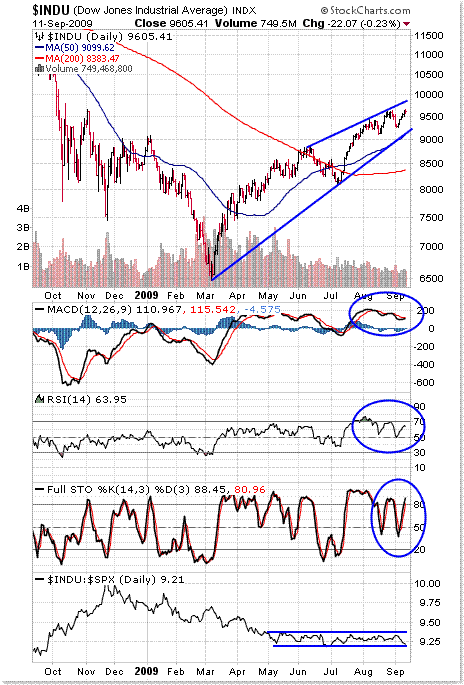
(Ed Note: Seasonality Chart from Don Vialoux)
Why it is that while some big investment banks failed, others like Goldman and Citi have survived?
Goldman Sachs – like everybody else – got a massive amount of financial support from the government. AIG borrowing at zero rate from the Fed and other forms of bailout of the government. They would then not have been alive. Goldman Sachs and Morgan Stanley would have ended up like Bear Sterns, like Lehman, like Merrill Lynch without the support of the government.
The paradox is that Goldman Sachs in many ways is the biggest hedge fund of all, much more leverage than any hedge fund and unlike all the other hedge funds, it is at access to the free money of the Fed and a guarantee of support. So if Goldman Sachs wants to be hedge fund, I will not be against them. Become a hedge fund, do whatever you want but do not be a bank holding company.
What is your take on Financial Reforms Bill?
All these institutions involved in commercial banking, investment banking, prop trading, private equity, hedge funds, market, derivatives, asset management, insurance, you name it, all these things can be done by separate institutions. Each one of them is smaller, not too big to fail and the big financials spread market has been a big disaster.
Look at Citigroup, look at ING. The idea that you have economies of scale and scope has actually shown that this institution is too complex to be managed. So I am in favour having them smaller with less systemic affects
A MUST read: read my friend, John Mauldin’s latest article, “The Center Cannot Hold,” John tells us why we could have one bang-up depression coming up. Don’t miss John’s latest, it’s a MUST! The market is telling us what. John tells us WHY” HERE – Richard Russell
The week that was…
It’s amazing how quickly we forget about 14 months of strong equity markets after one week of turmoil. May started off alright with a strong Monday and many asking the question, “will this May be different?” Then Tuesday brought the beginnings of what would be a week of trading that will be a part of text books for years to come.
Please check out our website at:http://www.raymondjames.ca/jamieswitzer. If you would like to receive our “Weekly Wrap”, please click HERE to subscribe.
Market Summaries
S&P/TSX Composite down 4.20% to 11692 (down 0.50% year-to-date)
S&P/TSX Venture Composite down 7.41% to 1549 (up 6.90% ytd)
Dow Jones Industrial Avg down 5.70% to 10380 (down 0.50% ytd)
Nasdaq Composite down 7.90% to 2266 (down 0.20% ytd)
Oil (West Texas Intermediate) down $11.04 to $75.11 (down $4.25 ytd)
Gold (Spot USD/oz) up $29.20 to $1208.40 (up $111.45 ytd)
The week that was…
It’s amazing how quickly we forget about 14 months of strong equity markets after one week of turmoil. May started off alright with a strong Monday and many asking the question, “will this May be different?” Then Tuesday brought the beginnings of what would be a week of trading that will be a part of text books for years to come.
As the week went on, the data coming out of the “PIIGS” nations (Portugal, Ireland, Italy, Greece and Spain) and Greece in particular painted an increasingly grim picture. It’s clear we will be dealing with these “problem children” for a long time to come. The issues they face have been built on decades of mismanagement and will not be cleared up with the band aid bailout solutions being tossed around. These actions simply buy time and as we are seeing this morning, it gives us all a false sense of security. Despite today’s “shock and awe” intervention from the EU, we will be hearing from Greece again shortly and it probably won’t be pretty.
Thursday was the pinnacle of last week’s market hysteria and our “technologically advanced” stock market systems were clearly not ready for the challenge. As traders lined up to hit the sell button, many stocks lost their bid and within minutes were facing catastrophic losses, triggering a sell-off that saw the Dow fall about 800 points in 10 minutes. While the bizarre event exposed many flaws in our automated trading world, it also taught a harsh lesson to those fond of the “stop loss.” Many are under the illusion that a stop loss is filled at the price entered for the stop (for example, $18). The reality of a stop is that it simply triggers a market order and in a market like Thursday’s, where buy orders become scarce, this is a dangerous proposition. Many stocks fell 20, 30 and 40% in minutes and many of the market orders were filled far below the desired price, only to see most of the shares come roaring back minutes later as the buying resumed and panic subsided.
Regardless of whether last week was a much-needed breather in the midst of a bull market or a precursor to more headwinds, one thing is clear, we are in for a wild ride. This is a new environment of shaky credit and mass stimulus that possesses an uncertain future. Along with trimming back our equity positions in mid April, we recommended adding the iPath S&P 500 VIX Short Term Futures Index (VXX-US) as a level of insurance last week at a price of $22.35 USD. With all the turmoil in global markets last week, the VXX hit a high of $31.54 only days later and despite today’s strength in the markets, we think this will be an important portfolio component going forward.
Soundbites
- Despite a high level of enthusiasm in the energy patch, a new $4.4 billion oil pipeline from Alberta to BC’s coast is running into intense opposition. Enbridge has proposed the 1170 km Northern Gateway project, which would see crude oil transported from the tarsands of Alberta to a deepsea terminal in Kitimat. Beyond the boon to Enbridge itself, the company is championing the economic benefits including an estimated 4000 jobs required to complete the construction and numerous permanent jobs upon completion. A number of first nations groups, including Carrier Sekani, Wet’suwet’en, and Gitsxan are at odds with Enbridge and its plans and plan on doing everything in their power to derail the pipeline. The main concern surrounds the number of streams the pipeline would cross, which the opposition estimates to be “about a thousand.”
- Global markets were extremely volatile last week with massive intraday swings taking place in almost all five trading sessions. Beyond the troubles plaguing Greece, investors are beginning to worry about what other ugly surprises the eurozone may have in store. While Greece’s issues are the first to come to a head, Portugal, Ireland, Italy and Spain are facing many of the same issues and may be next to drop a black cloud on global markets. The US greenback, which had been on a multi-quarter slide is all of a sudden on a tear versus the weakening Euro and for now seems to be back in favour with currency traders. Any additional sour news out of Europe will only strengthen gold and the US dollar as investors flee for traditional safe-havens.
- With a massive oyster crop in jeopardy due to the oil spill in the Gulf of Mexico, BC’s oyster farmers are bracing for the opportunity to potentially fill the supply shortage. Fisheries are now closed off the Louisiana Coast with no word yet as to when the fisheries may be re-opened. A Louisiana oyster typically fetches 8-12 cents on the wholesale market while BC’s oysters are closer to 30 cents a pop, so it remains to be seen how our “high-end” variety is received.
- Vancouver Mayor Gregor Robertson has big plans for our city’s green landscape and has designs on making Vancouver the world’s greenest city. With a vision first unveiled during the 2010 Winter Olympics, Robertson flexed a $1.5 million budget to woo potential investors to our city, wining and dining CEO’s and venture capitalists. Eight companies have already made the move since the Games, bringing an estimated $60 million with them and Robertson thinks we are just getting started. The City is now marketing the Olympic Village as the “greenest neighbourhood in the world” as they try and recoup some or all of the $1.2 billion they are exposed to thus far on development that fell on seriously hard times in the financial meltdown of 2008. As city council continues too implement new changes, more is being spent on getting vehicles off the road and with that came Thursday’s $25 million commitment to 55 more kilometers of bicycle lanes over the next decade. Robertson compares the buzz on his plans to that of the Silicon Valley before the tech boom – only time will tell…
Marketwatch – A Look at the Week’s Newsmakers
Enbridge Inc (ENB) – the company, known mostly for its huge pipelines division, is looking to diversify as its traditional business matures. Enbridge is looking at electrical power transmission and gas powered-power generation as it looks to expand into new areas of electrical infrastructure. The Calgary-based company sees itself in joint venture scenarios rather than starting from scratch and is willing to look at any facet of building new electrical transmission and distributions facilities.
Magna International Inc (MG.A) – was one of the few bright lights in Thursday’s session, soaring on strong earnings, a dividend re-instatement, and a long awaited share restructuring. Shares were up as high as 23% after CEO Frank Stronach put forth a proposal to liquidate all of the Stronach Trust’s class “B” multiple voting shares for a price tag of $863 million USD in cash and common shares. Stronach will still be the company’s largest shareholder but the re-org would ultimately shift power back to the shareholders, dropping Stronach’s voting shares from 66% to 7.5%. Beyond the proposed shift in voting structure, the company blew the doors of analysts’ earnings estimates and capped the day off with an announcement the 18 cent dividend would be re-instated.
Ventana Gold Corp (VEN) – announced Friday they have resolved disputes with Minera La Bodega and Minera De La Baja, two privately-held Columbian companies, to acquire all mineral rights, key surface rights, easements, equipment and facilities, and related intangibles on both properties. This finally eliminates the black cloud that has been cast over Ventana since the two companies changed their stance and went back on a deal negotiated in late 2008 early ’09. Investors are hoping this will pave the way for a long-anticipated takeout of Ventana’s prized Columbian assets which ironically issued phenomenal drill results in conjunction with the press release. In order to satisfy Bodega and Baja, VEN has agreed to pay $48 million to have free and clear title on the assets.
“Quote of the Day”
“The nice thing about egotists is that they don’t talk about other people.” – Lucille S. Harper
JAMIE SWITZER | Raymond James Ltd.
Senior Vice President, Financial Advisor
North Vancouver IAS
PH: 604.981.3355 | FAX: 604.981.3376
jamie.switzer@raymondjames.ca
MARC LATTA | Raymond James Ltd.
Senior Vice President, Financial Advisor
PH:604-981-3366 | FAX: 604.981.3376
marc.latta@raymondjames.ca
Suite 480, 171 West Esplanade
North Vancouver, British Columbia

This newsletter expresses the opinions of the writers, Marc Latta and Jamie Switzer, and not necessarily those of Raymond James Ltd. (RJL) Statistics and factual data and other information are from sources believed to be reliable but their accuracy cannot be guaranteed. It is for information purposes only and is not to be construed as an offer or solicitation for the sale or purchase of securities. It is not meant to provide legal, taxation, or account advice; as each situation is different, please seek advice based on your specific circumstance. RJL and its officers, directors, employees and their families may from time to time invest in the securities discussed in this newsletter. It is intended for distribution only in those jurisdictions where RJL is registered as a dealer in securities. Any distribution or dissemination of this newsletter in any other jurisdiction is strictly prohibited. This newsletter is not intended for nor should it be distributed to any person residing in the USA. Within the last 12 months, Raymond James Ltd. has undertaken an underwriting liability or has provided advice for a fee with respect to the securities of the Royal Bank of Canada. Raymond James Ltd is a member of the Canadian Investor Protection Fund.
America and the world face a financial conflagration of immense proportions. The world of fiat money and massive credit is buckling under the pressure of unpayable debt. Each day the safe haven of gold and silver related assets become more attractive. We ask where else do you go for safety? A conflagration is a fire out of control and that is exactly the conditions the world faces today. The inflationary depression has smoldered for 14 months and it will soon accelerate.
For the last 15 years the world has lived far beyond its means especially the US, UK and Europe and as we all know that cannot continue indefinitely. The federal government continues to hire when it should be firing. Having lost 80% of our industrial base we struggle in a service economy that cannot service 300 million plus people, never mind supply exports to offset the cost of imports that we no longer manufacture. We now supply indefinite unemployment benefits, which in reality cannot go on forever. The fiscal debt spirals ever higher and the Fed creates money and credit with no end in sight, which devalues the dollar. Taxation on individuals and businesses continues relentlessly higher. This is the way of corporatist fascism. This is now the way of America.
Officially the destruction of America began on August 15, 1971 when the US abandoned the gold standard. The Council on Foreign Relations said years ago, that 2012 would be the year for the implementation of world government.
In Europe we see the manifestations of years of reckless spending in Greece., a nation that will have to be bailed out by the IMF and other European countries, especially by Germany that holds much of the worthless bonds issued by Greece. Greek bonds are now yielding 17%. Such a premium will not save the economy. The debt service is unpayable. Greece should leave the euro zone; reissue the drachma and default, now. Their position is untenable. We said this on Athens International, French International, BBC worldwide and Deutsch Welle radio a few weeks ago. The Greeks certainly are not blameless, but 80% of the blame lies with the bankers. The outcome is Inevitable, whether it’s now or 1-1/2 years from now. These problems affect all euro zone nations and all will suffer accordingly. For the time being most of the damage to the euro is over, but in time the euro will break up, probably in the next two years. As a result official EU unemployment will hit 14%.
We do not believe the powers that be want Greece to bite the dust just yet, as we pointed out previously. We believe they envision a simultaneous collapse of many nations and multilateral devaluation and debt default. This is their style. This way they believe they can control things and cover up one of the biggest transfers of wealth and power in history. The elitists expect to then usher in world government, as they create another world war.
Those who recognize what the elitist plays are can safeguard their assets and perhaps become very wealthy in that process. Those who ignore the signs and warnings are doomed to lose most everything. Political solutions won’t work now and they won’t work later.
…..read considerably more HERE
-
I know Mike is a very solid investor and respect his opinions very much. So if he says pay attention to this or that - I will.
~ Dale G.
-
I've started managing my own investments so view Michael's site as a one-stop shop from which to get information and perspectives.
~ Dave E.
-
Michael offers easy reading, honest, common sense information that anyone can use in a practical manner.
~ der_al.
-
A sane voice in a scrambled investment world.
~ Ed R.
Inside Edge Pro Contributors

Greg Weldon

Josef Schachter

Tyler Bollhorn

Ryan Irvine

Paul Beattie

Martin Straith

Patrick Ceresna

Mark Leibovit

James Thorne

Victor Adair