
Investment/Finances
You go offshore, and you go into deep water, because that’s the last frontier. It’s the unexploited oil deposits. It’s big deposits. You can get these super wells out there where you can make 20,000…30,000…50,000 barrels a day out of one well. Because of these huge volumes and high pressures.
Deep Water Drilling and Expensive Oil
Byron: This blow out in the Gulf of Mexico absolutely should not have happened. Yes, it could have been prevented. But we are already on the other side of Peak Oil. Oil is going to keep getting more expensive and eventually it could get too expensive for life to be anything like what we’ve become accustomed to. The only way to keep that from happening is to go get more oil. A lot more oil. And there is a lot more oil out there, but it’s under a lot of water.
In the three years or so that I’ve been editing Outstanding Investments I’ve tailored the energy side of the portfolio heavily toward deep water oil exploration. And people say well gee, you have an awful lot of exposure for one segment of the industry. Well, that’s because that’s where the oil is.
Gary: Exactly.
Byron: You go where the oil is and the big oil is in deep water. I mean, there’s oil on shore in some parts of the world, but these are parts of the world where most investible plays can’t go. I mean, Saudis, they have lots of oil. Venezuela, they got lots of oil. Mexico, they got more oil than people give them credit for although they’re doing a horrible job of exploiting it. It’s the resource nationalism of the world.
On shore and in many parts of the world — Russia as well as all through the Middle East — the big private oil companies are just publicly owned and other oil companies are just not able to get their foot in the door. Or if they do, it’s under very, very, very limited, very circumscribed procedures. BP bought into the recovery of the rocky oil industry, but they’re getting paid a fee per barrel that they produce.
It’s a pittance really in terms of what’s coming out of the ground and the contribution that they would make towards bringing it out of the ground. So anyhow, where is the big oil in the world? How does a big oil company “move its needle”? How does it move its reserve needle? You go offshore, and you go into deep water, because that’s the last frontier. It’s the unexploited oil deposits. It’s big deposits. You can get these super wells out there where you can make 20,000…30,000…50,000 barrels a day out of one well. Because of these huge volumes and high pressures. Which the flip side of that is that if you blow out your well, which is what we’re seeing you can make a big mess in a fast hurry. That’s what we’re seeing in the Gulf of Mexico right now.
Gary: That can happen on shore as well. But under water, under all that water, that’s the other side of it. That when things go wrong…
Byron: That is the other side of it and I honestly am highly critical of the oil industry and the regulatory side of the house, too, for a distinct lack of imagination over the last 20 years. Everybody was imagining going further out and going deeper and deeper water, deeper and deeper wells. But there has been precious little R&D done in deep water well control, and deep water blow outs. We are watching — say in the last month — 20 years worth of research and development happen inside of a month.
They are literally just taking ideas, throwing them against the wall to see if they stick. You know, whether it’s that big box. Whether it’s the top hat, the top kill, the junk shot, the bridging shot. You know, all these different things that they’re talking about. We’re watching 20 years worth of R&D happening inside of a month and nobody really thought about it. Nobody put any big money into it.
Instead the money went into technology to conduct the operation and in a sense, the idea was that we’re going to put money into building really good equipment, and our technology is so good, and our procedures are so good that nothing bad will ever happen. Well something really bad happened. Now what? I mean that argument doesn’t hold water anymore, which is why at least in the U.S. — and it might be something that spreads elsewhere in the world — the offshore deep-water drilling regime anymore is going to become a much more exclusive club.
Only larger companies with deeper pockets who can afford the regulatory requirements need apply in the offshore deep water drilling space. To the extent that the U.S. government and other governments in the world really permit that kind of deep water drilling. There’s a, there’s a very loud and growing louder, very vocal segment within the political crown out there that just wants to say “see, we told you so.” This deep-water stuff, you should never do it.
To which I say there’s really an element of energy hypocrisy here because the same people who are saying we shouldn’t drill offshore are also the same ones who say we shouldn’t drill on shore. I mean, for the lack of drilling on 640 acres of land in the Arctic National Wildlife Refuge, for example – when I say 640 acres, I mean an acre here and an acre there. I don’t mean like all in one big spot either.
For the lack of drilling in the Arctic National Wildlife Refuge, which you do in the wintertime built on ice pads using ice roads when it’s 40 below 0, and all animal and plant life is in a hybernetic state. And we do understand how to drill in an on shore arctic environment. That is quite doable. And we have existing infrastructure 20, 30, 50 miles away in Prudhoe Bay and a working pipeline, the Alaskan pipeline.
For this lack of drilling in the Arctic National Wildlife Refuge that is all the more incentive for the energy industry to go into the far offshore and drill wells so far away that if something bad happens, it’s almost impossible to conceive of how you could control the problem. You know, in a very perverse sort of way, it’s almost good that the well blew out offshore Louisiana. Not that it’s a good thing because that’s not a good thing.
……read more HERE
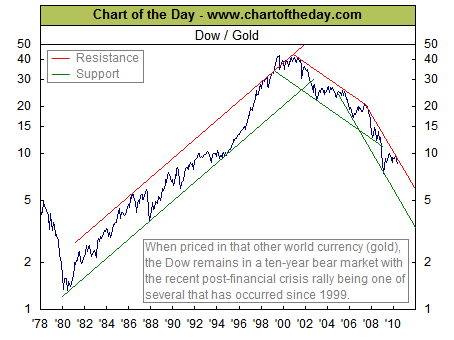
How is the stock market performing? It all depends on how you measure. When measured in US dollars, the Dow currently trades approximately 28% below its all-time record high. However, when measured with that other world currency (gold), the picture is even more bleak. To help illustrate the point, today’s chart presents the Dow divided by the price of one ounce of gold. This results in what is referred to as the Dow / gold ratio or the cost of the Dow in ounces of gold. For example, it currently takes 8.5 ounces of gold to “buy the Dow.” This is considerably less that the 44.8 ounces back in the year 1999. When priced in gold, the US stock market has been in a severe bear market for the entire 21st century
Dennis Gartman: “Panic, confusion, margin calls and “risk management” are the marching orders of the day. We would like very much to suggest that there are other concerns driving the commodity markets, but that would be wrong. For the moment there is nothing else driving the market… or any capital market for that matter… than is the forex market. “
How do I get my free Chart of the Day?
Simply enter and submit your email address HERE (we won’t share it with anyone) and you will receive one free chart per week and instantly receive the latest free Chart of the Day.
What is Chart of the Day?
Chart of the Day is a world renowned email newsletter devoted to providing professional money managers, investment advisors and individual investors with exclusive charts on a variety of financial markets and indicators.

“The feds assume a relationship between the economy and tax revenue that is divorced from reality. Six decades of history have established one far-reaching fact that needs to be built into fiscal calculations: Increases in federal tax rates, particularly if targeted at the higher brackets, produce no additional revenue… a ratio of federal revenue to GDP of no more than 18.3% would be realistic.” – David Ranson, Wall Street Journal.
…..full article HERE
Average federal revenues, as % of GDP, over various periods:
1950-59: 17.2%
1960-69: 17.9%
1970-79: 17.9%
1980-89: 18.3%
1990-99: 18.6%
1960-2000: 18.2%
2000-08: 18.2%
Financial crises have occurred very often in history. They are caused by unsustainable bubbles that go bust, and from excessive risk-taking and debt-leveraging by the private sector during the bubble. Then in the wake of, and as part of the response to, the economic downturn, government debts and deficits grow to unsustainable levels that can lead to default or inflation if not corrected. The crisis we are going through now follows this pattern.
Today there is a lot of talk about “de-leveraging”, yet the data shows that de-leveraging has barely begun. Debt ratios in the corporate sector as well as households in the US have essentially stabilised at high levels.
At the same time, we are seeing a massive “re-leveraging” of the public sector with budget deficits on the order of 10 per cent of GDP. The IMF and OECD are projecting that the stock of public debt in advanced economies is going to double and reach an average level of 100 per cent of GDP in the coming years.
This is all actually quite typical of what happens in a financial crisis. What explains this re-leveraging? First, “automatic stabilisers” (such as unemployment compensation) came into play during the recession. Second, countercyclical fiscal policies (such as tax cuts and spending increases) have been implemented by government to avoid depression because private demand is collapsing. Third, we have decided to socialise some of the private losses in the financial, corporate and housing sectors and put them on the balance sheet of the government.
Raising taxes
So, there is a massive buildup of public debt. And the lesson of history is that unless this buildup of sovereign debt is tackled eventually by raising taxes and controlling spending, then there are only two outcomes: default or high inflation.
Historically, we have seen a series of defaults and sovereign debt crises in both advanced and emerging market economies. If you are a country like the US, the UK or Japan that can monetise its fiscal deficits, then you won’t have a sovereign debt event but high inflation that erodes the value of public debt. Inflation is therefore basically a capital transfer from creditors and savers to borrowers and dissavers, essentially from the private sector to the government.
While the markets these days are worrying about Greece, it is only the tip of the iceberg, or the canary in the coal mine of a much broader range of fiscal crises. Today it is Greece. Tomorrow it will be Spain, Portugal, Ireland and Iceland. Sooner or later Japan and the US will be at the core of the problem, shaking the global economy.
We need to recognize that we are in the next stage of financial crisis. The coming issue is not private-sector liabilities, but public-sector liabilities.
Revived economic growth alone will not generate enough tax revenue to relieve this sovereign debt crisis. Fiscal deficits are huge and structural. They are not due solely to a cyclical downturn in growth but to long-term commitments such as pensions, social security and health care. To avoid default or high inflation, the advanced economies will require some combination of raising revenues through taxes and cutting government spending.
In Europe, where tax rates are already very high, the right adjustment is cutting spending instead of raising taxes further. In the US, the average tax burden as a share of GDP is much lower than in other advanced economies. The right adjustment for the US would be to phase in revenue increases gradually over time so that you don’t kill the recovery while controlling the growth of government spending.
Political gridlock
What worries me most is the political gridlock in Washington. While everyone agrees that $10 trillion (Dh36.7 trillion) deficits (by the Obama administration’s own estimates) for the next decade are not sustainable, there is no political will to act. The two parties are completely divided. Effectively, the Republicans are against any form of revenue increases. The Democrats are against spending cuts, especially of entitlements.
If the Republicans take control of the House of Representatives in the next election and refuse any revenue increases while the Democrats veto spending cuts, the path of least resistance will be runaway fiscal deficits which will then be monetised by the Federal Reserve, which has already embarked on this path. In just the last year alone, the Federal Reserve has bought $1.8 trillion of Treasury securities and agency debt, a course that will inevitably lead to high inflation if sustained. It is what is popularly known as printing money.
In Greece (with yields higher than 12 per cent on two-year bonds) or Spain or Portugal, the bond markets are forcing an adjustment. In spite of the recession, the markets are telling them to either straighten out their problems or go bankrupt.
Unfortunately, there is no such adjustment being forced upon Washington at the moment because the bond market has not woken up to the dangers ahead. You can borrow at a zero percentrate on the short end and 3.6 per cent on the long end. As a result, the political system is going to resist fiscal consolidation. This means the risk of something serious happening in the US in the next two or three years is significant.
These Rules below from the Legendary Trader Dennis Gartman. For subscription information for the 5 page plus Daily Gartman Letter L.C. contact – Tel: 757 238 9346 Fax: 757 238 9546 or E-mail: dennis@thegartmanletter.com or HERE to subscribe at his website
1. Never, Ever, Ever, Under Any Circumstance, Add To A Losing Position… Ever! Adding to losing positions will lead to ruin. You can count on it. Ask the Nobel Laureates in Economics at Long Term Capital!
2. Trade Like A Mercenary Soldier: As Jesse Livermore said, it is not ours to be bullish or bearish, but to be right.
3. Mental Capital Trumps Real Capital: Capital comes in two types; mental and real. Holding losing positions costs measurable real capital, but immeasurable mental capital.
4. We Are Not A Business Of Buying Low And Selling High; We are, however, a business of buying high and selling higher. Strength begets strength, and weakness further weakness almost always.
5. In Bull Markets One Can Only Be Long or Neutral, and in bear markets, one can only be short or neutral. This may seem self-evident, but very few understand it, and fewer still embrace it.
6. “Markets Can Remain Illogical Far Longer Than You Or I Can Remain Solvent.” J.M. Keynes. Illogic does often reign, and it is our duty to learn to handle it as best we might.
7. Buy Markets That Show The Greatest Strength; Sell Markets That Show The Greatest Weakness: Metaphorically, when bearish we need to throw rocks into the wettest paper sacks, for they break most easily. When bullish we need to sail the strongest winds, for they carry the farthest.
8. Think Like A Fundamentalist; Trade Like A Chartist: The fundamentals may drive a market and need to be understood, but if the chart is not bullish, why be bullish? Trade when the technicals and fundamentals, as you understand them, run in concert, one with the other.
9. Trading Runs in Cycles; Some Good; Most Bad: In “good times,” even errors turn to profits; in “bad times,” the most well researched trade will go awry. This is the nature of trading; accept it and move on.
10. Keep Your Technical Systems Simple: Complicated systems breed confusion; simplicity breeds elegance. The great traders we’ve known have the simplest methods of trading. There is a correlation here!
11: In Trading/Investing, An Understanding Of Mass Psychology is Often More Important Than An Understanding of Economics: Simply put, “When they are cryin’, you should be buyin’! and when they are yellin’, you should be sellin’!” This is psychology at work and its most elegant.
12. It Takes Buying And Lots Of It To Put A Market Up; It Takes Only A Lack Of Buying To Put Any Market Down: Gravity is an amazing force of nature; it is even more amazing in the world of investing.
13. There Is Never Just One Cockroach: The lesson of most markets is that bad news follows bad… usually hard upon and always with detrimental effect upon price, until such time as panic prevails and the weakest hands finally exit their positions.
14. Be Patient With Winning Trades; Be Enormously Impatient with Losing Trades: The older we get,the more small losses we take each year… and our profits grow accordingly.
15. Fear Turns To Greed At Break Even… And Vice Versa: Know this; understand this; accept this and deal with it.
16. Do More Of That Which Is Working and Less Of That Which Is Not: This works in life as well as trading. Do the things that have been proven of merit. Add to winning trades; Cut or eliminate losing ones. If there is a “secret” to trading (and of life), this is it.
17. All Rules Are Meant To Be Broken…. but only very, very infrequently. Genius comes in knowing how truly infrequently one can do so and still prosper, but when one must, one must!
-
I know Mike is a very solid investor and respect his opinions very much. So if he says pay attention to this or that - I will.
~ Dale G.
-
I've started managing my own investments so view Michael's site as a one-stop shop from which to get information and perspectives.
~ Dave E.
-
Michael offers easy reading, honest, common sense information that anyone can use in a practical manner.
~ der_al.
-
A sane voice in a scrambled investment world.
~ Ed R.
Inside Edge Pro Contributors

Greg Weldon

Josef Schachter

Tyler Bollhorn

Ryan Irvine

Paul Beattie

Martin Straith

Patrick Ceresna

Mark Leibovit

James Thorne

Victor Adair