
Investment/Finances
Too much stuff.
People come to think what they must think when they must think it. With stagnant incomes, towering debts, and no real hope of increasing their purchasing power, they’re beginning to think that they don’t need so much stuff.
“Rethinking the pursuit of happiness in a recession,” is a headline from The New York Times. The article talks about people who live quite happily and comfortably with little stuff and little income. One couple has an income of $24,000 per year – and no debt. They make a point of having 100 personal items – or less. They could earn more money, but they don’t need to. Because they are no longer supporting so much stuff.
“The idea that you need to go bigger to be happy is false,” says the woman in question.
“Studies of consumption and happiness show that people are happier when they spend money on experiences rather than material objects,” says the Times.
And when people downsize their lives intentionally they end up with more time and money to spend on experiences – such as vacations. Or tennis lessons. Or reading a good book.
You take a vacation. Even if it isn’t perfect, you tend to remember the good parts for a long time. An object, on the other hand, gives its satisfaction very quickly…and then becomes a source of expense and nuisance.
We spent the last week cleaning out the garage and the workshop.
“I just can’t believe it. I mean, how fast things fill up. We bought this place 15 years ago. It was huge. It was empty. I thought we could fill it with junk for the rest of our lives. But now it’s so full, we have to throw things out. Besides, I’ve had enough of this. I want to get rid of all this. From now on, I want to lead a simpler, more organized life.”
Elizabeth seemed ready to take up the “less is more” chant herself.
“No, I don’t necessarily want less… I want better. And that means being more choosy and getting rid of junk. We keep things for years and years thinking we’ll need them. Then, we don’t need them at all and have to throw them out.”
Damien (our gardener) backed up a big wagon in front of the garage. Old paint cans. Bicycles with broken wheels. Pieces of steel. Cardboard boxes. A rusty barbecue. Everything went into the wagon.
“Wait…Damien…what’s that you’re throwing away…?”
Once he gets started, Damien is hard to stop. In his hands was an antique – a hoe-like metal object used for raking the coals out of a brick bread oven.
“Wait a minute…let’s save that.”
“Why, what good is it?”
“I don’t know…it’s an antique…”
“Well, if we wait long enough, everything will be an antique…”
“Good point.” The hoe went into the wagon too.
Regards,
Bill Bonner
for The Daily Reckoning
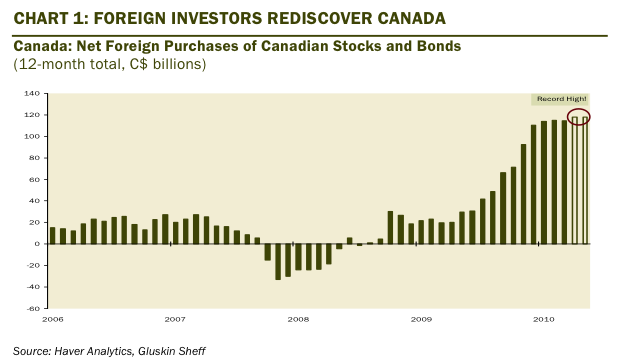
We just hosted a dinner in Boca Raton, Florida, and once again, the interest among American high net worth families in Canada is overwhelming. Indeed, the relative risk-reward opportunity of investing in Canadian assets relative to the United States has rarely been as compelling as is the case today.
Cities and states are running out of cash. In response Governments Go to Extremes as the Downturn Wears On. Here are few examples
Hawaii Furloughs Its Children
Four-day weeks have been used by a small number of rural school districts in the United States, especially since the oil shortage of the 1970s. During the current downturn, their ranks have swelled to more than 120 districts, and more are weighing the change.
But Hawaii is an extreme case. It shut schools not only in rural areas but also in high-rise neighborhoods in Honolulu. Suffering from steep declines in tourism and construction, and owing billions of dollars to a pension system that has only 68.8 percent of the money it needs to cover its promises to state workers, Hawaii instituted the furloughs even after getting $110 million in stimulus money for schools.
Unlike most districts with four-day weeks, Hawaii did not lengthen the hours of its remaining school days: its 163-day school year was the shortest in the nation.
Children, meanwhile, adjusted to a new reality of T.G.I.T. Getting them up for school on Mondays grew harder. Fridays were filled with trips to pools and beaches, hours of television and Wii, long stretches alone for older children, and, occasionally, successful attempts to get them to do their homework early.
But if three-day-weekends in Hawaii sound appealing in theory, many children said that they wound up missing school.
“I’m really not a big fan of furloughs,” said Nira Marte, a fifth grader, explaining that she missed the time with her friends and her teacher.
….read more HERE
“The man [Bernanke] has taken $400 billion, $400 billion, onto the Federal Reserve’s balance sheets, of dicey loans at best. I mean he’s turning the Federal Reserve into a pawn shop. You have something bad, that you can’t sell, take it to the Federal Reserve, he’ll lend you treasury bills against it, or treasury bonds against it. Now someday somebody’s got to pay for that and you know who the somebody is? My little girl, you, me, I mean, it’s going to be the American taxpayer that’s going to have to pay for this…”
“What if, I wonder, the whole modern construct of what passes for making the right moves in an advanced society is plain wrong?”
“I asked someone who knows what percentage of their income – which is to say the income of a reasonably successful person – now goes to taxes, and the answer was, “Over 60%.”
What if the modern version of society is really nothing more than a sleight of hand designed to fool the masses into becoming little more than government mules, allowed their simple pleasures in exchange for providing the muscle and the money needed to feed the beast?”

A Philosophical Look: The Meaning of Life in the West
Watching my children grow older, now heading into the treacherous shoals of the teenage years, has been a visceral reminder of how the human mind develops. As young children, we see the world with fresh eyes and wonderment, and then quickly begin testing the physical and societal bounds as part of morphing into our more mature selves.
As we age into our teens and beyond, the testing of boundaries evolves into a series of calculations. If I do “A,” we wonder, will it lead to “B” or maybe “Z”?
From a young age, most of us are told to advance our education and otherwise better ourselves so that we will be able to find a good job, or a succession of good jobs, that will provide sustenance and security lasting most of a lifetime before retiring to dawdle about in our golden years.
At least that is the modern view of life pursued by the vast majority of the citizenry in the developed world.
But having spent some time in rural Argentina recently – where it seems to me that most people spend more time living and less time planning to live – I have had some time to ponder the assumptions embedded in this view.
What if, I wonder, the whole modern construct of what passes for making the right moves in an advanced society is plain wrong?
Is the goal of working hard to get a good job and then moving up the corporate ladder really so desirable? Is marrying and having 2.5 kids and growing old in a glorified box in the burbs really so wonderful?
I asked someone who knows what percentage of their income – which is to say the income of a reasonably successful person – now goes to taxes, and the answer was, “Over 60%.”
What if the modern version of society is really nothing more than a sleight of hand designed to fool the masses into becoming little more than government mules, allowed their simple pleasures in exchange for providing the muscle and the money needed to feed the beast?
An increasing number of the mules seem to me to have become disheartened at the difficulty of creating and keeping enough wealth to live the life envisioned in youthful dreams. And correctly so: building lasting wealth is relatively easy when you keep 90%, but nearly impossible when you keep just 40%. And, if the trend now in motion continues in motion, the productive elements will soon be lucky to keep 30%.
While even I can’t foresee things getting as bad as they did in Britain in 1974, when the top 750,000 wage earners were slapped with a tax rate of 98%, the steady build toward more regulations, more government, more tariffs, and more taxes in more sectors of the economy will affect a broader swath of the public and, in so doing, weigh even more heavily on the nation.
And it will result in much the same thing experienced by the British at the time – a mass expatriation by the more independent-minded and entrepreneurial types.
(While the audience obviously skews toward the idea of expatriation, it is interesting that a just concluded International Living survey found that some 96% of respondents were now actively considering expatriation.)
But I drift like a pick-up truck going too fast around a rain-slicked corner.
The modern version of the world, at least to my eyes, appears to be losing credence with an increasing number of Americans. Simply, the material well-being and little extras that we the people have previously dreamed of are now unaffordable for most – especially now that a willingness to take on an excess of debt is no longer being readily confused with net worth.
For the government, with its switch long rusted on expansion mode, the promises of a better tomorrow must be preserved, if only as an inspirational illusion. Yet, with the hard reality of a collapsing Camelot obvious for all to see, the administration and Congress are now discomforted by the loud chorus of mules braying for more and better fodder. And increasingly by the voices of others, the workers in this economy, who are beginning to chafe in the traces.
Attempting to maintain societal status quo, the government is pursuing fiscal and monetary policies that are anything but status quo, including running trillion-dollar deficits as far as the eye can see. But maintaining the status quo is only going to get harder. Social Security, a time bomb planted by FDR, will run a deficit this year, as opposed to 2017 as recently believed. The deficit is no surprise to anyone, but the accelerating pace of the nation’s fiscal ruin very much should be.
I was in grade school when John F. Kennedy delivered his signature line, “Ask not what your country can do for you, but rather what you can do for your country.”
In today’s paradigm, millions of Americans demand that the country do more for them than they are willing or able to do for themselves, for many in no small part because they have already been asked to give up so much. At the same time, the government is making increasingly muscular demands that those still able to give, give more.
On both sides of the equation, the government looms large – as you would expect it to in a world where public institutions have become the controlling force in virtually all aspects of life.
But the paradigm is broken, in no small part because a long succession of U.S. governments have habitually made politically easy or expedient choices – in the process squandering the wealth of generations and setting the stage for a serious confrontation between the government mules that have and those that have naught.
Of course, I hope for the best as the country goes through the paradigm shift to whatever’s coming next. Yet, because no one can say what the new paradigm will look like – and a lot less or a lot more government are both equally likely – I am simultaneously planning for the worst, including buying hard assets and diversifying internationally.
To fail to do so would be to passively accept the life of a government mule.
—-
As David said, diversifying internationally is one of the most critical things to do right now, for any savvy investor. Discover the 5 best ways of “going global” in our new report.
-
I know Mike is a very solid investor and respect his opinions very much. So if he says pay attention to this or that - I will.
~ Dale G.
-
I've started managing my own investments so view Michael's site as a one-stop shop from which to get information and perspectives.
~ Dave E.
-
Michael offers easy reading, honest, common sense information that anyone can use in a practical manner.
~ der_al.
-
A sane voice in a scrambled investment world.
~ Ed R.
Inside Edge Pro Contributors

Greg Weldon

Josef Schachter

Tyler Bollhorn

Ryan Irvine

Paul Beattie

Martin Straith

Patrick Ceresna

Mark Leibovit

James Thorne

Victor Adair