
Investment/Finances
A brief Dollar rally began after the US elections and the official announcement of QEII by the US Fed. The two created a great trading week in currencies, but more so in commodities.
[Journal Preface] Did we mention we’re contrarians at heart? As October wore on and legions of new “experts” declared resources the place to be we started to get uncomfortable with the sudden surfeit of company we had in the metals space. Not that we mind fresh buyers coming in after we own something. Far from it. Still, things became so good so quickly it’s hard not to get nervous.
Longer term we have no concerns but short term things truly are overdue for at least a small pull back. Most of the expected good news has been delivered at a market level and buyers seem to be running out of reasons to keep buying. Add to that a tsunami of institutional money that, contrary to popular opinion and fund marketing brochures is often the last in, and we think things will settle for a while here.
A brief Dollar rally began after the US elections and the official announcement of QEII by the US Fed. The two created a great trading week in currencies, but more so in commodities. QEII has become a lightning rod for policy concerns surrounding the greenback. Combine this with on-going concerns out of Euroland and expectation of continued strength for hard assets, which we expect to continue for a while yet. While obviously good for the metals space, a more cautious approach by those who were early in the metal price moves should still be the order of the day.
It isn’t clear whether the new Republicans in the US Congress will extend a tax cutting focus to actual deficit cutting and the true fiscal easing that brings. They may push towards balanced budgets and create a cross Atlantic alignment which could prove highly useful, but that will be next year’s story. The start of QEII makes it clear monetary expansion is still favoured in Washington. This “weak Dollar” policy in all but name has been jet fuel for metal prices.
Large pools of cash are now scrambling to get into the metals space in response to these policy concerns. These require liquidity, and ideally an element of leverage as well. That has been bringing funds into mid-tier producers, and increasingly into explorers with larger assets on offer. This isn’t, so far, a tide lifting all boats. Precious metals and copper are still favoured areas, plus situations that look like potential take-over candidates. We have some comment on what makes a junior take-over candidate, after some thoughts on a take-over that now looks unlikely.
The decision by Canada’s federal government to not allow the bid by BHP Billiton for Potash Corp of Saskatchewan (POT-T, N;) will be a starting point for further discussion. A lot of market minded Canadians either agree with the decision or at the least have been voicing mixed feelings on the bid. Many domestic commentators have suggested it’s a bad omen for Canadian markets. We don’t think so.
The government of Saskatchewan led opposition to the bid by labeling it a special case. POT has half of the world’s defined potash resource in hand as well as 30% of current output. The deposits it mines are rich, but also deep and expensive to capitalize. Even though the province vested its shares of POT into public markets long since, it has concerns about revenue streaming and more simply about how major mineral suppliers are regulated.
BHP counterpoints that POT sells through a Sask based marketing agent that handles all of the province’s potash orders. It is the effective price setter for potash. BHP said it would do its own sales directly and let the market set prices, while pushing as much product into the market as it could. That might reduce the Sask government’s tax revenues and jeopardize its other potash producers if it knocked prices down. Realistically this would be very unlikely to sideline existing production, but it could dampen new development.
These statements on marketing by BHP bid were what set off the alarm bells in Saskatchewan. The company may have expected a sympathetic hearing about breaking up a cartel-like oligopoly. However, BHP has used a similar price setting mechanism for iron ore and the breakdown of that system now appears to favor large sellers. But there is no reason to point fingers in either case — price setting systems for bulk minerals allowed miners to operate through decades of low margins. Oligopolies surround bulk minerals because no one else wanted to play.
Those low margins prevented capital infusions to mining, and hence supply constraints now that more buyers are available. The Saskatchewan government could adjust the taxing of potash to increase its revenue stream, but that’s not its biggest concern. Large mining concerns have become big pools of wealth after a century in the wilderness, and the real concern is over who controls the authority that wealth brings.
In 2000 the BHP valuation (prior to the merger with Billiton) bottomed at $15 billion, or less than half its offer for POT. Today BHP is in the top 1% of corporate scale, and taking over POT is one of the few ways it has to expand at scale. The billions required for a new potash mine is much easier to find than it had been, but still requires a pool of expertise and underlying financial assurance to do. Canada giving that up, again, is the real issue.
Canada has lots of expertise in financing and developing deep mines. During the nickel company take overs we and others argued that the equity gains could circulate back into start-up companies that are an important part of the country’s mining market. Others argued that losing them and Alcan as independents “hollowed out” the Canadian industry, and that argument has gained ground in the past few years.
Market ethics were pushed aside to deal with the Credit Crunch. Canada’s “plodding” banking sector enjoyed the fruits of its prudence while competitors imploded. A special case its true, and it wasn’t just Canadian banks that eschewed the advantages in front of them. Two years from that nadir a much improved future for resource sectors is an established fact. Scarcity and allocation of resources is a growing, and a “special”, concern.
Any area with a large share of a mineral market is going to be drawn in to those concerns. The POT output and assets will be a part of that. As a fraction of any corporation large enough to bid for them they could become levers that press the mining jurisdiction to choose between competing forces quite outside the potash business. We are in the mixed feelings camp, but do respect the simple truth that no one has a “right” response to the bid. A pause to rethink the rules even at the expense of blunting market forces makes sense for everyone this time.
M&A Continues Apace
The two copper companies we follow that are in the midst of being taken-over show two aspects of M&A. The Globestar deal prices in cash flow projections from its existing mine, with several other assets as a potential bonus for the buyer. The Antares take over is based on an evaluation of a single asset still years from cash flow. What makes them similar?
Obviously both being copper stories does. That’s not a coincidence. The Crunch related downdraft for metal companies has been worked out of the market, and copper’s supply constraint is topical. Some will question whether that’s a red flag for the sector. History does indicate that take-over heats up at the bottom and the top of warehousing cycles — when assets are cheap or when buyers are flush. In this secular cycle it is about buyers being flush, which may signal an intra-cycle consolidation point. Few believe it’s a true top for copper, including us. That being true, more of the same is likely.
Another important similarity is a regional upside potential for the buyer, each at its own scale. The Cerro de Maimón mine is the only one dealing with VMS deposits in central Dominican Republic. Since these high-grade systems tend to travel well, that makes the Globestar buyer the regional go-to for other deposits in the district. While Antares’ Haquira is a one off, it is in Peru’s rapidly expanding copper belt and this gives buyer First Quantum entry to arguably the best place to expand outside of its African base. So yes, location is important.
That leaves scale and quality. While shareholders would prefer discoveries to be large, its actually buyers’ scale that is important to the deal. The Globestar operation is a scale we have been avoiding at exploration level since the Crunch, but it’s also profitable for a smaller producers. For metals with diversified supply like copper or gold there are buyers at most deposit scales and the GMI bid now opens up the field for other deposits of this scale. Scale is more important in subsectors with fewer buyers, but keep in mind that very small markets don’t need big deposits. Quality is more important to them.
Quality is a big subject that we will leave for now, outside of comments in the various updates.
CLICK HERE to access your FREE Yukon Report from HRA now! HRA initiated coverage on 15 companies since early 2009 – the average gain to October 10, 2010 is 278%!
The HRA – Journal, HRA-Dispatch and HRA- Special Delivery are independent publications produced and distributed by Stockwork Consulting Ltd, which is committed to providing timely and factual analysis of junior mining, resource, and other venture capital companies. Companies are chosen on the basis of a speculative potential for significant upside gains resulting from asset-base expansion. These are generally high-risk securities, and opinions contained herein are time and market sensitive. No statement or expression of opinion, or any other matter herein, directly or indirectly, is an offer, solicitation or recommendation to buy or sell any securities mentioned. While we believe all sources of information to be factual and reliable we in no way represent or guarantee the accuracy thereof, nor of the statements made herein. We do not receive or request compensation in any form in order to feature companies in these publications. We may, or may not, own securities and/or options to acquire securities of the companies mentioned herein. This document is protected by the copyright laws of Canada and the U.S. and may not be reproduced in any form for other than for personal use without the prior written consent of the publisher. This document may be quoted, in context, provided proper credit is given.
©2010 Stockwork Consulting Ltd. All Rights Reserved.
Published by Stockwork Consulting Ltd.
Box 85909, Phoenix AZ , 85071 Toll Free 1-877-528-3958
hra@publishers-mgmt.com http://www.hraadvisory.com
Daily Telegraph: Europe’s hastily assembled bailout fund already seems to be coming apart at the seams, and that’s before Ireland has even tapped into it. Austria is refusing to contribute bailout money for Greece, citing the country’s failure to meet conditions……read more HERE
NY Times: “If things are getting worse in Ireland, for instance, that will have a contagion impact on the other euro zone economies ” …read more HERE
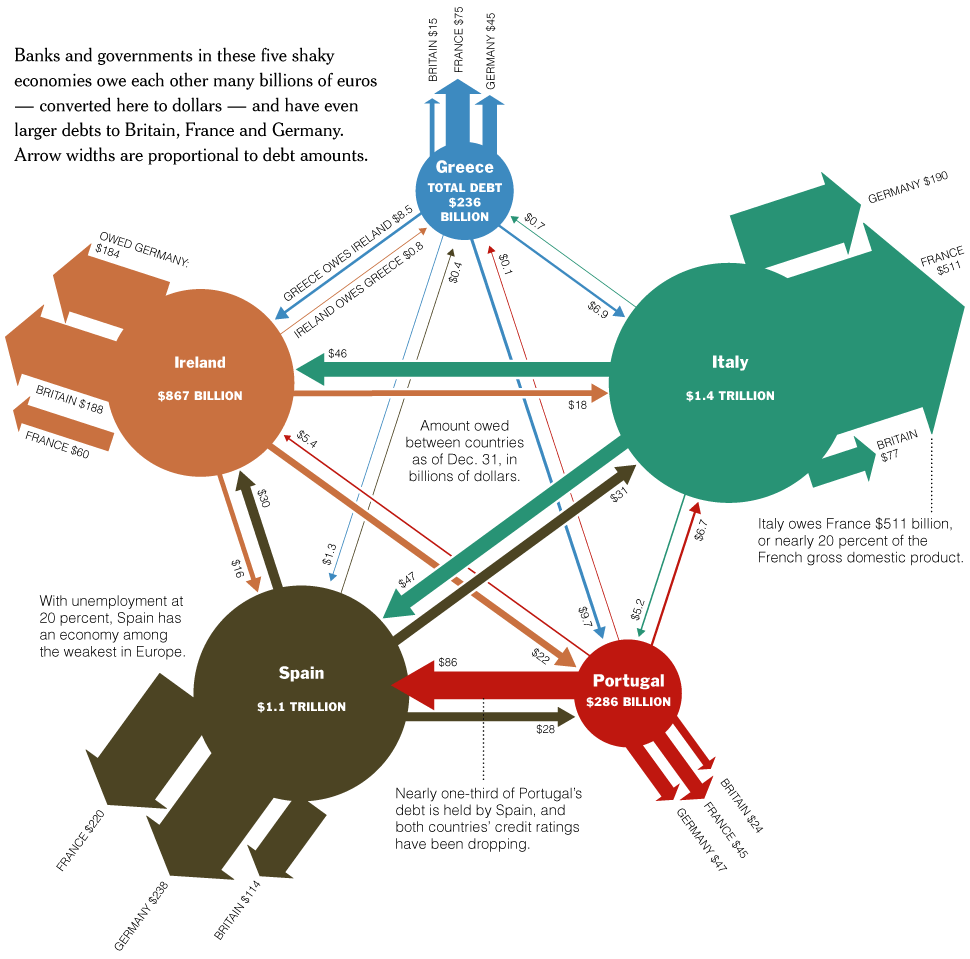
For a larger image click HERE
Fasten Your Seat Belt: Europe Collapse has begun
by John R. Taylor via Victor Adair
Now that Ben Bernanke has re-introduced quantitative easing (QE2) to a mostly incredulous world and, across the ocean, the Eurozone has begun unraveling again, our thoughts should turn to the parlous state of the world and the risks ahead. These are amazing times and seem to grow more so every day. Policy errors are popping up everywhere and are likely to multiply dramatically as the political problems are serious, answers hard to find, and the decision makers are not up to the task. Bernanke has proven that he is more a college professor and less a trader, which will cost the world dearly. Sometime between June and August Bernanke lost his stomach for the “exit strategy,” probably influenced by his predecessor’s summer announcement that the US economy had ‘hit an invisible wall.” While it can be argued that QE1 has been a success due to the liquidity crisis, it did not expand the Fed’s balance sheet and came when the economy was still reeling. This new edition dramatically expands the balance sheet, actually funding the entire projected government deficit over the next few months. Although the world believes that QE2 is there to push the dollar sharply lower, Bernanke argued that his goal was something else. On the day after the Fed’s move, he wrote in a Washington Post editorial piece that QE2 would push up the equity market, bonds, and other risky securities thereby stimulating consumption and economic activity. Even Greenspan did not publicly proclaim his “put,” but now Bernanke has made it the centerpiece of US strategy. Equities are already overpriced, with profit margins at all-time highs and PE ratios far above average. Speculation is now more American than apple pie – but this is a very risky time to practice it. As one highly respected analyst noted about Bernanke’s article, “these are undoubtedly among the most ignorant remarks ever made by a central banker.” As we and many others have noted that QE has shown little or no positive impact on actual economic activity, so the Fed has taken a big gamble, and if it fails as we expect it will have nowhere else to go. With the Republican victory tainted by the Tea Party “starve the beast” mentality, austerity has come to Washington. This next year will be a terrible one for the world’s biggest economy, so we would go against Bernanke on the equity side, but buy government bonds along with him.
The Eurozone has begun its collapse a little later than we thought. My compliments to the political prowess of the euro-leaders for holding things together for so long, but this is an impossible situation and the crisis is on its way. Jean-Claude Trichet caught the spirit of the situation today in Seoul when he said that “it is absolutely necessary to change the governance of Europe” and called for moving “as far as possible in the direction of an economic and budgetary quasi-federation.” I only disagree with part of one word, ‘quasi,‘ as Europe must move to a full economic federation if the euro is to survive. With 16 countries using the euro and Estonia on the way, the odds of moving there is currently lower than infinitesimal. Things will change after the approaching horrible economic and political catastrophes that will wrack some of these economies and societies. Unfortunately nothing will happen before the current situation gets unbearable – this is the way of democratic politics. As all the leaders are still working toward the same goals, and no one has stepped forward express the inchoate fears of the European populace, this should take years. By the start of next year the Eurozone will enter a recession that will test the current leadership. The euro, which has been perceived as if it were a German mark, has already topped and will decline until it is priced like an Italian lira in the next few months. With Europe and the US in recession next year, commodity prices will drop again and global growth will suffer despite the outperformance of domestic Asian economies. With the policy stresses, and the risk of significant errors in judgment, international strife becomes more likely as well.
By John R. Taylor, Jr.
Chief Investment Officer, FX Concepts
http://www.fx-concepts.com/
Headquartered in New York City, we are one of the world’s leading independent providers of foreign currency management and research. Since 1988, we have managed currencies for institutional investors through both overlay and absolute return strategies. We employ a unique methodology integrating the study of cycles, quantitative model-building, and technical forecasting.
We have a long track record of innovation in currency management. In a market where diversification is limited, we have controlled risk and enhanced returns by using diverse instruments and markets, such as emerging currencies and options. Our track record in currency management confirms our belief that technical and quantitative models, combined with market intelligence and experience, provide consistently superior risk-adjusted performance.
Axe Spending, Slash Government Employees – Simplify & Cut Taxes. I the President’s National Commission on Fiscal Responsibility and Reform Proposal the overall goals are to achieve $4 trillion in deficit reduction through 2020, reduce the deficit to 2.2% of GDP by 2015, cap revenue at or below 21% of GDP, reduce the debt to 40% of GDP by 2037, modify the tax code, reduce tax rates, slow down the rate of healthcare costs, and to lengthen Social Security’s solvency.
It’s broken up into 5 parts:
1. Enact tough discretionary spending caps and provide $200 billion in illustrative domestic and defense savings in 2015.
2. Pass tax reform that dramatically reduces rates, simplifies the code, broadens the base, and reduces the deficit.
3. Address the “Doc Fix” not through deficit spending but through savings from payment reforms, cost-sharing, and malpractice reform, and long-term measures to control health care cost growth.
4. Achieve mandatory savings from farm subsidies, military and civil service retirement.
5. Ensure Social Security solvency for the next 75 years while reducing poverty among seniors.
Discretionary Spending Caps:
The spending caps don’t kick in until 2012 – no mention if it’s before of after the elections – and will only be rolled back to 2010 levels. Starting in 2013, there will be an additional 1% cut in discretionary budget authority every year though 2015.
$200 billion in cuts, split evenly between defense and domestic spending, can be found on pages 19 and 20 of the report.
A few that caught our attention include:
Sponsor
Defense:
- Freeze federal salaries, bonuses, and other compensation at the Department of Defense for three years.
- Freeze noncombat military pay at 2011 levels for 3 years.
- Reduce spending on Research, Development, Test & Evaluation by 10 percent.
- Reduce overseas bases by one-third.
Domestic:
- Freeze federal salaries, bonuses, and other compensation at non-Defense agencies for three years.
- Cut the federal workforce by 10% (2-for-3 replacement rate).
- Eliminate 250,000 non-defense service and staff augmenteecontractors.
- Eliminate all earmarks.
- Slow the growth of foreign aid.
Comprehensive Tax Reform:
The proposal includes 3 plans for changing and simplifying the tax code. Each calls for the elimination of some tax credits, write-offs and deductions (maybe even including the mortgage deduction). In return, the income tax-rates will be lowered.
The Zero Plan (we think the zero stands for zero deductions and tax credits) would set income tax rates at 8%, 14% and 23% and rise as credits and deductions are added back in. Capital gains and dividends would be taxed as ordinary income. The corporate rate would be reduced to 26%.
Wyden-Gregg Style Reform would repeal AMT, PEP, and Pease, establish 3 rates –15%, 25% and 35%, and triple standard deduction to $30,000 ($15,000 for individuals).
However, it would repeal state & local tax deduction, cafeteria plans, and miscellaneous itemized deductions, limit mortgage deduction to exclude 2nd residences, home equity loans, and mortgages over $500,000 and limit charitable deduction with floor at 2% of AGI.( iStock is not a fan of discouraging charitable contributions.) The Wyden-Gregg makes no mention of cap-gains or dividends.
The 3rd option calls on the Finance and Ways & Means Committees and Treasury to develop and enact comprehensive tax reform by end of 2012. In the meantime, it would give a “haircut” for itemized deductions, employer health exclusion, and general business credits that would take effect in 2013 if reform is not yet enacted.
This plan makes no mention or suggestion as to whether all or some of the Bush tax-cuts should be extended, or for how long. To iStock – option 3 is by far the least attractive of the plans.
Of the plans – we probably prefer option 1 without exemptions.
Reducing Health Care Costs:
Paying doctors less and tort reform sums up this section fairly well.
In addition to alienating Drs and lawyers, starting in 2020, the panel suggests containing growth in total federal health spending to GDP+1% by establishing a process to regularly evaluate cost increases.
With benefits and costs of Obamacare up in the air and not address by the commission, nobody knows what healthcare costs for the federal government and states are going to be. There have been plenty of headlines about employers dropping coverage, the McDonalds exemption, increasing premiums…
All of these issues are likely to drive more – not less – people into government provided healthcare. In addition, the high cost of paying for pre-existing conditions will have to come from somewhere.
In all likelihood, a greater share of the cost of healthcare is going to be hoisted upon the federal and state governments. Under that scenario, iStock is not sure that paying Dr.s and lawyers less and GDP+1% are real solutions to containing this monster’s escalation.
Mandatory Savings:
The two biggest savers are using a lower inflation calculation for indexing costs and reducing farm subsidies by $3 billion per year. In addition, federal workers will have to pay ½ of their pension costs – not the current 1/14th.
Most of the cost cuts in this section are small; between 2011 and 2020 the total saving is estimated to be $248 billion. Besides military personnel and federal employees, most American’s won’t even notice the difference.
Strengthening Social Security:
The idea is to have people work longer, receive smaller cost of living adjustments, tax more income, reduce benefits for high income earners (means testing) and have state and local government employees start to contribute in 2020 (no federal employees?).
Anybody that’s ever paid attention knew years ago that these Social Security changes were inevitable. Heck, when I was ten, thirty-four years ago, my dad told me these adjustments were coming. What the hell took the government so long to admit it?
This is the first year that the “trust fund” is paying out more money than it is taking in. Seniors are not seeing any cost of living increases, while costs are going up. Social Security is already broken.
Entitlement reform, while likely to shortchange many, is 100% necessary. Between Medicare and Social Security, the US has somewhere between $70 and $140 trillion in unfunded liabilities. We have read that there is not that much money in the entire world!
Like it or not, we have real structural problems that require real solutions. The President’s National Commission on Fiscal Responsibility and Reform is a good way to get the national conversation started on how and what changes we are willing to make. However, the time for talk is short, and the need for action is now.
Sincerely,
iStockAnalyst.com Staff
Two years have passed since the worst financial crisis since the 1930s dealt a body blow to the world economy. Working with policymakers at home and abroad, the Federal Reserve responded with strong and creative measures to help stabilize the financial system and the economy. Among the Fed’s responses was a dramatic easing of monetary policy – reducing short-term interest rates nearly to zero. The Fed also purchased more than a trillion dollars’ worth of Treasury securities and U.S.-backed mortgage-related securities, which helped reduce longer-term interest rates, such as those for mortgages and corporate bonds. These steps helped end the economic free fall and set the stage for a resumption of economic growth in mid-2009.
-
I know Mike is a very solid investor and respect his opinions very much. So if he says pay attention to this or that - I will.
~ Dale G.
-
I've started managing my own investments so view Michael's site as a one-stop shop from which to get information and perspectives.
~ Dave E.
-
Michael offers easy reading, honest, common sense information that anyone can use in a practical manner.
~ der_al.
-
A sane voice in a scrambled investment world.
~ Ed R.
Inside Edge Pro Contributors

Greg Weldon

Josef Schachter

Tyler Bollhorn

Ryan Irvine

Paul Beattie

Martin Straith

Patrick Ceresna

Mark Leibovit

James Thorne

Victor Adair