
Daily Updates
There are many items that influence the day-to-day moves in a stock, bond, or commodity’s price — earnings news, corporate financials, simple supply and demand, and a whole lot more. Heck, I’ve even read an academic study that argued the weather has a huge influence on whether markets close up or down!
But when it comes to figuring out the bigger-picture, longer-term moves for whole investment classes, there’s nothing better than watching a few key economic indicators.
And since this week is going to be a very busy one for data releases, I wanted to spend a little time today talking about the most important indicators you should pay attention to, along with an update on where those items currently stand right now.
Let’s start with one that will be coming out this Friday and is sure to make a big splash …
U.S. Employment Numbers from
The Bureau of Labor Statistics
While weekly unemployment claims are somewhat important to the markets, the major employment dipstick is what we get from the BLS every month.
…..read full article HERE.
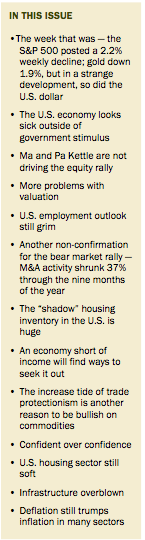
THE ECONOMY LOOKS SICK OUTSIDE OF GOVERNMENT STIMULUS
Now that Cash-for-Clunkers is over, auto sales are collapsing again. Edmunds.com says the run-rate so far in September is down to 8.8 million units at an annual rate, but we see now that JD Power’s tracking is down to 590,000, which would be little better than a 7.0 million rate or half the pace of August and 24% below the already-depressed levels of a year ago. The November 30th expiry date for the first-time homebuyer subsidy, and this group has been responsible for one-third of housing activity, may also have something to do with the below-consensus sales figures for August that came out last week.
But don’t worry — Uncle Sam is coming back to the rescue. Congress is moving to extend emergency jobless benefits to over one million workers who are about to see their benefits expire by year-end. The House already approved on Tuesday a 15-week extension in states with unemployment rates of 8.5% or higher (oh — that only includes 27 states right now, by the way) and now Congress is looking at extending and expanding the homeownership tax credit. The short-term-ism in fiscal policymaking in terms of still trying to promote consumption and credit remains is fully intact and is actually quite sad because the U.S. boomer population is seriously short of savings needed to fund a boom in the retirement community over the next two decades. A Harvard University report shows that 60% of Americans do not have enough savings to fund their retirement. Why the government wants to resist the natural trend towards higher savings rates is … well, it’s unnatural. When your homeownership rate is over 67% and your consumption-to-GDP ratio is over 70%, you’re no exactly suffering from under-spending.
ANOTHER REASON TO BE BULLISH ON COMMODITIES
It’s called trade protectionism. First came the U.S. tariffs on Chinese-made tires a few weeks ago. Then lat week we saw the EU impose anti-dumping duties of nearly 40% on imports of steel pipe from guess where? China. And now we hear out of Australia that its foreign investment regulator wants to impose 15% caps for global purchases of the country’s large companies.
….read more HERE.
Ed Note: Truthiness is a term first by comedian Stephen Colbert in 2005, to describe things that a person claims to know intuitively or “from the gut” without regard to evidence, logic, intellectual examination, or facts
PETROLEUM: THE POLITICS OF FEAR
The world is filled with uncertainties. How can politicians be so certain on the veracity of anthropogenic global warming? There is a large and persuasive body of scientific evidence that carbon dioxide is not the villain assumed in the Global Warming debate. Their naïve warming assumption is then compounded by the claim that man is the cause of the carbon effect. On both counts numerous scientific studies have countered to the opposite. Nevertheless both assumptions are regarded as fact today by the G20 political leaders. For example, in his recent speech to the United Nations President Obama said, “The danger posed by climate change cannot be denied, and our responsibility to meet it must not be deferred. If we continue down our current course, every member of this Assembly will see irreversible changes within their borders. Our efforts to end conflicts will be eclipsed by wars over refugees and resources. Development will be devastated by drought and famine. Land that human beings have lived on for millennia will disappear.” With so much evidence to the contrary, President Obama’s statement reflects the politics of fear. It is the modality of change in politics today. If you frighten people with rhetoric
enough legislators will vote for a bill that gives government more control. One aspect of the president’s demeanor cannot be denied and that is his ability to speak with authority while ignoring half the world’s scientific community.
I always reserve the right to change my mind. No state of nature exists in perpetuity. Change is constant. That’s the way I feel about the energy debate this AM. I have long believed that if North Americans solved their addictive dependence on foreign oil the world would be measurably better off. Both Mexico and Canada are also addicted – to oil exports. Throughout history wars a have been fought over supplies of dense, cheap energy such as oil. The First Gulf War is a more recent example. Today China is tying up all the energy and natural resource assets possible in Asia, Australia, Africa, and Canada. Russia’s claim to Arctic energy sovereignty and her belligerent stance on shipments of natural gas to Western Europe are other examples of the powerful ‘eco-politics’ of oil and gas addiction. Venezuela’s proposed shipment of gasoline to Iran is about petroleum geopolitics.
Nevertheless, the world’s petroleum-based economy is winding down. Have no doubt. Despite President Obama’s glib assurances to the contrary at the United Nations, the economic disruption will be significant and the transition will be longer than expected. It will not be as smooth as his UN talk. That is a real problem with the environmentalist program. Deep in my soul I am an environmentalist. But I am also a realist. More to the point I am a conservationist. You can talk all you want about environmentalism but no one can define it in rational application. If environmentalism is truly a global necessity (for example targeting Global Warming) why do Americans expect the copper mines in Chile to remain open (we import 37% of our copper from mines in countries like Chile) and why do we continue to worry about the security of the Straits of Hormuz? Let’s just do away with oil and petroleum. While we are in the process of environmental, self flagellation we might also do away with coal. A sensible person, for example Energy Secretary Chu, knows that alternative energy sources in their present form will supply only 25% of our energy needs by 2030. (See Energy Secretary Chu’s May 15, 2009 Bloomberg Interview). It seems, from the President’s speech at the United Nations, that he hasn’t listened to what his chief energy czar and a world-renowned scientist believes.
To believe that humans are the cause of the polar ice caps melting is height of hubris. There is plenty of scientific evidence that climatic warming and cooling runs in long cycles. There is even more compelling evidence that CO2 is a relatively minor greenhouse gas. In spite of this scientific evidence, Congress may pass exorbitantly expensive carbon cap and trade legislation. If the Senate does not pass this bill, President Obama’s EPA will surely unilaterally declare carbon dioxide gas as a pollutant.
The basic question in my mind is whether man or God controls the weather. I wish to err on the side of God. But Washington, London and Brussels in their politicized-hubris believe that we can change the climate, eliminate environmental hazards, increase the overall human quality of life for billions and run a productive global economy on much more expensive energy – all in the short run. The truth is that today’s alternative energy technologies are vastly more expensive than oil and gas and, yes, even coal. If I were a cynic I would suggest that the political motives are overriding common sense.
Peter Huber, Forbes November 27, 2006 makes a very good point. He claims that we are going to live with carbon and uranium for decades – perhaps only one or two or three (as Energy Secretary Chu suggests) but for many of us it will be a lifetime. The rest is simply the politics of fear – and boy how it is working. Huber notes,
“Most voters probably understand the tradeoffs between carbon and uranium, but few have a real grip on the realities that keep these fuels so dominant.”
Evidently our President fits into the category of bereft of the realities of dominant sources of energy. It is, therefore, fair to ask; what is a more realistic approach to address our energy addictions? There are three:
1) Develop a short term focus on energy addiction through Conservation. Within a decade the smart electric grid and smart appliances can conserve significant energy. Mass transit and hybrid vehicles will assist in this effort.
2) Develop an intermediate term plan (the next 10 to 15 years) to limit energy waste and reduce foreign energy dependence. Domestic natural gas for example is one plentiful source of energy that is relatively clean and will substitute for absurdly expensive bio-diesel and petroleum-based gasoline in the near term.
3) Spend as much energy R&D dollars as possible for a long term – 3 to 5 decades – solution. Nuclear energy, including uranium and thorium fuels, MUST be part of the long term solution if we are to be free from the blackmail and dwindling petroleum resources of foreign energy suppliers.
Perhaps the most important aspect of addressing the problem of North American energy addiction is to allow the commodity markets to determine the best solutions over the next decades. Not only are the claims of global warming (GW) and anthropogenic GW questionable, but so are today’s proposed solutions. Wind and solar in their current form, as alternative sources will not replace petroleum. Ask anyone from Nantucket if they want
their sea view littered with windmills. Not in their back yard! Nuclear, in the US, cannot get off the starting line. Senator Reid has helped President Obama kill funding for the nuclear waste repository planned in Nevada. Not in Senator Reid’s back yard!
There are not many economical, carbon free alternatives remaining – no matter what the environmental lobby contends. The litany of compounding of errors that I have discussed brings Michael Crichton’s comment to mind. In his book State of Fear, he said,
“Nobody believes a weather prediction 12 hours ahead. Now we are being asked to believe a prediction that goes out 100 years in to the future. And make financial investments based on that prediction? Has everybody lost their minds?”
Conservation in the very short run is achievable. Natural gas is plentiful and very, very cheap. Longer term nuclear is clean safer than it has ever been. Fourth Generation plants will burn all their nuclear fuel. It is time to make some hard and good decisions and stop tilting at windmills just to make excuses for more government intrusion into Everyman’s life.
You can sign up for Dr. Berry’s free Morning Notes HERE.
Michael Berry has been a portfolio manager for both Heartland Advisors and Kemper Scudder where he successfully managed small and mid cap value portfolios. Dr. Berry has specialized in the study of behavioral strategies for investing and has been published in a number of academic and practitioner journals. His definitive work on earnings surprise, with David Dreman, was published in 1995 in the Financial Analysts Journal.
Previously, Dr. Berry was a professor of investments at the Colgate Darden Graduate School of Business Administration at the University of Virginia and has also held the Wheat First Endowed Chair at James Madison University.
Dr. Berry is a respected and dynamic speaker. He regularly presents around the world on topics such as value investing, the role of Austrian Economics in investment management, behavioral investing strategies and is a specialist in developing case studies to teach investors how to invest. While a professor, he published a case book, Managing Investments: A Case Approach.
Ed Note: Tyler Bollhorn will be speaking at the:

The Money Talks All Star Trading Super Summit
Saturday, October 24, 2009 -The Sheraton Vancouver Wall Centre
Click HERE for the Speaker Lineup and to REGISTER if you want to take advantage of this Event.
Developing a Trading Strategy
Stockscores.com Perspectives for the week ending Sept. 25, 2009

Most traders start trading the stock market without much of a plan. They get a tip from a friend, perhaps read an article or watch a stock report on TV and decide to make that first trade. If the market is doing well they can get lucky and make a profit. Some virgin traders might even go a number of months trading profitably, convinced that they know what they are doing.
After 20 years of trading and training thousands on how to trade I can tell you that a person who trades without a well thought out plan will eventually lose. Their stock market profits are just short term loans which, as long as the trader continues in the game, eventually get repaid.
My first stock trade was motivated by a tip from a friend; I lost money. Despite the pain of losing I was captivated by the stock market and the notion that I could make money without having to work. Foolish thoughts to be sure, for making money in the stock market is certainly work, but that was something I would come to realize later.
- Get the StockSchool Pro Free

- DisnatDirect named the number one Canadian brokerage for Traders by Surviscor! Open and Fund a brokerage account with DisnatDirect and receive the StockSchool Pro home study course free, including special Pro level access through the DisnatDirect client website. Offer only available to Canadian residents. For information, click here
After a few years of stock market loans and repayments I realized that I was not getting any closer to my dream of making a living from the stock market. I decided I needed a plan and at the core of the plan would be a trading strategy.
It seemed obvious to me that if I was going to get good at picking winning stocks I should look at how winning stocks behaved early in their trends. I downloaded chart data for every stock that I could and manually went through those charts one at a time in search of the important trends that I wanted to be able to predict. I filled large binders with chart printouts, marked up with pencil identification of patterns that I found repeated over time.
Through this process I created a list of trading rules which I tested and retested. Satisfied that my rules worked I started to trade them. I did not have an abundance of capital when I began which is good since it meant that my mistakes did not cost me a lot. However, the process of applying my trading rules was informative and it led to modifications to my strategy. With time, success came and I started to pull money out of the market consistently. In one three month period I earned better than a 1500% return.
This sounds great, and it is a fun process. However, while it is simple it is not easy. There are a number of components that are needed to form a trading strategy and ultimately, the trading plan.
First, you need to have an idea. This should be the relatively simple foundation of the strategy, the source of the opportunity. Many of my trading strategies revolve around the idea that abnormal market activity is a clue to future price trends. I use this idea in different ways and I have a number of different strategies based on this same idea.
From the idea comes the rule development phase. First, what are the criteria for entry? These should be as simple and concise as possible for you need to be able to apply the rules over and over again without a lot of room for bias in how they are applied.
Most aspiring traders focus on the trade entry and forget to consider risk management and the entry point. Trust me when I say that the entry decision is the easy part; having good risk management and a set of rules for maximizing profit and minimizing loss is more important.
Traders don’t get to play if they lose all their capital. Capital preservation is absolutely essential and should be the focus for all traders. Taking big losses or tying up your cash in stocks that are going no where is how traders become long term investors.
For every trade you should know and be comfortable with the risk. You should have a set of rules to determine when the trade is a bust and you need to hit the eject button. I have never met a trader that was always right and so we all need to have a plan for what to do when we are wrong.
Our emotions get most involved in the exit decision. It is normal to worry about whether we are selling too early, that there may be more upside that we might miss out on if we sell. Of course, we also worry about the loss of profit, watching a winner turn in to a loser. Overcoming these emotions requires well tested rules for the best time to exit. The rules should maximize profitability over a large number of trades rather than trying to extract the most out of every trade. Trying to sell stocks at their tops is an expensive way to trade since it rarely happens. Be happy with getting most of the profit along the way but always be willing to leave a little on the table.
The process of developing a trading strategy can take months but as you gain more experience it should be far less time consuming. I developed a new trading strategy this past week over a couple of days and had fun doing it.
Be aware that a trading strategy should always evolve as market conditions change. That very first strategy that I developed years ago is something that I still use but I have constantly tweaked the rules over time to make sure it kept up with the changing market.
So, before you make another trade, make sure you have a plan. Write down your rules, test them to prove to yourself that they will make profits and then put money to work.

Every trader should have a few different strategies available to them for different market conditions. For the past number of weeks I have good success looking for abnormal breakouts from good chart patterns. However, since the market spent most of this past week pulling back from its highs, I think it is time to change it up a bit.
When I see a market with upward momentum pulling back I look for opportunities to play the pull back. Often, stocks will come back to their upward trend line and bounce off of it, resuming the longer term upward trend. I call this strategy a Pull Back Play, it is a swing trading strategy (with an expected hold period of less than two weeks) taught in the StockSchool Pro course.
I ran this Stockscores Market Scan this weekend and found a few set ups. I think we may still be a couple of days early since the major market indexes have not yet shown the signs of a bounce off of a trend line but I do expect it will happen soon. I suggest monitoring the market closely for the kind of set ups that you see in the stock featured below and continue to apply this strategy in the near term as the market is likely to bounce back from its recent weakness.

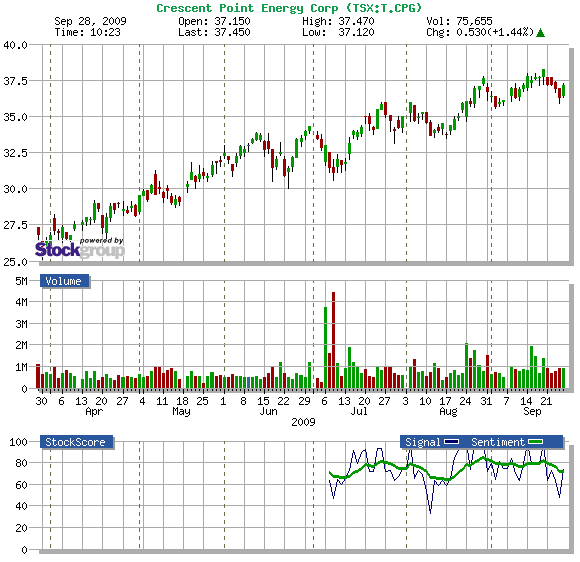
1. T.CPG
T.CPG has been in a very strong and orderly upward trend but has been pulling back from its high for the previous four days. On Friday it showed some new strength as it bounced off of the upward trend line. Support at $35.85.
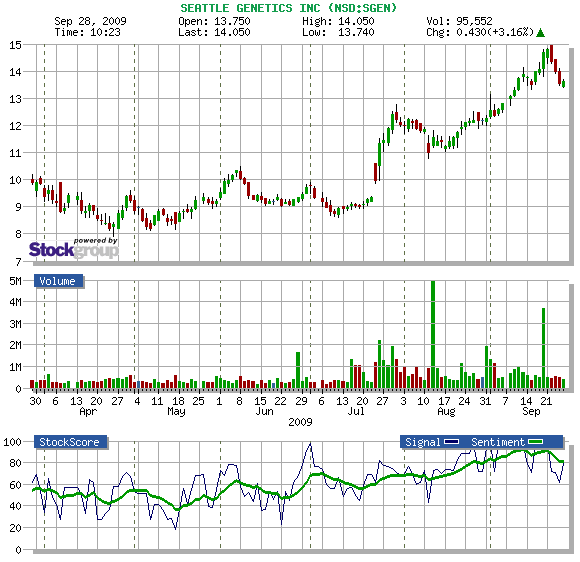
2. SGEN
The trend on SGEN got a little bit too steep up until this week but that was corrected by three days of selling pressure. This brought the stock back to its upward trend line and with the close above the open on Friday I think it can bounce back and continue higher in the short term. If the stock closes below support at $13.40 then this swing set up is a bust.
Tyler Bollhorn started trading the stock market with $3,000 in capital, some borrowed from his credit card, when he was just 19 years old. As he worked through the Business program at the University of Calgary, he constantly followed the market and traded stocks. Upon graduation, he could not shake his addiction to the market, and so he continued to trade and study the market by day, while working as a DJ at night. From his 600 square foot basement suite that he shared with his brother, Mr. Bollhorn pursued his dream of making his living buying and selling stocks.
Slowly, he began to learn how the market works, and more importantly, how to consistently make money from it. He realized that the stock market is not fair, and that a small group of people make most of the money while the general public suffers. Eventually, he found some of the key ingredients to success, and turned $30,000 in to half a million dollars in only 3 months. His career as a stock trader had finally flourished.
Much of Mr Bollhorn’s work was pioneering, so he had to create his own tools to identify opportunities. With a vision of making the research process simpler and more effective, he created the Stockscores Approach to trading, and partnered with Stockgroup in the creation of the Stockscores.com web site. He found that he enjoyed teaching others how the market works almost as much as trading it, and he has since taught hundreds of traders how to apply the Stockscores Approach to the market.
References
Get the Stockscore on any of over 20,000 North American stocks.
Background on the theories used by Stockscores.
Strategies that can help you find new opportunities.
Scan the market using extensive filter criteria.
Build a portfolio of stocks and view a slide show of their charts.
See which sectors are leading the market, and their components.
Disclaimer
This is not an investment advisory, and should not be used to make investment decisions. Information in Stockscores Perspectives is often opinionated and should be considered for information purposes only. No stock exchange anywhere has approved or disapproved of the information contained herein. There is no express or implied solicitation to buy or sell securities. The writers and editors of Perspectives may have positions in the stocks discussed above and may trade in the stocks mentioned. Don’t consider buying or selling any stock without conducting your own due diligence.
Brief comment below from the Ledendary Trader Dennis Gartman. For subscription information for the 5 page plus Daily Gartman Letter L.C. contact – Tel: 757 238 9346 Fax: 757 238 9546 or E-mail:dennis@thegartmanletter.com HERE to subscribe at his website.
“THE US$ IS STRONG; THE YEN, ON THE OTHER HAND, IS SOARING and the forex world has been turned upside down since Friday afternoon with the month and quarter end now upon us and the attitude toward the dollar and the Yen turn sharply against those who’ve grown accustomed everyday and every minute to selling those currencies and buying the others. The boat, as we have warned too many times of late, has indeed become too heavily laden with US dollar and Yen bears, and as the carry trades become too crowded, the rush to try to get through an ever smaller door to escape their losses before the month and quarter end is becoming maddening and difficult. The implications for the stock markets are not positive; the implications for the commodity markets are perhaps worse; the implications for the bond markets, on the other hand, are good and growing better.” – Dennis Gartman of The Gartman Letter.
Japan: Possible Culprit to Drive U.S. Interest Rates Higher
In investing, it’s important to think unconventionally and creatively while at the same time considering risks – no matter how remote or unmanageable they are. I keep thinking: What would drive our interest rates up in the US?
China is the obvious culprit as it’s the largest holder of our fine Treasury obligations. If China’s exports to the US don’t recover to the pre-Great Recession level then, considering its large overcapacity and bad-debt problems, it may quite suddenly find itself unable to buy as many of our bonds/bills. Or even worse, it may start selling them. But this scenario is one I’ve discussed in the past more than once.
Then you start looking down the list of who’s who in the ownership of our government debt, and you find Japan only slightly behind China. Japanese interest rates were circling around zero, but they still failed to stimulate the economy that’s been in a recession for as long as I can remember. The Japanese savings rate was very high, and thus, as government debt ballooned over the last two decades, it was happily absorbed by consumers who were net savers – they had extra funds to invest. However, Japan has one of the oldest populations in the developed world. As people get older they save less; thus the savings rate has been on a decline in Japan. (The fact that their exports fell 36% did not help their savings rate, either. To save you need income).
The appetite for Japanese bonds will decline in tandem with their savings rate. The Japanese government (and corporations) will have to start offering higher yields to entice interest in its bonds. Interest rates in Japan will rise, and this of course will put a significant interest-servicing burden on the already highly leveraged Japanese government. But more importantly (at least from our selfish US perch), Japan will finally become a formidable competitor for borrowing. Our borrowing costs will rise. In addition, Japan may also start buying less or selling US debt, not by choice but out of necessity, putting additional pressure on US interest rates.
Not to appear as an “on the other hand” economist (I’m not one), but the counter-argument to this is, the US consumer may become a net saver and will be able to offset (at least some of the) declining demand from our friends across the Pacific. – Vitaliy N. Katsenelson
Ed Note: The Legendary Trader Dennis Gartman will be speaking at the:
The Money Talks All Star Trading Super Summit
Saturday, October 24, 2009 -The Sheraton Vancouver Wall Centre
Click HERE for the Speaker Lineup and to REGISTER if you want to take advantage of this Event.
Mr. Gartman has been in the markets since August of 1974, upon finishing his graduate work from the North Carolina State University. He was an economist for Cotton, Inc. in the early 1970’s analyzing cotton supply/demand in the US textile industry. From there he went to NCNB in Charlotte, N. Carolina where he traded foreign exchange and money market instruments. In 1977, Mr. Gartman became the Chief Financial Futures Analyst for A.G. Becker & Company in Chicago, Illinois. Mr. Gartman was an independent member of the Chicago Board of Trade until 1985, trading in treasury bond, treasury note and GNMA futures contracts. In 1985, Mr. Gartman moved to Virginia to run the futures brokerage operation for the Virginia National Bank, and in 1987 Mr. Gartman began producing The Gartman Letter on a full time basis and continues to do so to this day.
Mr. Gartman has lectured on capital market creation to central banks and finance ministries around the world, and has taught classes for the Federal Reserve Bank’s School for Bank Examiners on derivatives since the early 1990’s. Mr. Gartman makes speeches on global economic and political concerns around the world.
Author of Japan: Possible Culprit to Drive U.S. Interest Rates Higher –Vitaliy N. Katsenelson
Vitaliy N. Katsenelson is a director of research at Investment Management Associates (http://www.imausa.com/). He is an author of Active Value Investing: Making Money in Range-Bound Markets (http://contrarianedge.com/book/) (John Wiley & Sons, 2007). He is also an adjunct faculty member at the University of Colorado at Denver, Graduate School of Business where he teaches Practical Equity Analysis and Portfolio Management class. Katsenelson is a regular contributor to the Financial Times and Forbes; wrote articles for Barron’s, BusinessWeek, The Rocky Mountain News, Financial Planning Magazine and many other financial publications (TheStreet.com, The Motley Fool, Minyanville.com, MarketWatch. He is a CFA charter holder, member of CFA Institute and has served on the boards of the CFA Society of Colorado. Katsenelson received both his bachelor of science and his master of science in finance from the University of Colorado at Denver, where he graduated cum laude. Visit his site, Vitaliy’s Contrarian Edge (http://www.contrarianedge.com/).
-
I know Mike is a very solid investor and respect his opinions very much. So if he says pay attention to this or that - I will.
~ Dale G.
-
I've started managing my own investments so view Michael's site as a one-stop shop from which to get information and perspectives.
~ Dave E.
-
Michael offers easy reading, honest, common sense information that anyone can use in a practical manner.
~ der_al.
-
A sane voice in a scrambled investment world.
~ Ed R.
Inside Edge Pro Contributors

Greg Weldon

Josef Schachter

Tyler Bollhorn

Ryan Irvine

Paul Beattie

Martin Straith

Patrick Ceresna

Mark Leibovit

James Thorne

Victor Adair