
Daily Updates
Quotable
 “What is still lacking from our market understanding are the particulars of how and why we keep on acting out the same old emotional scripts.”
Woody Dorsey
 FX Trading – Dow Theory suggests caution…could be dollar bullish
…..read the whole analysis HERE.

.

The Bottom Line
Weakness in equity markets over the next few weeks will provide a buying opportunity (particularly in sectors that benefit from favourable seasonal influences). Selected sectors (notably information technology) already are showing positive seasonal influences. Now is the time to do your home work in order to determine which securities will be top choices for investment during the November to April period of seasonal strength.
Editor Note: The highly recommended monday visit to this Don Vialoux report where he analyses an astonishing 40 plus Stocks, Commodities and Indexes.
6 charts and commentary below. Much more at this link HERE
The S&P 500 Index slipped 8.08 points (0.74%) last week. Intermediate trend is up, but is testing the trend line. The Index remains above its 50 and 200 day moving averages. Support is at 1,019.95. Volume continues to trend lower. MACD recorded a negative rollover from an overbought level on Friday. RSI recently turned lower after briefly reaching the 70%. Stochastics recorded a short term sell signal on Friday on a fall below 80%. First downside risk is to support at 1,019.

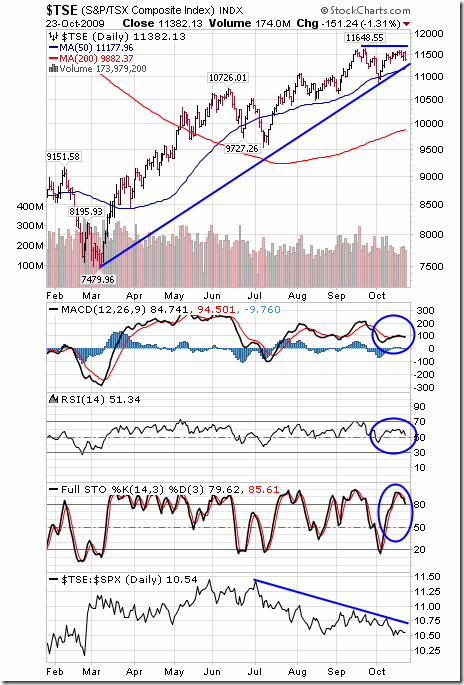
The TSX Composite Index lost 122.63 points (1.07%) last week. Intermediate trend remains up, but its trend line is being tested. The Index remains above its 50 and 200 day moving averages. The Index peaked five weeks ago at 11,648.55. Support is at 10,855.16. MACD and RSI rolled over last week from a short term overbought level. Stochastics recorded a short term sell signal on Friday on a move below 80%. Strength relative to the S&P 500 Index remains negative. First downside risk is to support at 10,855.
Weakness in the U.S. Dollar continues to dominate trader activity in equity and commodity markets. The modest recovery on Friday triggered significant selling in North American equity indices and commodities priced in U.S. Dollars. Strength was attributed to rumors of international central bank activity to stabilize the currency. The U.S. Dollar slipped another 0.15 last week. Intermediate trend remains down. Short term momentum indicators are oversold, but may be trying to recover. Upside potential is to its 50 day moving average at 77.00. The 50 day moving average has proven to be a reliable short term resistance level during the past six months. However, a recovery to the 50 day moving average should not be considered as a change in the Dollar’s intermediate downtrend.

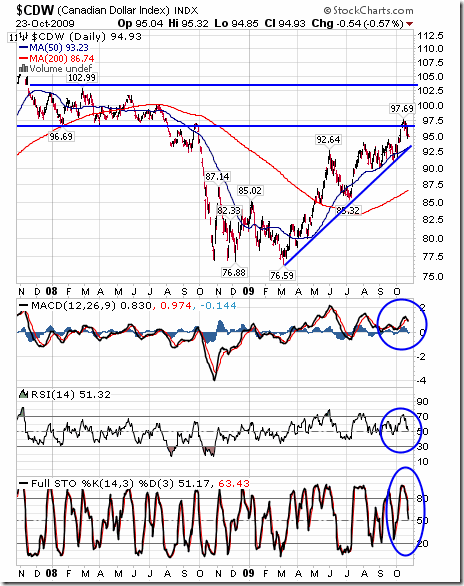
The Canadian Dollar dropped 1.56 cents U.S. last week after the Bank of Canada “jaw boned” the currency lower. Resistance at the bottom of a band of resistance between 97 and 103 was confirmed. Intermediate trend remains up. Short term momentum indicators have rolled over from overbought levels and continue to trend lower. The Dollar remains above its 50 and 200 day moving averages. Downside risk is to its 50 day moving average at 93.33. Its 50 day moving average has proven to be a reliable support level during the past six months.
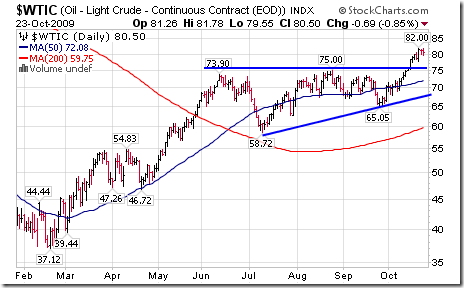
Crude oil added $1.48 U.S. per barrel last week, but stalled late in the week with the recovery in the U.S. Dollar. Intermediate trend remains up. Downside risk in a correction is to its 50 day moving average currently at $72.08. Upside potential is to $86.50,
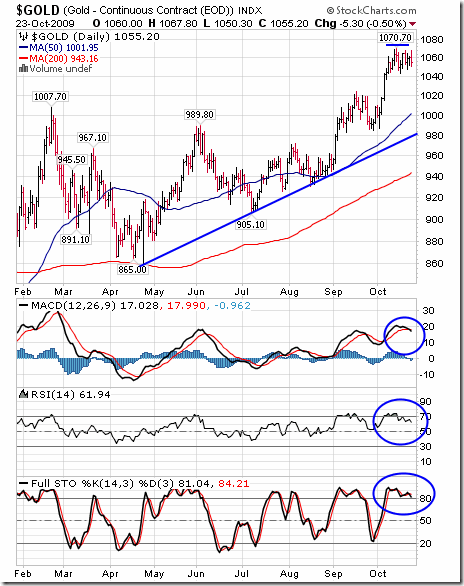
Gold added $2.30 U.S. per ounce last week. Early technical signs of a short term peak have appeared. MACD and RSI have rolled over from a short term overbought level. However, technical requirement for seasonal profit taking (i.e. a move by Stochastics below 80% and at least one day when price moves lower than the previous day) have yet to be met. Requirements likely will be met this week. More information on seasonal trades in gold is offered near the end of this blog.
Click HERE. for the rest of the 40 plus charts and commentary on at charts of Indices, Currencies, Commodities…..and more…..
Don Vialoux has 37 years of experience in the Investment Industry. He is a past president of the Canadian Society of Technical Analysts (www.csta.org) and a former technical analyst at RBC Investments. Don earned his Chartered Market Technician (CMT) designation from the Market Technician Association in 1995. His CMT paper entitled “Seasonality in Canadian Equity Markets” was published in the Spring-Summer 1996 edition of the MTA Journal. Don also has extensive experience with Exchange Traded Funds (also know as Index Participation Units) as well as conservative option strategies. In 1990 he wrote a report that was released in the International Federation of Technical Analyst Journal entitled “Profiting from a Combination of Technical and Fundamental Analysis”. The report introduced ” The Eight Phases of the Stock Market Cycle”, an investment concept that continues to identify profitable entry and exit points for North American equity markets. He is currently a member of the Toronto Society of Fundamental Analyst’s Derivatives Committee. Now he is the author of a daily letter on equity markets available free on the internet. The reports can be accessed daily right here at www.dvtechtalk.com.
The US as Failed State
The US has every characteristic of a failed state.
The US government’s current operating budget is dependent on foreign financing and money creation.Too politically weak to be able to advance its interests through diplomacy, the US relies on terrorism and military aggression. Costs are out of control, and priorities are skewed in the interest of rich organized interest groups at the expense of the vast majority of citizens. For example, war at all cost, which enriches the armaments industry, the officer corps and the financial firms that handle the war’s financing, takes precedence over the needs of American citizens. There is no money to provide the uninsured with health care, but Pentagon officials have told the Defense Appropriations Subcommittee in the House that every gallon of gasoline delivered to US troops in Afghanistan costs American taxpayers $400.
“It is a number that we were not aware of and it is worrisome,” said Rep. John Murtha, chairman of the subcommittee.
According to reports, the US Marines in Afghanistan use 800,000 gallons of gasoline per day. At $400 per gallon, that comes to a $320,000,000 daily fuel bill for the Marines alone. Only a country totally out of control would squander resources in this way.
While the US government squanders $400 per gallon of gasoline in order to kill women and children in Afghanistan, many millions of Americans have lost their jobs and their homes and are experiencing the kind of misery that is the daily life of poor third world peoples. Americans are living in their cars and in public parks. America’s cities, towns, and states are suffering from the costs of economic dislocations and the reduction in tax revenues from the economy’s decline. Yet, Obama has sent more troops to Afghanistan, a country half way around the world that is not a threat to America.
It costs $750,000 per year for each soldier we have in Afghanistan. The soldiers, who are at risk of life and limb, are paid a pittance, but all of the privatized services to the military are rolling in excess profits. One of the great frauds perpetuated on the American people was the privatization of services that the US military traditionally performed for itself. “Our” elected leaders could not resist any opportunity to create at taxpayers’ expense private wealth that could be recycled to politicians in campaign contributions.
Republicans and Democrats on the take from the private insurance companies maintain that the US cannot afford to provide Americans with health care and that cuts must be made even in Social Security and Medicare. So how can the US afford bankrupting wars, much less totally pointless wars that serve no American interest?
The enormous scale of foreign borrowing and money creation necessary to finance Washington’s wars are sending the dollar to historic lows. The dollar has even experienced large declines relative to currencies of third world countries such as Botswana and Brazil. The decline in the dollar’s value reduces the purchasing power of Americans’ already declining incomes.
Despite the lowest level of housing starts in 64 years, the US housing market is flooded with unsold homes, and financial institutions have a huge and rising inventory of foreclosed homes not yet on the market.
Industrial production has collapsed to the level of 1999, wiping out a decade of growth in industrial output.
The enormous bank reserves created by the Federal Reserve are not finding their way into the economy. Instead, the banks are hoarding the reserves as insurance against the fraudulent derivatives that they purchased from the gangster Wall Street investment banks.
The regulatory agencies have been corrupted by private interests. Frontline reports that Alan Greenspan, Robert Rubin, and Larry Summers blocked Brooksley Born, the head of the Commodity Futures Trading Commission from regulating derivatives. President Obama rewarded Larry Summers for his idiocy by appointing him Director of the National Economic Council. What this means is that profits for Wall Street will continue to be leeched from the diminishing blood supply of the American economy.
An unmistakable sign of third world despotism is a police force that sees the pubic as the enemy. Thanks to the federal government, our local police forces are now militarized and imbued with hostile attitudes toward the public. SWAT teams have proliferated, and even small towns now have police forces with the firepower of US Special Forces. Summons are increasingly delivered by SWAT teams that tyrannize citizens with broken down doors, a $400 or $500 repair born by the tyrannized resident. Recently a mayor and his family were the recipients of incompetence by the town’s local SWAT team, which mistakenly wrecked the mayor’s home, terrorized his family, and killed the family’s two friendly Labrador dogs.
If a town’s mayor can be treated in this way, what do you think is the fate of the poor white or black? Or the idealistic student who protests his government’s inhumanity?
In any failed state, the greatest threat to the population comes from the government and the police. That is certainly the situation today in the USA. Americans have no greater enemy than their own government. Washington is controlled by interest groups that enrich themselves at the expense of the American people.
The one percent that comprise the superrich are laughing as they say, “let them eat cake.”
Paul Craig Roberts was Assistant Secretary of the Treasury in the Reagan administration. He is coauthor of The Tyranny of Good Intentions. He can be reached at: PaulCraigRoberts@yahoo.com
Legendary investor Jim Rogers In 1970, Rogers joined Arnhold & S. Bleichroeder. That same year, Rogers co-founded the Quantum Fund. During the following 10 years the portfolio gained 4200% while the S&P advanced about 47%.[4] It was one of the first truly international funds.
In 1980, Rogers decided to “retire”, and traveled on a motorcycle around the world. Since then he has been a guest professor of finance at the Columbia University Graduate School of Business.
Our Take
As a fan and reader of all of Jim Rogers’ books, I was happy to pore through “A Gift to My Children”. I read the book in 1 hour and purchased several copies for the younger members of my family. This book is not for advanced value investors, but rather for young minds. If I had this book when I was 8 years old, I would be a much wiser and smarter person today. Rogers delivers on his promise of providing gifts to younger members of society and deserves compliments for doing so. If you’re interested in cultivating a young mind and potentially rearing the next Warren Buffett, this book is for you.
Jim Rogers’ Keys to Success (taken from the titles and sub headings of each chapter):
1. Do not let others do your thinking for you
2. Focus on what you like
3. Good habits for life & investing
4. Common sense? not so common
5. Attention to details is what separates success from failure
6. Let the world be a part of your perspective
7. Learn philosophy & learn to think
8. Learn history
9. Learn languages (make sure Mandarin is one of them)
10. Understand your weaknesses & acknowledge your mistakes
11. Recognize change & embrace it
12. Look to the future
13. “Lady Luck smiles on those who continue their efforts”
14. Remember that nothing is really new
15. Know when not to do anything
16. Pay attention to what everybody else neglects
17. If anybody laughs at your idea view it as a sign of potential success
Most powerful exercise from the book:
“Reflect on situations where conventional wisdom and custom turned out to be wrong. Take the time to find out what actually happened.”
Favorite Quotes:
“Anything that is a must see, must try, must read, should almost certainly be avoided, especially if it is popular.”
“Never act upon wishful thinking. Act without checking the facts, and chances are that you will be swept away along with the mob.”
“Learn to stay calm especially in times of pressure or turmoil. You will make much better decisions.”
“Do not get married until you are at least 28 and know a bit more about yourself and the world.”
“Learn to do as much arithmetic and figures as possible in your head.”
Article contributed by Miquel Barbosa of Seeking Alpha
Market Buzz – A Consolidation and Two Great Sales
After a good beginning to the past week, the S&P/TSX composite index ended down just over one per cent. As I was piecing together this column, I read and heard a number of pundits state there was real reason for the declines at week’s end.

This though seems a tad curious given the fact we have seen the S&P 500 run around 60 per cent from its March lows with the operating PE (trailing) expanding a massive ten points to just under 28 times earnings over the period. Given that historically we have seen markets trade at a multiple of closer to 15 when the economy has just turned from contraction to expansion (as we have seen in Q3), a consolidation or near-term correction should not be a surprise.
Switching gears, we take a look at some brief positive tidbits of news from a couple solid stocks from our Canadian Small-Cap Universe (www.keystocks.com).
The first, came from World Point Terminals Inc. (WPO:TSX), which announced that it had completed the transaction with Statoil South Riding Point LLC, a subsidiary of StatoilHydro ASA, pursuant to which Statoil acquired the shares Bahamas operations.
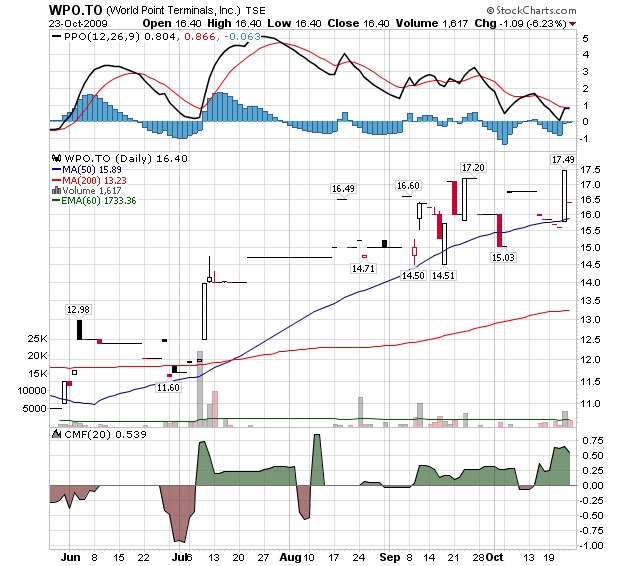
The sale process began in July, 2009, when World Point signed a stock purchase and sale agreement with Statoil for the sale of the company’s Bahamian operations. The final purchase price for the shares was
US$258.25 million.
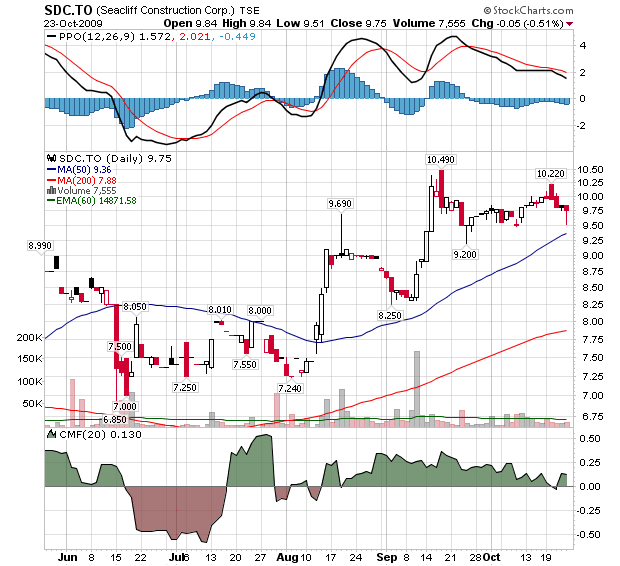
The second set of positive news came courtesy of Seacliff Construction Corp’s (SDC:TSX) contraction division Dominion Construction, which announced it had been awarded three major contracts in British Columbia, valued at approximately $77.9-million in total. The first new contract, valued at approximately $48.6-million, is for the construction of a four-story, 170,000-square-foot office building at the Broadway Tech Centre in Vancouver. Construction is expected to begin in early November of this year and to be completed in January, 2012.
Finally, we look forward to the release of The Cash Store Financial Services Inc’s (CSF:TSX) first quarter 2010 conference call for the three months ended September 30th, 2009 on Thursday, October 29th of this coming week.

Looniversity – Investing vs. Speculating
The main difference between speculating and investing is the amount of risk undertaken in the trade. Typically, high-risk trades that are almost akin to gambling fall under the umbrella of speculation, whereas lower-risk investments based on fundamentals and analysis fall into the category of investing. Investors seek to generate a satisfactory return on their capital by taking on an average or below-average amount of risk. On the other hand, speculators are seeking to make abnormally high returns from bets that can go one way or the other. It should be noted that speculation is not exactly like gambling because speculators do try to make an educated decision on the direction of the trade, but the risk inherent in the trade tends to be significantly above average.
For KeyStone, the need to become overly speculative in search of blue sky type returns is neither necessary or a strategy that will pay off long term. We believe that through diligent research, investors are able to uncover excellent long-term investment opportunities, without the extreme levels of risk found in many stock market speculations.
Put it to Us?
Q. I am looking at investing in some U.S. IPO’s. Can you tell me how I would go about doing this as an average investor?
– Ian Orion; Calgary, Alberta
A. First off, an IPO is an initial public offering and the first sale of stock by a private company trying to go public. An IPO often serves as a way for companies to raise capital for funding current operations and new business opportunities. To get in on a U.S. IPO, you will need to find a company that is about to go public. This is done by searching S-1 forms filed with the U.S. Securities and Exchange Commission. To participate in an IPO, an investor has to be registered with a brokerage firm. When companies issue IPOs, they notify brokerage firms, which in turn notify investors. Many Canadian brokerage firms have U.S. affiliates which may be able to help you in this respect.
KeyStone -Why Subscribe?
-
I know Mike is a very solid investor and respect his opinions very much. So if he says pay attention to this or that - I will.
~ Dale G.
-
I've started managing my own investments so view Michael's site as a one-stop shop from which to get information and perspectives.
~ Dave E.
-
Michael offers easy reading, honest, common sense information that anyone can use in a practical manner.
~ der_al.
-
A sane voice in a scrambled investment world.
~ Ed R.
Inside Edge Pro Contributors

Greg Weldon

Josef Schachter

Tyler Bollhorn

Ryan Irvine

Paul Beattie

Martin Straith

Patrick Ceresna

Mark Leibovit

James Thorne

Victor Adair