
Daily Updates
In 2008, Fortune magazine wrote that: “In 2005 Roubini said home prices were riding a speculative wave that would soon sink the economy. Back then the professor was called a Cassandra. Now he’s a sage.” In September 2006, he warned to a skeptical IMF that: “The United States was likely to face a once-in-a-lifetime housing bust, an oil shock, sharply declining consumer confidence, and, ultimately, a deep recession.” He also foresaw “homeowners defaulting on mortgages, trillions of dollars of mortgage-backed securities unraveling worldwide and the global financial system shuddering to a halt”. The New York Times labeled him “Dr. Doom”, whereas, in hindsight, IMF economist Prakash Loungani has called him “a prophet”. As Roubini’s descriptions of the current economic crisis have proven to be accurate, he is today a major figure in the U.S. and international debate about the economy, and spends much of his time shuttling between meetings with central bank governors and finance ministers in Europe and Asia.
Dateline Oct. 29th
Dr. Doom – AKA New York University Professor Nouriel Roubini – is at it again. The man who is credited with being the first to point to the questionable lending practices that ultimately led to the housing bubble and the global recession, is now taking dead aim at what he believes is setting the stage for the next financial crisis – a US dollar asset bubble.
On Monday, Professor Roubini told CNBC that we are headed for the “mother of all carry trades” as interest rates widen amongst the major currencies. Roubini fears that now that US interest rates are zero-bound, investors will use the US dollar to fund the purchase of higher-yielding currencies – particularly those concentrated in several emerging nations presently benefitting from higher oil and commodity prices. This, according to Roubini, is a “dangerous” game.
Roubini does not believe US interest rates can remain at zero for the long term, and once the recovery is truly established, the Federal Reserve will be forced to fast-track interest rate hikes to fend off the threat of inflation. He also questions the sustainability of current commodity prices – especially oil – which he says is presently overvalued when economic realities are considered.
This warning should give pause to currency trade participants as a rapid US dollar appreciation, combined with a depreciation in the currencies on the other side of the carry trade, would quickly place these trades in a losing position. Obviously, this would lead to a sudden unwinding, sharply increasing demand for the dollar as traders scramble to buy enough dollars to cover their short positions.
The act of closing these carry trades would create the equivalent of a US dollar bubble supported not by economic fundamentals, but simply by the need to cover massive short positions. This bubble, like all asset bubbles, would inevitably collapse upon itself, but the damage could be so widespread that it would likely send the US economy back into recession in a scenario Roubini described earlier this year as a recession “double-dip”.
We need only look at our recent history to find an example of just how quickly carry trades can turn. During the mid 1990s, the Asian currency crisis weakened the yen against the major currencies, and the Bank of Japan responding by dropping interest rates to near zero in order to encourage spending and prop up the yen (sound familiar?). This gave rise to the yen-funded carry trade using very cheap yen to buy Australian and US dollars at a time when the US Federal Funds rate was 5.5 percent. So long as interest rates remained stable and the exchange rate between the two currencies continued to favor a long USD position, investors could profit on the interest rate carry.
Sadly, good things can’t last forever, and in October of 1998, the Bank of Japan implemented a plan to recapitalize the country’s banks boosting the yen by 12 percent – literally – overnight. Meanwhile, the US dollar suffered a significant drop during a stock market correction which caused the US bond market to fall on the same day that the Yen was appreciating. The cumulative effect of these events caused the exchange rate between the dollar and the yen to move so much, that most of the open carry trades were suddenly in a negative position.
This unexpected exchange rate reversal triggered a mad rush to unwind the off-side positions, and many large hedge funds and a handful of high-wealth individuals suffered very public losses. This led to a further sell-off, prompting US Federal Reserve Chairman Alan Greenspan to declare that the world was facing a credit crunch. The Fed responded by dropping the Federal Funds rate by 75 basis points over the span of the next three months, effectively closing the interest rate gap between the two currencies, further compounding carry trade losses. It is the potential for a repeat of this scenario that has Roubini once again taking on the role of Dr. Doom.
Technical Action on Wednesday and Yesterday
Technical action by S&P 500 stocks was substantially bearish on Wednesday and mixed yesterday. On Wednesday one S&P 500 stock broke resistance (Verizon) and 64 stocks broke support. The Up/Down ratio fell from 4.54 to (313/113=) 2.77. Yesterday, two S&P 500 stocks broke resistance (Care Fusion and O’Reilly Auto) and two stocks broke support (First Solar and Monster Worldwide). The Up/Down ratio slipped to (312/113=) 2.76.
Technical action by TSX Composite stocks also was substantially bearish on Wednesday and mixed on Thursday. No TSX stocks broke resistance on Wednesday and 22 stocks broke support. The Up/Down ratio plunged from 4.49 to (140/48=) 2.92. Yesterday, two TSX stocks broke resistance (Maple Leaf Foods and Dundee Bancorp) and one stock broke support (Husky Energy). The Up/Down ratio slipped to (140/49=) 2.86.
Weekly Bullish Percent Index Sector Review
All sector Bullish Percent indices fell last week. Seven more indices fell below their 15 day moving average from an intermediate overbought level and achieved the requirement for a Bullish Percent Index sell signal. Only the index for Consumer Staples remains above its 15 day moving average. All indices remain intermediate overbought and most have established a downtrend.
….go HERE to view the Bullish Percent Charts. Be sure to read the Great commentary and analysis by Hap Sneddon of Castlemoore that Don Vialoux has also posted. Its a 979 word article with charts on the strange situation in Canada today. Canadians are scrambling to defend against the second wave of swine flu, but oblivious to the danger of the second wave of sell off in the stock market. What makes human beings like this? Discusses where the term ‘second wave’ comes from
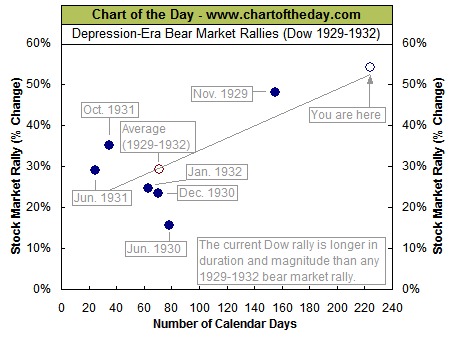
For some perspective on the current stock market rally and how it compares the 1929-1932 bear market (which also included bank failures, bankruptcies, severe stock market declines, etc.), today’s chart illustrates the duration (calendar days) and magnitude (percent gain) of all significant Dow rallies that occurred during the 1929-1932 bear market (solid blue dots). For example, the bear market rally that began in November 1929 lasted 155 calendar days and resulted in a gain of 48%. As today’s chart illustrates, the duration and magnitude of the current Dow rally (hollow blue dot labeled you are here) is greater than any that occurred during the 1929-1932 bear market. Chart courtesy of ChartoftheDay.com signup Free
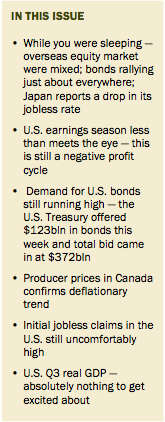
PRODUCER PRICES IN CANADA CONFIRM DEFLATIONARY TREND
Canada’s industrial product price index (IPPI), which is similar to the U.S.’s producer product index (PPI), surprised to the down side, falling 0.5% in September versus market expectations of a 0.2% decrease. Since May of this year, the month-over-month trend in IPPI has been very volatile, going up one month then reversing course the next month, so it is difficult to find a trend with these monthly gyrations. Of the 21 major groups, over 85% were either down or flat on the month and a measly 15% (or just three groups) managed to eke out an increase. Again, this attests to our deflationary and hence income-heavy tilt to our investment strategy.
….read more HERE.
Quotable
1 WITCH. Thrice the brinded cat hath mew’d.
2 WITCH. Thrice and once, the hedge-pig whin’d.
3 WITCH. Harpier cries:—’tis time! ’tis time!
1 WITCH. Round about the caldron go;
In the poison’d entrails throw.—
Toad, that under cold stone,
Days and nights has thirty-one;
Swelter’d venom sleeping got,
Boil thou first i’ the charmed pot!
ALL. Double, double toil and trouble;
Fire burn, and caldron bubble.
2 WITCH. Fillet of a fenny snake,
In the caldron boil and bake;
Eye of newt, and toe of frog,
Wool of bat, and tongue of dog,
Adder’s fork, and blind-worm’s sting,
Lizard’s leg, and owlet’s wing,—
For a charm of powerful trouble,
Like a hell-broth boil and bubble.
ALL. Double, double toil and trouble;
Fire burn, and caldron bubble.
3 WITCH. Scale of dragon; tooth of wolf;
Witches’ mummy; maw and gulf
Of the ravin’d salt-sea shark;
Root of hemlock digg’d i the dark;
Liver of blaspheming Jew;
Gall of goat, and slips of yew
Sliver’d in the moon’s eclipse;
Nose of Turk, and Tartar’s lips;
Finger of birth-strangled babe
FX Trading – Things that still frighten us on Halloween Eve
We are quite happy to see the IMF upgraded Asian growth. We were pleasantly surprised with the better than expected GDP report yesterday. We are looking forward to eating belling busting barrels of candy tomorrow. But there are still a few items that frighten us when we do our stream of consciousness thing:
US consumer still groggy after US government dolling out massive amounts of candy
– Lending to non-bank private sector negative after $17 trillion global government stimulus
– Moody’s warning on Greece and Portugal finance
– Crude a bit sticky near $80, despite “blow out” US GDP
– US housing market still in the doldrums
– US commercial real estate shoe might be dropping
– 47% vacancy rates in Chinese commercial real estate
– Emerging stock markets looking topping and mutual fund flows subsiding
– Central banks collectively tightening at the margin
– Global cooling cycle now upon us at peak of tree-hugger climate change hysteria
– US government across-the-board
– Conditions of TSTBTBTF Banks (Too small to be too big to fail)
– Larry Summers and his stupid policies and ideas
– A belief a lower dollar cures US ills
– A replay of stock market action similar to the 1929-30 pattern
– Yankees still have a chance to win the World Series
– Latvia contagion
– Being asked to dig in the Victory Garden
– Gold prices over $1,000
– Russian oligarchs with FBI escorts
– Czars of any kind
– The Government of Goldman Sachs
In short, a whole bunch of things still out there which appear risk aversion like.
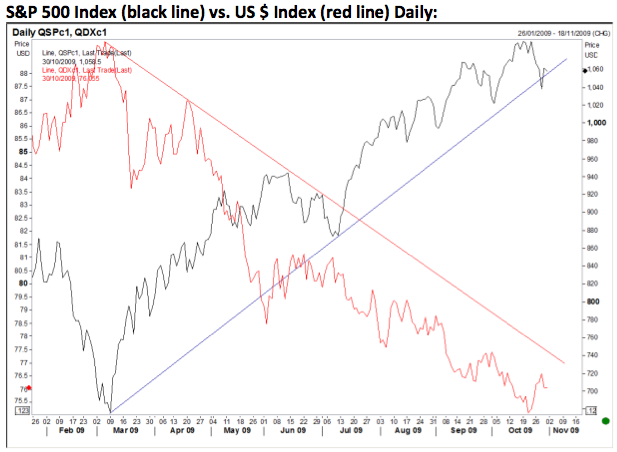
No follow-through yet from the big gains yesterday…hmmmm…stay tuned.
Happy Halloween!
Jack Crooks
Black Swan Capital LLC
www.blackswantrading.com
We continue to pull off some sweet trades in our Forex & Currency Futures Service….
Yesterday Jack and JR took profits in the New Zealand dollar and Euro…this morning they grabbed a small gain in the Euro-Pound cross and have some interesting trade setups working….
If you are interested in a spot forex and currency futures service that provides actionable recommendations for both short-term and position traders, plus provides trading rationales based on both technical and fundamental setups, you might want to consider giving our service a try. You can learn more about Black Swan’s Forex & Currency Futures service by clicking below.

Regards,
David Newman, Director of Sales and Marketing, Black Swan Capital
dnewman@blackswantrading.com
-
I know Mike is a very solid investor and respect his opinions very much. So if he says pay attention to this or that - I will.
~ Dale G.
-
I've started managing my own investments so view Michael's site as a one-stop shop from which to get information and perspectives.
~ Dave E.
-
Michael offers easy reading, honest, common sense information that anyone can use in a practical manner.
~ der_al.
-
A sane voice in a scrambled investment world.
~ Ed R.
Inside Edge Pro Contributors

Greg Weldon

Josef Schachter

Tyler Bollhorn

Ryan Irvine

Paul Beattie

Martin Straith

Patrick Ceresna

Mark Leibovit

James Thorne

Victor Adair