
Daily Updates
The technical evidence was subtle, but gold appeared to have its best day in months on Thursday. The night before, we had told subscribers to brace for a new wave of selling that would bring the April Comex contract down to at least $1073, exactly $23 below the previous day’s settlement price. When the dust had settled, however, the futures had fallen no lower than $1088 – off a mere $8 from the previous day’s close. Moreover, the reversal from the day’s lows was swift and decisive, leaving April Gold at $1108 by day’s end, $20 off the lows. Most encouraging of all, however, was that the bounce came precisely from a “Hidden Pivot midpoint,” and that it ultimately blew past two resistance peaks on the hourly chart without pausing for breath. Taken together, these telling technical signs offer the most encouraging evidence of bullion’s resurgence that we’ve seen since Comex gold reached a record-high $1227.50 on December 3.
….read more HERE
Market Buzz – Bridgewater Continues Strong Growth
Toronto’s main market ended down 1.81 points, or 0.02 per cent, at 11,629.63. Five of the index’s ten main sectors were lower, including the hefty financials group. The index is down 0.68 per cent on the week.
For the month, the Toronto Stock Exchange’s S&P/TSX composite index ended up 4.8 per cent, a solid rebound from a dismal January, when it fell more than 5 per cent.
For their parts, the Dow and the S&P 500 saw their best monthly gains since November, while the Nasdaq locked in its best advance since December. For February, the Dow rose 2.6 per cent, while the S&P 500 gained 2.9 per cent and the Nasdaq climbed 4.2 per cent.
Having said this, all three major U.S. stock indexes were also down for the week, following two weeks of gains. The Dow slipped 0.7 per cent, while the S&P 500 declined 0.4 per cent and the Nasdaq shed 0.3 per cent.
What sent them lower? Likely U.S. economic data that reinforced views of rapid growth this year, particularly in respect to the housing market which appears to have yet to fully stabilize. Add to this consumer sentiment that is weakening and we are left with a decidedly cautious broader market. In the end, this is about where we should be, proceeding with caution.
This past week marked the reporting of the 2009 fiscal year-end results from our top tech selection for 2009, Bridgewater Systems Corporation (BWC:TSX). Bridgewater is a mobile personalization company which has seen its shares gain over 200 per cent in the past 12 months on continued strong financial performance.
Revenue of $66.7 million for fiscal 2009 increased 51 per cent compared with $44.2 million for fiscal 2008. The year-over-year increase mainly reflects contribution from new products, such as the Home Subscriber Server and Policy Controller, license revenue from existing customers, as well as revenue from the delivery of integrated solutions.
Net earnings for 2009 were $11.2 million, or $0.44 per share fully diluted, versus $2.8 million, or $0.11 per share fully diluted, in the prior year.
Looniversity – When is Insider Activity Useful?
First, we define insiders as any person who has or has had access to valuable nonpublic information about a corporation.
While insider activity can in many cases be no reflection on the future of a company, according to Craig Columbus, chief market strategist at Thomson Financial, which studies insider activity, the following trends – tracking the telling moves of so-called “all-star” insiders – are worth paying attention to.
1) Sector Watch – Sectors with patterns of peaks and troughs create opportunities for savvy executives to trade and, as such, insider activity can often be quite useful. Columbus says insider buying in financial, retail, machinery, oil/oil service, medical supply, and semi-conductor can be a positive sign, while executive selling at software, retail, computer, communications equipment, semi-conductor and biotech sectors can be a negative sign.
2) Small-caps – Both buying and selling (particularly selling), from insiders, of companies with market capitalizations below $500 million should be paid particular attention.
3) Bigwigs – The higher the insider is on the corporate ladder, the better the quality of information becomes on predicting future price movements. In other words, the trades of CEOs, chief financial officers and presidents tend to be more predictive than the trades of other officers and directors. These individuals are often in the best position to rate the company’s prospects.
Put it to Us?
Q. If the price of one of my stocks drops, where does my money go?
– Darcy Maul; Toronto, Ontario
A. First, a quick review of stock basics: Owning a stock means owning a portion (usually very small) of a company. If the value of the entire company fluctuates, so will the value of your stock.
When a share’s price decreases in value, that change in value is not redistributed amongst any parties; the value of the company simply shrinks. The stock market is governed by the forces of supply and demand. In other words, it is not a zero-sum game, like gambling in a casino, in which there is an equal loser for every winner and vice versa.
So, even though it might feel like someone is taking your money when your stock declines, the cash is simply disappearing into thin air with the popularity of the stock. However, this decline in popularity corresponds to something tangible; the company’s ability to carry on its operations efficiently, which is reflected in its earnings.
KeyStone’s Latest Reports Section
- Newly Listed China-based Sports Apparel Manufacturer, Solid Growth Profile with PE of under 8, EV/EBITDA of 3.7, & $1.00 Per Share in Cash – BUY (New Buy Report)
- China-based Fertilizer Stock Produces Better-than-Expected Q3 and Ups Fiscal 2010 Revenue Guidance – Rating Maintained (Flash Update)
- Strong Q2 2010 Revenue & EPS Growth, Aggressive Growth Plan, & Attractive Valuations Allow Us to Maintain Our BUY Rating on Alternative Financial Services Provider Despite 57% Gain in Six Months. (Flash Update)
- Reiterate our SELL HALF Recommendation, HOLD Remaining Position for our Top 2009 Canadian Wireless Software Pick After Shares Jump over 250% (Flash Update)
- Pure Play Chinese Construction Company, Strong EPS Growth, Growing Backlog, PE of under 8 – Initiate Coverage with BUY (New Buy Report)
Plan, Process, Practice
Stockscores.com Perspectives for the week ending February 26, 2010
In this week’s issue:
- Weekly Commentary
- Strategy of the Week
- Stocks That Meet The Featured Strategy

Being a successful trader requires a plan. Whether you want to sit in front of the screen all day and make short term day trades or spend only 15 minutes a day managing your position trades, that plan needs to define the rules for entry, exit and risk management. There needs to be more than just rules, a good plan needs to systematize the process of identifying and executing opportunities.
Many traders realize the need for a plan but they don’t go far enough in creating one. They might write down their rules but not spend enough time defining the exact processes for executing those rules. Or, they may fall short in testing their rules to the point that they can have confidence in them.
I go so far as to practice each component of the process and look for ways to improve it. Particularly with day trading, it is easy to miss out on opportunities if the process is flawed. It is one thing to know what to look for, quite another to find them in time to capitalize on the opportunity.
For example, I have two options for creating my day trading watch lists. One is to use TradeStation software. This allows me to do a real time scan to pull out the most liquid and abnormal stocks. However, the process to create the Watch List takes me about 11 minutes.


My alternative is to use Stockscores. With the Market Scan tool I can create my Watch List (including going through the charts to eliminate those that I don’t want to monitor) in about five and a half minutes.
The problem is that Stockscores can only help me build the Watch List about an hour after the open. So, for the first few times that I create the Watch List I use the real time method of TradeStation and then, as the trading day progresses, I use Stockscores for its time saving simplicity.
Missing out on good trading opportunities because of a lack of timeliness is another problem faced by most traders. We have all had the experience of seeing a great trade set up after it had run its course, giving us a case of the woulda coulda shouldas.
But again, this is a problem of process, not rules. If we can develop a better process to find the trade set ups then we can allow the rules to shine a light on the good trading opportunities. Here again, tools and preparation help.
You can combine the Stockscores Market Scan and the new Stockscores Trading Desk to create lists of stocks to monitor for entry signals. Even the longer term, more conservative trader can really improve their performance by creating a group of Exchange Traded Funds to check each day before the market closes to see if there is an entry signal. With the preparation work done once a week, this process might only take four or five minutes a day, something that many busy people can find time for.
When day trading, I rely on some of my tools to put the charts in front of me so I don’t have to waste time going through them one by one. Multiple monitors help in this regard because I can easily watch 30 stocks in real time with minimal effort.
Tools have a cost, but so too does missing out on a trading opportunity. I pay close to $1000 a month for tools but they can easily generate that for me with one trade. You have to spend money to make money.
Today, my day trading strategies revealed the following 19 trades, the number beside the trade was the reward for risk multiple that the trade paid. A two means it paid two times the risk. A minus one means it lost one risk element. So, if my risk tolerance is $500, a two means I made $1000 on that trade. The higher you set your risk tolerance, the more capital you need to trade the opportunities.
DMMD: -1
WTW: 2.2
CCC: 3
ATHN: 3
ATHN: -1
FCN: 3
FCN: 1
FCN: 1
ARM: 1
INT: -1
INT: -1
INT: 2.5
GVA: -1
STV: 4
DECK: 4.3
CROX: -1
MHK: 0
MHK: 0
The total of all of these is 19 which means a $100 risk tolerance would lead to $1900 in profits.
However, this is only if you executed every trade. Since many trades come up at the same time, it is nearly impossible to do this without a computer and good tools to help. You need a good tool to create the Watch List and a good tool to monitor the stocks for the entry signal. And most of all, you need very good mechanical processes to execute without emotion or human error.
Are the tools and process enough? No, like anything there is still one other factor that many people are unwilling to provide. Hard work.
It is hard work to spend the time to practice enough so that the process becomes second nature. A professional hockey player does not have the time to think when trying to put the puck in the net. The moves must be instinctual. The same can be said for the trader, particularly the day trader. The processes need to be practiced so much that they become instinct.
I can look at a chart and tell whether it is worth trading in only seconds because I have spent so much time practicing. But it does not have to take 20 years to get to this point if you have a good plan, process and a good approach to practice. Work hard at achieving these things and you can be a successful trader.

The overall market is a bit lost right now, not sure if it should go up or down and so, over the span of a few days, it tends to go no where. That is a hard market for many traders to trade because there is no strong trend to ride.
It makes it necessary to trade individual stocks that are moving on their own story. The best way to find those is to search for stocks that are trading abnormally. Using the Stockscores.com Market Scan, you can do a search for stocks that are trading Abnormal Volume and at least 500 trades a day. I did that and uncovered an abnormal stock that has a predictive chart pattern. See below.

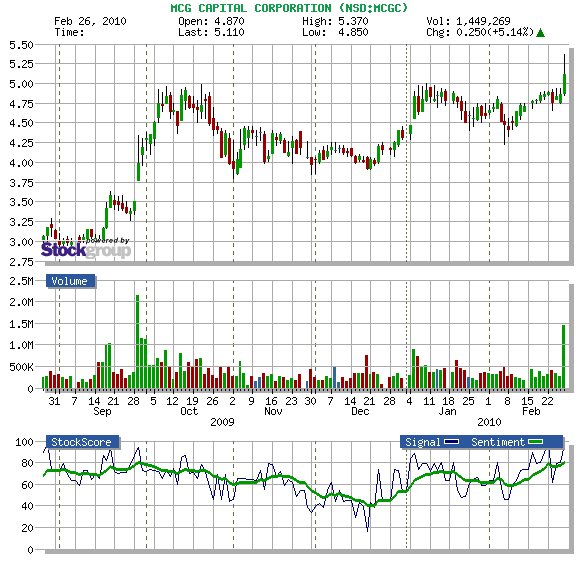
1. MCGC
MCGC breaks out from an ascending triangle pattern with abnormal volume supporting the break through resistance. The stock came to life late in Friday’s trading session and, while it faded in to the close, it looks like it has good potential in the weeks to come. Support at $4.66.
Click HERE if you want to learn from some of the timeless advice from some of worlds best traders including the very successful Tyler Bollhorn.

Tyler Bollhorn started trading the stock market with $3,000 in capital, some borrowed from his credit card, when he was just 19 years old. As he worked through the Business program at the University of Calgary, he constantly followed the market and traded stocks. Upon graduation, he could not shake his addiction to the market, and so he continued to trade and study the market by day, while working as a DJ at night. From his 600 square foot basement suite that he shared with his brother, Mr. Bollhorn pursued his dream of making his living buying and selling stocks.
Slowly, he began to learn how the market works, and more importantly, how to consistently make money from it. He realized that the stock market is not fair, and that a small group of people make most of the money while the general public suffers. Eventually, he found some of the key ingredients to success, and turned $30,000 in to half a million dollars in only 3 months. His career as a stock trader had finally flourished.
Much of Mr Bollhorn’s work was pioneering, so he had to create his own tools to identify opportunities. With a vision of making the research process simpler and more effective, he created the Stockscores Approach to trading, and partnered with Stockgroup in the creation of the Stockscores.com web site. He found that he enjoyed teaching others how the market works almost as much as trading it, and he has since taught hundreds of traders how to apply the Stockscores Approach to the market.
References
Get the Stockscore on any of over 20,000 North American stocks.
Background on the theories used by Stockscores.
Strategies that can help you find new opportunities.
Scan the market using extensive filter criteria.
Build a portfolio of stocks and view a slide show of their charts.
See which sectors are leading the market, and their components.
Disclaimer
This is not an investment advisory, and should not be used to make investment decisions. Information in Stockscores Perspectives is often opinionated and should be considered for information purposes only. No stock exchange anywhere has approved or disapproved of the information contained herein. There is no express or implied solicitation to buy or sell securities. The writers and editors of Perspectives may have positions in the stocks discussed above and may trade in the stocks mentioned. Don’t consider buying or selling any stock without conducting your own due diligence.
Disclaimer
This is not an investment advisory, and should not be used to make investment decisions. Information in Stockscores Perspectives is often opinionated and should be considered for information purposes only. No stock exchange anywhere has approved or disapproved of the information contained herein. There is no express or implied solicitation to buy or sell securities. The writers and editors of Perspectives may have positions in the stocks discussed above and may trade in the stocks mentioned. Don’t consider buying or selling any stock without conducting your own due diligence.
Quotable
Gold? Yellow, glittering, precious gold?…
This yellow slave
Will knit and break religions, bless th’ accursed,
Make the hoar leprosy adored, place thieves,
And give them title, knee and approbation
With senators on the bench. – William Shakespeare
FX Trading – A “Long” Car Ride with a Gold Bug
About two weeks ago, I unfortunately had to attend a funeral for my wife’s uncle. He was really a great person—fun, intelligent, and a man with real integrity and deep religious conviction. I admired him greatly. My father-in-law gold bug (MFL)—another of my real life heroes – drove with me on the trip to the funeral and back. So I quizzed him along the way about his deep convictions about gold.
….read more HERE
Precious metal and U.S. dollar start to trade in tandem, but for how long?
TOKYO (MarketWatch) — Gold’s been quite the rebel lately — and investors are giving it much more than a passing glance.
The precious metal recently broke from its usual inverse relationship with the U.S. dollar to move more in sync with the climb in the greenback, showing off its prowess as a resilient world favorite.
….read more HERE
-
I know Mike is a very solid investor and respect his opinions very much. So if he says pay attention to this or that - I will.
~ Dale G.
-
I've started managing my own investments so view Michael's site as a one-stop shop from which to get information and perspectives.
~ Dave E.
-
Michael offers easy reading, honest, common sense information that anyone can use in a practical manner.
~ der_al.
-
A sane voice in a scrambled investment world.
~ Ed R.
Inside Edge Pro Contributors

Greg Weldon

Josef Schachter

Tyler Bollhorn

Ryan Irvine

Paul Beattie

Martin Straith

Patrick Ceresna

Mark Leibovit

James Thorne

Victor Adair