
Daily Updates
Ed Note: Canadian Investors be sure to read down to Dividend Hotspot #4: Unfairly-punished Canadian royalty trusts.
The Dividends Are Flowing Again …
Last year’s dividend numbers were the worst in more than half a century, as corporations large and small struggled with a lack of financing, weak economic conditions, and poor earnings. But now, things are finally looking up …
According to the latest data from Standard & Poor’s, February was a very solid month:
- 45 S&P 500 constituents increased their dividends vs. 30 a year earlier
- Two companies initiated new payments (vs. none in the same month last year)
- And only one company decreased its payment vs. 18 cuts in February 2009 …
Plus, for the first two months of 2010, dividend-paying stocks also outperformed non-dividend-paying stocks in terms of capital appreciation — 1.57 percent vs. -0.24 percent!
Does that mean everything is easy from here on out? Of course not.
Actual cash payments still fell on a year-over-year basis, and it will probably take a few more years before total dividend payments return to the highs previously reached in 2008.
So I still think you need to be selective in terms of the sectors and specific issues you choose.
Where Do I See Dividend Opportunities Right Now?
I try to diversify the Dividend Superstars portfolio in terms of sectors and industries. But I can think of at least four areas that I really like right now …
Dividend Hotspot #1: Big-brand consumer staples.
These are the firms that sell products that people won’t — or can’t — live without. Basic necessities like food, beverages, cigarettes and toothpaste.
As such, their businesses tend to be very stable. They often boast big brand names and long track records of success. And it would be very hard for an upstart to compete with them effectively.
In short, they thrive whether the economy plunges into recession or is growing like gangbusters.
Even better, my favorite consumer staples firms almost always boast big operations in foreign countries. That means they’re profiting substantially as fast-growing emerging markets adopt Western lifestyles and flock to American brands.
Most importantly — precisely because these companies are so darn stable and profitable — they typically reward their investors very handsomely by mailing out big, fat dividend checks like clockwork.
Dividend Hotspot #2: Utilities with strong dividend histories.
Wall Street brokers love to call these “widow and orphan” stocks because they’re supposedly so boring. And it’s true that these companies just chug along year in and year out, providing the basic services we need to live our daily lives. Water, electricity and gas are hardly exciting things to talk about. At the same time, what’s not boring about utilities is that many have been paying dividends with amazing regularity and raising their payments every year for decades. And that means investors who buy these stocks get fatter and fatter checks every year.
Dividend Hotspot #3: Select master limited partnerships (MLPs).
While MLPs can operate all kinds of businesses, most are engaged in the transportation of oil, gas and other natural resources … typically through a vast network of pipelines that can span entire continents.
I think of these companies as “trolls at the oil bridge” because whenever oil or gas needs to get from a production field to an end destination, it generally has to go through an MLP’s pipeline. And when you own that pipeline, you get to collect a very nice toll in the process!
Plus, the fact that these companies generally engage in just the transportation of resources also limits the downside they experience when commodities prices take short-term dips.
Dividend Hotspot #4: Unfairly-punished Canadian royalty trusts (CANROYs).
As I mentioned three weeks ago, a lot of investors have written off these Canadian firms that buy the rights to royalties from the production and sale of natural resources. And for a while, I was one of them.
Reason: There has been massive uncertainty surrounding these companies. Namely, a law change that is going to affect them in a major way starting in 2010.
However, I recently did an in-depth analysis of individual CANROYs, including an examination of what would happen to them under a revised legal structure. And my conclusion was that a few of these former dividend darlings are worthy of new investment money right now.
Bottom line: Based on the latest dividend data, payments should only continue rising from here. And if you select the strongest stocks in the strongest sectors, you stand to not only collect fat income checks but also benefit from capital appreciation, too.
Best wishes,
Nilus
P.S. If you’d like a series of special reports that discuss exactly what companies I’m recommending in the four dividend hotspots mentioned above, click here. They’re yours free when you sign up for a year of my Dividend Superstars service. At just $69 for the entire package, it’s a great deal!
This investment news is brought to you by Money and Markets. Money and Markets is a free daily investment newsletter from Martin D. Weiss and Weiss Research analysts offering the latest investing news and financial insights for the stock market, including tips and advice on investing in gold, energy and oil. Dr. Weiss is a leader in the fields of investing, interest rates, financial safety and economic forecasting. To view archives or subscribe, visit http://www.moneyandmarkets.com.
John Embry: As Confidence Returns, Gold Will Rise
Source: Interviewed by Gordon Holmes, The Gold Report 03/08/2010
The Gold Report caught up with John Embry, Chief Investment Strategist, Sprott Asset Management, to get his thoughts on gold and some mining stocks he favors. Embry, an industry expert in precious metals, has researched the gold sector for over 30 years. Read about why he thinks gold could gain another 30% this year as a greater proportion of the public realizes the degree of difficulty that sovereign debt is in. He believes as confidence in gold returns people will seek an outlet in gold stocks, especially small-cap gold producers and junior explorers with solid projects.
The Gold Report: John, in Investors Digest of Canada you recently said you’re expecting gold to gain another 30% this year.
John Embry: I would say at least 30%. I said that I thought it would be the best year to date. We’ve had nine years consecutive higher year-end prices and the best year in that span for a year’s return was 31%. I think this will be the year that we exceed it in this, the 10th year of the bull market.
TGR: What’s driving this? Why is this year going to be the best year?
JE: I think we’re getting very close to the point when a greater proportion of the public realizes the degree of difficulty that sovereign debt is in. And at that point, when you can’t depend on your government paper as a safe haven, I think that fact puts gold in a much better light in more people’s eyes.
TGR: You might say the first leg down were the individuals who couldn’t pay their mortgages and that caused part of the ’08 collapse. And now it looks like it’s the government’s.
JE: It’s very simple, actually. Private demand, as you know, was so weak that governments had to step in to maintain order in the economy and in so doing, they spent an enormous amount of money, at the same time that revenue streams fell because of the weakness in the private sector. Governments spent dramatically more money and the results are a budget deficit I never thought I’d see in my life. I’m shocked at the numbers in many places.
TGR: It’s been unbelievable. Now when you talk about gold, you’re talking about bullion. How do you see the gold stocks? Do you think we’re going to have a pullback? Ian Gordon of Longwave Analytics and Richard Russell (Dow Theory) predict the Dow will go to 1000.
JE: I don’t agree with them. As much as I love Richard Russell—he’s probably been as big an influence in my career as anyone—I don’t think that deflation is necessarily the outcome when you have a pure fiat currency system. I think the far greater risk is hyperinflation because I believe that these guys that are in control today have seen the depressionary ’30s, and they will move heaven and earth to prevent that outcome. And when you’ve got the capacity to create unlimited money, I believe you can do it. So I hear Gordon and Russell and I respect them, but I’m in the camp that thinks we’ll get hyperinflation first. We’ll eventually have to clean out the debt, but I think we go hyper before that.
TGR: So hyperinflation. Would that include stocks as well?
JE: I think stocks will do fine. They may have a violent correction first because a lot of people don’t know what the heck we’re talking about here. And when they see inflation mounting and economic conditions being less than ideal, they’ll sell their stocks. But the fact is that if you go back and look at any hyperinflationary environment anywhere, stocks did infinitely better than paper instruments. So precious metals first, stocks second.
TGR: When you’re talking about stocks, you’re not talking just about gold stocks.
JE: No, I’m talking about good businesses. I’m not talking necessarily about banks and other stuff that’s more dubious, based all on paper, but businesses like breweries, for example. People are always going to drink beer and a good brewing company will do exceptionally well in the debased currency of whatever country it’s in.
TGR: So you think that we might have a sell-off and in that sell-off all equities, including gold stocks, would go down.
JE: Gold stocks, maybe. I believe the next time everything goes down, gold isn’t going down. And if that were to be the case, I think gold stocks might surprise. They’ve been awful. Given what the gold price has done, gold stocks, by and large, have been awful.
Well, the well-promoted ones and the odd good one have done okay, but across the whole list, it’s been pretty hard slog over the last three or four years, particularly 16 to 17 months ago when it we hit bottom. I thought they were going to zero.
So many of them are trading at less than they were back in November 2003, which was the real peak of the excitement in gold stocks, if you can imagine. Six and half years ago. The gold price has done nothing but go up in that time.
TGR: In this next cycle are you seeing better returns for producers or the juniors that have pounds in the ground?
JE: Oh, I think the juniors. The whole thing is a matter of confidence. They’ve got so much volatility in the gold price. You get a good thrust up and you got a violent correction and I think they’ve got so many people discouraged and going the wrong way on these gold stocks that right now the degree of confidence is very low. If I’m right and the gold price stages a dramatic breakout in the next 12 months—and I’m talking hundreds and hundreds of dollars on the upside—then I think the confidence will return and people will seek an outlet in gold stocks because so many of them have been beaten up. More importantly, the overall market cap of all the gold stocks is really small in the context of all the money around.
TGR: What’s the seasonality of this year?
JE: I think that probably we may continue to wallow around here for maybe the better part of another month. Maybe not quite that long. But, historically, mid-March to mid-May has been a really good period. When I look at the fundamentals and everything that’s going on, I see no reason why it shouldn’t be a very good period this time. And there’s one other development. I don’t know whether it will come to fruition, but on March 25th the CFTC is going to be investigating position limits in gold and silver on the COMEX. And if they ever put any teeth into those things and kept these bullion banks from what they’re doing on the short side with their large positions, I think that could have a salutary impact on gold and silver prices.
They’re finally going to have to address this because there’s been so many complaints about the bizarre price action on the COMEX in both gold and silver.
TGR: What about some individual stocks? Any that you’d like to comment on?
JE: Gold Fields (NYSE:GFI) remains very cheap. It’s been under a cloud, I think, because there’s been a lot of conversation among some of the more radical factions in South Africa about nationalizing the gold mines. I don’t believe it’s going to come to that. I talked to a chap who knows South African President Jacob Zuma fairly well and Zuma is certainly not in favor of that. There’s always going to be radical factions. If they want to destroy their gold industry, nationalize.
TGR: That’ll do it.
JE: Hopefully, cooler heads will prevail. On that basis, Gold Fields is extraordinarily cheap based on its reserve base.
TGR: What about consolidation plays? Do you think the time is right for that?
JE: I think the big problem is that the guys that head up some of these gold companies don’t have the confidence in their own product that they should have. As a result, they’re reluctant to pull the trigger on acquisitions that to me would be brilliant at this stage in time. We’ve seen some activity, as you mentioned, in Mexico. I know Goldcorp (NYSE:GG, TSX:G) has been picking up a few around its big silver play down there. And I think that’s a great move. My attitude is that these guys, without exception, all have long-term reserve issues. If there’s ever been a better time, based on my outlook for where all this is going, to pick them up, I can’t think of one. These guys should be looking for anything that’s real and using their paper right now to buy it.
Another stock I like that I sound like a broken record on is a Canadian-based company called Wesdome Mines (TSX:WD). They’ve got two operating gold mines, one in Quebec and one in Ontario. You couldn’t be operating in a better geopolitical environment. They’re both profitable. They had a dividend last year; they will pay a dividend this year. I believe the Canadian dollar, despite other people’s belief that it’s going to be very strong, isn’t. Given the budgetary problems and everything that are coming up here, Canada will move heaven and earth to make sure its currency doesn’t move up against the U.S. dollar, so I don’t see any further cost pressures because of a stronger currency in Canada. They’re having success with extending their ore bodies and they’ve got absolutely blue chip mining facilities and the stock, which probably earned something like 20 to 25 cents last year when it reports, trades at just over two bucks. I just think the thing is dirt cheap. I look at a lot of stuff that’s years from production with market caps three times as big as this one. This one’s got a total market cap of $215 million. So I think, of all the small stocks that I look at, I like small producers that are basically overlooked and this, to me, is probably the most overlooked small producer. I’m always interested in profitability and the ability to extend their reserve life related to market cap.
TGR: Any others?
JE: One that I like up here in Canada that I’ve liked for years that’s just coming into production, and they are really adding to their reserve base, is Lake Shore Gold Corp. (TSX:LSG), which trades around three bucks. I think that they’ll eventually prove up multi-three, four million ounces just outside of Timmins, which is another great place to be operating because of its long mining history. I’m a little less adventuresome these days in the sense that my greatest concern down the road for gold stocks is if my maligned view of where this is all headed occurs, one of the few sources of revenue for governments may be taxing gold mines. So I want to be in a geopolitical area where there is some respect for law and people aren’t totally rapacious like they are in some of the third world countries.
They’ll always go where the money is and in this case they may be even more desperate for money, so that’s why when people ask me how should I be exposed to the gold industry, I say, well, the first thing you’ve got to have as the core of your portfolio is bullion, because that’s forever. You don’t have the same leverage to the upside necessarily, but on the other hand you know what you’ve got. The gold stocks are ephemeral, but if you hit them right, you’re going to make a fortune. You will get a three- or four-time bigger move than you will in bullion at some point in time. But the long-term hold is bullion, in my opinion.
TGR: Would you speculate? I read that the IMF is going to be selling some gold and India stepped up earlier. What are your thoughts on that?
JE: The whole thing irritates me. The IMF has announced the sale of this gold 500 times and every time with the express purpose of knocking the price of gold down. It was interesting the last time when the Indians actually relieved them of over 200 tons because that was what basically vaulted the market from about $1,045, which the Indians paid, up to $1,225 in the space of less than a month. That has been followed by the third significant correction in the last three or four years.
I think we’ve seen the vast proportion of the correction and I think what may be one of the factors that could get this thing going again is when somebody does relieve the IMF of the gold, the 191 tons to be exact. There’s speculation that India might be prepared to go to the plate again because the Chinese have been reluctant to step up. Number one, I don’t think they want to be seen publicly doing it. They’d probably rather do it more clandestinely because they’ve got so much money to convert into hard assets. And, secondly, as somebody pointed out, the Chinese at least have a domestic supply of gold. They can buy all their domestic to augment their reserves, where the Indians really don’t have that. So I think the Indians conceivably have a bigger vested interest here in taking that IMF gold. And there’s also sort of the suggestion that the Chinese wouldn’t want to be seen to be paying more than the Indians did, so they’re reluctant to step up with the gold price $50 higher currently than the Indians paid. If it was really a free market, if they were really prepared to sell it to anybody, I think I could name any number of institutions, organizations, individuals that would be more than glad to relieve them of it. It’s not much money. It’s $6 billion. They throw it around as if it’s a big deal. Heck, given the budget deficits in some of these countries, $6 billion is literally a piss in the ocean.
GR: That’s right. What do you think when Soros came out and said that gold was a bubble?
JE: I wrote about that and I got it right. I was very pleased about that because some people got all upset. The people that were negative on gold thought this was great, brilliant George Soros doesn’t like gold. But if you read between the lines, if you read really what he said, he said gold is the ultimate bubble, but he didn’t say gold is currently the ultimate bubble. I believe that it will be the ultimate bubble. I think the gold price is going to go crazy and at that point I’d be worried about. And then it came out after the fact that Soros had been a major buyer of gold for his funds in the fourth quarter. So who knows what he was doing. The fact is, depending how you interpreted his remark, he was speaking at Davos, which is a very mainstream event, and he said something that can be interpreted any number of ways.
TGR: Right. And, again, I think the financial talking heads used it as the negative.
JE: Absolutely. The mainstream guys were all over it. The guys who have never like gold have been wrong all the way up and said, oh, my god, George Soros doesn’t like gold. But I think George Soros’ remarks were misinterpreted and if you saw what he was doing, not what he was saying, he was buying gold.
TGR: Alright. Any last comments?
JE: The only comment I’d make is I really think things are sufficiently serious here in a financial or monetary debasement sense that everybody—and I have never been a table pounder—but I think every single person with a serious portfolio has got to have a reasonably significant exposure to precious metals. This isn’t something that’s just insurance for those who’ve got cold feet. This is something I think is a mainstream thing that people must have.
TGR: When you say a significant portion, what percentages are you thinking?
JE: I used to say 5% to 10% when it was just an insurance thing and the market was pretty sanguine. I say at least 20% now. I see the other assets as being less attractive. I wouldn’t buy a bond if you gifted me with the money to do it.
TGR: John, once again, I appreciate it.
John Embry is chief investment strategist at Sprott Asset Management and Sprott Gold and Precious Minerals Fund. He also co-chairs the Central GoldTrust Board of Trustees. An industry expert in precious metals, John’s industry experience as a portfolio management specialist spans more than 45 years; he’s simultaneously researched the gold sector for 30-plus of those years. He joined Sprott in 2003, after 15 years as Vice-President Equities at RBC Global Investment.
Want to read more exclusive Gold Report interviews like this? Sign up for our free e-newsletter, and you’ll learn when new articles have been published. To see a list of recent interviews with industry analysts and commentators, visit our Expert Insights page.
The Canadian Dollar has a history of moving higher from mid March to the end of May. Will history repeat this year?
Seasonal influences
A recent seasonality study by EquityClock.com based on data for the past 20 years shows that the Canadian Dollar has a seasonal sweet spot between mid March and the end of May. On average, the Canadian Dollar has gained 2.0 percent per period against the U.S. Dollar. The sweet spot corresponds to a period when seasonal demand for commodities such as lumber, copper, zinc and nickel as well as manufactured goods such as autos reaches a high. ar Forex (F) Seasonal Chart.

Technical influences
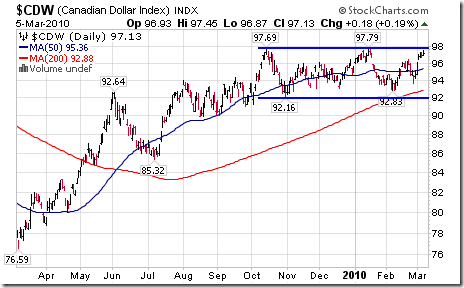
The Canadian Dollar appears poised to move above a tight five month trading range between 92.16 cents and 97.79 cents U.S. Intermediate trend is up. The Canuck Buck recently bounced from its 200 day moving average currently at 92.71 cents U.S. . The Canadian Dollar held its trading range despite a 9.6 percent gain by the U.S. Dollar Index since December. Historically, the Canadian Dollar has traded lower when the ddddU.S. Dollar traded higher. A break above resistance at 97.79 cents U.S. implies intermediate upside potential to 103.75 cents U.S.
Fundamental influences
A series of events are coming together to trigger a breakout by the Canadian Dollar during its next seasonal sweet spot between mid March and the end of May.
The Canadian economy is recovering strongly. News last week, that fourth quarter real annualized Gross Domestic Product rose by a faster than expected 5.0% rate, confirmed the trend. Growth is coming from greater federal government spending related to an economic stimulus program and from rising demand and prices for commodities including copper, zinc, nickel, crude oil, potash and lumber.
Strength in the Canadian economy and its currency relative to other G8 countries is attracting speculative attention by international investors. The Russian central bank recently noted its intentions to diversify its currency reserves by purchasing Canadian Dollars.
Early technical signs of an intermediate peak in the U.S. Dollar Index have appeared during the past two weeks. Recent strength in the U.S. Dollar Index was triggered partially by weakness in the Euro that, in turn, was triggered by concerns about a possible default by Greece’s debt. At least a temporary resolution of Greece’s financial crisis is likely to be reached this week. The U.S. Dollar Index has a history of peaking each year near the end of March. Technical confirmation of an intermediate peak in the U.S. Dollar likely will be the trigger for a breakout by the Canadian Dollar above the 97.79 cents U.S. level.
The Bank of Canada confirmed last week that monetary policy is expected to remain accommodative until at least the end of the June, but hinted that an easy money policy was approaching an end. Anticipation of a tightening monetary policy in the second half of 2010 will prompt strength in the Canadian Dollar.
What to do
The preferred strategy is to continue to own investments that trade in Canadian Dollars. Investments in securities trading in other currencies also are possible if they are fully hedged against currency risk. Investments in U.S. Dollars are particularly vulnerable if not hedged.
….read more and view the Charts in Don’s Tuesday report HERE.
Don Vialoux has 37 years of experience in the Investment Industry. He is a past president of the Canadian Society of Technical Analysts (www.csta.org) and a former technical analyst at RBC Investments. Don earned his Chartered Market Technician (CMT) designation from the Market Technician Association in 1995. His CMT paper entitled “Seasonality in Canadian Equity Markets” was published in the Spring-Summer 1996 edition of the MTA Journal. Don also has extensive experience with Exchange Traded Funds (also know as Index Participation Units) as well as conservative option strategies. In 1990 he wrote a report that was released in the International Federation of Technical Analyst Journal entitled “Profiting from a Combination of Technical and Fundamental Analysis”. The report introduced ” The Eight Phases of the Stock Market Cycle”, an investment concept that continues to identify profitable entry and exit points for North American equity markets. He is currently a member of the Toronto Society of Fundamental Analyst’s Derivatives Committee. Now he is the author of a daily letter on equity markets available free on the internet. The reports can be accessed daily right here at www.dvtechtalk.com.
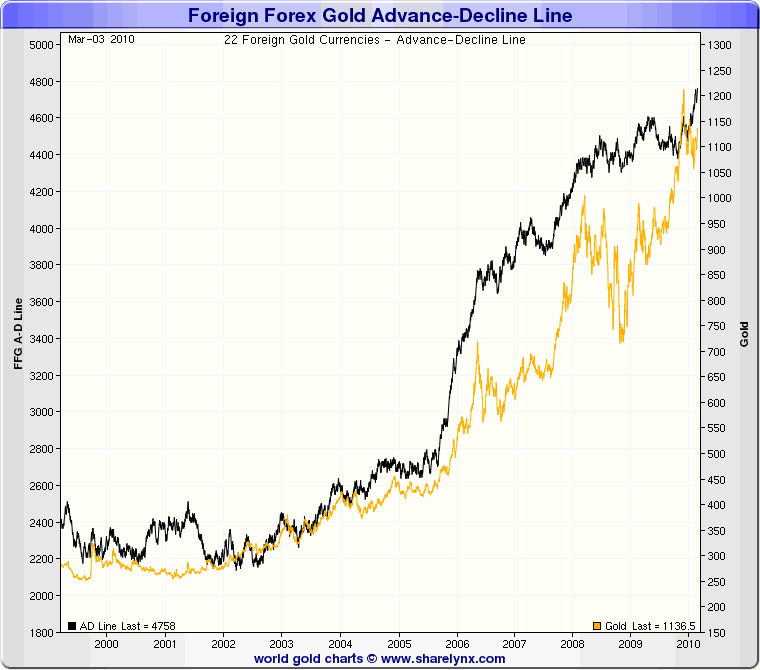
Here’s a couple of charts showing gold in Foreign Currencies Gold Forex measured by an advance-decline line.
To That Perma-Gold Bear Who Says Gold is Not in a Bull Market
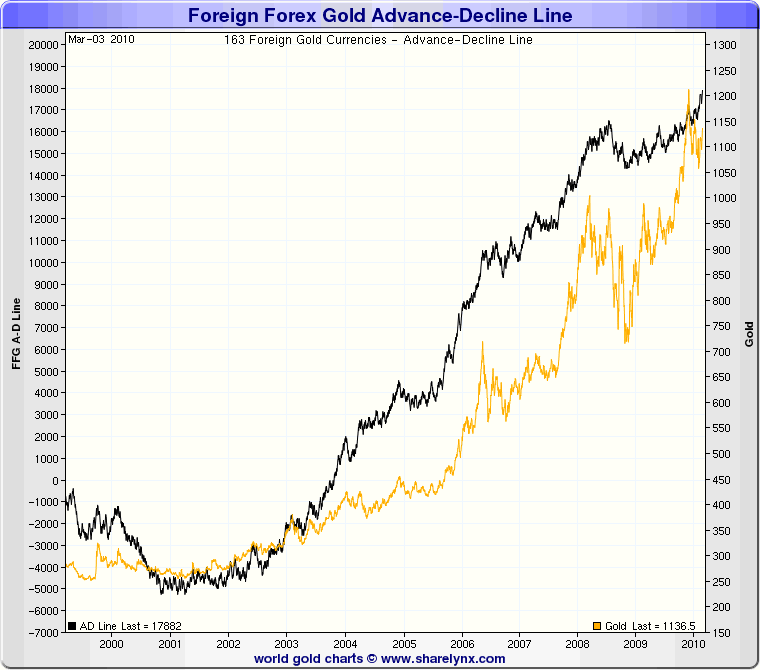
As can be clearly seen when the price runs the advance-decline line rockets upwards.
In other words the advance-decline line only rises when the majority of currencies measured in gold are rising strongly.
So it’s a good indicator for strength in a rising price.
The first chart is for 22 major currencies & the second for a more broader 163 foreign currencies.
As can be currently see the indicator is rising strongly.(Courtesy of Bill Murphy)
On Major Moves, Grandich has been very right and not only saved many investors fortunes, but expanded them dramatically. On November 3, 2007 at the MoneyTalks Survival Conference, Peter Grandich of the Grandich Letter warned that “an unprecedented economic tsunami will hit American beginning in 2008”. Peter advised publicly to short the US market two days from the top in October, 2007 and stayed short until the last week of October, 2008. He began to buy stocks in March 7th, 2009. He also bought oil and oil related investments near the lows after the dive from $147.
….go to visit Peter’s Website.
Market Buzz – Seacliff Jumps On Strong 2009 Results
After a strong February, March kicked off with a bang as Toronto’s main index jumped 3 per cent for the first week of the month as earnings season stepped into high gear with strong earnings results from TD Bank (TD:TSX) and Bank of Montreal (BMO:TSX), which drove the heavily influential financial sector.
The gains were punctuated by a strong 150.17 point gain Friday to close at 11,975.14, about 229 points higher than where it started the year.
News on the jobs front in the U.S. helped keep the market in a rosy mood as the U.S. Labor Department’s monthly report, seen as the most important measure of the economy’s health, showed fewer jobs were cut in February than expected. Employers cut 36,000 jobs last month, better than the 50,000 to be cut forecast by economists polled by Thomson Reuters. The unemployment rate held steady at 9.7 per cent. Economists were expecting it to rise to 9.8 per cent.
We caution investors to not get too excited about these numbers as they still show the U.S. is shedding jobs. A drop in unemployment is necessary for the economy to make a sustained rebound.
Switching gears a bit, we got some excellent news from two stocks we follow closely in our Canadian Small-Cap Universe (www.keystocks.com). Both Seacliff Construction Corp. (SDC:TSX) and MOSAID Technologies Incorporated (MSD:TSX) posted strong quarterly numbers this past week and have seen their share prices and have seen their share prices rise 71 per cent and 54 per cent, respectively, from our recent recommendations.
Seacliff Construction, a diversified infrastructure and construction company, reported solid 2009 year end results. Revenues rose 14.5 per cent to $578.1 million from $504.9 million in 2008. 2009 adjusted net income rose 20.8 per cent to $28.6 million, or $1.38 per share, from $23.7 million, or $1.24 per share, in 2008.
The stock jumped $1.19 to $13.75; a new all time high on the news and our fully updated report and rating has been released to our clients.
Looniversity – Why Do Companies Care About Their Stock Prices?
Here’s the irony of the situation: companies live and die by their stock price; yet for the most part, they don’t actively participate in trading their shares within the market. Companies receive money from the securities market only when they first sell a security to the public in the primary market, which is commonly referred to as an initial public offering (IPO).
The original company that issues the stock does not participate in any profits or losses resulting from these transactions because this company has no vested monetary interest. This is what confuses many people; why does a company, or more specifically its management, care about a stock’s performance in the secondary market when this company has already received its money in the IPO?
Well, there are a number of good reasons public companies care about their stock price. Below are some of the more important factors.
- Management are often Shareholders – They have a vested interest: shares go up, they win too.
- Secondary Financing – The stock market acts as a barometer for financial health. The better a company’s stock performs, the cheaper it will receive debt financing and the better a position it is in to use its share price as currency to raise further cash if necessary.
- The Hunters and the Hunted – Unlike private companies, publicly traded companies, if they allow their share price to decline substantially, stand vulnerable to takeover by another company.
- Wrath of the Shareholders – In extreme cases, shareholders can band together and try to oust current management in a proxy fight.
Put it to Us?
Q. Should I pay special attention to a company’s “whisper number” around earnings time?
– Shawn Brow; Toronto, Ontario
A. For those unfamiliar with the term, whisper numbers are unofficial and unpublished earnings per share forecasts that circulate among the professionals and “elite investors” on Wall Street. What affects bearing whispers has on you depends first on the type of investor you are. If you are a longer-term investor, the price action around earnings season will over time be merely a small blip, so the whisper number can be trivial. If you are a short-term or momentum trader, the whisper may be followed more closely.
Having said this, we believe you should view whisper numbers with a fair bit of suspicion. Why, you ask? Well, if a true insider knew that a company was going to beat earning expectations, why would he or she tell the world and have it published for everyone to see?
Just remember that while whisper numbers might sound important, in the end, they’re just a fancy name for a rumour and we are never partial to basing our investment decisions on rumour.
KeyStone’s Latest Reports Section
- Canadian Infrastructure Stock Posts Strong 2009, Shares up Over 71%, But Strong Cash Position & Relative Fundamental (PE of 10) Allow Us to Maintain BUY Rating Long term (Flash Update)
- Canada’s Largest Facilities Maintenance Company Posts Strong 2009 Results, 25% Gain Prompts Near-term Ratings Change, Long-term Remains the Same (Flash Update)
- Pure Play Chinese Construction Company, Strong EPS Growth, Growing Backlog, PE of under 8 – Initiate Coverage with BUY (Flash Update)
- Micro-Cap Environmental Company Generates 7 cents in Earnings for 2009; Trades At $0.32 with $3.2 Million in Cash, No Long-Term Debt and Good Prospects for Growth in 2010 and Beyond (Flash Update)
- China-Based Staple Good Manufacturer Jumps 142% in 5-Months Prompting Rating Change (Flash Update)
-
I know Mike is a very solid investor and respect his opinions very much. So if he says pay attention to this or that - I will.
~ Dale G.
-
I've started managing my own investments so view Michael's site as a one-stop shop from which to get information and perspectives.
~ Dave E.
-
Michael offers easy reading, honest, common sense information that anyone can use in a practical manner.
~ der_al.
-
A sane voice in a scrambled investment world.
~ Ed R.
Inside Edge Pro Contributors

Greg Weldon

Josef Schachter

Tyler Bollhorn

Ryan Irvine

Paul Beattie

Martin Straith

Patrick Ceresna

Mark Leibovit

James Thorne

Victor Adair