
Daily Updates
How to profit from the “fertilizer wars”
Ed Note: Stock Recommendations towards bottom of the article
There’s nothing like scarcity and supply disruptions to fuel violent price spikes. And there’s nothing like the basic human needs for food and water to light that fuse.
Today’s world food supplies run on razor-thin inventories.
While the food riots of 2008 have all but disappeared from our short-term memories, the threat of them returning grows stronger with every passing day.
According to the World Bank, food prices increased 83% between February 2005 and February 2008. In April 2008, when the United Nation’s World Food Programme warned that a “silent tsunami” of hunger was sweeping the globe because of soaring food prices, it was more than just a clever sound bite tossed off by a bureaucrat: It was a warning that the world’s poor were being squeezed as increasingly higher portions of their family incomes were being spent on the food they required for their very survival.
Improved fertilizers will be a key to the solution of this problem. And they won’t just promote crop growth – savvy investors who fertilize their portfolios will be pleased with their profit harvest.
Let me explain…
…..read more HERE
This isn’t the first time that I’ve written about Canada, a well-run country that has avoided many of the mistakes made by the United States. Its budget deficit is moderate, its balance-of-payments deficit is also small, its banking system is in pretty good shape and it faces very little inflation risk, since the country has maintained a reasonable monetary policy.
At this point, you might well be asking: Well, if you’ve said this all before, why does it bear repeating now?
The answer is simple: As I’ve hunted for attractive investments recently, I have noticed that a very high percentage of those companies are domiciled north of the border.
In short, it’s time to invest in Canada.
…..read it all HERE
Washington is patting itself on the back for having orchestrated an amazing economic recovery. But Washington lawmakers are a delusional bunch of boneheads, say Marc Faber and Mike “Mish” Shedlock, editor of the Gloom, Boom, and Doom Report and investment advisor at SitkaPacific Capital Management, respectively.
The economy is NOT recovering, they say, and the U.S. faces a depressing “eventuality” of either crushing deflation (Shedlock) or runaway inflation (Faber). The timing and type of this eventuality is uncertain, say the gurus, but they are certain it’s too late for America to change course.
“It’s beyond repair — it’s too late,” to avert fiscal disaster, Faber declares.
“The day of reckoning has arrived. The question is how long it takes to play out.”
This grim outlook doesn’t mean you’re helpless. Faber recommends individuals prepare for doomsday by buying gold, owning assets abroad and buying property outside of major cities.
BC should see its GDP rise by 3.4 per cent this year, making it among Canada’s economic growth leaders, according to an RBC Economics report released Thursday. “We have good growth prospects for BC in 2010 and 2011, reflecting more favorable global financial conditions, improved prospects in the US and stronger economy related to the 2010 Olympic and Paralympic Games,”
Craig Wright, senior vice-president and chief economist, RBC, said in an interview about the RBC Economics Provincial Outlook. “And that will continue as we go forward.” Also, the housing market in BC has bounced back and is producing continued support for the economy.” According to the report, BC’s forecast GDP rise of 3.4 per cent compares favorably to Canada’s projected 3.1 per cent growth in 2010. The report said BC’s forecast growth rate represents a significant improvement compared to the contraction of 2.5 per cent in 2009, which marked BC’s worst performance since 1982. However, the report also notes that BC’s forecast growth of 3.4 per cent in 2011 is slower than the national average of 3.9 per cent, mostly because of the removal of the “stimulus” the 2010 Olympics and Paralympic Winter Games provided. Wright said it is also a reflection that in 2011, other provinces will begin bouncing back as well. Wright said the 2010 Olympics has already provided a boost to tourism, retail trade and other services, adding that the Games will help speed up an emerging economic recovery, while positioning BC “as a top destination for travelling, emigrating and doing business.” The report also said that BC’s economy should continue to benefit from very low interest rates and that housing starts are expected to rise to 25,600 units in 2010, after falling to 16,000 units in 2009. However, the HST is expected to temper new home building in the second half of the year. The outlook for BC’s labour market is also encouraging, with a predicted return to pre-recession levels by the end of the year, with RBC forecasting a rise in job growth of 2.1 per cent this year compared to a 2.4 per cent decline in 2009. The unemployment rate should average 7.7 per cent, slightly higher than last year’s 7.6 per cent, because of the entry of more people into the labor market. Wright said capital investment should also pick up in BC, “thanks in large part to strength in the energy and mining sectors.” Meanwhile, Central 1 Credit Union chief economist Helmut Pastrick agreed, in an interview, that BC should see renewed growth this year, although he assessed the RBC report as a bit too rosy. “I’m a little lower on the growth rate (than RBC),” said Pastrick. “I see about 2.8 per cent this year and 3.0 per cent next year. “And (RBC) is assuming stronger US growth and more housing starts than I do. Given the fact that economic growth across North America is lower than normal for this stage in the recovery, we remain cautious on equities for the second half of the year. Although markets are fairly valued at current levels, risks are to the downside if earnings expectations over the next few quarters are not met.
Soundbites
- If corporate Canada was ever being hollowed out, it is now being filled in. For the first time in five years, the announced acquisitions of international companies by Canadian entities outstripped foreign takeovers in 2009. After the year started with dismal mergers-and-acquisitions figures, total transaction activity rose by more than 50% by the fourth quarter, pushing the M&A trade balance into a surplus, according to the Financial Post Crosbie: Mergers and Acquisitions in Canada database. “They have gone on a bit of a shopping spree,” said Douglas Porter, deputy chief economist at BMO Capital Markets. Canada’s relative economic strength and high loonie afford a competitive edge in cross-border M&A activity. But as the global economy improves, and as more international players go hunting for foreign assets, there has been no fundamental change that would prevent another spate of takeovers of Canadian properties similar to what was seen in 2006-07, said John Manley, head of the Canadian Council of Chief Executives. “It doesn’t allay any concerns I would have about the hollowing out effect,” Mr. Manley said. “If you think Canadian champions matter, we haven’t solved that problem.” Until the global economy normalizes and competition levels out, however, Canada appears well-positioned to build on a promising 2009.
- A likely interest rate hike in July by the Bank of Canada and growing demand for Canadian investments will propel the loonie past the US dollar by the summer, according to a growing chorus of economists predicting parity. Luckily for investors, the recent rise of currency-hedged ETFs will make it much easier to maintain foreign positions in 2010 while navigating through volatile exchange rates. Avery Shenfeld, chief economist with CIBC World Markets, was the latest economist to weigh in; saying in a report the Canadian dollar will reach $1.02 USD by September, before dropping to 97¢USD by year’s end. “If as we expect, the Bank is out in front of the US Federal Reserve by a couple of quarters, a higher Canadian dollar will help tighten monetary conditions,” Mr. Shenfeld said in a new strategy report.
- The Canadian government should privatize Canada Post as part of a broader plan to improve the nation’s economic productivity, the Organization for Economic Co-operation and Development said in a report last week. The OECD’s Going For Growth analysis of 30 Western economies comes just days after Finance Minister Jim Flaherty floated the possibility of selling off Crown corporations to trim Canada’s ballooning national debt. The report also called on Western Political leaders to control deficit spending by shutting down some of the programs that were intended to stimulate national economies devastated by the global recession. Governments should also resist industry lobbying efforts to water down proposed banking regulations aimed at avoiding a repeat of the crisis, according to the OECD. The report said major steps are needed to improve economic productivity after a recession that will result in continued high unemployment and lower economic growth potential in western economies. “The global recession has left deep scars,” said secretary general Angel Gurria. “The only way to begin healing them is to take affective action now to help our economies recover their lost potential. Canada was urged to boost competition in “network” sectors – telecommunications, power utilities and postal service – that act as “the oil in the engine” of the national economy, said Yvan Guillemette, an economist at the Paris-based, government-funded agency that provides economic and social policy advice to 30 member nations, including Canada.
Marketwatch – A Look at the Week’s Newsmaker’s
Bank of Nova Scotia (BNS) – wrapped up first-quarter earnings season with a 17% jump in profit and the highest revenue in its history, amid surging demand for home loans and personal lines of credit. For the three months ending on January 31, Canada’s third-biggest bank posted net income of $988-million, or 91¢ a share, compared with $482-million (80¢) last year. The results come on an anniversary of the low point of last year’s stock-market meltdown, when the global banking system was on the brink of collapse. Like nearly all its domestic peers, Scotiabank exceeded analyst’s expectations for the quarter against the backdrop of a resurgent economy, one of the biggest equity rallies in a generation and rock-bottom interest rates put in place by The Bank of Canada as a way to put liquidity back into the system.
Cisco System Inc. – has unveiled a new network router it says will usher in a new era of ubiquitous video on the Internet. The new router, known as the CRS-3 (Carrier Routing System), is three times faster than the CRS-1 Cisco models currently employed by broadband and telephone carriers around the world. Cisco said the CRS-3 would allow carriers such as AT&T in the United States to offer bigger and faster web services and would give rise to a new era of video-enabled web services online. Cisco chief executive John Chambers said “video is the killer app” of the Internet and that the new capabilities of Cisco’s technology would enable a whole host of new innovations in fields such as health care. Cisco, based in San Jose, California, said the new technology would be capable of routing 322 terabytes of data per second – roughly the equivalent of the entire printed collection of the U.S. Library of Congress – and offers enough bandwidth to stream every movie ever made in just four minutes.
Great Canadian Gaming Corp. (GC) – an operator of casinos and thoroughbred racetracks, posted a better-than-expected fourth-quarter profit, helped partly by its cost cutting and capital management programs. For the quarter ended December 31, the company posted a net profit of $9.8-million, or 12¢ per share, compared with a net loss of $1.7-million, or 2¢ per share, a year ago. Revenue was almost flat at $96.3-million. Analysts on average were expecting the company to earn 8¢ per share on revenue of $96.3-million, according to Thomson Reuters. Earnings before interest, taxes, depreciation and amortization (EBITDA) as a percentage of revenue were 34.3% in the fourth quarter, compared with 24.4% a year ago. Shares of the Richmond, BC-based company closed yesterday at $7.78 on the Toronto Stock Exchange.
TransCanada (TRP-T) – announced it has received a permit from the South Dakota Public Utilities Commission (PUC) to construct and operate the South Dakota portion of the Keystone Gulf Coast Expansion Pipeline project. TransCanada filed its permit application with the PUC in March 2009. The PUC conducted public input hearings across the project area and a formal evidentiary hearing was held in November 2009. The PUC order attaches a number of conditions to construction and operation of the pipeline in the State. The order finds that the project, if constructed and operated in accordance with those conditions, will not significantly impact the environment or the health, safety or welfare of those in the area and satisfies all applicable requirements of the State of South Dakota. When completed, the Keystone expansion project will increase the commercial design of the Keystone Pipeline system from 590,000 barrels per day to approximately 1.1 million barrels per day. The 12-billion USD system is 83 per cent subscribed with long-term commitments of 910,000 barrels per day for an average term of approximately 18 years. The Keystone Pipeline System will link a reliable and stable source of Canadian crude oil with the largest refinery market in the world.
“Quote of the Day”
“If you don’t know where you are going, you will wind up somewhere else!” – Yogi Berra
JAMIE SWITZER | Raymond James Ltd.
Senior Vice President, Financial Advisor
North Vancouver IAS
PH: 604.981.3355 | FAX: 604.981.3376
jamie.switzer@raymondjames.ca

March 15 (Bloomberg) — Money market interest rates at five-month highs show the Federal Reserve is laying the groundwork to siphon a record $1 trillion in excess cash from the banking system and sending a bearish signal on Treasuries.
“Russell Comment — Uh oh, it’s starting, Ben Bernanke is beginning to get cold feet, and now he wants to begin cutting back on Fed largesse. When that happens, we’ll see how our “improving” economy fares without the stimuli and quantitative easing (money printing).”
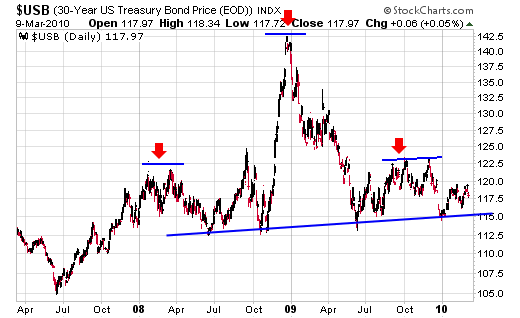
“The 30 year T-bond shows the bond in a huge head-and-shoulders top. The long blue line identifies the support, which comes in at about 115. If the long-bond breaks below 115, the whole situation is going to change. This would mean that the US is having trouble selling its debt.”
“I’ve said this repeatedly — the central banks can continue to inflate until the bond market says they can’t. So far, the bond markets are shaky, but basically they have held together.”
“The word most often used to explain what’s happening is “deleveraging.” As this occurs, unemployment stays high, profits are squeezed, and tax receipts to cities, states and the federal government are diving. The result of the whole process boils down to one phrase — massive DEBT in the face of collapsing income and chronic unemployment.
The situation has now moved beyond people and cities. It has moved to nations such as the widely-talked about PIIGS — Portugal, Italy, Ireland, Greece and Spain. Greece has swallowed the kool aid and is now on a tough, disciplined course. This Greece has been bailed out by the now-shaky Euro Union. However, the Greek situation brought to the front the questioning of all sovereign debt. Default swaps are now available on most sovereign debt, so you can buy insurance on the safety of any sovereign debt including even the debt of the US.
The initial result of all the above should be deflation. The world is already awash with goods and merchandise, more than the world’s population can possibly consume. As buyers pull back on their consuming (particularly American buyers) prices will be forced down. This deflationary trend in prices will scare the hell out of the central banks. Their reaction will be that they will battle deflation as never before. A tidal wave of fiat money will roll out across the planet. This will have the effect of lowering the purchasing power of all fiat currency. And it will be the time for gold to shine.
Let me simplify it. The greater the debt, the more acute the deflaltionary forces. The more debt and the less consuming, the greater the bearish-power of the deficits and the more deflationary the pressures. The greater the deflation, the more fiat money will be created by the central banks. The true solution will entail sacrifices that are greater than the people are willing to accept. In the end, the politicians want to please the people, since that’s where the votes are. In the end, a new monetary system will have to be created. The dollar will lose reserve status to a basket of currencies, which will include gold.”
Gold since 1985 (posted by Money Talks – click HERE to see a larger chart)
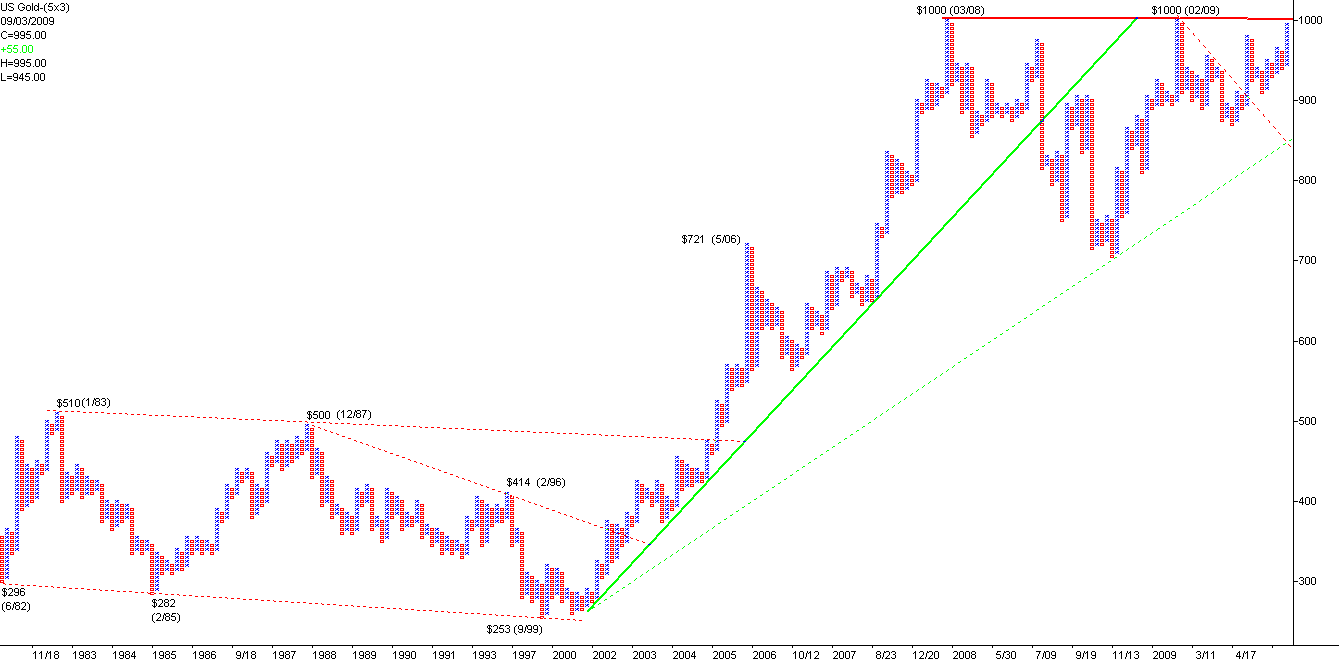
Richard Russell has made his subscribers fortunes. One of the best values anywhere in the financial world at only a $300 subscription to get his DAILY report for a year. HERE to subscribe. Amongst his achievements Richard was in cash before the 2008/2009 Crash and he has been Bullish Gold since below $300
Ed Note: Richard Russell is bullish Silver and holds one of the largest single positions he has held since the 1950’s in the precious metals.
-
I know Mike is a very solid investor and respect his opinions very much. So if he says pay attention to this or that - I will.
~ Dale G.
-
I've started managing my own investments so view Michael's site as a one-stop shop from which to get information and perspectives.
~ Dave E.
-
Michael offers easy reading, honest, common sense information that anyone can use in a practical manner.
~ der_al.
-
A sane voice in a scrambled investment world.
~ Ed R.
Inside Edge Pro Contributors

Greg Weldon

Josef Schachter

Tyler Bollhorn

Ryan Irvine

Paul Beattie

Martin Straith

Patrick Ceresna

Mark Leibovit

James Thorne

Victor Adair