
Daily Updates
1. Gold and Silver:
Treading Water
2. Salares Lithium Strikes Again
1. Gold and Silver: Treading Water
Gold and silver seem to be treading water. The good news is that gold does not seem to want to fall below $1100 and that silver below $17 per ounce. So I suppose the real question is whether the two precious metals break up or down from here. But these are, in my opinion, short run considerations. You see the world is changing and with the change must come a dramatic rethinking of its currency system. Everyone knows it.
China is rattling her currency sword as well. Here we agree with Paul Krugman the more than left wing MIT Professor who claims that China is stuck in an unenviable position. If she dumps her dollar portfolio the value of the dollar will fall – just what Washington would love to see. This would be anathema to China. So Beijing is very astutely encouraging her citizens to buy gold and silver – really for the first time in decades. This is a sort of home-made solution to the nasty Forex imbalance conundrum. Wars have been fought over such issues as currency debasement.
The historical root of this problem, of course, is the reserve currency status of the US dollar. That lofty status bestowed on the US greenback following WWII has allowed our leaders in Washington to issue debt at will, which other countries must purchase, because they required dollars to trade. It has been a 60 year US party indeed. Now the bill is past due. With the Nixon Administration’s dismantling of the post-war Bretton Woods agreement and the move to a “goldless” (Godless?) floating exchange rate system, the decline began in earnest.
It was at this point that academe promised that modern economic theory (both Keynesian and Monetarists) and their proponents would always do the right thing independent of the politicos. For a time it worked. It was called the “Great Moderation.” You know, no more serious recessions no bubbles, no economic trauma and reduced regulation in the system. But even then we were firmly on our way to a tipping point which many (Rogoff, Ferguson and many more) believe we are now past.
The French leaders appear smarter than Americans with respect to twentieth century currency thinking whether we like to admit it or not. During WW II they surrendered early on and Canada, the British Commonwealth and the Americans came to their rescue. They went to nuclear energy in a big way early and now export $60 billion of electricity a year to Britain. Finally they began redeeming gold for dollars in the late 60s and early 1970s. It would seem that France realizes that money is gold, energy and other unprintable and rare commodities. It remains to be seen what France will decide to do with the ailing Euro.
Today all currencies are adrift in a swelling sea of indebtedness with no anchors. It is a sea where no one on the bridge wants to deal with the massive deleveraging necessary. It remains, as I have oft suggested, a race to the currency bottom. One certain pathway forward to cancel the mountainous waves of debt is to inflate them away by allowing relative currency values to sink. In the hearts and minds of both politicians and bankers worldwide it is the easier way forward. Who will go to the bottom first? The Chinese base their stubborn peg to the dollar on the belief that it is the US currency among all others.
One reason gold and silver have been manipulated for so long (yes manipulated – exchange rates can be manipulated as in China’s peg to the dollar) is that they are a natural anchor to a floating rate, fiat currency system; they have served that purpose for thousands of years. As Ted Butler points out, on March 25th we shall see if the CFTC modifies the way futures markets work to remove the ability to “wag the dog.” Please stay tuned. Our current system has been dysfunctional since 1971 when gold was ripped from its dollar backing.
If you are a trader, what happens to gold and silver in the short run matters to you. If you are a long term discovery investor and believe that the currency tipping point has been passed then you must also believe that gold and silver (and other commodities), should account for at least 10% TO 20% OF YOUR PORTFOLIO. We think that across the 3 discovery spaces (incubator, mature and legacy) the gold and silver names have not followed the price appreciation of the metals. Please take note.
Salares Lithium Strikes Again
…..to read more of this letter from Dr. Berry’s FREE email, sign up HERE
Dr. Michael Berry is a pioneer in the emerging field of “discovery investing.” He researches and writes on companies that focus on discovery in natural resources, high technology and biotech.
Previously, he successfully managed small and mid cap value funds for Heartland Advisors and Kemper Scudder.
While at the Darden School, University of Virginia, he was a professor of investments and has held the Wheat First Endowed Chair at James Madison University. His research in the study of behavioral strategies for investing has been published in numerous academic and practitioner journals.
He publishes Morning Notes by Michael A. Berry, Ph.D. The notes discuss geopolitics and their effect on capital markets.
…..Subscribe for Dr. Berry’s FREE email HERE
John Kaiser: Game-Changer on Rare Earths Horizon?
Source: Interviewed by Sally Lowder of The Energy Report 03/18/2010
Kaiser Bottom-Fish Report editor John Kaiser, caught for this exclusive Energy Report interview as this year’s PDAC was winding down, suggests that the bigger the event grows, the fewer the opportunities to pick up buzz during informal networking. Still, he did come away from the 2010 Prospectors & Developers Association of Canada International Trade Show & Investors Exchange in Toronto last week with a bit of news that may be a game-changer in the rare earth elements space.
The Energy Report: You’re a long-time participant in the annual PDAC convention. Everybody who wasn’t able to be there wants to know about any compelling stories or particularly interesting tidbits that you learned this year, when the event brought people into Toronto from more than 100 countries around the world.
JK: In the past few of the 20 years I’ve been going to this conference—and this year is no exception—it has become increasing difficult to pick up any prominent buzz, be it about a sector being red hot or be it about a major new discovery.
TER: Why do you suppose that’s happening?
JK: The reason is simple; this conference has become so big, so global. What in 1994 would have been the big Voisey’s Bay’s buzz that everybody was talking about or Bre-X in the following year, even if something like this did come along now, the collective size of 400 companies exhibiting would dwarf it. . .There are several hundred trade show exhibitors; numerous talks covering everything from country-focused issues to deposit models to new discoveries and so on. It’s very difficult for any single thing to stick out.
Even worse, because it is now so large and dispersed, you do not have that intensity of networking of the past, the random networking where you would bump into people you hadn’t seen for a long time and hear about this or that. By the end of the conference you had all these bits and pieces gelling in your head and you could say, “Oh, yeah, this was what was interesting.” No, now it’s more you know in advance what you’re looking for; you make the sessions; you track down those companies, and you have the face-to-face you planned with these. So, the old aspect of serendipity of bumping into stuff and stuff floating to the surface just does not happen in this environment.
TER: Did you come away with any sense of how people are feeling about the economy?
JK: There was no irrational exuberance at all at this conference. In fact, it’s a bit like a teeter-totter poised to go either way. There is hope that China will pull the global economy back on track and reinvigorate Europe and the United States. On the other hand, there also is concern that this will fall apart, and that as the fiscal stimulus packages come to an end interest rates start to rise that we will see a double-dip recession in the North American markets. And if that happens to coincide with a problem in China, which has been going hell-bent at an incredible pace thanks to its $585 billion fiscal stimulus program, there is concern that this could end very badly.
So we are almost in the eye of a hurricane, and everybody’s wondering where we will be next year.
TER: Which way are you leaning?
JK: My own feeling is that if we come out of this with the global economy back on track and the disparate signs of life that we see in the North American economy are actually more than just flickers, next year we should see the supercycle that dominated the talk at this conference from ’03 to ’08. This time it will be taken seriously, and massive amounts of money will flow into the sector. But as I say, it all hinges now on where the global economy goes.
TER: Anything else that stands out from your PDAC experience this year?
JK: Quite a few of the rare earth companies were represented, there were several rare earth receptions and a whole morning devoted to talks about the rare earth deposits, geology, market and so on. These were surprisingly well-attended for a Wednesday morning, when traditionally 90% of the delegates are still in bed. So that is actually a pretty good indicator of the interest in this space.
Particularly with the assistance of one of the stocks listed going up during the days of the conference, I would say that the rare earth space is probably on the threshold of achieving a whole new level of serious attention from investors.
TER: Any companies in that space that you find particularly interesting?
JK: The interest has been a lot of talk and a lot of tire-kicking, but not really a lot of money going into the treasury. This may change in the not-too-distant future, though.
TGR: How so?
JK: I had an interesting meeting with a representative of Molycorp Minerals, who explained their timeline of activities. If I understand it correctly, we could see a Molycorp IPO before the summer. What the institutional market is missing in the rare earth sector is a vehicle large enough for serious investments. There has been incredible media buzz about the rare earth space. The Chinese are very clearly interested in seeing rare earth deposits developed outside of China to take the pressure off them to export what they consider a resource they need to hoard for the long term.
Having said that, nobody wants to buy stocks such as Quest Uranium Corporation (TSX.V:QUC) to any large degree. With these smaller players, there are so many uncertainties about whether the feasibility study will indicate a profit margin, whether they’ll ever get a permit to get to production, or whether the metallurgical process actually will work. An aversion to investing in these very risky single-asset projects has inhibited the serious money coming into these plays. If a major company such as Molycorp does an IPO and lists on the New York Stock Exchange, though, it will validate the space and pull a lot of money into all the smaller companies. So I sense the timeliness for this improving over the next two or three months.
TER: Do you see any other companies besides Molycorp with an asset base that could actually pull off something as significant as an IPO and list a rare earth play on the New York or Toronto Exchange?
JK: A counterpart is Lynas Corporation Ltd. (ASE:LYC), listed on the Australian Stock Exchange. This company has a market cap of AU$815 million, and last year raised AU$450 million basically from institutional investors around the world after the Australian Foreign Investment Review Board said no to a Chinese proposal to put up debt and equity financing in exchange for majority control of Lynas. So this has already happened in Australia, but that market is not as liquid and popular as, say, the New York Stock Exchange.
I wouldn’t be surprised if Lynas Corp. also seeks a New York Stock Exchange listing; however, the significance of Molycorp is that this is a home-grown, American deposit, and on April 1, we’re supposed to hear the results of the RESTART bill proposal, an analysis of what America’s vulnerabilities are to rare earth supply. If they decide that we have a problem here, the intensity of the hand-wringing about what to do about it would increase and companies such as Molycorp will receive a lot of attention as at least a major part of the solution to the problem. As you may know, Molycorp has been in the process of getting its Mountain Pass deposit back into production, and it also has the ability and the knowledge base necessary to acquire other projects elsewhere in the world to beef up its rare earth supply potential.
TER: Thank you, John. You also mentioned RESTART in a previous Energy Report interview a couple of months ago (“John Kaiser: Balancing Security of Supply Worries with Optimism on the R&D Front”). We recently saw a news release about this recently, and for readers who aren’t familiar with it, RESTART stands for “Rare Earth Supply-chain Technology and Resources Transformation” (for more information, see below).
John Kaiser, a mining analyst with 25-plus years of experience, produces the Kaiser Bottom-Fish Report. It specializes in high-risk Canadian resource sector securities and seeks to provide investors with a framework for intelligent speculation. His investment approach integrates his “bottom-fishing strategy” with his “rational speculation model.” After graduating from the University of British Columbia in 1982, John joined Continental Carlisle Douglas, a Vancouver brokerage firm that specialized in Vancouver Stock Exchange listed securities, as a research assistant. Six years later, he moved to Pacific International Securities as research director and also became a registered investment adviser. Not long after moving to the U.S. with his family in 1994, John cast his own line in the water, so to speak, with publication of the premier edition of the Kaiser Bottom-Fish Report.
******
Note: RESTART, proposed as a means of reviving a competitive rare earths industry in the U.S., has been put forward as potential legislation by an organization known as USMMA, the United States Magnet Materials Association. USMMA reported submitting this proposal, designed to create a path forward toward “a ‘whole-of-government’ approach to resolving the Rare Earth Elements (REE) supply crisis,” to a number of federal entities—the U.S. Department of Commerce, U.S. Department Energy, U.S. Department State, U.S. Department of Defense, Office of the U.S. Trade Representative, and Office of Science and Technology Policy within the Executive Office of the President. The RESTART proposal calls for up to $1.2 billion in funding to reestablish domestic rare earth mining as well as U.S. facilities for refining, alloying, melting and production of rare earths and rare earth-based products.
USMMA said that it has already successfully advocated for inclusion of a congressionally-mandated study of the rare earth supply-chain in the FY10 National Defense Authorization Act. The organization was founded by three high-performance magnet producers and suppliers in 2006: Thomas & Skinner, Inc. (Indianapolis, IN), Hoosier Magnetics (Ogdensburg, NY) and Electron Energy Corporation (Landisville, PA) in 2006. U.S. Rare Earths, Inc. (a private company) joined the group in 2009.
******
Want to read more exclusive Energy Report interviews like this? Sign up for our free e-newsletter, and you’ll learn when new articles have been published. To see a list of recent interviews with industry analysts and commentators, visit our Expert Insights page.
Over the course of the last 12 months, many analysts and newsletter writers have been discussing precious metals stocks as an alternative to fiat currencies. What opportunities remain—new and old—in Mexico, Colombia and elsewhere for investors? In this exclusive interview with The Gold Report, Mike Kachanovsky, aka ‘Mexico Mike’, (Investor’s Digest of Canada), discusses why he believes the market is better than ever for precious metals, as well as the abating political risk for mining companies in countries such as Mexico, Colombia and Vietnam.
The Gold Report: Mike, in our last interview, you stated you were fairly optimistic about precious metals because government reaction to the financial crisis was to keep interest rates low and issue large amounts of currency. Are you still as optimistic about metals at this time?
Mike Kachanovsky/ Mexico Mike: Absolutely. I’ve been probably more excited about the precious metals after the way things have unfolded in the last 12 months or so than I was even during our last interview. (See “Silver’s Scarcity Premium” 6/9/09) The same factors still apply in terms of having artificially low interest rates and quantitative easing, where many nations are debasing their currency and printing money. I believe that inflation is only just now starting to become a factor. You’re starting to see that commodity prices across the board are increasing and it’s decoupling somewhat from the U.S. dollar. The U.S. dollar is showing a countercyclical strength in the last few months that’s largely a reaction to what’s going on in Europe. But the commodities are holding firm and in many cases are rising, nonetheless. I think it’s just a matter of time until the U.S. dollar rolls over again and may begin to lose value relative to other currencies. That’s when you’re going to see the real upside potential in the precious metals become a reality.
TGR: Do you think the decoupling is ultimately a good thing and how much time is involved for this turnaround that you’re forecasting?
MK: It’s always difficult to put a timeline on this sort of thing. There’s quite a number of moving parts and different factors that are having an impact. I mentioned the troubles going on in Europe. Some of the nations there are having fiscal difficulty in their own budgeting. You have a lot of feedback loops clouding the waters somewhat in terms of when all this is going to come to pass. I don’t necessarily like to put a timeline on it. In fact, if you’d asked me a year ago I would’ve thought we would be much higher now than where gold and silver are priced. Is it a good thing that resources are decoupling from the dollar? Yes and no. I think what you’re seeing is that investors are starting to put money into commodities as an alternative to traditional financial vehicles. People believe that commodities are going to hold value better than, for example, owning short-term treasury notes or owning dollars themselves. And so, in that sense the fact that people are losing confidence in the more mainstream financial investments to me is a bad thing. It’s a sign that our economy is under duress and that people don’t feel that good about the future. However, if you happen to be an investor in commodities, of course it’s a good thing that you have strength.
TGR: What kind of portfolio adjustments are you making right now? Are you accumulating more stock, precious metals, cash?
MK: Well, I’ve always had a mentality of being a very aggressive investor and as such I buy the dips. My portfolio is almost entirely weighted towards resource stocks. That’s not just precious metals. I own oil and gas stocks. I have leveraged to rare earth elements, base metals and coal. I’m also looking at agricultural now as well. I think that’s a sector that’s going to outperform the overall broader market. When I see a pullback in the market, I use that as an opportunity to continue accumulating in buying the dips. I also buy physical bullion, gold and silver. I’ve never been a seller. I’ve always been a buyer. I’ve owned silver since it was under $5.00 and I bought another bar just last month on the pullback then. I don’t really overreact to what’s going on, on a cycle to cycle basis. As long as I’m convinced that the fundamentals are still in place for a long-term secular bull market then I don’t try to trade it. I just look for the opportune times to continue to average up as the market progresses higher.
TGR: Are you saying we’re in a pullback now?
MK: It’s hard to say. Commodities are notoriously volatile. To me a pullback is more a cyclical type of description and I think we’re still in an uptrend. However, for gold, a $100 downside move over a period of two weeks is not uncommon. If you look, you could probably define this gold bull market as being about a 10-year long phenomenon so far. There’s probably dozens of occasions where you had similar type dips in the value of similar magnitude and percentage. Did it constitute a pullback? Well, not necessarily, because gold has been up every year.
TGR: When you’re talking about dips for the purpose of taking advantage of them, you’d like to see some sort of long-term trend more than just a few days right?
MK: That’s correct. I should emphasize that part of the strategy of playing the dips is you have to be willing to sell the spikes. My personal strategy and philosophy is to maintain a core position in the stocks that I think are the best stocks that an investor has to be positioned in. Then I also maintain a trading position. I’ll buy extra stock in some of these companies when they sell off. Then as they spike high, I’ll unload that trading position and capture that net profit.
TGR: What stocks are you favorable towards right now?
MK: I still think silver is going to be one of the best commodities to be leveraged to. Silver is a frustrating metal for anyone that’s been aware of it and following it. It doesn’t seem to rise as quickly as we expect or hope. I still think silver has the potential to be one of those metals that can go from $15.00 to $50 or to have that 200% to 400% potential gain in one year that we’ve seen from some other metals like uranium. I believe that’s sometime in the future for silver as well.
When I’m looking at specifics stocks to gain leverage to, I want to find companies that are developing silver deposits that are cash-flow positive, have a number of projects on the go and are aggressively acquiring other prospects in this market. Then they are better positioned for when silver lifts off. I also look at market valuations relative to the peer group. When I see a company that I think is above average in terms of its fundamental strength and it’s trading at a discount to its peers in any sector, I’m going to want to buy some of that company. I feel that it’s just a matter of time until the market recognizes that strength and prices it in.
TGR: Are there any of those companies that that you’d like to share with us?
MK: One of them in particular is MAG Silver Corp. (TSX:MAG;NYSE.A:MVG). We can look at the chart for that company just in the last few weeks and see that it’s been rapidly rising in price. It appears to have been under accumulation and to me it’s one of the go-to stocks in Mexico for leverage in silver. Of course I own shares in it. I was a recent buyer of more stock and I know the management. It has a strong balance sheet, plenty of cash in the bank, no debt and a number of very good projects on the go. If you’re a bull and are expecting that silver has a lot further to run, I think MAG Silver is an exciting stock to own.
Paramount Gold and Silver (TSX:PZG;NYSE:PZG) is another Mexico resource play. They’re not in production, but they have several years of positive development in Mexico on their main asset. Paramount at this point is still priced way below their peaks from a few years ago. It’s achieved a much higher overall mineral inventory that is much more leveraged to gold and silver despite the fact that it’s a cheaper stock today. In fact they just announced last week another very good discovery hole that’s probably going to add significantly to their overall resource.
Very few of these companies that we talk about today were active in Mexico prior to 2000. One of them is Avino Silver and Gold Mines Ltd (TSX.V:ASM;OTCBB:ASGMF). They are a very small company and actually have a majority ownership of a Mexican mine that they have maintained going all the way back to the early ’90s. They are just now getting production recommencing. They completed development work. They call it a bulk sample, but it’s actually going to be a recommencement of mining. If you look at Avino on the basis of its peers, it’s a very cheap stock. They’ve been very efficient managing their capital. It’s a very tight share structure with superb exploration potential for future upside. It looks like their operations are going to be running at a fairly good margin to earn a profit at current prices. That’s the kind of company I like to look for as one that has a great upside, but it’s priced very far down the scale relative to other producers.
TGR: Do you have a preference in terms of companies that are speculative in their focus and are hoping to sellout versus a long-term viable production company?
MK: Again, I look at the market value of a company and decide. If I feel like I’m getting a discount of what the fair market premium should be, then I’m going to go after that company. Most of the time, the established producers are more conservative. A lot of the risk is out of the equation but their upside potential is also going to be less. I do not necessarily have a preference to more speculative stocks. I think it’s more accurate to say I have less fear of risk. I’m willing to take a gamble and try a position in a stock that has more risk if I believe it’s priced fairly and the upside risk is justified by the potential rewards that I’m going to gain by investing in those stocks.
TGR: Are you more likely to take those risks on a region like Mexico than you would anywhere else in the world right now?
MK: I think a lot of the places that investors consider risking today are maybe not as risky as they think. A few years ago I didn’t want to touch stocks from Brazil. I had this impression that Brazil was a very risky place to invest and I just didn’t want to go there. Instead you look at some companies that have been active in Brazil. Yamana Gold (TSX:AUY;NYSE:AUY) comes to mind. It has been very successful and basically built from its base in Brazil to become a worldwide reputable and strongly performing stock.
I think a lot of people still have this impression that Mexico is risky. Part of the reason is that the media focuses on what’s going on in certain border cities and there’s a lot of violence that’s over-reported. I think Mexico has its challenges like any other nation, but overall it’s a very stable country with a strong tradition of mining. There’s well-documented legal processes in advancing mining claims. It’s pro-mining, allowing foreign companies to come in and invest. You’re seeing a lot of companies now that have been in Mexico for a year or two or five that are producing fantastic earnings and drilling their operations. Other places like China are very popular for investing. I don’t see that same track record of strong performance for foreign companies that have been able to go in there and actually make money and build value for investors. So I don’t look at Mexico as a risky place to invest. There are other places that I think are risky and I’ll still go in there and look at them. If the value of those stocks is fairly discounted to that risk, I’ll still participate. In my opinion, Mexico is not a risky jurisdiction. It’s a great place to invest.
TGR: Do you think the investment “window” there is still wide open? Are there any new plays?
MK: I think it is still wide open. I think in a way this market meltdown and nasty correction that the entire precious metals mining sector went through over the last 18 months has been beneficial in some ways because it’s really helped to separate out a lot of the pretenders. There were a lot of companies that just staked a property and raised some money and I’m not necessarily convinced they were seriously into advancing to become stable, producing mining companies. Those companies have disappeared or gone bankrupt or moved on to other speculative sectors. So the companies that are still there and still focused are able to raise capital and develop projects and increase the scope of their activity.
It’s much clearer now to find who the winners are. Those companies continue to behave strongly and have that profile that I look for when I’m trying to pick from all the different companies that I think will be the best performers for the next few years ahead. Are there any new plays? I think just about every week you hear about another company that has established a position or bought up an old project or closed a transaction. Within the last couple of years, two that have really gained my trust are Endeavour Silver Corp. (TSX:EDR;NYSE:EXK) and Great Panther Silver Ltd. (TSX:GPR). They’re both companies that have been in Mexico for a number of years. Only in the last year have they really achieved traction in their operations to the point where they’re self funding. They’re earning a profit from their operations. They still have tremendous potential for future exploration. These are companies that are no longer spinning their wheels. It took probably a year or two for them to get that level of stability and become less risky.
TGR: Any companies in the rare earth space you’re following?
MK: Sure. Commerce Resources Corp. (TSX.V:CCE; Fkft:D7H;PK SHEETS:CMRZF) is one. One of the reasons I like Commerce is I believe it has a very strong management team. This is not just a new story. Rare earth elements burst into public awareness about five or six months ago. There was a mini-mania in a lot of the stocks that had leverage to them because people began discussing how China had a stranglehold on the metals and they’re very essential for many industrial applications. All of a sudden you had a lot of investors scrambling to find projects with leverage to these metals. Commerce is not just rare earth. It’s also exotic metals like tantalum and again, most investors or retail buyers have never heard of these things. The reason that I like Commerce is that it’s been committed since 2005 or perhaps even earlier to projects that are primarily leveraged to these exotic metals. They have an advanced project and a strong balance sheet with plenty of cash. I believe they’re sincerely focused on advancing to development, in which case the stock will probably have a much higher value at some point in the future if they’re successful. I think it’s very attractively priced in the market at this time and much cheaper than it was a year or two ago. Any time I can buy something that has great value at a lower price I tend to be interested in that kind of a stock.
TGR: Do you continue accumulation in a company like that or do you have a position and just hold on to it?
MK: Well, I bought a position originally in that story, I think about two years ago, and I actually did add to it just when the rare metals started to get hot and the investors started to get excited about them. Then I added again just recently on the bit of a price dip that we just had in late January. I don’t believe I’ve ever sold a share of that company. I just patiently accumulate.
TGR: Any other companies from our last interview that you could comment on?
MK: Let’s see. Eastmain Resources (TSX:ER). I’ve been a holder of Eastmain probably since 2003 and have never actually traded it. The management is superb. They’ve been focused and remain focused on the same part of the world. Year after year good markets or bad they just continue to move things forward. They’ve attracted some exceptional senior partners to work with, Goldcorp Inc. (NYSE:GG) being the most obvious one that most investors are familiar with. I think the best validation of that story comes from the fact that they’ve just recently closed a placement to raise additional money that I believe was 60% or 70% above the market price. If you’re familiar with the way most companies raise money, they usually have to dangle some sort of a market discount in order to attract a large financing. For Eastmain to be able to secure millions of dollars so far above market price tells me I’m not the only one that believes this company has a great future. Quebec is one of the best mining jurisdictions in the world. There’s just not that same upside initial discovery potential in Quebec that you may have from somewhere like Mexico that hasn’t seen a lot of that development exploration work. Eastmain is a bit of an anomaly in the fact that they grabbed a lot of their landholdings back in the late ’90s when the mining sector was in a severe recession. For a very small Canadian junior to have such excellent property holdings that are now attracting major partners is just another feather in their cap.
TGR: Are there any other parts of the world that you like and that you’re looking at right now?
MK: I just returned from a trip to Vietnam to review the only Canadian mining stock that’s active there. That company is Olympus Pacific Minerals (TSX:OYM). They actually own two mines that are both in production right now. The potential from these mines is fantastic. They have a mineral inventory above 1.6 million ounces of primarily gold. My opinion is if these mines were located in other more mining-friendly or more commonly accepted mining districts in the world this stock would be priced at several dollars a share. But Vietnam is considered far off the radar and is not known as a great mining center, and a lot of people still have misgivings about investing in communist countries. This stock is trading very far under the radar but has fantastic potential upside. I don’t own Olympus Pacific yet in my portfolio. I was under a confidentiality agreement to review the project. I’ve only just now been freed from that restraint and I can begin buying that stock in the market. It’s one of the most exciting stories I’ve looked at in a long time and I think it has a great future. The other country that I think is also very similar is Colombia. Much of the media’s presentation of Colombia was that it was a very risky, violent country and there’s almost no exploration because of an insurgency that was ongoing in that country for many years with drug lords and cartels. It’s similar to what we hear about Mexico today. Colombia has a lot of the same geology as countries like Guyana, Venezuela and Peru, where you have tremendous history of mining and superb resource potential. Because Colombia was basically closed for the last 15 years to foreign companies that were unable to operate there, you have all of that potential that’s only just now starting to become realized as the threat from war and from drug insurgence is diminished. There are a couple of companies that arrived early and achieved great things. One story that I like is Bandera Gold Ltd (TSX.V:BGL). I discovered the stock because they own a mine in Mexico and also a fantastic project in Colombia that they’ve only begun exploring now. They’ve begun reporting some very good numbers from it. Bandera is another of those companies with very good management, strong insider ownership and it’s done a very good job of navigating through difficult circumstances. I believe the upside is very high.
TGR: Thank you very much for a fantastic interview, Mike.
Mike Kachanovsky is a consultant providing analysis of junior mining and exploration stocks. His work is published on a freelance basis in a variety of publications, including the Mexico Mike column in Investor’s Digest of Canada. Mike is a founder of the website www.smartinvestment.ca , which serves as an online community for the discussion of all topics relating to junior mining stocks.
Want to read more exclusive Gold Report interviews like this? Sign up for our free e-newsletter, and you’ll learn when new articles have been published. To see a list of recent interviews with industry analysts and commentators, visit our Expert Insights page.
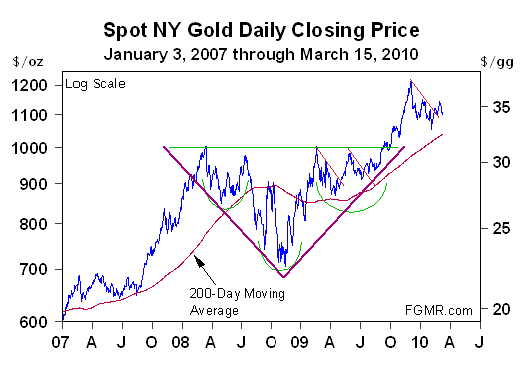
Gold has been stopped time and again in its decade-long bull market by recurring hurdles that appear at an ever-higher price. During these encounters, several things happen, most notable of which is the growing bearish sentiment in the face of a seemingly insurmountable price barrier. We are seeing that pattern repeat with gold’s inability to climb above $1140.
It is curious that this pattern repeats. It suggests that few learn from it, and more to the point, that somehow the fundamental outlook for gold has changed each time one of these barriers is hit. It hasn’t. The same factors driving gold higher all decade continue to drive it, mainly the ongoing debasement of national currencies by governments and central banks.
….read more HERE
Ed Note: Check out Peter Grandich’s list of interesting articles HERE
This brief comment below from the Legendary Trader Dennis Gartman. For subscription information for the 5 page plus Daily Gartman Letter L.C. contact – Tel: 757 238 9346 Fax: 757 238 9546 or E-mail: dennis@thegartmanletter.com or HERE to subscribe at his website
Finally, when it doubt we turn to the sage of the market, Mr. Richard Russell of the Dow Theory newsletter. Mr. Russel has been around for a very long while. He’s seen bull markets and he’s survived bear markets. Thus when he writes, we listen, and yesterday he wrote:
“OK, today I got three important bull signals, the great tide of the stock market has turned to bullish on the three counts I’ve been waiting for. The Dow closed at 10733.70 — at last above the critical 10725 level. This is a new high for the Dow, and it means that the Dow has finally confirmed the new high for the move on the part of the Transports. A Dow Theory bull signal — the primary trend of the market is bullish. At the same time, the great arm of the Dow has swung back above the 50% level. The Dow is now back in the bull zone above 10725. At the same time there were 627 new 52-week highs on the NYSE, a new high-total and well above the 523 new highs of January 11….An all-round historic day…
[So] what am I personally going to do about it? Honestly, nothing. Stocks are generally overvalued in this area…. Actually, the market is priced to produce losses over the years, particularly if you factor in inflation, commissions, dangerously low dividends and rising taxes.”
When great men are tacitly bullish, so too should we be. In our funds managed here we are skewed somewhat bullishly, being a bit net long, with the operative words here being “a bit.” We’ve a large number of shorts on to hedge ourselves, but we are modestly net long just because the trend is still up.
Can we imagine the nearby S&P futures trading back toward 1125-1130 over the course of the next several weeks? Of course we can, but at that point, we’d probably have to increase our net long position… and not modestly, but likely materially.
Richard Russell has made his subscribers fortunes. One of the best values anywhere in the financial world at only a $300 subscription to get his DAILY report for a year. HERE to subscribe. Amongst his achievements Richard was in cash before the 2008/2009 Crash and he has been Bullish Gold since below $300
Ed Note: Richard Russell is bullish Silver and holds one of the largest single positions he has held since the 1950’s in the precious metals.
-
I know Mike is a very solid investor and respect his opinions very much. So if he says pay attention to this or that - I will.
~ Dale G.
-
I've started managing my own investments so view Michael's site as a one-stop shop from which to get information and perspectives.
~ Dave E.
-
Michael offers easy reading, honest, common sense information that anyone can use in a practical manner.
~ der_al.
-
A sane voice in a scrambled investment world.
~ Ed R.
Inside Edge Pro Contributors

Greg Weldon

Josef Schachter

Tyler Bollhorn

Ryan Irvine

Paul Beattie

Martin Straith

Patrick Ceresna

Mark Leibovit

James Thorne

Victor Adair