
Daily Updates
After the sub-prime catastrophe in banking and realty sector, which led to the global recession in 2008-09, it is the turn of bullion markets now.
‘FRAUD’, that is the one word which comes to any investor’s mind when s/he reads about the Commodity Futures Trading Commission (CFTC) hearing on manipulations in bullion market by gold cartels.
So, the small and clean investors have been short-changed by big cartels during the past many years, especially during the recent boom time in bullion markets. Otherwise, how will you explain the biggest boom in paper gold (Exchange Traded Funds, ETFs) in the recent past with hardly any gold available in the market.
In fact, there is no gold left in this world if all the Gold ETFs ask for physical delivery. And, if that happens only god knows what will be the gold prices in the coming months — $10000 per ounce? Maybe, even more. Because, price of a commodity which is not available at all can go up to any level due to the sheer fact that it is not there in the market.
…..read more HERE
Market Buzz – Payday for Shareholders of this Aussies Cash Provider
Toronto’s main index kicked off the second quarter with a solid showing this Thursday, as new manufacturing data helped support the prospects for a continuing economic recovery. For the day, the S&P/TSX composite index climbed 108 points, or 0.9 per cent, to 12,146 – levels not seen in 18 months, giving it a fourth weekly gain in five.
For the week, shortened because of the Good Friday holiday, the TSX was up about 1.6 per cent.
The Institute for Supply Management said its U.S. manufacturing index for March came in at 59.6, better than the 57.5 reading that had been expected.
Other manufacturing surveys for the eurozone, Britain, and China also outperformed expectations. In the case of the eurozone, manufacturing activity was at a 40 month high in March. The reports suggested international trade was on the mend and contributed to a growing belief the global economy can avoid slipping back into recession.
That being said, we caution the sustainability of the numbers given the fact that each of these economies have been injected with steroids over the past year, primarily in the form of government stimulus and record-low interest rates. The question now becomes whether or not these numbers will level off or even weaken again when the boost is removed. With mortgage rates rising at some banks this past week and stimulus spending set to wind down over the summer in some segments, we will soon find out.
In Canada, for example, propping up the economy has been a $46-billion stimulus and the central bank has taken overnight rates to practically zero, which can lead to some misleading numbers near term.
For instance, broadly speaking, across the great white north, we see a red-hot housing market in the face of high unemployment and job uncertainty. These statistics run contrary to one another. Apparently, the low rates have been “just good to pass up.” But, will rate increases quickly lead to demand destruction? If the increases are sharp enough, that scenario is likely.
One place where we have seen excellent demand through the recession and into the “recovery” is in the pay-day loan market. The growth, which we have very successfully benefited from through our recommendation of The Cash Store Financial Service Inc. (CSF:TSX) – shares have more than doubled for our clients over the past nine months, has not strictly been seen in Canada.
In fact, another recommendation from our Small-Cap Universe (www.keystocks.com), The Cash Store Australia Holdings Inc. (AUC:TSX-V), has also benefited greatly.
With roots that date back to a single location launched in June 2004, The Cash Store Australia Holdings Inc. is a payday advance broker (44 locations), operating as an alternative to traditional banks throughout Australia, serving the needs of everyday people through its banner “The Cash Store.” The Cash Store acts as a payday advance broker on behalf of income earning consumers seeking short-term advances with a third party lender; without having to provide credit history or security on the loan, which is generally required by commercial lending institutions.
Recently, the company announced that its revenue for its second quarter ended December 31, 2009, rose 370.4 per cent to $2.7 million, up from $574,000 in the same quarter last year. Year-to- date, revenue was $4.5 million compared to $1.1 million in the first six months of fiscal 2009.
Net income for the second quarter was $16,000, or $0.00 per share, compared to a net loss of ($507,000), or ($0.03) per share, for the same quarter last year. For the six month period, the net loss was ($178,000), or ($0.01) per share, compared to ($702,000), or ($0.05) per share, in the same period last year.
We are happy to report that the company’s shares have jumped over 200 per cent in the last eight months.
Looniversity – Over-the-Counter (OTC) Stocks
Contrary to popular belief, over-the-counter stocks are not a generic set of stocks that securities regulators allow Joe and Jane Q. Public to purchase without a prescription from their broker.
No, over-the counter stocks is the name commonly given to companies that trade on a decentralized market (as opposed to an exchange market – TSX or NYSE) where geographically dispersed dealers are linked by telephones and computer screens. The market is for securities not listed on a stock or bond exchange. The NASDAQ market is an OTC market for U.S. stocks.
Typically though, investors associate OTC stocks with the OTC Bulletin Board (OTC-BB). The OTC-BB is a quotation medium for subscribing members. OTC-BB securities are traded by a community of Market Makers that enter quotes and trade reports through a highly sophisticated, closed computer network, which is accessed through Nasdaq Workstation II™. The OTC-BB is unlike The Nasdaq Stock Market in that it:
• Does not impose listing standards.
• Does not provide automated trade executions.
• Does not maintain relationships with quoted issuers.
• Does not have the same obligations for Market Makers.
Put it to Us?
Q. As a contrarian, all this talk about “socially responsible investing” in recent years has got me thinking that, while it may be good for my conscience to invest this way, in terms of returns, it might be better to look at “sin stocks.” What do you think?
– Shirley Sterling; Montreal, Quebec
A. Well, we hate to say it, but you may be right. Industries that lure us with “naughty” temptations can offer a good place to park a portion of your portfolio. First of all, these companies provide relatively stable returns to investors, both in good times and bad. As the old saying goes, “What do you do to celebrate good times? Drink, smoke, gamble, and have sex.” And, what do you do during stressful and recessionary times? “Drink, smoke, gamble, and have sex.” The returns provided by the companies related to these activities are often less prone to the cyclical downturns of the economy.
So-called “sin stocks” are generally those companies which are involved in the gambling, alcohol, tobacco, sex, and defense industries. Outside of the numbers, your choice to invest in these stocks will come down to personal beliefs and preferences.
KeyStone’s Latest Reports Section
-
- Emerging Australian Alternative Financial Stock Breaks in Profitability in Q2, Stock Jumps 200% Since Our Recommendation Eight Months Ago – Rating Change (Flash Update)
- China-based Forestry Company Posted Solid 2009, But Misses Q4 Estimates – Ratings Adjusted (Flash Update)
- Staple Consumer Service Company Posts Solid 2009 Results, Outlook Cautious, Ups Distributions for 9th Consecutive Quarter – Yield 5.76% – Near-Term Rating Change (Flash Update)
- Healthcare/Hospitality Service Trust Posts Sold 2009, Total Return Approaching 100%, Yield Remains Solid at 7% – Rating Updated (Flash Update)
- Reiterate our SELL HALF Recommendation, HOLD Remaining Position for our Top 2009 Canadian Wireless Software Pick After Shares Jump over 260% (Flash Update)
In this week’s issue:
Weekly Commentary
Strategy of the Week
Stocks That Meet The Featured Strategy

Currently, approximately 40% of the trading volume on the New York Stock Exchange is executed by a computer. That means a human being is not involved in the trade, at least not once the trade criteria have been programmed in to the computer.
There are two main reasons why computers are used to trade the market. First, computers can execute trades much more quickly than humans and second, computers are not emotional.
Computer based trading is typically referred to as algorithmic trading. The computer looks for the criteria it is programmed to find and then executes the trades with lighting speed. Using complex event processing software and ultra low latency data feeds, these orders are often executed in micro seconds. For scalping type strategies (where traders take advantage of bid-ask spreads and action gleaned from the Level 2 screens), humans don’t have a chance.
But algorithmic trading is not reserved to scalping strategies. They can also be used to execute on a set of rules that may generate trades every few minutes, hours, days or weeks. For these less time sensitive strategies, the real benefit for the computer driven trade is the absence of emotion.
We humans tend to take good trading strategies and screw them up because of our emotional attachment to money. The more we risk, the more emotional we get, the more likely we are to break one of our rules. Trading is hard for most people because of this emotion.
Should we all aspire to program our trading strategies in to a computer so that we can restrain our destructiveness over that strategy? I think it is a great goal but one that I think is hard for most to achieve.
- Get the StockSchool Pro Free

- DisnatDirect named the number one Canadian brokerage for Traders by Surviscor! Open and Fund a brokerage account with DisnatDirect and receive the StockSchool Pro home study course free, including special Pro level access through the DisnatDirect client website. Offer only available to Canadian residents. For information, click HERE
In recent months, I have gone through my trading strategies and made a real effort to reduce all of the rules for entry, risk management and exit down to logic. Logic has no rule for interpretation and can be entered in to a computer as a set of rules to be executed without fail. If you can have a winning strategy entirely based on logic it is possible to have the computer work for you all day while you do more enlightening things.
The one area that I have not been able to replace judgment with logic is in the reading of chart patterns. With practice, I am able to look at a chart pattern and know what my probabilities of the stock going one direction or another. I try to describe my interpretation with a set of rules but I have not been able to take those interpretations and describe them mathematically. My read of chart patterns is not yet ready for the computer.
There are companies who do run computer programs to identify chart patterns and I am amazed at how the plot those patterns with the computer driven lines. However, when I look at what they define as an ascending triangle pattern or a head and shoulder pattern, I have a hard time agreeing. The computer seems to be able to get it 80% right, but that last 20% can make a big difference between a winning and losing trading strategy.
Many have said that computers will eventually make all of the trading decisions but I don’t agree, at least not in their current form. Humans, with experience, have an ability to interpret the market’s action and adapt in ways that computers can not.
While I am not ready to replace myself with a computer, I am willing to farm a lot of the judgment out to one. Risk management and the exit decision are now entirely logic based for me, it is only the entry decision that still requires a little human touch.
Aspiring traders should put their learning effort in to reading chart patterns, spending time looking at the charts of stocks that have trended well and study how the looked early in the trend. I have spent 20 years doing that and can just tell when a stock has good potential. It is an art, meaning that success is not assured, but with practice, the art of trading can be applied to make some good money.
When I teach people to trade, we now focus on breaking that art down in to a series of skills. Each skill is relatively simple, putting them together to have a good result is just a matter of practice. The more you practice, the better you become and the better you can compete with the computers.

Weakness in the US dollar brought some buying in to the commodities, improving the chart of Oil. This helped the Canadian market more than most so I ran a Stockscores Simple strategy on the Canadian markets to try and find some trading opportunities.
Chart patterns are what I look for when analyzing charts. With practice, the predictive patterns can be found. Based on the results of the Market Scan, here are a couple of charts with good patterns making these stocks worth considering.

1. V.TME
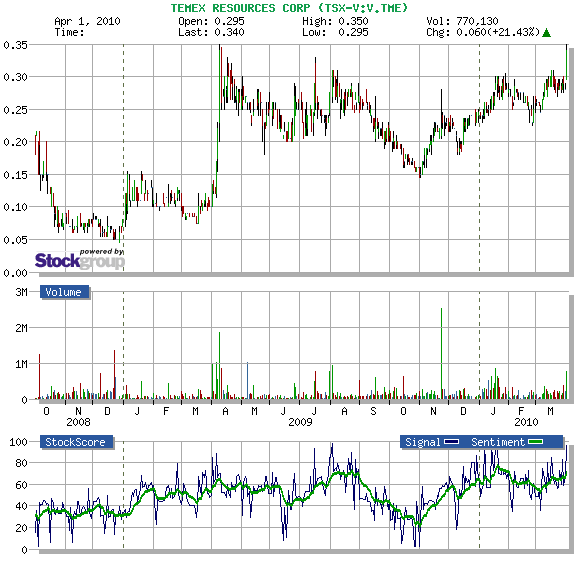
V.TME has had resistance at $0.30 over the past year but that was broken on Thursday with good volume supporting the breakout. The pattern in to the breakout is an ascending triangle pattern, one of the better predictors of future strength. Support at $0.27.
2. T.BIM
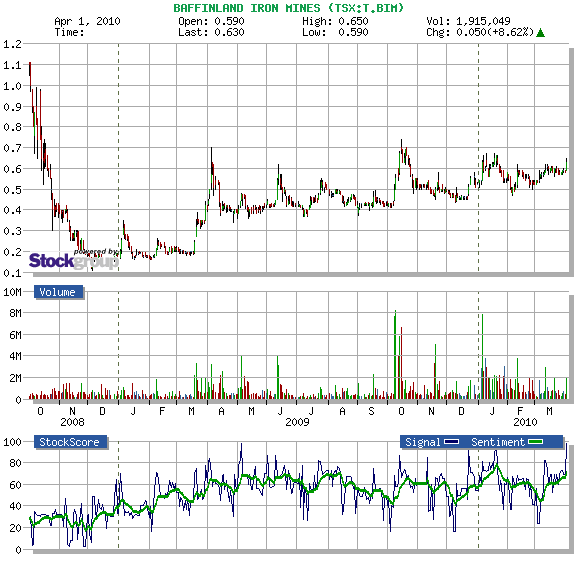
T.BIM broke out of a long term pennant pattern on Thursday with good volume supporting the breakout. Support at $0.57.
References
Get the Stockscore on any of over 20,000 North American stocks.
Background on the theories used by Stockscores.
Strategies that can help you find new opportunities.
Scan the market using extensive filter criteria.
Build a portfolio of stocks and view a slide show of their charts.
See which sectors are leading the market, and their components.
Click HERE for the Speaker Lineup and to Purchase the video if you want to learn from some of the worlds best traders including Tyler Bollhorn.

Tyler Bollhorn started trading the stock market with $3,000 in capital, some borrowed from his credit card, when he was just 19 years old. As he worked through the Business program at the University of Calgary, he constantly followed the market and traded stocks. Upon graduation, he could not shake his addiction to the market, and so he continued to trade and study the market by day, while working as a DJ at night. From his 600 square foot basement suite that he shared with his brother, Mr. Bollhorn pursued his dream of making his living buying and selling stocks.
Slowly, he began to learn how the market works, and more importantly, how to consistently make money from it. He realized that the stock market is not fair, and that a small group of people make most of the money while the general public suffers. Eventually, he found some of the key ingredients to success, and turned $30,000 in to half a million dollars in only 3 months. His career as a stock trader had finally flourished.
Much of Mr Bollhorn’s work was pioneering, so he had to create his own tools to identify opportunities. With a vision of making the research process simpler and more effective, he created the Stockscores Approach to trading, and partnered with Stockgroup in the creation of the Stockscores.com web site. He found that he enjoyed teaching others how the market works almost as much as trading it, and he has since taught hundreds of traders how to apply the Stockscores Approach to the market.
Disclaimer
This is not an investment advisory, and should not be used to make investment decisions. Information in Stockscores Perspectives is often opinionated and should be considered for information purposes only. No stock exchange anywhere has approved or disapproved of the information contained herein. There is no express or implied solicitation to buy or sell securities. The writers and editors of Perspectives may have positions in the stocks discussed above and may trade in the stocks mentioned. Don’t consider buying or selling any stock without conducting your own due diligence.
Quotable – China debt comments
“Indeed, high gross debt in an economy indicates sophistication of its financial and capital markets as well as overall indebtedness. Moreover, gross debt is a useful indicator in assessing macroeconomic risks to the extent that a potentially serious asset price deflation does not allow selling assets to pay off debt, as has been the case during the Great Recession as well as other major financial crises in history.
“However, in the absence of a serious asset price deflation, a more relevant concept of indebtedness for a country as a whole should be its external debt level, because domestic debt tends to be offset by domestic assets. Given the same level of indebtedness, external debt tends to make a country more vulnerable to the vagaries of international interest rates and exchanges that are beyond the country’s controls. And a country needs to generate sustainable foreign currency revenue (i.e., through exports) in order to service its external debt.
“Measured by external debt, China’s indebtedness is one of the lowest in the world. This substantially reduces the risk of a ‘macro margin call’ on China due to potential negative external shocks. While the relevant risks would be less to the extent that a country is able to issue the external debt denominated in its own currency, this has been the privilege for only a handful of economies in the world (e.g., G3).” – Qing Wang, Morgan Stanley
FX Trading – Zoom-zoom growth: Comdols supported, but we like Euro-block pairs
Well, if true, stocks did it again. They forecasted a recovery. The optimists have been right; piling into stocks with confidence as they climbed the proverbial Wall of Worry. The worry warts (guilty as charged) look like they were wrong; especially if the China credit bubble concerns prove untrue.
…..read more HERE
…comes from a number of structural headwinds in PIMCO’s analysis: deleveraging, reregulation, and the forces of deglobalization.
Investment Outlook
Bill Gross | April 2010
Rocking-Horse Winner
There once was a family who lived in a fine house on Main Street USA sometime in the 1980s. It was a handsome house with a big yard and a white picket fence, but something always seemed to be missing. There was never enough of this or that – a fancier car, another TV, it didn’t seem to matter – there was never enough. And so, the house came to be haunted by an unspoken phrase, “there must be more money, there must be more money.” The walls seemed to whisper it in the middle of the night, and even during the day everyone heard it although no one dared say it aloud. The chair spoke, the bedroom armoire, and even five-year-old Billie’s toy rocking horse would eerily demand almost in unison, “there must be more money, there must be more money.”
One day, sensing the family’s distress, little Billie asked his father, “What is it that causes you to have money?” “Well, you go to school, get a good job, and get raises,” his Dad said, “but these days there just doesn’t seem to be enough.” But Billie, being just a little boy didn’t understand and so he went off to ride his rocking horse, searching for the “clue” to “more money.” The horse was a special toy because not only did it whisper like the walls and the living room chair, but it seemed to answer questions if you only rode it fast enough. And so Billie would sit on top of his horse when no one was looking, charging madly up and down, back and forth in a frenzied state to a place where only he and his pony could go. “Take me to where there is money,” he would command his steed.

At first, Billie could not make the horse answer the way it had when he asked about Christmas presents or what kind of ice cream Mom would bring home from the store. Finding money seemed too hard of a question for a toy horse, but it made him try even harder. He would mount it again and again, whipping its head with the leather straps, forcing it faster and faster until it seemed its mouth would foam. “Where is the money, where is the money?” Billie would scream, and at last the horse in full gallop cried out, “borrow the money, borrow the money!”
At just that moment Billie’s Mom came around the corner and into his room and his eyes blazed at her as he fell to the floor. She rushed to his side, but he was unconscious now, yet still whispering the horse’s answer. He continued in that condition for the next 25 years, full grown, and confined comatose to his hospital bed. His family would visit, hoping for his revival, and then miraculously one day in 2008 he awoke with his father and mother at his side. “Did I find the money?” he asked, as if it were still the same afternoon. “Did you borrow it?” “We did,” his Dad answered, “but we borrowed too much.” Billie’s eyes seemed to close at that very instant and he died the next night.
Even as he lay dead, his mother heard his father’s voice saying to her, “My God, we became rich – or what we thought was rich – and we thought that was good, yet now we’re poor and a lost soul of a son to the bad. But poor devil, poor devil, he’s best gone out of a life where he rode to his doom in order to find a rocking horse winner.”
For readers lost in the literative metaphor of another of my lengthy introductions to investment markets, let me connect the dots and suggest that it is symbolic of the perversion of American-style capitalism over the past 30 years – a belief that wealth was a function of printing, lending, and of course borrowing money in order to make more money. Our “horse” required more and more money every year in order to feed asset appreciation, its eventual securitization and the borrowing that both promoted. That horse, like Billie, however, died in 2008 and we face an uncertain and lower growth environment as a result. The uncertainty comes from a number of structural headwinds in PIMCO’s analysis: deleveraging, reregulation, and the forces of deglobalization – most evident now in the markets’ distrust of marginal sovereign credits such as Iceland, Ireland, Greece and a supporting cast of over-borrowed lookalikes. All of them now force bond and capital market vigilantes to make more measured choices when investing long-term monies. Even though the government’s fist has been successful to date in steadying the destabilizing forces of a delevering private market, investors are now questioning the staying power of public monetary and fiscal policies. 2010 promises to be the year of choosing “which government” can most successfully substitute the governments’ fist for Adam Smith’s invisible hand and for how long? Can individual countries escape a debt crisis by creating even more debt and riding another rocking horse winner? Can the global economy?
The answer, from a vigilante’s viewpoint is “yes,” but a conditional “yes.” There are many conditions and they vary from country to country, but basically it comes down to these:
- Can a country issue its own currency and is it acceptable in global commerce?
- Are a country’s initial conditions (outstanding debt, structural deficit, growth rate, demographic balance) moderate and can it issue future public debt as a substitute for private credit?
- Can a country’s central bank be allowed to reflate via low or negative real interest rates without creating a currency crisis?
These three important conditions render an immediate negative answer when viewed from an investor’s lens focused on Greece for instance: 1) Greece can’t issue debt in its own currency, 2) its initial conditions and demographics are abominable, and 3) its central bank – The ECB – believes in positive, not negative, real interest rates. Greece therefore must extend a beggar’s bowl to the European Union or the IMF because the private market vigilantes have simply had enough. Without guarantees or the promise of long-term assistance, Prime Minister Papandreou’s promise of fiscal austerity falls on deaf ears. Similarly, the Southern European PIGS face a difficult future environment as its walls whisper “the house needs more money, the house needs more money.” It will not come easily, and if it does, it will come at increasingly higher cost, either in the form of higher interest rates, fiscal frugality, or both.
Perhaps surprisingly, some of the countries on PIMCO’s “must to avoid” list are decently positioned to escape their individual debt crises. The U.K. comes immediately to mind. PIMCO would answer “yes” to all of the three primary conditions outlined earlier for the U.K. in contrast to Greece. We as a firm, however, remain underweight Gilts. The reason is that the debt the U.K. will increasingly issue in the future should lead to inflationary conditions and a depreciating currency relative to other countries, ultimately lowering the realized return on its bonds. If that view becomes consensus, then at some point the U.K. may fail to attain escape velocity from its debt trap. For now though, “crisis” does not describe their current predicament, yet that bed of nitroglycerine must be delicately handled. Avoid the U.K. – there are more attractive choices.
Could one of them be the United States? Well, yes, almost by default to use a poor, but somewhat ironic phrase, because a U.S. Treasury investor must satisfactorily answer “yes” to my three conditions as well, and the U.S. has more favorable demographics and a stronger growth potential than the U.K. – promising a greater chance at escape velocity. But remember – my three conditions just suggest that a country can get out of a debt crisis by creating more debt – they don’t assert that the bonds will be a good investment. Simply comparing Greek or U.K. debt to U.S. Treasury bonds is not the golden ticket to alpha generation in investment markets. U.S. bonds may simply be a “less poor” choice of alternatives.
The reason is complicated, but at its core very simple. As a November IMF staff position note aptly pointed out, high fiscal deficits and higher outstanding debt lead to higher real interest rates and ultimately higher inflation, both trends which are bond market unfriendly. In the U.S. in addition to the 10% of GDP deficits and a growing stock of outstanding debt, an investor must be concerned with future unfunded entitlement commitments which portfolio managers almost always neglect, viewing them as so far off in the future that they don’t matter. Yet should it concern an investor in 30-year Treasuries that the Congressional Budget Office estimates that the present value of unfunded future social insurance expenditures (Social Security and Medicare primarily) was $46 trillion as of 2009, a sum four times its current outstanding debt? Of course it should, and that may be a primary reason why 30-year bonds yield 4.6% whereas 2-year debt with the same guarantee yields less than 1%.
The trend promises to get worse, not better. The imminent passage of health care reform represents a continuing litany of entitlement legislation that will add, not subtract, to future deficits and unfunded liabilities. No investment vigilante worth their salt or outrageous annual bonus would dare argue that current legislation is a deficit reducer as asserted by Democrats and in fact the Congressional Budget Office. Common sense alone would suggest that extending health care benefits to 30 million people will cost a lot of money and that it is being “paid for” in the current bill with standard smoke, and all too familiar mirrors that have characterized such entitlement legislation for decades. An article by an ex-CBO director in The New York Times this past Sunday affirms these suspicions. “Fantasy in, fantasy out,” writes Douglas Holtz-Eakin who held the CBO Chair from 2003–2005. Front-end loaded revenues and back-end loaded expenses promote the fiction that a program that will cost $950 billion over the next 10 years actually reduces the deficit by $138 billion. After all the details are analyzed, Mr. Holtz-Eakin’s numbers affirm a vigilante’s suspicion – it will add $562 billion to the deficit over the next decade. Long-term bondholders beware.
So I’m on this rocking horse called PIMCO, a “co”-jockey appropriately named Billie, I suppose, and I’m whipping that horse in a frenzy, “The house needs more money, the house needs more money.” Hopefully my fate is not the same as the one created by D.H. Lawrence, nor is the horse’s answer. Billie’s rocking horse was a toy created in the 1980s and abused for two decades thereafter. Today’s chastened pony cannot cry out “borrow money,” but simply the reverse – “lend prudently.” In today’s marketplace, prudent lending must be directed not only towards sovereigns that can escape a debt trap, but ones that can do so with a minimum of reflationary consequences and currency devaluation – whether it be against other sovereigns or hard assets such as gold. Investment strategies should begin to reflect this preservation of capital principal by positioning bond portfolios on front-ends of selected sovereign yield curves subject to successful reflation (U.S., Brazil) and longer ends of yield curves that can withstand potential debt deflation (Germany, Core Europe). In addition, as increasing debt loads add impetus to higher real interest rates worldwide, a more “unicredit” bond market argues for high quality corporate spread risk as opposed to duration extension. In plain English, that means that a unit of quality credit spread will do better than a unit of duration. Rates face a future bear market as central banks eventually normalize QE policies and 0% yields if global reflation is successful. Spreads in appropriate sovereign and corporate credits are a better bet as long as global contagion is contained. If not, a rush to the safety of Treasury Bills lies ahead.
Above all, however, lend prudently, lend prudently if you want to be a rocking horse winner. And for you would be jockeys: be careful when you put your foot in the stirrups. Riding a thoroughbred can be a thrilling but risky proposition. Just look what happened to Billie – poor devil.
William H. Gross
Managing Director
Past performance is not a guarantee or a reliable indicator of future results. Investing in the bond market is subject to certain risks including market, interest-rate, issuer, credit, and inflation risk; investments may be worth more or less than the original cost when redeemed. Sovereign securities are generally backed by the issuing government, obligations of U.S. Government agencies and authorities are supported by varying degrees but are generally not backed by the full faith of the U.S. Government; portfolios that invest in such securities are not guaranteed and will fluctuate in value. Investing in foreign denominated and/or domiciled securities may involve heightened risk due to currency fluctuations, and economic and political risks, which may be enhanced in emerging markets.
PIGS refers to Portugal, Italy, Greece, and Spain.
This article contains the current opinions of the author but not necessarily those of the PIMCO Group. The author’s opinions are subject to change without notice. This article is distributed for informational purposes only. Forecasts, estimates, and certain information contained herein are based upon proprietary research and should not be considered as investment advice or a recommendation of any particular security, strategy or investment product. Information contained herein has been obtained from sources believed to be reliable, but not guaranteed. No part of this article may be reproduced in any form, or referred to in any other publication, without express written permission of Pacific Investment Management Company LLC. ©2010, PIMCO.
-
I know Mike is a very solid investor and respect his opinions very much. So if he says pay attention to this or that - I will.
~ Dale G.
-
I've started managing my own investments so view Michael's site as a one-stop shop from which to get information and perspectives.
~ Dave E.
-
Michael offers easy reading, honest, common sense information that anyone can use in a practical manner.
~ der_al.
-
A sane voice in a scrambled investment world.
~ Ed R.
Inside Edge Pro Contributors

Greg Weldon

Josef Schachter

Tyler Bollhorn

Ryan Irvine

Paul Beattie

Martin Straith

Patrick Ceresna

Mark Leibovit

James Thorne

Victor Adair