
Daily Updates
…..for all of Don’s exhaustive review of 49 market charts go HERE – A review of 7 key charts below:
Don’s article in the National Post “Should Canadians go shopping for U.S. stocks?” HERE
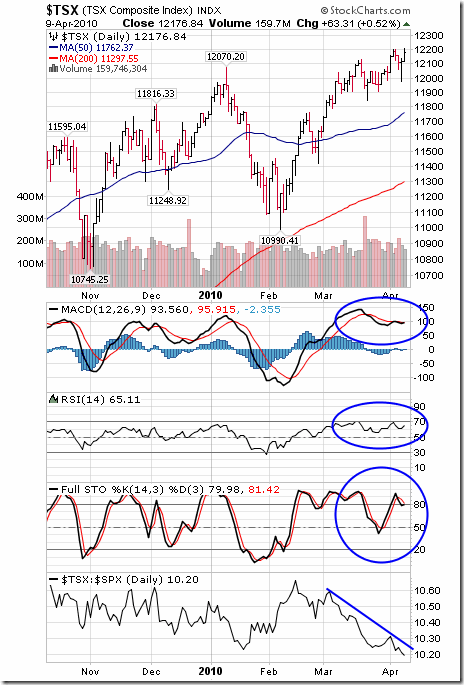
The TSX Composite Index gained another 25.78 points (0.21%) last week. The Index closed at an 18 month high on Friday. Intermediate trend is up. Short term momentum indicators have stalled at overbought levels. Support is a 10,990.41. Seasonal influences remain positive. Strength relative to the S&P 500 has been negative during the past seven weeks mainly because of strength in the Canadian Dollar. Intermediate downside risk is to its 50 day moving average currently at 11,762.37.

The Dow Jones Industrial Average rose 70.28 points (0.64%) last week. The Average closed at an 18 month high on Friday. Intermediate trend is up. Seasonal influences remain positive. Short term momentum indicators are intermediate overbought, but continue to trend higher. Strength relative to the S&P 500 resumed a negative trend. Intermediate downside risk is to its 50 day moving average currently at 10,510.78.
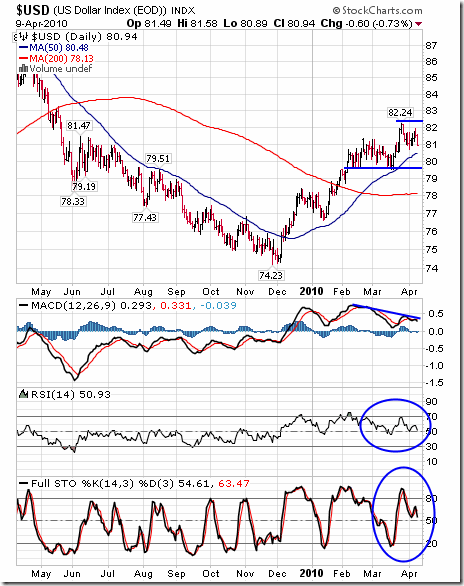
The U.S. Dollar added 0.23 last week. However, focus was on the 0.60 drop on Friday on anticipation of a deal to bail out Greece. Resistance has formed at 82.24. Short term momentum indicators are overbought and trending down. MACD has established an intermediate downtrend. Short term downside risk is to support at 79.51. ‘Tis the season for the U.S. Dollar to start moving lower!
David Skarica at www.addictedtoprofits.com notes that much of the strength in the U.S. Dollar since December can be attributed mainly to weakness in the Euro. Currencies for major countries outside of the Euro (Canada, Brazil, Australia, non-Euro based countries in Europe) have trended higher. A bailout of Greece and a corresponding recovery in the Euro could trigger significant weakness in the U.S. Dollar relative to all major world currencies.
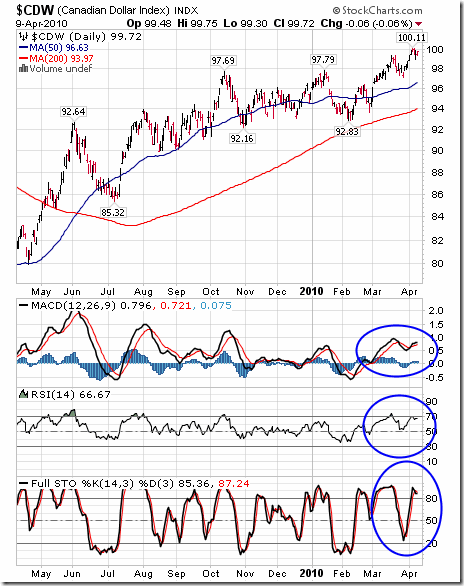
The Canadian Dollar added another 0.57 last week. It briefly broke “par” to reach a 22 month high. Short term momentum indicators are overbought, but continue to trend higher. ‘Tis the season for the Canadian Dollar to move higher! April is the strongest month in the year for the Canadian Dollar. Intermediate upside potential is to 103.75.
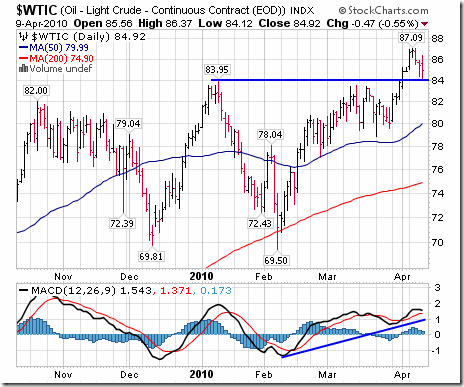
Crude oil slipped $0.75 last week after reaching an 18 month high. MACD is overbought, but continues to trend higher. ‘Tis the season for crude oil to move higher!
Interest Rates
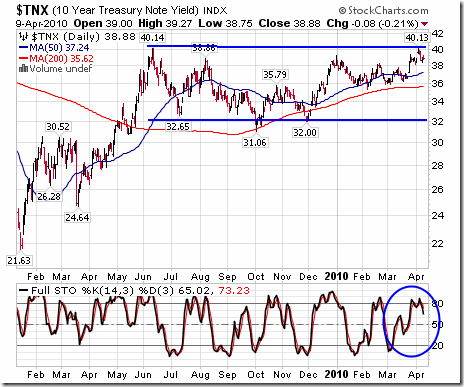
The yield on ten year U.S. Treasuries tested resistance at 4.014 last week, but backed off after a successful auction in mid week. Short term momentum indicators are overbought implying that a break above the 11 month trading range is unlikely to occur soon.
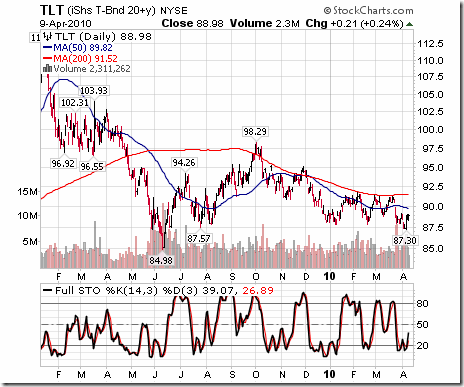
Conversely, prices of long term U.S. Treasuries held above long term support. Short term momentum indicators are trying to bottom.
…..for the rest of Don’s exhaustive review of 49 market charts go HERE
…..Don’s article in the Saturday National Post – Charts, fundamentals show solid prospects for Bombardier
Quotable
“How poor are they that have not patience! What wound did ever heal but by degrees?” – William Shakespeare
FX Trading – Seven Stages of the Dollar
Note: This is a reprint of a piece we did back in 2008. If you have read Currency Currents for any length of time, you likely know we believe the US dollar bottomed in March 2008 (the credit crunch low) and has entered a multi-year bull market. We think we are now about to enter Stage 2 in the dollar cycle: The beginning of a self-reinforcing process. Relatively better US economic growth and rising interest rates will be the drive.
It’s always difficult to pinpoint where we are in terms of a trend. Long-term trends in the currency markets have ranged from six to ten years, measured by the various bull and bear markets in the dollar since the inception of the free-floatingcurrency market back in 1971. Here’s the pattern of long-term bear and bull markets in the dollar as measured by the US $ Index:
…..read more HERE
Stockscores.com Perspectives for the week ending April 11, 2010
In this week’s issue:
Weekly Commentary
Strategy of the Week
Stocks That Meet The Featured Strategy

I am in Calgary on Monday and Edmonton on Tuesday doing one trading workshop at 7:00pm in each city. These workshops are mini-classes where I will teach some analytical methods and then demonstrate how I use those methods to find and execute trading opportunities. We’ll also do analysis of the overall market and hopefully find some trading opportunities to take advantage of.
These presentations are free to attend courtesy of Disnat, who will be on hand to open brokerage accounts for anyone interested. For location details and to register, go to this link. We are expecting large turn outs so you may want to arrive a bit early to get a good seat.
This week, I want to talk about how you get paid as a trader. I hope to change how many of you approach the stock market because I think it is important that traders take the right approach if they are going to succeed.
The “normal” way to approach trading is to want to make money on every trade. While every trader wants this, it is also important to recognize that it is an impossible goal. Losing money on trades is party of making money trading. Rather than judge success one trade at a time, it is extremely important to take a big picture view of the trading process.
- Get the StockSchool Pro Free

- DisnatDirect named the number one Canadian brokerage for Traders by Surviscor! Open and Fund a brokerage account with DisnatDirect and receive the StockSchool Pro home study course free, including special Pro level access through the DisnatDirect client website. Offer only available to Canadian residents. For information, click HERE
My typical trading strategy is historically right 70% of the time. Whether I am day, swing or position trading, I expect to lose 30% of the time and make 70% of the time. On the surface, that sounds pretty good, but the rookie trader would probably consider a strategy that has a 85% success rate much better. This may not be the case.
It is important that we understand how much money is made on the successful trades and lost on the losers. A strategy that is usually right but suffers big losses when it is wrong can be a loser overall despite its high success rate.
So, when judging a strategy we also need to know the average gain on the winners and average loss on the losers. I reference Reward for Risk when I make this judgment.
The risk of a trade is how much you lose if you get stopped out. If you buy 100 shares of a stock at $10 with a stop loss point at $9, your risk is $100. If you then sell that stock at $12, you make $200, yielding a Reward for Risk ratio of two (you earned two times the reward for the risk you take).
If my average Reward for Risk on my winners, which happen 70% of the time, is two, and my average loss is one 30% of the time then I have a strategy that averages a two for one Reward for Risk. A good strategy because it means that over a large number of trades I make money.
However, remember that this Reward for Risk ratio is an average over a large number of trades. It does not mean that every winner earns a Reward for Risk ratio of two. In fact, I find that most of my trades earn less than two when they are right. It is the occasional big winner that ultimately pays me most of my profits.
One or two times out of ten, I can get a trade that pays me five to fifteen times my risk. These trades are the source of the majority of the profits of a trading strategy.
The issue that many traders encounter is that they exit their good trades too early to enjoy the big gains. Their overall profitability suffers because they don’t catch the big winners.
Why is this? Simply, it is because fear causes us to exit our winners early to avoid having the winner turn in to a loser. We avoid the pain of watching a profit turn in to a loss. It is this risk adversity that limits the performance of many good traders.
To overcome this problem, you must have a set of simple exit rules that work to keep you in to the best trades while still locking in some profit on the many marginal trades that you make. I have spent a lot of time working to fine tune the exit rules, not to maximize the profit on one trade, but to maximize the overall profitability over many trades.
This is a skill that all traders should work on. The tendency is to focus on making the best entry decisions but the impact of the exit decision on your overall profitability is probably more substantial.
If you would rather learn my rules than come up with your own, consider attending the Stockscores three day live classes that will be taught in Calgary and Edmonton through April and May. Information on these classes can be found here.

Although the basic principles of my trading method stay the same, the way that I find opportunities does change over time. Right now, I like looking for stocks making abnormal price moves out of good chart patterns. I can use the Stockscores Market Scan to filter for potential trades by running the Abnormal Day Up scan available to Pro members. I then inspect the charts to see if the abnormal action is out of one of the predictive chart patterns that I look for.

1. V.FO
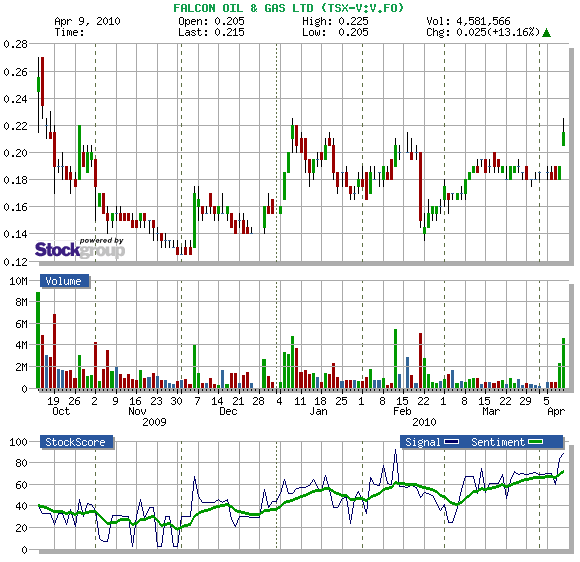
V.FO broke out of a pennant pattern on Friday. This is not an ideal pattern but this stock has been such a strong performer for me in the past that I am willing to consider it despite the overhead resistance showing on the chart. Support at $0.18.
2. LTXC
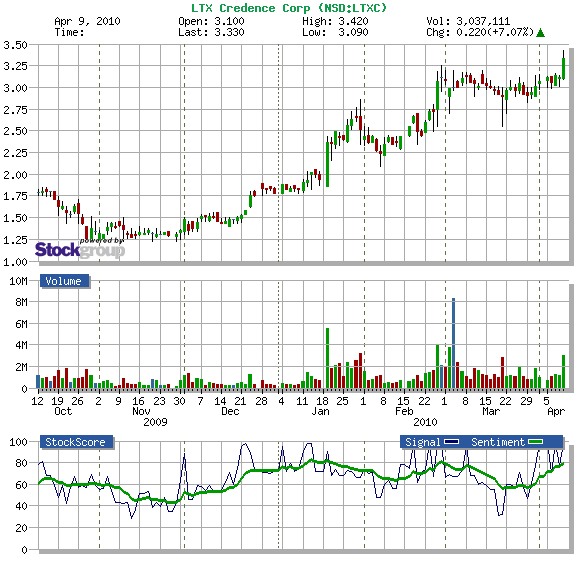
LTXC has already had a great run but had stalled around $3.25 over the last five weeks which is old resistance from two years ago. The distance down to support is relatively small making the reward for risk potential good on this trade. Support at $2.95.
 ‘
‘
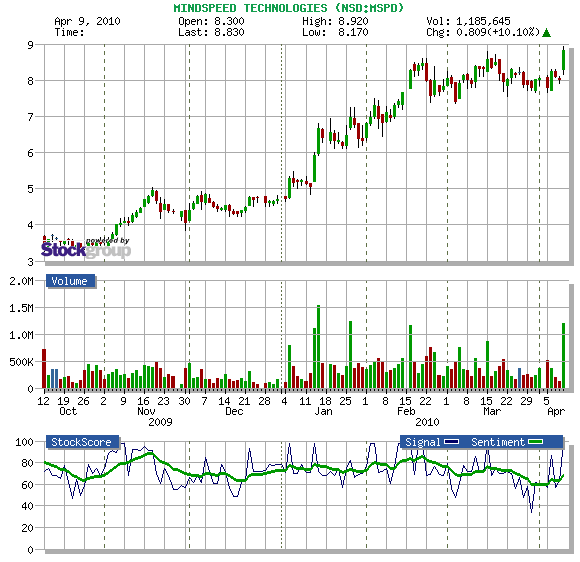
3. MSPD
MSPD is a stock that I featured in the daily newsletter back in July and it has been a great performer. Over the last six weeks, it has consolidated in to a trading range. On Friday, it broke out of that range on strong volume, indicating that it is ready to make the next leg up. Support at $7.90.
References
Get the Stockscore on any of over 20,000 North American stocks.
Background on the theories used by Stockscores.
Strategies that can help you find new opportunities.
Scan the market using extensive filter criteria.
Build a portfolio of stocks and view a slide show of their charts.
See which sectors are leading the market, and their components.
Click HERE for the Speaker Lineup and to Purchase the video if you want to learn from some of the worlds best traders including Tyler Bollhorn.

Tyler Bollhorn started trading the stock market with $3,000 in capital, some borrowed from his credit card, when he was just 19 years old. As he worked through the Business program at the University of Calgary, he constantly followed the market and traded stocks. Upon graduation, he could not shake his addiction to the market, and so he continued to trade and study the market by day, while working as a DJ at night. From his 600 square foot basement suite that he shared with his brother, Mr. Bollhorn pursued his dream of making his living buying and selling stocks.
Slowly, he began to learn how the market works, and more importantly, how to consistently make money from it. He realized that the stock market is not fair, and that a small group of people make most of the money while the general public suffers. Eventually, he found some of the key ingredients to success, and turned $30,000 in to half a million dollars in only 3 months. His career as a stock trader had finally flourished.
Much of Mr Bollhorn’s work was pioneering, so he had to create his own tools to identify opportunities. With a vision of making the research process simpler and more effective, he created the Stockscores Approach to trading, and partnered with Stockgroup in the creation of the Stockscores.com web site. He found that he enjoyed teaching others how the market works almost as much as trading it, and he has since taught hundreds of traders how to apply the Stockscores Approach to the market.
Disclaimer
This is not an investment advisory, and should not be used to make investment decisions. Information in Stockscores Perspectives is often opinionated and should be considered for information purposes only. No stock exchange anywhere has approved or disapproved of the information contained herein. There is no express or implied solicitation to buy or sell securities. The writers and editors of Perspectives may have positions in the stocks discussed above and may trade in the stocks mentioned. Don’t consider buying or selling any stock without conducting your own due diligence.
Trader blows whistle on gold & silver price manipulation
Metal$ are in the pits
There is no silver lining to the activities of JPMorgan Chase and HSBC in the precious-metals market here and in London, says a 40-year veteran of the metal pits.
The banks, which do the Federal Reserve’s bidding in the metals markets, have long been the government’s lead actors in keeping down the prices of gold and silver, according to a former Goldman Sachs trader working at the London Bullion Market Association.
Maguire was scheduled to testify last week before the Commodities Futures Trade Commission, which is looking into the activities of large banks in the metals market, but was knocked off the list at the last moment. So, he went public.
Maguire — in an exclusive interview with The Post — explained JPMorgan’s role in the metals pits in both London and here, and how they can generate a profit either way the market moves.
“JPMorgan acts as an agent for the Federal Reserve; they act to halt the rise of gold and silver against the US dollar. JPMorgan is insulated from potential losses [on their short positions] by the Fed and/or the US taxpayer,” Maguire said.
In the gold pits, Maguire sees HSBC betting against…….
…..read more HERE
It is inevitable that the big traders and hedge funds will push the naked shorts to the wall by asking for physical metal. We could therefore see more hedge funds switching out of GLD like Greenlight Capital did last summer, which leads to the second likely outcome. If we get a squeeze on the naked shorts, the sky is the limit for precious metal prices. – from the article below
A “New Dynamic” in the Gold Market”
by James Turk – Free Gold Money Report
April 1, 2010 – The shorts in gold – and particularly the shorts in silver – felt some pain today. Gold climbed $11.80 to close on the Comex at $1125.10, a 1.1% gain for the day. Silver did nearly twice as well, up 2.1% for the day and ending at $17.876, the highest in ten weeks. The gold/silver ratio fell to 62.9 from 63.6 the day before.
Now that the downward pressure put on gold and silver prices by the gold cartel for option expiry and quarter-end window dressing is behind us, it is no surprise that the precious metals have jumped higher. Physical demand – which is always the major driver of the gold price in the long-run – remains strong, as evidenced by high premiums pretty much everywhere.
The big news that has now begun influencing the market is the stunning revelation by GATA at a Commodity Futures Trading Commission (CFTC) hearing last week about the London whistle-blower who had explained to the CFTC how JP Morgan Chase has been manipulating/capping precious metal prices. In a shocking parallel to the inaction by the SEC after receiving warnings from Harry Markopolos about the Madoff ponzi, the CFTC has apparently been sitting on this information.
The whistle-blower, Andrew Maguire, is an experienced precious metal trader in London. In this riveting interview on King World News with GATA director, Adrian Douglas, Maguire describes a “new dynamic” impacting gold. Specifically, there is a huge short position in the market. But there is even more.
The CFTC hearing confirmed what GATA has been saying all along, that the gold market is being manipulated. To achieve this manipulation, the gold cartel has accumulated a huge short position. Importantly, the hearing confirmed that the gold cartel’s huge short positions are ‘naked’, meaning that these positions are not hedged. More to the point, the CFTC hearing revealed that there is 100-times more paper-gold outstanding than physical gold.
The market is now starting to absorb the significance of what GATA has uncovered over the years and summarized succinctly in its prophetic announcement in The Wall Street Journal more than two years ago, seven weeks before the collapse of Bear Stearns and the start of the present financial crisis: “The objective of this manipulation is to conceal the mismanagement of the U.S. dollar so that it might retain its function as the world’s reserve currency. But to suppress the price of gold is to disable the barometer of the international financial system so that all markets may be more easily manipulated. This manipulation has been a primary cause of the catastrophic excesses in the markets that now threaten the whole world.”
The revelations from the CFTC hearing are earth-shaking, and indeed a “new dynamic” has emerged. The gold cartel now has a big target painted on its forehead. One can never predict the future, but it seems to me that as this news about the gold cartel’s huge naked short position spreads, two things will happen.
It is inevitable that the big traders and hedge funds will push the naked shorts to the wall by asking for physical metal. We could therefore see more hedge funds switching out of GLD like Greenlight Capital did last summer, which leads to the second likely outcome. If we get a squeeze on the naked shorts, the sky is the limit for precious metal prices.
The gold cartel may not yet be finished, and won’t be until the unholy Wall Street-D.C. axis is dismantled. But the gold cartel is on its way out.
Over the past ten years, the gold cartel has staged a controlled retreat. It has been fighting the advancing gold price with propaganda, paper short sales and the occasional dishoarding of physical metal from central bank vaults and more recently, the IMF. This retreat is I suspect about to turn into a rout, which means the upside potential for the precious metals is huge.
For my specific trading recommendations, see Trading.
Posted Monday April 12th – Important Message from the Gold Market below:
Ride the Gold Market to Glory …
I’ve got some important ground to cover with you today, so let’s get started.
First, no matter what happens in the world today …
No matter what happens in the markets …
No matter how good the economic news may be …
Nor how bad it may become …
Why? Because gold is a win-win investment, and because it’s now knocking on the door of its next rocket ride higher. More on that rocket ride in a minute.
First, I want to review with you why I think gold is a win-win investment: It’s because there are really only two possible economic scenarios that lie ahead …
Scenario #1: The Federal Reserve’s (and other central banks) efforts to save the U.S. economy and financial system succeed.
In the short term, that is. I doubt that they will succeed in the longer term.
But I do believe the Federal Reserve and other central banks have largely kicked the can down the road for now, and, thanks in large part to China’s economic growth, we are seeing definite signs of economic improvement, all over the globe.
So what happens next then?
The credit crunch affecting homeowners and businesses eases … money flows through the pipeline … and the trillions of paper dollars central banks have created begin to work their way through the system.
And no matter how hard central bankers try to reign them in, inflation begins to move up quite sharply.
The inflation we will see, however, will be unlike past inflations. It won’t be in wages. It won’t be in real estate prices. It won’t be in the latest tech goodies.
It will be fought in the arena of paper currencies versus tangible assets.
After all, under this scenario, the trillions of dollars worth of fiat money flooding into the global economy will be chasing fewer and fewer goods in the natural resource sector, pushing their prices inevitably higher.
Obviously, gold will continue to do quite nicely under this scenario.
Scenario #2: Government and central banks rescue efforts fail, economies slump again, sovereign debt defaults steamroll across the globe.
Bearish for gold? No way, Jose! The Fed and other central banks will just keep pumping trillions more dollars into the system, but to no avail, as they’re largely bankrupt balance sheets get exposed for exactly what they are — “Emperors and Empires With No Clothes!”
The greenback will experience the worst decline of all currencies, dramatically losing much of its purchasing power, partly due to the intentional willingness to devalue the currency coming out of Washington, and partly because all currencies will be losing purchasing power.
Gold will do quite nicely under this scenario as well.
So how high do you think gold will go in each of these cases?
In scenario 1, I see gold easily hitting my MINIMUM TARGET of $2,300 an ounce, the inflation-adjusted high that would be equivalent to what $850 gold was in January 1980, its first major record high.
In scenario 2, I see gold easily exceeding $2,300 an ounce … and heading to more than $5,000 an ounce.
Let’s Also Not Forget That Gold Demand Is Soaring While Supplies Continue To Shrink Dramatically
Many analysts are claiming that in either of the above scenarios, gold’s rising price will eventually bring oodles of new supply to the market, hence killing, or at least smothering the bull market for a while.
But in fact, the demand/supply equation in gold is heavily tilted toward rising prices, and even far worse than the long-term dire supply picture for oil. In fact, I would even venture to say that the world reached “Peak Gold Production” nine years ago.
Consider the following …
- The U.S. Geological Survey — a division of the Department of the Interior — recently announced that there are now fewer than 50,000 tons of proven gold reserves left in the ground worldwide.
At current mining rates, that means the world will run out of gold within 20 years.
- South Africa, the world’s former top producer of gold, is experiencing some of the steepest production declines.
South Africa’s production has plunged nearly 95% from its peak to its lowest level in 86 years, while mine production there has the potential to fall even further as the credit crisis continues to impact mining companies.
Adding to the supply crunch: Big miners are simply not finding world-class deposits. Why? Simple. Because all the elephant-sized gold deposits have already been found.
And on the demand side, gold is being gobbled up in record or near record amounts in every corner of the globe.
We all know that India is the world’s largest consumer of gold. But China isn’t far behind with total gold consumption valued at $14 billion in 2009.
Indeed, according to a very recent report from the World Gold Council, China’s gold jewelry and investment demand could double in the next decade to $29 billion.
Plus, I have absolutely no doubt Beijing continues to buy gold — on the sly — on practically every dip in prices, scooping up gold in many forms, from physical bullion … to gold certificates … and even via the SPDR Gold Trust (GLD), where China has recently bought up $155.6 million worth of the gold.
Why is Beijing buying gold?
Plain and simple: It’s the best way China can hedge against the inevitable demise of the dollar.
Bear in mind, China only has about 1.6% of its total reserves in gold, compared to 70.4% for the U.S. … and 66.1% for Germany.
So if Beijing were to increase its gold reserves to just 5% of its total reserves, that would mean Beijing would buy up nearly 72 million ounces more gold. That alone would be enough to send the yellow metal to more than $2,000 an ounce.
Also bear in mind, all the gold that’s ever been mined in the history of the world is about 165,000 metric tons, or 5.3 billion ounces. And all of it could fit into a cube measuring roughly 25 meters a side.
Once Gold Closes Above $1,162 An Ounce, The Lid Comes Off
Gold is inching up on the charts, trading at $1,146 as I pen this issue. On my proprietary trading systems, $1,162 represents a critical area for gold.
Once the precious yellow metal — the world’s only real, tangible form of money and wealth — closes solidly above $1,162, the lid comes off. New record highs will be seen soon thereafter.
What if gold rallies to $1,162, but fails to close above that level? No problem. Gold would simply consolidate for a few more weeks or months, between $1,000 on the downside and $1,162 on the upside.
But I have no doubt that gold will blast off and give me that major buy signal. Just as I have no doubts whatsoever that gold is going to soar to at least $2,300 an ounce, if not higher.
As I said at the outset, hold all previously suggested gold recommendations that I’ve made for your core holdings. And get ready to ride them to glory.
Best wishes,
Larry
P.S. With gold inching closer to yet another massive breakout higher, why not join my other Real Wealth Report subscribers so you can get ALL of my recommendations. My specific picks in gold shares, alternative gold investments, oil, natural resources — and more — to help you protect and grow your money for years to come.
At $99, it is truly a bargain, and I would not be surprised if just one of my recommendations covers the cost of the membership several times over. Click here to join now.
From Sunday April 12th
Important Message from the Gold Market …
When you’ve been trading gold for 32 years like I have, you develop a sixth sense for the precious yellow metal.
You can hear it speak to you. You can feel its heartbeat. You can interpret its signals.
Gold anticipates the not-so-obvious and often completely unforeseen economic developments better than any other investment I know of.
That’s why I am writing to you today. Gold’s rally last week to as high as $1,156 an ounce has an important message for all of us: It’s telling us that all is not well with the world and that something major is brewing out there.
What’s going on out there that’s not so obvious and that gold is picking up on?
It’s the relationship between China and the U.S. — and the implications of that relationship not just for the Chinese yuan, but also for the U.S. dollar.
You see, Treasury Secretary Tim Geithner travelled to Beijing this past week, where he got on his knees with his hat in his hand, begging Beijing to push up the value of its currency.
Now, no doubt, in the media, you’ve been hearing for years that China’s currency is undervalued.
But gold is telling you something different.
It’s telling you the other side of the story.
It’s telling you that if the Chinese yuan is undervalued, then the dollar must be overvalued against that currency too.
And that means that the U.S. dollar will soon resume its sharp decline in value, especially against what is now the world’s second largest economy.
So, right now, I want you to be prepared. First, by this heads up I’m sending you. And second, by understanding the historical progression of the relationship between gold and the dollar.
So let’s step back in time a bit …
How Gold and the Dollar
Were Irrevocably Separated
It’s 1947. We’re in a London office on St. Swithins Lane. Inside are six members of the London Gold Committee. A bullion expert from N.M. Rothschild & Sons says, “Gentlemen, it is eleven o’clock.” We begin.
Each member immediately calls his office on a special direct telephone line to determine how much gold is available for sale and how much is bid for.
All heck is breaking loose because there’s not enough gold for sale to meet demand. Reason: Investors around the world have been jittery for weeks. They’ve been watching America’s financial position deteriorate.
In fact, America’s balance sheet is in such terrible shape that Treasury Secretary John Snyder had earlier been forced to announce new bond offerings to help cover the worst budget deficit in the history of the U.S. ($45 billion in the red), not to mention a $247 billion national debt.
The official price of gold is $35 an ounce and climbing. It seems like everyone wants the yellow metal. They’re worried that the value of the U.S. dollar will plummet in international currency markets.
Everyone’s hanging onto the gold they have, making the market even tighter.
Over the next few months, the buying pressure mounts, driving gold’s price up to $43.25, a gain of 23.5%. There are frequent rumors that the U.S. Treasury’s stockpiles of gold are dwindling. The squeeze is on.
The bull market in gold lasts until 1951 when Washington announces the so-called Treasury-Federal Reserve Accord, stipulating that the Treasury and the Federal Reserve act separately with respect to dollar policy and monetary policy.
The agreement effectively hands Washington the ability to spend unlimited amounts of money, with the Fed backing up the check book.
Twenty years later, the Bretton Woods Agreement on currencies is disbanded as Washington spends so much money and the Fed prints so much out of thin air that there simply isn’t enough gold to go around. Period.
Then, in 1973, all ties between gold and the dollar are officially cut by President Richard Nixon. Gold skyrockets from $43.25 an ounce to $850 over the next seven years, nearly a TWENTY-FOLD GAIN.
Now, Compare Our Nation’s Debts
Today with Those in 1947, 1973 and 1980
In 1947, the official national debt was $247 billion. The price of gold was $35.
In 1973, the official national debt was $469 billion. The price of gold was $43.25.
In 1980, the national debt was $930 billion. The price of gold reached $850 an ounce.
Today, our official national debt is a whopping $12.78 trillion. That’s …
- Thirteen times greater than it was in 1980
- Twenty-seven times larger than our 1973 national debt, which broke the back of the gold standard
- And nearly FIFTY-TWO TIMES larger than our national debt in 1947
And I emphasize, that’s just the official debt.
Today we also have more unfunded contingent liabilities than ever and more than any country in history, with our total outstanding debt and liabilities now exceeding $137 TRILLION.
Let’s Connect The Dots …
1943: Gold jumps as the world worries about our $247 billion national debt.
1973: The gold standard is abolished by President Nixon as our national debt hits $469 billion and all over the world investors are redeeming their weakening dollars for gold.
1980: Gold skyrockets to $850 an ounce as our national debt hits nearly one trillion dollars.
April 2010: A trade war between China and the U.S. heats up dramatically. Treasury Secretary Geithner travels to Beijing and essentially begs China to boost the value of its currency to “rebalance the global economy.”
And what country in the world has the biggest stash of U.S. dollars that would effectively be sold to boost the value of the yuan?
China!
Gold’s reaction: It starts to jump again, and flash buy signals.
Why? Because gold speaks the truth. That any revaluation higher in the yuan means mountains of dollars are going to be dumped, causing a massive dollar devaluation.
Not surprising, considering our national debt alone is now almost $13 trillion, more than twenty-seven times larger than is was when the gold standard was abolished.
My view: Listen to gold and what it’s telling you. I have absolutely no doubt that what’s going on between China and the U.S. … including Geithner’s visit to Beijing … is the next inevitable step in the demise of the dollar … and all about inflating away the U.S. debt problems.
Stay safe and cautious,
Larry
This investment news is brought to you by Uncommon Wisdom. Uncommon Wisdom is a free daily investment newsletter from Weiss Research analysts offering the latest investing news and financial insights for the stock market, precious metals, natural resources, Asian and South American markets. From time to time, the authors of Uncommon Wisdom also cover other topics they feel can contribute to making you healthy, wealthy and wise. To view archives or subscribe, visit http://www.uncommonwisdomdaily.com.
-
I know Mike is a very solid investor and respect his opinions very much. So if he says pay attention to this or that - I will.
~ Dale G.
-
I've started managing my own investments so view Michael's site as a one-stop shop from which to get information and perspectives.
~ Dave E.
-
Michael offers easy reading, honest, common sense information that anyone can use in a practical manner.
~ der_al.
-
A sane voice in a scrambled investment world.
~ Ed R.
Inside Edge Pro Contributors

Greg Weldon

Josef Schachter

Tyler Bollhorn

Ryan Irvine

Paul Beattie

Martin Straith

Patrick Ceresna

Mark Leibovit

James Thorne

Victor Adair