
Daily Updates
Michael Ballanger: There’s Still Money in the Juniors
While Union Securities, Ltd. Investment Advisor Michael Ballanger says we’re still in a vintage bear market situation, he sees opportunities for investors in the junior mining sector. In this exclusive interview with The Gold Report, Michael explains the rule of thumb he uses when investing in the juniors.
The Gold Report: Back in March of 2009, you said we were seeing a vintage bear market rally at that point. What’s your opinion of the market a year later?
Michael Ballanger: We’re still in a vintage bear market rally, but there have been some mitigating events that have shaped my opinion. I did not, and I don’t think anybody realized the extent to which the printing press would be turned on by central banks globally.
If you can accept the premise that we’re in a massive global bear market in purchasing power of cash, then everything else that is denominated in cash is going to be in an inverse of that which is a bull market.
You’re not necessarily going to get price-to-earnings multiple contraction, which you should’ve seen by now, given the overbought status of the S&P 500 and many other industrial markets globally. Because the replacement power of equities within a reflationary spiral can only be higher.
I’m not doom and gloom driven right now. I still maintain that in all senses it’s a bear market rally. But I think the re-flation effect will largely offset the P/E multiple contraction that I had forecast a year ago. You may just have a sideways market, 10% swings either way. It’s going to be a lot like the ’70s. You trade very straight-line, flat line, little rallies up, little declines downward. The big bull market won’t be seen in the major averages like the S&P and the Dow.
TGR: Do you see a scenario where we will get back to those bull markets?
MB: What is happening right now is that you’ve got, to coin the phrase, the potential for a conflagration of stock prices upward. Everything is in place right now for a massive return of inflation. I don’t buy the hyperinflation route, but the seeds are sown for inflation. What’s missing right now is money velocity. The only way I see the S&P and the Dow moving to record highs is if money velocity kicks in. Money velocity is the match that ignites the inflationary tinderbox.
TGR: Last year you described a valuation gap in the TSX. Do you still see that there a year later?
MB: Oh, very much so. A lot of junior mining companies that survived the bad times, let’s say from 1997 until 2002, issued a lot more stock than they did in the past.
In the 1990s, many of these companies would start their exploration campaign from a market float of 10 million shares. By the time they’d raised money and done all their exploration work, they might have gotten to 30 million. Many of these companies have gone from 30 million to 100 million shares outstanding. So the leverage, based on the smaller capital structure of a lot of these companies, may not be quite as dynamic as it was in the late 1970s.
A lot of the institutional money is managed by younger people who were probably in kindergarten when share prices were exploding in the late 1970s. I don’t think they have the experience or the knowledge to understand that this mania is coming and that we may be in it right now.
A great degree of trepidation is still being shown toward the venture capital sector and the Canadian junior mining sector particularly. There hasn’t been that propensity by the larger institutional funds to buy that sector yet. The retail investor has got a huge advantage right now over the larger professional or mutual fund/hedge fund investor because they have the ability to buy these things. Later on in the cycle, perhaps a year down the line, these larger professional and institutional investors will return to the Venture Exchange. When they do, that’s going to be the driving impetus that takes the exchange to 4,000 or 5,000.
TGR: You have a rule of thumb for pricing junior exploration companies. Would you explain that for our readers?
MB: A company makes an initial discovery of gold. Through the drilling and exploration process, they come to a 43-101 compliant resource base of, let’s say, 10 million ounces in the ground. Take the gold price, for example $1,000 an ounce, and multiply it by 10 million ounces. That gives you a $10 billion in situ metal value.
My recommendation is that investors can pay up to 10% of in situ metal value. In this instance, if you had a $10 billion asset, you wouldn’t let your clients or investors pay over a billion dollars of market valuation.
Here’s the reason. The location of a discovery is critical to what the mergers and acquisitions departments of the major mining companies are willing to pay based on in situ metal value. For example, if it’s in northern Siberia, they will probably be willing to pay 12% or 13% of in situ metal value to take over a company. If it’s in Timmins, Ontario, which is the heart of the Abitibi Greenstone belt, major mining companies might be more willing to pay up to 40% of in situ metal value. If my clients have been advised to pay no greater than 10% of in situ metal value, then if the exploration and the delineation of that discovery pans out and a major does come to take it out or take it over, you’re going to get a lift.
TGR: Now if this is a standard method that’s used to value junior exploration companies, what causes some explorers to trade at a substantial discount and some over that?
MB: One of the reasons, obviously, is political jurisdiction. We’ve seen what’s happened in various parts of the world, where confiscatory regimes will arbitrarily come in and confiscate a discovery made by a foreign national. You’ve seen it in Venezuela. You’ve seen it in some parts of Africa. When I’m trying to evaluate a junior, after looking at management, I look for where they are exploring. Does the country in which they’re exploring have great respect for and protection of the rule of law, the rule of contract law, primarily?
The provinces of Ontario and Quebec have the models for mining law. Canada is a commodity-driven country, but the two provinces of Quebec and Ontario are the most mining- and exploration-friendly provinces anywhere in the world.
Outside of Canada, I would think Mexico, which is heavily reliant on its mining business and mining industry, has been a place where they’ve actually respected the rule of contract law admirably.
TGR: You’ve said the underlying commodity is your third criteria in looking at companies. Where do you see the price of gold headed for the remainder of this year and into the next couple?
MB: I’m pretty run of the mill, like everybody else. I hate putting dollar numbers on it. However, as I said, if money velocity catches all this freshly printed money globally, and becomes the spark that ignites the inflationary bonfire, then you can just pick any number you want for gold prices north of $3,000 an ounce. Who knows?
For 2,000 years we’ve known that gold is money. The people that are in charge of central banks and treasuries globally have illustrated to us that they have no respect for fiat currency. They have proven it because they have, without any consideration of the ramifications for the average citizen, elected to debauch the currency. That’s not just the U.S. That’s everywhere. The inverse of that is gold. Gold is money. There’s no counterparty risk associated with it. The same stuff we’ve read a thousand times by anybody that likes gold is what I believe. Gold is money. Fiat currency is paper with a promise.
Therefore, I certainly think it’s going to see a new high here in the next two quarters, above $1,220. More so if the so-called “Green Shoots” recovery does actually prove to be an actual recovery rather than a money-printing exercise. Then demand, which will be the money velocity, will force people’s hands and they will have to underpin their currency. That applies particularly to the central banks. The central banks have to find some way to maintain the integrity of their banking system.
The bottom line is that gold can go up for another five to eight years, and still not be considered to be a spike or bubble like all the anti-gold people talk about.
While I like gold, what interests me even more in the near term is silver. I think that silver is the poor man’s gold. I don’t want to get into any sort of great conspiracy theory, but I do think there’s been some funny business that’s been going on in the reporting methods of the Commodity Futures Trading Commission (CFTC). I don’t think silver is trading where it would rightfully be if there wasn’t funny business going on. Every study of global supply versus global demand on silver would suggest that we would have sharply higher prices than where we are today. Just to be really conservative, a 50-to-1 ratio of 50 ounces of silver being worth 1 ounce of gold would be normal. That would take us to a very conservative number of around $24. If the CFTC looked at position limits that are largely held by a couple of big investment banks in New York and perhaps one in London, you would see some legislation that would restrict position limits.
Silver, therefore, represents my favorite of all the metals right now. One of the reasons that junior silver explorers and junior silver companies are so attractive in my world is it’s hard to find one. You know the names Pan American Silver Corp. (TSX:PAA;NASDAQ:PAASO) and Silver Standard Resources Inc. (TSX:SSO;NASDAQ:SSRI). There are very few companies right now that are actually pure silver producers, or certainly very few that are pure silver explorers. That’s a very attractive area to get involved with. If you can find the right management and the right location, it’s going to be a funnel effect. I think that when people start moving to try to find a pure silver equity there’s only going to be handful. So Econ 101 dictates that when you have big demand against finite supply, the price variable is going to go up. The pricing variable on a lot of these junior silver explorers and producers I think has really elastic potential behind it. I think it’ll be quite explosive.
TGR: Michael, what are some of undervalued companies that you think fit into this good management/right properties model?
MB: I will use three different types of juniors in my examples: gold and base metals exploration, gold development and one silver explorer/developer. The one exploration junior that has met all the criteria above is Explor Resources Inc. (TSX.V:EXS). In the interest of fairness and full disclosure, I am a shareholder. Also, our firm and I have been corporate finance and investment banking representatives for this company since May 2007. Explor is in the heart of the Abitibi Greenstone belt, which is a geological environment that stretches from north of Duluth, Minnesota, right across the tops of the provinces of Ontario and into northern Quebec. The Abitibi Greenstone belt has produced 180 million ounces of gold and 450 million tons of copper-zinc ore over the last 120 years.
In Explor’s exploration model they are searching for what can be called an “elephant.” An elephant in the junior exploration game is an ore body that takes on just like it sounds—elephant status, elephant size. Explor’s put together the biggest quality land package of any junior I’ve ever seen in and it is largely within the Abitibi Greenstone Belt.
The one that is the most exciting in the gold arena right now is an acquisition they made last year in the Timmins, Porcupine. It’s actually west of the Mattagomi River in Timmins, Ontario. Over the last 100 years, 70 million ounces of gold have been produced out of Timmins.
Last June 25th, in an area west of Timmins, a junior called Lake Shore Gold Corp. (TSX:LSG) made a discovery at 83 meters of 12 ¾ grams at an elevation of 865 meters of depth, which was the first of its kind west of the Mattagami. In fact, it was one of the best drill holes in Canadian gold mining and exploration history. Explor has a 1,900-hectare parcel of ground called The Timmins Porcupine West Gold Property, which has had around $25 million of shallow exploration work completed over the years. Explor is executing a deep exploration program following the Hollinger-McIntyre model, which is significant because those two mines (located about ten kilometers to the east) produced over 30 million ounces and, like Explor’s land, were associated with a major porphyry unit.
The second major package is the first serious land package assembled in over 40 years, located next to the world’s largest and richest volcanogenic massive sulfide deposit—Xstrata PLC’s (LSE:XTA) Kidd Creek Mine, which was a 140 million ton copper-zinc-lead-silver deposit that would have an in situ metal value of over $70 billion at today’s metal prices. The most recent addition to that assemblage is a four-claim block located 600 meters from the Kidd open pit.
The third property is located in the Duparquet region in the province of Quebec, tied on to the Clifton Star-Osisko joint venture. It’s called the East Bay property. November 3rd of last year Clifton Star Resources Inc. (TSX.V:CFO) announced a joint venture with Osisko Mining Corp. (TSX:OSK). That was at around $2.35 a share. Within three months of that particular joint venture announcement, the stock traded as high as $8.25 a share. They have a low-grade, big-tonnage, big-ounce deposit in that area. The biggest land package surrounding that deposit is Explor’s.
Explor’s CEO and President, Chris Dupont, is a seasoned ex-Inco, ex-Noranda mining engineer born in the heart of the Abitibi, and with our help now has a $5 million cash position and is currently drilling with two rigs on the Timmins Porcupine West prospect.
TGR: Now, Michael, in addition to Explor, are there other companies that excite you nearly as much?
MB: There’s another one called Ely Gold & Minerals Inc. (TSX.V:ELY). It is based on a fairly attractive area of real estate in Nevada. It’s a 43-101 compliant, 400,000-ounce deposit. John Brownlie is the geologist. He’s been successful in putting one of Castle Gold Corp.’s (purchased by Argonaut Gold Ltd. (TSX:AR) in Feb. 2010) gold properties into production in Mexico as well.
Nevada is a mining-friendly jurisdiction within the United States. Ely has ounces in the ground. It trades at a reasonable market capital structure. If you take the 400,000 ounces at today’s market value and you start working on the metric of gold at $1,100, it’s got half a billion dollars in the ground, but the whole value of the company’s more like $16 million.
The last one I’ll mention takes us down to Peru and it’s a interesting little company by the name of Tinka Resources Ltd. (TSX.V:TK; Fkft:TLD; Pksheets:TKRFF), which is run by Andrew Carter out of Vancouver. He and his team have had extensive operating experience in Peru. So in terms of Mother Nature, the geology’s right, but what they have is really interesting. They have a 43-101-compliant silver resource of approximately 20.3 million ounces that could grow dramatically with continued exploration. Again, in the interest of full disclosure, we financed the company at $.10 per share. It trades at about $.23 right now. That financing closed in January of 2010.
TGR: Michael, any final thoughts on the junior mining sector?
MB: There was a reason why investors took the Venture Exchange to 3,300 in ’07. You had $150 oil. You had gold approaching $1,000 an ounce. Copper was nearly $4. They weren’t mispricing it, but what happened was the Venture Exchange got over-owned by all the highly levered hedge funds. When Lehman Brothers went down during the meltdown, these guys got redeemed and they had to blow out and just liquidate en masse. Around 80% of the juniors got nailed with forced redemptions. So that’s where the opportunities arose.
I don’t see that this time around. It’s a different breed, a longer-term kind of investor class that owns the juniors now. They’re not gapping up. It doesn’t feel like hot money is in it. In terms of risk in the Canadian junior sector, I don’t see it as being anywhere near what it was two years ago, because you don’t have that hot money in it now. It’s sort of a more seasoned long-term investment approach to it. But if we get the move in the metals I’m looking for in the next year-and-a-half, I think that you’re going to see 4,000 to 5,000 for the Venture Exchange. If you’ve had somebody picking the right issues and you do your own due diligence to find those issues, I think you’ll make yourself a pile of money.
TGR: Well, our readers will like that. Thank you for your time.
Michael Ballanger completed his undergraduate studies at Saint Louis University, where he earned a B.Sc. in Finance and a B.A. in Marketing. He joined the investment industry in 1977 with McLeod Young Weir, Ltd., and currently serves as an Investment Advisor at Union Securities, Ltd. His substantial background in corporate financing is further informed by his 30 years of experience as a junior mining and exploration specialist.
Want to read more exclusive Gold Report interviews like this? Sign up for our free e-newsletter, and you’ll learn when new articles have been published. To see a list of recent interviews with industry analysts and commentators, visit our Expert Insights page.
04/13/10 St. Louis, Missouri – Data released yesterday showed that the US posted a budget deficit for a record 18th straight month. The budget gap was $65.4 billion last month, which was wider than the $62 billion figure predicted by most economists. The data proves we are still on path to reach a record $1.6 trillion shortfall this fiscal year. The only good news from the report is that revenues were slightly higher than a year ago, but the problem is that government spending continues to outpace any increase on the revenue side.
If the deficit ends up coming in right where the administration predicts (it will likely be even higher), the $1.6 trillion would represent 10.6% of the US Gross Domestic Product. This would be the largest deficit as a percentage of GDP that the US has run since World War II.
The growing deficits will eventually drive Treasury yields higher, as our government continues to flood the market with US debt. But for now, global investors continue to eat what we are cooking, so the markets pretty much ignored the report. The stock market rose above the important psychological level of 11,000 and the 10-year treasury moved higher also moving yields down below 3.85%.
Today we will get a report that will probably show the trade deficit increased to $38.5 billion from $37 billion the month before. We will also get a report that will reflect import prices and the ABC consumer confidence numbers. I don’t expect any of this data to ‘move the markets’, as most traders will be focusing on a plethora of data to be released here tomorrow. Wednesday is shaping up to be a big day…
…..read more HERE (beginning 2/3rds of the way through the 4th paragraph.

Sentiment, as shown by the CBOE put call ratio is getting to the point (arrow) where there could be some sort of reaction. When the 5 day m.a. gets to the .75 region, we frequently see a multi session decline.
Ed Note: the full comment below for the chart above from The Daily Todd Market Forecast.
In the early going, news that the Eurozone reached had still another agreement on Greece caused the Euro to rally and the dollar to drop. Both knee jerk reactions. How many times has this happened in the last 3 months?
Late in the day, the greenback made a bit of a comeback and this caused stocks to give back some of the day’s gains. Still, the Dow achieved another 18 month high and managed to close over 11,000. This isn’t surprising. There Dow tends to be drawn to a big round number like a magnet, but what happens now?
Sentiment, as shown by the CBOE put call ratio is getting to the point (arrow) where there could be some sort of reaction. When the 5 day m.a. gets to the .75 region, we frequently see a multi session decline.
If we do get a drop, it should be used for buying . In our opinion, the stock market still has higher to go over the next several months.
Steve’s postion on:
OTHER MARKETS
We’re on a sell for bonds as of March 24.
We’re on a buy for the dollar and a sell for the Euro as of March 24.
We’re on a buy for gold as of April 7.
We’re on a buy for silver as of April 1.
We’re on a buy for Copper as of Feb. 11.
We’re on a buy for crude oil as of April 1.
We are long term bullish for all major world markets, including those of the U.S., Britain, Canada, Germany, France and Japan.
Ed Note: William Shakespeare’s To be, or not to be from Hamlet can read HERE
TODD MARKET FORECAST (ranked #1 by Timers Digest – details HERE)
We provide daily commentary via e-mail for the stock market, gold, oil, bonds, currencies and stock index futures. We also publish a monthly newsletter. Service Fees are $200 per year or $60 per quarter. Subscribe HERE
Our approach is mainly technical in nature. We pay attention to chart patterns, volume, overbought – oversold indicators and market sentiment. However, consideration is also given to fundamentals such as interest rates, Fed policy, earnings and the economy.
We have two main approaches. First we seek to provide specific entry and exit points for conservative investors who utilize mutual funds and ETFs. We also give precise instructions for short term traders who utilize ETFs, Options and stock index futures.
Stephen Todd – A Short Biography
Since 1984, the editor and publisher of the Todd Market Forecast, a monthly newsletter with emphasis on the stock market, but also with sections about gold, oil, currencies and bonds.
Steve spent a number of years as an engineer in a steel mill before becoming a stock broker with a number of Firms, including E.F. Hutton, Bache and Paine Webber.
He has published articles on the economy and the stock market in the following publications: Barron’s, Stock Market Magazine, Futures Magazine, The National Educator and others.
His stock market commentary is heard on CNBC, Bloomberg, Associated Press Radio, Business Radio Network, CKNW in Vancouver, British Columbia, KFWB, Los Angeles and ROBTV in Toronto, Ontario.
TODD MARKET FORECAST (ranked #1 by Timers Digest – details HERE)
We provide daily commentary via e-mail for the stock market, gold, oil, bonds, currencies and stock index futures. We also publish a monthly newsletter. Service Fees are $200 per year or $60 per quarter. Subscribe HERE
Our approach is mainly technical in nature. We pay attention to chart patterns, volume, overbought – oversold indicators and market sentiment. However, consideration is also given to fundamentals such as interest rates, Fed policy, earnings and the economy.
We have two main approaches. First we seek to provide specific entry and exit points for conservative investors who utilize mutual funds and ETFs. We also give precise instructions for short term traders who utilize ETFs, Options and stock index futures.
Stephen Todd – A Short Biography
Since 1984, the editor and publisher of the Todd Market Forecast, a monthly newsletter with emphasis on the stock market, but also with sections about gold, oil, currencies and bonds.
Steve spent a number of years as an engineer in a steel mill before becoming a stock broker with a number of Firms, including E.F. Hutton, Bache and Paine Webber.
He has published articles on the economy and the stock market in the following publications: Barron’s, Stock Market Magazine, Futures Magazine, The National Educator and others.
His stock market commentary is heard on CNBC, Bloomberg, Associated Press Radio, Business Radio Network, CKNW in Vancouver, British Columbia, KFWB, Los Angeles and ROBTV in Toronto, Ontario.
….read part 1 of 4, Precious Metals, HERE
Maverick Investing in the Age of Obamanomics Part 2
Food for Thought
In 1980 the historic ‘70s gold bull market finally topped out at $850. After adjusting for inflation, to merely equal what it did in 1980, gold would have to go (only) to $2,300, and silver topped out at $50 in 1980. After adjusting for inflation since then, to merely make a new high, silver would have to go over $125 and gold to $2,300!
Why might the metals go even higher? Most compelling is the fact that the biggest single factor that drives gold and silver is monetary inflation, and that’s already several times greater now than it was during the great gold-and-silver bull market of the ‘70s. In fact, gold and silver have been rising in response to money creation since 2003. Add to that the silver supply/demand phenomenon, and that means far higher prices—unless they repealed the law of supply and demand when I wasn’t looking.
These are just a few of the reasons why ignoring gold or silver will cost you a fortune in missed opportunities. In the worst case, gold is headed towards at least $2,500 an ounce (currently over $1,000, up from $280 so far), and silver is headed for at least $100 (currently more than $17, up from $4). And the best by far is still ahead. Long term gold and silver investors should make as much as ten times their money—and maybe a lot more—before we get a sudden rush of brains to the head and create a sound currency.
Gold can be spun out into a thread that is so thin it is nearly invisible to the naked eye. It can be pounded out into a plate so thin that light can pass through it. It won’t rust or corrode. It will look the same in 1,000 years as it does now.
It bonds well with other metals to form alloys of varying purity, and most of the gold ever mined is still in existence.
No other reality-based myth has been as durable as gold. We’ve all heard of The Golden Boy, The Pot of Gold at the End of the Rainbow, The Golden Touch, The Golden Fleece, The Golden Rule (he who has the gold makes the rules?), The Goose That Laid the Golden Eggs, and the Gold Medal for the winner. Golden engagement and wedding rings are recognized all over the world as a symbol of bonding through marriage. In India and the Middle East, gold is oft en melted down into jewelry and worn for security and a display of wealth.
Silver is the poor man’s gold. Think of gold as large denomination money, and silver as small bills. A one-ounce gold coin is now worth more than $1000, but you can buy a roll of pre-1965, ninety percent silver dimes for under $60 a roll. Partly because it is so much cheaper, the potential buying pool is much larger, and industrial use is so much greater, silver will be more profitable than gold by at least one hundred percent! Silver is by far the more important industrial metal. There are more than two thousand silver industrial applications, and Uncle Sam has zero stockpiles of silver. It can be polished to be more reflective than any other metal, which is why it is used as backing for glass to make mirrors. It has thousands of essential uses in industry. It is an essential component for the manufacture of all audio and videotape, and all film. But above all, it is routinely accepted as money, especially in India, China, and the Middle East.
And remember, silver went from under $2 to $50 in the last bull market, when the consensus was that there was many times more silver than gold above the ground. Now the ratio is reversed. There is five times more gold above ground than silver.
I’ve written repeatedly that the Fed can follow its path of QE, short for the euphemism “quantitative easing” (which, in turn, is the secret code for wholesale printing of money), until the bond market says “no more.”
Well, the bond market is speaking (Updated 04/13 @ 3:08pm PST)
Dear Mr Russell,
You have mentioned that bond yields will likely rise – and rise faster than expected.
However, other key analysts like David Rosenberg have pointed out that as the US baby boomers start shifting their wealth into bonds (from equities and real estate), this will drive yields down in next 3-10 years.
Any comments on this factor? Thanks in advance.
Russell response (Update 04/13 @ 3:08pm PST) — David Rosenberg is an excellent analyst. But his thesis that bonds are headed higher because of baby boomers desire for yield is a very risky and theoretical scenario. Personally, I prefer to follow the market, which means the charts. The chart below (from the Chart Store) tells an entirely different story (I showed this chart just before the bond market cracked. Here we see a huge head-and-shoulders BOTTOM pattern with an upside breakout, which means that interest rates are now heading higher. Please show this chart to Mr. Rosenberg.

Russell vs Rosenberg 04/12/2010
From Russell
— it’s saying, “Enough.”. Lower bond prices mean rising rates. With the long-Treasury bond breaking down, higher rates should first hit the housing market, where the rate for a 30-year fixed mortgage has climbed half a point since December, hitting 5.31% last week. Just as the increase in interest rates accelerates, the Fed has halted its emergency $11.25 trillion program to buy mortgage debt, which places ever further pressure on rates.
Russell comment in four words, “The fun is over.”
Chart via Money Talks (source HERE)
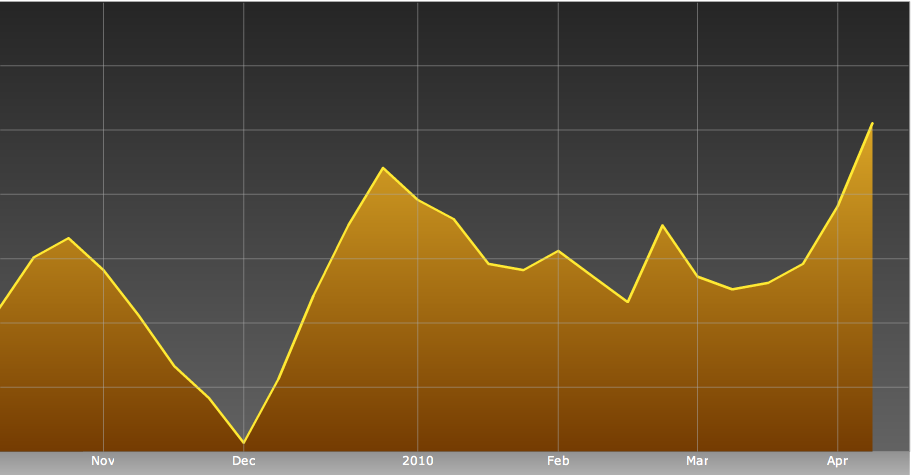
Home sellers now face what I believe will be at least a 20-year bear market in bonds. How so, Russell? From the early 1980s to 2010, the US economy has enjoyed a 30-year bull market in bonds resulting in consistently lower rates. This was a huge force behind the real estate boom. Today’s home owners and would-be sellers don’t realize it, but we are still in a bear market for housing. Interest rates have put a cap on housing prices. I see it here in La Jolla. Sellers of houses are holding out for peak and ridiculous prices, not wanting to lose money from their purchase price at the top. Potential buyers don’t have the cash or the credit to take out mortgages. The next phase — sellers will finally “get it.” The housing bonanza is over, and the price and market value of homes will be heading down.
If there are any surprises in the mix, here’s what I think they may be: Rates will move up FASTER than many think possible. Second surprise — cash is going to be loved and WANTED. But I’ve been telling my subscribers that for years.
x- From Richard Russell – Dow Theory Letters. Richard has made his subscribers fortunes. One of the best values anywhere in the financial world at only a $300 subscription to get his DAILY report for a year. HERE to subscribe. Amongst his achievements Richard was in cash before the 2008/2009 Crash and he has been Bullish Gold since below $300
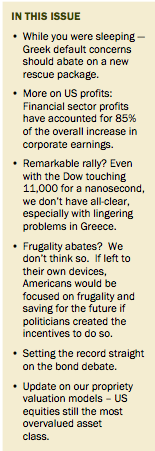
SETTING THE RECORD STRAIGHT ON THE BOND DEBATE
From David Rosenberg
“You really have to have a read of “Yield Views Couldn’t Differ More” on page B1 of the weekend WSJ. It pits Jim Caron, a good pal and former Merrill rates- strategist colleague against Goldman Sach’s Jan Hatzius, a former formidable competitor and I would argue runs one of the best, if not the best, economics houses on Wall Street. Jim is bond bearish, Jan is bond bullish. The world pretty well knows my view (Ed Note: see below). The article talked more about supply than it did about inflation, which is the much more critical ingredient in any simulation of interest rate determination.
The “Current Yield” column in Barrons also runs with the bond-bear theme (“Next, a Sharp Jump in T-Yields”). This time, and again, it focuses on the Morgan Stanley forecast of a 5.5% peak in the yield of the 10-year note. We are told in the article to throw away the econometric models of the past and rely solely on the supply backdrop. Again, this logic defies how bonds rallied through most of the Reagan years despite all the bond supply used to spend the Russians out of submission in terms of military expenditure. We are also told that the consensus is underestimating the recovery — another reason to be bearish on bonds. “
One reason why interest rates cannot rise (Ed Note: emphasis mine) is because if they do, there will never be a sustained improvement in the pace of economic activity, especially housing. One reason why interest rates cannot rise is because if they do, there will never be a sustained improvement in the pace of economic activity. Housing is the classic leading indicator, and the most interest-sensitive sector, and until it revives, it seems highly unlikely that bond yields will rise on any sustained basis or that the Fed will embark on a path towards higher policy rates. For a truly sombre assessment on the prospects for a housing recovery, see what Robert Shiller has to say on page 5 of the Sunday NYT biz section. (“Don’t Bet The Farm on the Housing Recovery”).
….read David’s whole report HERE.
….read David’s whole report HERE.
-
I know Mike is a very solid investor and respect his opinions very much. So if he says pay attention to this or that - I will.
~ Dale G.
-
I've started managing my own investments so view Michael's site as a one-stop shop from which to get information and perspectives.
~ Dave E.
-
Michael offers easy reading, honest, common sense information that anyone can use in a practical manner.
~ der_al.
-
A sane voice in a scrambled investment world.
~ Ed R.
Inside Edge Pro Contributors

Greg Weldon

Josef Schachter

Tyler Bollhorn

Ryan Irvine

Paul Beattie

Martin Straith

Patrick Ceresna

Mark Leibovit

James Thorne

Victor Adair