
Daily Updates
Friday’s bombshell that the SEC (Securities and Exchange Commission) leveled a securities fraud charge against Goldman Sachs, alleging that the investment bank knowingly misled investors over the sale of risky sub-prime mortgage derivatives, known as CDOs (Collateralized Debt Obligations) triggered a mini market crash. The allegation implied that Goldman Sachs hired a hedge fund manager to put together these CDO’s, consisting of securities it knew would fail, And then the very hedge fund who designed the derivatives shorted it – those very securities that it sold to the public via Goldman – raking in over a $2B in profits with corresponding losses to the retail investors they solicited to buy them.
Now, Wall Street itself is being attacked, though deservedly so, and traders, especially those on Wall Street, have become nervous. Someone is going to be taken out to the woodshed. But, my sense is that this a show staged to win lost votes for Obama and his socialist (neo-Marxist) cohorts and nothing more. Thinking that Goldman Sachs is going to be brought down is akin, in my opinion, in abolishing the Federal Reserve. Both are deserved, but neither will happen, unless we see a true revolution in this country – an event I hope never comes to fruition for all the obvious reasons – Mark Leobovit – VRTrader
Market Musings & Data Deciphering
Breakfast with Dave….go directly and read the full commentary HERE.
In this Issue:
• While you were sleeping – markets still reeling from Goldman news.
• Q1 earnings appear to be off to a good start but we wonder about the quality of earnings being reported.
• A nascent recovery and V-shaped bull market completely premised on rampant government stimulus is going to have a payback.
• The FDIC closed eight banks on Friday, bringing the tally to 44. • It’s not all about Goldman Sachs.
• Can there really be any doubt that what we have on our hands is a government policy that is aimed at transferring losses and liabilities from the private sector to the public sector?
• Economists still refuse to see deflation.
…read full commentary HERE.
Market Buzz – Big Fight Brewing, Big Gains Accruing
A week that appeared destined to extend the 7-week rally experienced since early February was derailed early as legendary investment bank Goldman Sachs Group Inc. (GS:NYSE) was charged with fraud by the U.S. Securities and Exchange Commission (SEC) regarding the marketing of a debt product tied to sub-prime mortgages that was designed to fail.
The lawsuit is the biggest crisis in years for Goldman, which emerged from the global financial crisis as Wall Street’s most influential bank. Goldman shares dropped as much as 15.6 per cent and are currently off more than 12 per cent. The broader markets also fell after the news.
Goldman immediately defended itself, vowing to fight the SEC civil suit. Goldman officials were quick to state that the SEC’s charges are completely unfounded in law and fact and they will vigorously contest them to defend the firm and its reputation.
As the big boys squared off for what may be the fight of the year, one of our top rated small-caps over the past year reported some great news over the past week – particularly for shareholders who bought into the stock on our recommendation in June 2009, when the stock traded at $11.00.
The company, World Point Terminals Inc. (WPO:TSX), has been involved in the business of bulk storage and the transshipment of various liquid products and related activities.
This past week, World Point announced that it had entered into a binding letter of intent with World Point Holdings, Inc. (Holdings), an entity controlled by the Novelly family, pursuant to which the company has agreed that Holdings would, through a series of transactions, acquire all of the issued and outstanding common shares in the capital of the company. Pursuant to the proposed transaction, shareholders of the company who are not also shareholders of Holdings would receive US$19.90 in cash (equivalent to approx. CAD$20.01 at today’s exchange rate) for each World Point common share.
At US$19.90, including the extraordinary dividend of US$0.50 issued in December (still not factoring in regular dividends), the gain on the stock is currently 85 per cent and 80 per cent at the going private transaction price and current price respectively – all this in less than 10 months.
Looniversity –Paper Profits – Unrealized Gains & Losses
An unrealized loss occurs when a stock decreases after an investor buys it, but he or she has yet to sell it. If a large loss remains unrealized, the investor is often hoping the company’s fortunes will turn around and the stock’s worth will increase past the price at which it was purchased. If the stock rose back above the original price, then the investor would have an unrealized gain for the time he or she still holds onto the stock.
For example, say you buy shares in ABC Company at $10 per share and then shortly afterwards, the stock’s price plummets to $3 per share, but you do not sell. At this point, you have an unrealized loss on this stock of $7 per share. Let’s say the company’s fortunes shift and the share price soars to $18. Since you have still not sold the stock, you’d now have an unrealized gain of $8 per share.
Gains or losses are said to be “realized” when a stock is sold. This is especially important from a tax perspective as, in general, capital gains are taxed only when they are realized. Unrealized gains and losses are also commonly known as “paper” profits or losses, which implies that the gain/loss is only real “on paper.”
Put it to Us?
Q. In reference to the shares of a company, what does the “float” refer to?
– Robert Hall; Calgary, Alberta
A. The term “float” refers to the regular shares that a company has issued to the public that are available for investors to trade. The figure is arrived at by taking a company’s outstanding shares and subtracting from it any restricted stock. Restricted stock is stock that is under some sort of sales restriction; for example, stock that is held by insiders cannot be traded because they are in an escrow lock-up period following an initial public offering.
A company’s float is an important number for investors because it indicates how many shares are actually available to be bought and sold by the general investing public. Of note, there is an inverse correlation between the size of a company’s float and the volatility of the stock’s price. In other words, in most cases, the lesser the float, the more volatile the share price typically is.
KeyStone’s Latest Reports Section
- Pull-back in China-Based Stable Good Manufacturer Presents Opportunity – Rating Change (New Buy Report)
- Specialty Paper Manufacturer Shares Hit New All Time High, Up 134% in 3-months, Announce Acquisition – Rating Change (Flash Update)
- World Point Announced Going Private Transaction, Shares Gain 81% in 10-months – SELL (Tender Shares) (Flash Update)
- Emerging Australian Alternative Financial Stock Breaks in Profitability in Q2, Stock Jumps 200% Since Our Recommendation Eight Months Ago – Rating Change (Flash Update)
- China-based Forestry Company Posted Solid 2009, But Misses Q4 Estimates – Ratings Adjusted (Flash Update)
Stockscores.com Perspectives for the week ending April 17, 2010
In this week’s issue:
Weekly Commentary
Strategy of the Week
Stocks That Meet The Featured Strategy

I am in Vancouver on Wednesday and Victoria on Thursday doing one trading workshop at 7:00pm in each city. These workshops are mini-classes where I will teach some analytical methods and then demonstrate how I use those methods to find and execute trading opportunities. We’ll also do analysis of the overall market and hopefully find some trading opportunities to take advantage of.
These presentations are free to attend courtesy of Disnat, who will be on hand to open brokerage accounts for anyone interested. For location details and to register, go to this link. We are expecting large turn outs so you may want to arrive a bit early to get a good seat.
I was speaking with a friend about the markets, he expressed a very bearish outlook on not only the stock market but the economy over the next year or two. His arguments were good, based mostly on the follow through from the financial collapse and the inability of the housing market to sustain the prices that prevail in the city where we live.
My tendency is to always argue the other side, so I countered with the show of increasing strength in Asia and their need to drive expansion with the purchase of commodities. Since I live in Canada, our area is well positioned to benefit from the rise of the middle class in China and India and their need for the goods that the Western World has had for 50 years. The evidence of this trend can be seen by the strength in the Canadian dollar.
But here is the thing. I have no idea what is going to happen. If my friend had told me that he felt the stock market was going to go crazy to the upside over the next two years because of strength in Asia, I might have countered that he should not be so optimistic, that this strength would bring inflation which would bring rising interest rates which would drive down the domestic economy.
And that’s just because I like a good debate, a tendency that drives my wife crazy.
- Get the StockSchool Pro Free

- DisnatDirect named the number one Canadian brokerage for Traders by Surviscor! Open and Fund a brokerage account with DisnatDirect and receive the StockSchool Pro home study course free, including special Pro level access through the DisnatDirect client website. Offer only available to Canadian residents. For information, click HERE
I have met a lot of very smart people who present very smart arguments about what will happen in the future. I respectfully consider each of their opinions as nothing more than a well articulated guess. We don’t know what will happen, the future is uncertain.
When making predictions, one has to respect that being right is not enough. You must also be right at the right time. How many times have you watched the market do things that you thought were completely irrational? Is the market wrong to go higher day after day when your analysis indicates that it is way over valued? Perhaps, but you can go broke being right if the market does not agree with you.
Therefore, what is important beyond all else, is what you do when you are wrong in your predictions. Being wrong is inevitable so you must have a plan for what to do when you are wrong. Every investor needs to know that point where the market will have proven their prognostication wrong. They need to know where the emergency exit door so they can minimize the damage.
If you want to put the odds in your favor, I think it is also helpful to wait for the market to show signs that it is starting to agree with you. Think the banking stocks are priced too high and destined for a sharp correction? Great! But wait for a break of the upward trend line in banking stocks before you initiate the trade.
Finally, no matter how smart you are, you are not smarter than the collective wisdom of the millions of people who invest in the stock market. This is not to say that you can not be right and they can be wrong. What I mean is that until they start to agree with you, being right will not make you any money. Timing is everything.

The market faced strong selling pressure on Friday after it was announced that Goldman Sachs was being investigated for fraud relating to some products they developed for short seller John Paulson. My Paulson made a couple billion dollars on the collapse of the home mortgage market.
I don’t think this investigation was the real cause for the selling pressure on Friday, just a catalyst. The market has been overdue for some profit taking since it has been on a steady climb higher over the past few months.
However, the US market indexes did have an abnormal down day on abnormal volume and the Dow and S&P 500 broke their short term upward trend lines. This is the Reversal of Fortunes strategy set up.
I don’t think that the market is going to head in to a substantial sell off from here. What is more likely is that we will see some profit taking which will take the major indexes back to their long term upward trend lines.
This should set up for a short sell swing trade on stocks that had an abnormal down day on Friday and broke their upward trend lines. I consider this a swing trade because I don’t think the move lower will be a long one. I would look for a confirming signal on the intraday, 15 or 60 minutes charts, of the following stocks which I found using the Stockscores Market Scan tool.

1. EWJ
EWJ is an ETF representing the Japanese market, it broke its upward trend line and should now fall back to the longer term downward trend line. Watch for a confirming chart patter on the intraday chart before taking the trade.

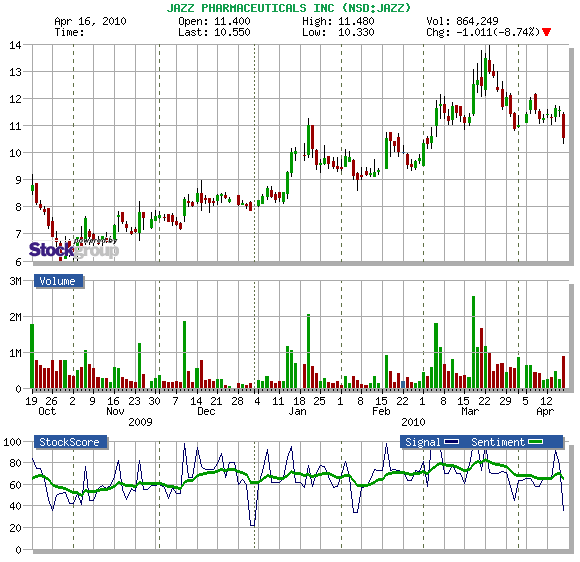
2. JAZZ
Unlike the market indexes, JAZZ has actually broken its long term upward trend line and did so from a falling top chart pattern. Watch for a confirming chart patter on the intraday chart before taking the trade.
 ‘
‘
References
Get the Stockscore on any of over 20,000 North American stocks.
Background on the theories used by Stockscores.
Strategies that can help you find new opportunities.
Scan the market using extensive filter criteria.
Build a portfolio of stocks and view a slide show of their charts.
See which sectors are leading the market, and their components.
Click HERE for the Speaker Lineup and to Purchase the video if you want to learn from some of the worlds best traders including Tyler Bollhorn.

Tyler Bollhorn started trading the stock market with $3,000 in capital, some borrowed from his credit card, when he was just 19 years old. As he worked through the Business program at the University of Calgary, he constantly followed the market and traded stocks. Upon graduation, he could not shake his addiction to the market, and so he continued to trade and study the market by day, while working as a DJ at night. From his 600 square foot basement suite that he shared with his brother, Mr. Bollhorn pursued his dream of making his living buying and selling stocks.
Slowly, he began to learn how the market works, and more importantly, how to consistently make money from it. He realized that the stock market is not fair, and that a small group of people make most of the money while the general public suffers. Eventually, he found some of the key ingredients to success, and turned $30,000 in to half a million dollars in only 3 months. His career as a stock trader had finally flourished.
Much of Mr Bollhorn’s work was pioneering, so he had to create his own tools to identify opportunities. With a vision of making the research process simpler and more effective, he created the Stockscores Approach to trading, and partnered with Stockgroup in the creation of the Stockscores.com web site. He found that he enjoyed teaching others how the market works almost as much as trading it, and he has since taught hundreds of traders how to apply the Stockscores Approach to the market.
Disclaimer
This is not an investment advisory, and should not be used to make investment decisions. Information in Stockscores Perspectives is often opinionated and should be considered for information purposes only. No stock exchange anywhere has approved or disapproved of the information contained herein. There is no express or implied solicitation to buy or sell securities. The writers and editors of Perspectives may have positions in the stocks discussed above and may trade in the stocks mentioned. Don’t consider buying or selling any stock without conducting your own due diligence.
Stockscores.com Perspectives for the week ending April 17, 2010
In this week’s issue:
Weekly Commentary
Strategy of the Week
Stocks That Meet The Featured Strategy
I am in Vancouver on Wednesday and Victoria on Thursday doing one trading workshop at 7:00pm in each city. These workshops are mini-classes where I will teach some analytical methods and then demonstrate how I use those methods to find and execute trading opportunities. We’ll also do analysis of the overall market and hopefully find some trading opportunities to take advantage of.
These presentations are free to attend courtesy of Disnat, who will be on hand to open brokerage accounts for anyone interested. For location details and to register, go to this link. We are expecting large turn outs so you may want to arrive a bit early to get a good seat.
I was speaking with a friend about the markets, he expressed a very bearish outlook on not only the stock market but the economy over the next year or two. His arguments were good, based mostly on the follow through from the financial collapse and the inability of the housing market to sustain the prices that prevail in the city where we live.
My tendency is to always argue the other side, so I countered with the show of increasing strength in Asia and their need to drive expansion with the purchase of commodities. Since I live in Canada, our area is well positioned to benefit from the rise of the middle class in China and India and their need for the goods that the Western World has had for 50 years. The evidence of this trend can be seen by the strength in the Canadian dollar.
But here is the thing. I have no idea what is going to happen. If my friend had told me that he felt the stock market was going to go crazy to the upside over the next two years because of strength in Asia, I might have countered that he should not be so optimistic, that this strength would bring inflation which would bring rising interest rates which would drive down the domestic economy.
And that’s just because I like a good debate, a tendency that drives my wife crazy.

I have met a lot of very smart people who present very smart arguments about what will happen in the future. I respectfully consider each of their opinions as nothing more than a well articulated guess. We don’t know what will happen, the future is uncertain.
When making predictions, one has to respect that being right is not enough. You must also be right at the right time. How many times have you watched the market do things that you thought were completely irrational? Is the market wrong to go higher day after day when your analysis indicates that it is way over valued? Perhaps, but you can go broke being right if the market does not agree with you.
Therefore, what is important beyond all else, is what you do when you are wrong in your predictions. Being wrong is inevitable so you must have a plan for what to do when you are wrong. Every investor needs to know that point where the market will have proven their prognostication wrong. They need to know where the emergency exit door so they can minimize the damage.
If you want to put the odds in your favor, I think it is also helpful to wait for the market to show signs that it is starting to agree with you. Think the banking stocks are priced too high and destined for a sharp correction? Great! But wait for a break of the upward trend line in banking stocks before you initiate the trade.
Finally, no matter how smart you are, you are not smarter than the collective wisdom of the millions of people who invest in the stock market. This is not to say that you can not be right and they can be wrong. What I mean is that until they start to agree with you, being right will not make you any money. Timing is everything.
The market faced strong selling pressure on Friday after it was announced that Goldman Sachs was being investigated for fraud relating to some products they developed for short seller John Paulson. My Paulson made a couple billion dollars on the collapse of the home mortgage market.
I don’t think this investigation was the real cause for the selling pressure on Friday, just a catalyst. The market has been overdue for some profit taking since it has been on a steady climb higher over the past few months.
However, the US market indexes did have an abnormal down day on abnormal volume and the Dow and S&P 500 broke their short term upward trend lines. This is the Reversal of Fortunes strategy set up.
I don’t think that the market is going to head in to a substantial sell off from here. What is more likely is that we will see some profit taking which will take the major indexes back to their long term upward trend lines.
This should set up for a short sell swing trade on stocks that had an abnormal down day on Friday and broke their upward trend lines. I consider this a swing trade because I don’t think the move lower will be a long one. I would look for a confirming signal on the intraday, 15 or 60 minutes charts, of the following stocks which I found using the Stockscores Market Scan tool.
1. EWJ
EWJ is an ETF representing the Japanese market, it broke its upward trend line and should now fall back to the longer term downward trend line. Watch for a confirming chart patter on the intraday chart before taking the trade.
2. JAZZ
Unlike the market indexes, JAZZ has actually broken its long term upward trend line and did so from a falling top chart pattern. Watch for a confirming chart patter on the intraday chart before taking the trade.
‘
References
Get the Stockscore on any of over 20,000 North American stocks.
Background on the theories used by Stockscores.
Strategies that can help you find new opportunities.
Scan the market using extensive filter criteria.
Build a portfolio of stocks and view a slide show of their charts.
See which sectors are leading the market, and their components.
Click HERE for the Speaker Lineup and to Purchase the video if you want to learn from some of the worlds best traders including Tyler Bollhorn.
Tyler Bollhorn started trading the stock market with $3,000 in capital, some borrowed from his credit card, when he was just 19 years old. As he worked through the Business program at the University of Calgary, he constantly followed the market and traded stocks. Upon graduation, he could not shake his addiction to the market, and so he continued to trade and study the market by day, while working as a DJ at night. From his 600 square foot basement suite that he shared with his brother, Mr. Bollhorn pursued his dream of making his living buying and selling stocks.
Slowly, he began to learn how the market works, and more importantly, how to consistently make money from it. He realized that the stock market is not fair, and that a small group of people make most of the money while the general public suffers. Eventually, he found some of the key ingredients to success, and turned $30,000 in to half a million dollars in only 3 months. His career as a stock trader had finally flourished.
Much of Mr Bollhorn’s work was pioneering, so he had to create his own tools to identify opportunities. With a vision of making the research process simpler and more effective, he created the Stockscores Approach to trading, and partnered with Stockgroup in the creation of the Stockscores.com web site. He found that he enjoyed teaching others how the market works almost as much as trading it, and he has since taught hundreds of traders how to apply the Stockscores Approach to the market.
Disclaimer
This is not an investment advisory, and should not be used to make investment decisions. Information in Stockscores Perspectives is often opinionated and should be considered for information purposes only. No stock exchange anywhere has approved or disapproved of the information contained herein. There is no express or implied solicitation to buy or sell securities. The writers and editors of Perspectives may have positions in the stocks discussed above and may trade in the stocks mentioned. Don’t consider buying or selling any stock without conducting your own due diligence.
By MARCY GORDON (AP) – 20 hours ago
WASHINGTON — The government has accused Goldman Sachs & Co. of defrauding investors by failing to disclose conflicts of interest in mortgage investments it sold as the housing market was collapsing.
The Securities and Exchange Commission said in a civil complaint Friday that Goldman failed to disclose that one of its clients helped create — and then bet against — subprime mortgage securities that Goldman sold to other investors.
The SEC said the fraud, a blow to the reputation of Wall Street’s most powerful firm, was orchestrated in 2007 by a Goldman vice president then in his late 20’s. The employee, Fabrice Tourre, has since been promoted to executive director of Goldman Sachs International in London.
Tourre, the SEC said, boasted to a friend that he was able to put such deals together as the mortgage market was unraveling in early 2007.
In an email to the friend, he described himself as “the fabulous Fab standing in the middle of all these complex, highly leveraged, exotic trades he created without necessarily understanding all of the implications of those monstrosities!!!”
Two European banks that bought the securities lost nearly $1 billion, the SEC said.
The agency is seeking to recoup profits reaped on the dealGoldman Sachs denied the allegations. In a statement, it called the SEC’s charges “completely unfounded in law and fact” and said it will contest them.
Goldman, founded more than 140 years ago, built a reputation as a trusted adviser to its investment banking clients. In recent years, it shifted toward taking more risks with its clients’ money and its own. Goldman’s trading allowed the firm to weather the financial crisis better than most other big banks.
It earned a record $4.79 billion in the last quarter of 2009.
The SEC’s enforcement chief said the agency is investigating a wide range of practices related to the crisis. The prospect of possible legal jeopardy for other major financial players roiled the stock market.
Goldman Sachs shares fell more than 12 percent. The Dow Jones industrial average sank more than 100 points in midday trading.
The charges come as lawmakers seek to crack down on Wall Street practices that helped cause the financial crisis. Among proposals Congress is weighing are tougher rules for complex investments like those involved in the alleged Goldman fraud.
The Goldman client implicated in the fraud is one of the world’s largest hedge funds, Paulson & Co. The SEC said it paid Goldman roughly $15 million in 2007 to put together an investment offering that was tied to mortgage-related securities the hedge fund viewed as likely to decline in value.
Separately, Paulson took out a form of insurance that allowed it to make a huge profit when those securities became nearly worthless.
ABN Amro, a major Dutch bank, was the biggest loser in the securities, having paid Goldman $841 million, according to the SEC. And IKB, a German commercial bank, lost nearly all its $150 million investment, the agency said. Most of the money they lost went to Paulson in a series of transactions between Goldman and the hedge fund, the SEC said.
The civil lawsuit filed by the SEC in federal court in Manhattan was the government’s most significant legal action related to the mortgage meltdown that ignited the financial crisis and helped plunge the country into recession.
The SEC is seeking unspecified fines and restitution from Goldman Sachs and Tourre.
Asked why the SEC did not also pursue a case against Paulson, Enforcement Director Robert Khuzami said: “It was Goldman that made the representations to investors. Paulson did not.”
Paulson & Co. is run by John Paulson, who reaped billions by betting against subprime mortgage securities. He is not related to former Treasury Secretary Henry Paulson.
In a statement, Paulson & Co. said: “As the SEC said at its press conference, Paulson is not the subject of this complaint, made no misrepresentations and is not the subject of any charges.”
Goldman told investors that a third party, ACA Management LLC, had selected the pools of subprime mortgages it used to create what are known as synthetic collateralized debt obligations. But, the SEC alleges, Goldman misled investors by failing to disclose that Paulson & Co. also played a role in selecting the mortgage pools and stood to profit from their decline in value.
“Goldman wrongly permitted a client that was betting against the mortgage market to heavily influence which mortgage securities to include in an investment portfolio, while telling other investors that the securities were selected by an independent, objective third party,” Khuzami said in a statement.
The SEC charges come after Goldman Sachs denied last week it bet against clients by selling them mortgage-backed securities while reducing its own exposure to them.
In an annual letter to shareholders, Goldman said it began reducing its exposure to the U.S. mortgage market in late 2006. It said it did so by selling mortgage investments or buying credit default swaps. The swaps are a form of insurance that pays out if the value of the underlying asset declines.
Those hedges, also known as short positions, served Goldman well. As the housing market began cratering and losses piled up for other big banks, Goldman suffered less damage. That led to criticism that the bank benefited at the expense of clients who bought mortgage-backed securities that became toxic. Goldman denied that.
“Our short positions were not a ‘bet against our clients,'” Goldman said in the letter. “Rather, they served to offset our long positions. Our goal was, and is, to be in a position to make markets for our clients while managing our risk within prescribed limits.”
In the letter, Goldman also rejected claims that it profited from the mortgage market meltdown.
AP Business Writers Alan Zibel in Washington and Stevenson Jacobs in New York contributed to this report.
-
I know Mike is a very solid investor and respect his opinions very much. So if he says pay attention to this or that - I will.
~ Dale G.
-
I've started managing my own investments so view Michael's site as a one-stop shop from which to get information and perspectives.
~ Dave E.
-
Michael offers easy reading, honest, common sense information that anyone can use in a practical manner.
~ der_al.
-
A sane voice in a scrambled investment world.
~ Ed R.
Inside Edge Pro Contributors

Greg Weldon

Josef Schachter

Tyler Bollhorn

Ryan Irvine

Paul Beattie

Martin Straith

Patrick Ceresna

Mark Leibovit

James Thorne

Victor Adair