
Daily Updates
In last week’s video and in my Nov. 7 column, I gave you very specific forecasts on key markets: The Dow Industrials, gold, silver, the euro and oil.
I also gave you some suggestions on how to play those forecasts. Now, I’m happy to say, those forecasts seem to be coming to fruition.
So let’s review them, since the markets are making critical moves and there’s lots of money to be made!
First up, the Dow Industrials. Here’s what I said two weeks ago: “The Dow is still under the influence of a weekly sell signal that has not been reversed and would only be reversed if the Dow were to close above 12,498. For the S&P 500, the equivalent signal would be a close above the 1,307.25 level.”
And in last week’s video, I added that the “Dow was failing at massive resistance” and that it was “preparing for a new leg down.”
Over the past several trading sessions we did indeed see the Dow try to push higher, but now it’s succumbing to the selling forces at work. Those include a not-so-good economy in the U.S. … and a wickedly plunging European economy that’s being devastated by a sovereign debt crisis.
Now, here’s an updated chart of the Dow Industrials from last week’s video:
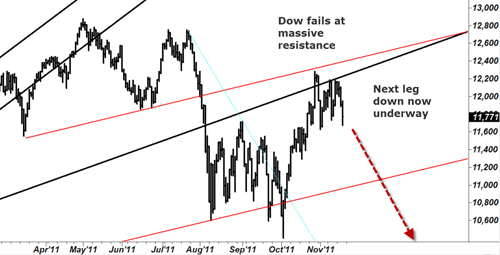
As you can clearly see, the Dow was repelled by overhead technical resistance, and it stumbled sharply last week. It is now on a path toward much lower levels, with the first support level coming in around 11,200, and then the previous low around the 10,300 to 10,400 level.
I’ve previously suggested inverse ETFs such as the ProShares UltraPro Short Dow30 ETF (SDOW) and theProShares UltraPro Short S&P 500 Index Fund (SPXU) and others. Hold them!
Next, none other than gold, the market that seems to set off more emotional reactions than any other. Here’s what I said two weeks ago, “Gold would require a close above the $1,830 level to negate all the sell signals my system has generated.”
And in last week’s video I showed you a chart of gold, demonstrating the massive overhead resistance in gold, and telling you, in no uncertain terms, that “the pressure is still on gold” and that “you should refrain from adding any new positions or trading the long side on a short-term basis.”
Few believed me. But now, here we are and gold has plunged back down to near the $1,700 level, generating a very important sell signal by closing below $1,754.
Make no mistake about it: Gold is under pressure cyclically, technically from the charts, and fundamentally — because the crisis in Europe is sending hoards of investors into liquidation mode and into cash.
So while one might think the crisis in Europe is bullish for gold, it is not. The sovereign debt crisis will only become bullish again for gold once the United States meets the reaper with its debt crisis, which will become the biggest in the history of civilization.
Here’s an updated daily chart of gold. You can clearly see how gold’s attempt to get back above the $1,800 mark failed miserably, and now, how the next leg down should be underway.
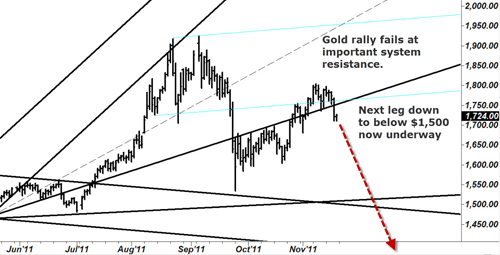
Look for support at the following levels …
|
$1,696.50
|
$1,567.40
|
$1,432.90
|
$1,386.90
|
$1,253.80
|
I suggested a purchase of the ProShares UltraShort Gold ETF (GLL). If you acted on that suggestion, hold that position!
Now, to silver. In my previous column I told you that for silver to turn bullish again it would require a close above the $38.88 level. And in last week’s video I told you that I believed that “another devastating crash in silver was about to begin.”
With last week’s selloff from a high of $34.92 to a low of $30.92 as I pen this column, I believe silver’s next leg down has begun.
Warning: Once you see silver close below $29.13, the crash will be in full force. Though there are some support levels below $29, they are minor and I fully expect to see silver plunge to at least $25, and probably much lower.
You can see my latest silver chart here.
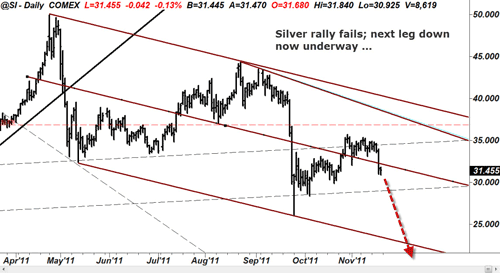
And here are my updated system support levels for silver:
|
$29.136
|
$27.981
|
$23.931
|
$23.341
|
$19.996
|
$19.521
|
I suggested you purchase the ProShares UltraShort Silver ETF (ZSL).If you acted on that suggestion, hold that position!
Now, the U.S. dollar. Here’s what I said two weeks ago: “Naturally, as cash leaves Europe and heads down a rabbit hole for safety, it’s going to … the dollar [since it’s] still the world’s reserve currency.” And in last week’s video, I told you that “everything I monitor tells me that the dollar is going to rally more now.”
Here’s a chart of the U.S. Dollar Index. As you can see, the dollar has staged a pretty significant rally, a rally that’s the precise opposite image of the euro, which is plunging.
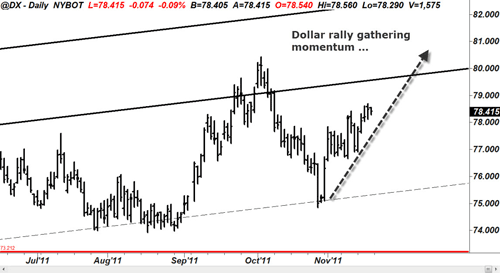
Expect the dollar rally to continue. But bear fully in mind that it’s only a matter of time before the dollar’s bear market resumes.
I previously suggested an inverse ETF position on the euro, which is effectively like going long the dollar, via the ProShares UltraShort Euro ETF (EUO). If you acted on that suggestion, hold that position!
And now, to oil. While oil staged what seemed to be a powerful rally last week, soaring to over $100 a barrel — I repeat my recent warnings: “There is very little doubt in my mind that crude oil has experienced nothing more than a sharp, short-term rally that has done nothing to change the intermediate-term trend which remains bearish.
“For that trend to be reversed, oil would have to close above $100.93 on a Friday, weekly closing basis.”
Oil failed to close above that level. So I remain bearish on oil. I suggested buying the ProShares UltraShort DJ-UBS Crude Oil ETF (SCO). If you acted on that suggestion, hold that position!
Stay tuned!
Best wishes, as always …
Larry
P.S. For more in-depth analysis of today’s rapidly changing world and markets, including very specific entry and exit points for many more recommendations, it behooves you to consider a membership to my Real Wealth Report.
It could not only save you tens of thousands of dollars by helping you to appropriately protect your money — but also help you garner potential HUGE profits as well. To join, click here now.
About Uncommon Wisdom
For more information and archived issues, visit http://www.uncommonwisdomdaily.com
Uncommon Wisdom (UWD) is a free daily investment newsletter published by Weiss Research, Inc. This publication does not provide individual, customized investment or trading advice. All information is based upon data whose accuracy is deemed reliable, but not guaranteed. Performance returns cited are derived from our best estimates, but hypothetical as we do not track actual prices of customer purchases and sales. We cannot guarantee the accuracy of third party advertisements or sponsors, and these ads do not necessarily express the viewpoints of Uncommon Wisdom or its editors. For more information, see ourTerms and Conditions. View our Privacy Policy. Would you like to unsubscribe from our mailing list? To make sure you don’t miss our urgent updates, just follow these simple steps to add Weiss Research to your address book.
The Bottom Line
Technical, fundamental and seasonal influences point to another volatile period for equity markets around the world this week. Economically sensitive sectors are following seasonal patterns. An opportunity to add to positions will present itself when short term technical indicators start to recover. Preferred strategy is to accumulate economically sensitive equities and related ETFs on short term weakness, particularly if they benefit from favourable seasonal influences.
Be sure to look at the 45 Charts and comments HERE
Also:
Mark Leibovit’s Daily Gold Comment
More information on Mark’s services is available at
http://www.vrtrader.com/login/index.asp
GOLD – NEUTRAL
Negative Leibovit Volume Reversals and the potential of again seeing 1600 in Spot gold have put me on the defensive. The 50-day moving average supported Thursday’s decline, so let’s see if it can hold this week. My opinion is that the Gold Market’s gone rogue, but don’t be lulled into complacency, it won’t be a smooth ride to $11,000. We’ve been hearing a lot of cross conversations about gold. On one hand it’s been emerging as the world shadow currency but it’s no longer tracking precisely in opposition to the dollar, others argue its only a commodity in a volatile marketplace and its approaching bubble status. We’ve got hedge funds and institutions purchasing and divesting in the paper gold market while international governments and individual investors are stockpiling the precious metals in safety deposit boxes and bullion vaults. So what is it that has the western world bankers shivering in their shoes? The onset of the next great currency war is only in its initial stages and the world’s countries are in the process of a build-up of their national gold reserves. Make sure you take delivery of the physical metal and don’t let a shakeout scare you. Gold at 1600, 1500 or 1200 is a steal when we’re eyeing $11,000 sometime in the next four or five years. Silver? That’s another story altogether. You can almost make up any number here once speculative fires are set. Best guess? $250!
Market Buzz – Boyd Booms, Market Busts
After posting strong gains in October, the last five trading days marked Toronto’s worst weekly loss in eight weeks. On Friday, Toronto’s benchmark S&P/TSX Composite index dipped 22.99 points to 11,892.44. The index notched a weekly loss of 3.1%, its largest weekly percentage loss since the week ending September 23, 2011.
In a market that is taking its cues from an unstable macro environment in Europe, do not expect this type of volatility to end anytime soon. A deleveraging world will continue to keep the markets focus in the near term on macro issues until a credible Euro debt reduction plan is not only implemented, but shown to be carried through.
It is also our opinion that the U.S. has a great opportunity, while the world is distracted with the Euro market, to quietly draft and enact a credible long-term debt (not just deficit) reduction plan.
When Europe calms (and it eventually will for a time at least), the world will turn its eye to the largest debtor nation, the United States, and the current plan to “reduce the deficit gradually” is not good enough in our opinion. Eventually, those lending will want or require higher rates.
Also Friday, Statistics Canada reported Canadian prices rose 2.9% in October from a year ago, higher than expectations, but still retreating from the 3.2% posted in September. The core inflation rate, which excludes the prices of volatile items like food and energy, dipped to 2.1%, higher than the Bank of Canada’s target inflation rate of 2%.
The core inflation rate is still above where the Bank of Canada would like it to be and that will take away some ability for the Bank of Canada to sound too dovish. The result, the Canadian currency strengthened against the U.S. after the data was released, as the inflation numbers put temporary pressure off Canada’s central bank to further ease interest rates. The Loonie has appreciated in value by 1.7% against the greenback since Monday.
In our Canadian Stock Coverage Universe (www.keystocks.com), we saw strong positive earnings numbers out from a number of companies this past week including very strong numbers from long-time favourite, Boyd Group Income Fund (BYD.UN:TSX).
The company reported that its sales increased by 41.1% to $97.3 million in the third quarter of 2011 compared with sales of $69 million for the same period last year. Net earnings were $6.5 million, or 6.7% of sales, compared with net earnings of $1.9 million, or 2.8% of sales, for the same period last year.
The Boyd Group Inc. is the largest operator of collision repair centres in North America. The company also announced an increase in its monthly distribution to $0.0375 per trust unit. The first distribution will be payable on December 22, 2011, to unitholders of record at the close of business on November 30, 2011.
Looniversity – Should I Prefer Preferred to Common?
One way to add to the product mix in your portfolio during bear markets is through preferred stocks. A preferred stock typically pays a fixed dividend before any dividends are paid to common stockholders. In the event of liquidation, they represent partial ownership in the company and receive priority over common stockholders, but after bondholders. So, if safety is your primary concern, as a bondholder, you are first in line. Owners of preferred stock do not enjoy the same voting rights as common stockholders. The advantages of owning preferred shares include a greater claim on the company’s assets and having a higher priority status, in terms of receiving dividends.
There are four basic types of preferred stock:
- Cumulative Shares: These shares have dividends, which build up if the company does not make the scheduled dividend payments as promised. This is the most common form.
- Non-Cumulative shares: These shares do not allow unpaid dividends to build up.
- Participating Preferred Shares: These shares receive a regular dividend and allow owners to participate with common stockholders in extra dividends.
- Convertible Shares: These shares can be exchanged for another type of security, usually common stock.
Put It To Us?
Q. I am 12 years old and have some money put aside from babysitting and other things, but I really want to learn how to save better. Can you help?
– Elisha Brooks; Calgary, Alberta
A. First off, the fact that you are already concerned about saving leaves you miles ahead of most of your peers, nice job! How much should you save? You actually may be able to save 100 per cent of your money. Does that mean you should? Not at all. The best way to develop good saving habits is to make saving a regular part of your life, along with spending.
Save before spending. Whenever some money gets into your hands, from a job or your allowance or whatever, take your savings out immediately before spending any of the money. The beauty of this system is that once you’ve removed your savings, you’re free to spend the rest.
Negotiate with your parents. This may or may not work for you, but it’s worth a shot. See if they’ll “match” your savings, in order to encourage good saving habits. If they match your savings dollar-for-dollar, for example, that would mean that for every $25 you plunk into savings, they’d plunk an additional $25.
Consider the “opportunity cost” of purchases. For example, imagine that you can either buy concert tickets for $50 or you can invest the money. If you invest for 10 years and your investment grows by an average of 11 per cent per year, your original $50 will become $142. So, your decision can be framed like this: “Would I rather have these tickets now or $142 in ten years?” If you choose the tickets, then by all means, buy them.
KeyStone’s Latest Reports Section
- Oil & Gas Service Stock Post Very Strong Q3, Management Outlook Strong for Remainder of 2011 & 2012 – Rating Cautiously Upgraded (Flash Update)
- As Expected Oil & Gas Service Company Posts Seasonally Weak Q2, Risk Remains on Balance Sheet – Poised for Strong Second Half of 2011 (Flash Update)
- Healthcare/Hospitality Service Trust Posts Strong Q3 2011, Solid Yield – Rating Increased (Flash Update)
- Underfollowed Oil & Gas Service Stock Posts Very Strong Q3, Solid Outlook for Balance of 2011 – Reiterate BUY (Flash Update)
- Staple Consumer Products Company Announces Strong Sales Growth, Adjusted EBITDA, & Distributable Cash for Q3 2011 – Strong Growth from Strategic Acquisitions & Rating Upgraded (Flash Update)
Dramamine market got you down? You are not alone. David Rosenberg explains: “Yesterday’s trade was rather telling. The Nasdaq dropped 2% and not only did volume rise but the breadth was awful with losers beating winners by a 5-to-2 margin (9-to-2 on the NYSE). The fact that the Nasdaq sliced below support of 2,600 and dipped below its 50-day moving average for the first time in six weeks is a bit ominous to say the least; while the S&P 500 undercut its lows of the past four weeks (even though it has managed to hold above the 50-day m.a. of 1,205). But between the slide in equities, commodities, oil and gold, coupled with the rally in Treasuries, yesterday had a certain eerie 2008 feel to it.
It is with regret and unflinching moral certainty that I announce that Barnhardt Capital Management has ceased operations. After six years of operating as an independent introducing brokerage, and eight years of employment as a broker before that, I found myself, this morning, for the first time since I was 20 years old, watching the futures and options markets open not as a participant, but as a mere spectator.
The reason for my decision to pull the plug was excruciatingly simple: I could no longer tell my clients that their monies and positions were safe in the futures and options markets – because they are not. And this goes not just for my clients, but for every futures and options account in the United States. The entire system has been utterly destroyed by the MF Global collapse. Given this sad reality, I could not in good conscience take one more step as a commodity broker, soliciting trades that I knew were unsafe or holding funds that I knew to be in jeopardy.
I have learned over the last week that MF Global is almost certainly the mere tip of the iceberg. There is massive industry-wide exposure to European sovereign junk debt. While other firms may not be as heavily leveraged as Corzine had MFG leveraged, and it is now thought that MFG’s leverage may have been in excess of 100:1, they are still suicidally leveraged and will likely stand massive, unmeetable collateral calls in the coming days and weeks as Europe inevitably collapses. I now suspect that the reason the Chicago Mercantile Exchange did not immediately step in to backstop the MFG implosion was because they knew and know that if they backstopped MFG, they would then be expected to backstop all of the other firms in the system when the failures began to cascade – and there simply isn’t that much money in the entire system. In short, the problem is a SYSTEMIC problem, not merely isolated to one firm.
comment via Karl Denniger:
Oh boy.
Look folks, the risks involved here are real.
Rick Santelli was just on CNBC pointing out that there have been no answers forthcoming on the MF Global mess. There are reports that several people who you would never expect to have gotten caught in something like this did, including Gerald Celente.
The reason they got caught is the same reason I would have gotten caught if I had been clearing through MF Global: Despite being around the markets since well before the 2000 crash and having successfully negotiated that and the 2008 mess everyone has believed, right up until MF blew up, that customer funds were in fact segregated and thus this risk would never occur.
Simply put everyone has now discovered that this assumption is wrong.
Nothing that has come out of the CME, the SEC or Washington DC that has restored my confidence that MF Global is, in fact, a one-off situation. In point of fact The Fed is now requiring margin on certain repo transactions where they never did before, implying that there may well be additional snakes in the grass and additional unrecognized and intentionally hidden risks of this sort.
Read Ann’s entire missive. Yes, it’s highly partisan, but given what has just happened and Obama’s continued insistence that “no crimes were committed” (yet no grand juries have been convened to investigate, so how would he know?) it is entirely justified.
Folks, we must insist that the rule of law be brought back into the forefront. We mustdo this particularly with credit instruments and other OTC derivatives and that has to happen right now. In addition all off-balance sheet BS must be ended immediately.
I have, since 2007, advocated that all credit instruments be forced onto an exchange and that cash margin be required on all underwater positions, marked nightly, without exception or offset. This has been “pooh-poohed” as impractical due to bespoke contracts and other considerations.
Now it turns that I was in fact right – there were additional “snakes” in the grass that were cheating. First we had ENRON, then Bear and Lehman and now this.
Here’s reality folks: We either fix this problem and do it now or you had better pray that Europe doesn’t detonate, because if it does you’re going to see the very thing that everyone was talking about back in 2008 happen on a global scale, it’s a hundred times the size that Lehman was, and we will not be immune to it here in the United States — in fact we’ll damn near be the “center of the sun!”
There is the potential for an imminent cascade failure on these contracts just as there was in 2008; it has not gone away, it has not been attenuated, it has in fact grown in size since 08 and if we do not act to put a stop to it and the risk becomes realized it will be too late.
-
I know Mike is a very solid investor and respect his opinions very much. So if he says pay attention to this or that - I will.
~ Dale G.
-
I've started managing my own investments so view Michael's site as a one-stop shop from which to get information and perspectives.
~ Dave E.
-
Michael offers easy reading, honest, common sense information that anyone can use in a practical manner.
~ der_al.
-
A sane voice in a scrambled investment world.
~ Ed R.
Inside Edge Pro Contributors

Greg Weldon

Josef Schachter

Tyler Bollhorn

Ryan Irvine

Paul Beattie

Martin Straith

Patrick Ceresna

Mark Leibovit

James Thorne

Victor Adair