
Daily Updates
Quotable
“Some people see things that are and ask, Why? Some people dream of things that never were and ask, Why not? Some people have to go to work and don’t have time for all that.” – George Carlin
FX Trading – If our $ call is right, correlations may change big time!
Our longer term dollar call for a while now is simply this: The US dollar entered a multi- year bull market after bottoming in March 2008. If that proves correct, it is likely we will witness some major changes in correlations that seemed to be such layups during the US dollar 7-year bear market phase. Many of us just assume the recent past will be projected into the future. But maybe the less recent past is a better guidepost.
….read more HERE
Make your way through this tome from Martin Armstrong. He may be incarcerated but that has not stopped his razor sharp mind from carrying on his particular brand of analysis. This is a good read and should lend a note of caution to the future. – Michael Levy

“In 1914, Britain reached its peak as the center of the global economy. It passed that torch to the United States who by 1929 became the leading world economy who was also a CREDITOR nation just as China is today. There will be no 1930’s style depression, for the cards are nowhere near the same. Yet China will become the leading world economy by 2016, and then suffer its 1929.”
….read it all HERE.
These past few years have shown us how unfair investments have become.
With billion dollar Ponzi schemes and market manipulation plaguing our markets, it is becoming much harder to understand where the markets are heading. Goldman Sachs were just accused of securities fraud, adding more insult to injury (see SEC charges against Goldman Sachs).
This leads us to the next conspiracy theory that, if proven correct, could reap big rewards for those who are in the know.
But first a comment from Richard Russell:
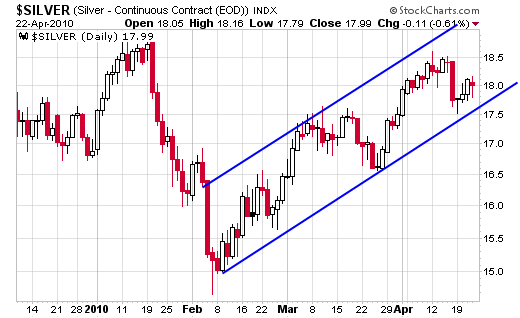
Today an ounce of gold will buy 64 ounces of silver. The historical ratio has been around 16 to 1, so silver compared with gold is cheap. Nobody knows whether silver will climb back to that old ratio, but we do know that silver is cheap. I like silver here, and the easiest way to buy silver is through the ETF (SLV). The negative — central banks don’t collect silver.- Richard Russell Dow Theory Letters
Silver Manipulation
by Equedia
For months we have been raving about precious metals such as gold and silver, with many past newslettersfocusing on gold. But this time around, we’re going to focus specifically on silver and why we are heavily favouring silver and silver miners right now.
Gold is great. But we think silver is better.
Silver historically trails gold in a precious metals bull market because everyone sees gold as an alternative to money. But a closer look will tell you that silver posts better percentage returns nearly every time there is a sustained gold rally.
If you like gold, you should love silver
For thousands of years, the gold/silver ratio price per ounce has remained relatively constant at 16 to 1-meaning one ounce of gold can buy 16 ounces of silver. Coincidently, that ratio remains relatively constant for the amount of silver versus gold in the world. For every ounce of gold in the ground, there is roughly 17.5 ounces of silver.
Right now, the gold and silver price spread is 60 to 1.
We think there is a good reason why. And this reason alone, if exposed, could send silver prices through the roof…
Even though there is far more silver on earth than gold, the silver market is much smaller than gold. This makes transactions much more visible and the market more susceptible to large fluctuations – and thus, manipulation. Silver is a less-active and lower-volume market than gold, which means that purchases even by individual investors can make an impact on silver prices.
That is exactly what the Commodity Futures Trading Commission (CFTC) is thinking.
The CFTC is currently investigating the manipulation of the silver market by the big banks, including J.P. Morgan. This isn’t the first time this has happened. The CFTC has done this many times before.
But this time, they had no choice.
The Consipracy Theory?
…..read more HERE
Market Buzz – Distinction Group “Cleans-up” in Q1
Toronto’s main stock index gained ground for its fifth consecutive day this Friday, rising within a stone’s throw of a 19-month high as strong economic data and a weaker U.S. dollar boosted demand for resource stocks.
Overall, the Toronto Stock Exchange’s S&P/TSX composite index ended the session up 78.77 points, or 0.65 per cent, at 12,239.64. The index has rose every day this week, led by rebounding commodity prices as well as strong U.S. earnings, posting a 1.4 per cent gain over the period. Metal prices climbed, particularly gold, giving the materials sector a 1.04 percent gain. All ten TSX subgroups finished the session stronger.
Having said this, analysts will be keeping a close eye on the strength of first-quarter corporate earnings for a clue as to the market’s near-term direction. The Q1 2010 season kicks off in earnest next week.
The forward looking PE is shrinking as earnings have been and continue to recover in recent quarters, but we caution the quarterly numbers we are seeing at present in some segments. Particularly, in the case of the Q4 2009 results we just saw and the Q1 2010 results we are beginning to see. The numbers are coming off depressed levels when much of the world thought we were heading towards financial Armageddon. So, the year-over-year comparisons will look favourable, but are a bit misleading. In many cases, given the solid rally, much of the turnaround is already baked into the markets, broadly speaking.
Switching gears to our Canadian Small-Cap Universe (www.keystocks.com), we witnessed Distinction Group Inc. (GD:TSX) get a jump on the first quarter earnings season by posted a solid set of Q1 results.
Distinction Group is a Canadian leader in the janitorial, restoration, and mechanical maintenance service market. The company serves a diversified group of clients in various sectors such as office buildings, commercial buildings, industrial facilities, airports, infrastructure/utility providers, retail stores, shopping centers, and institutional/health establishments. Distinction Group is headquartered in Lachine, Quebec and has 17 offices with approximately 8,800 employees across Canada.
For the first quarter ended February 28, 2010, revenues increased 6.4 per cent to $64.23 million from $60.37 million in the same period of 2009. EBITDA grew by 16.3 per cent to $3.7 million in 2010 from $3.1 million in 2009. The company’s first quarter net earnings stood at $1.7 million, or $0.056 per share fully diluted, in 2010 compared to $1.5 million, or $0.048 per share fully diluted, in 2009.
Next week, we look forward to several sets of results and updated reports for our premium clients.
Looniversity –Return on Equity (ROE) – Why and How?
Return on equity encompasses the three main “levers” by which management can poke and prod the corporation – profitability, asset management, and financial leverage. By perceiving return on equity as a composite that represents the executive team’s ability to balance these three pillars of corporate management, investors can not only get an excellent sense of whether they will receive a decent return on equity, but also assess management’s ability to get the job done.
Return on equity is calculated by taking a year’s worth of earnings and dividing them by the average shareholder’s equity for that year:
One year’s earnings
ROE = ————————-
Shareholder’s equity
One of the quickest ways to gauge whether a company is an asset creator or a cash consumer is to look at the return on equity that it generates. By relating the earnings generated to the shareholder’s equity, an investor can quickly see how much cash is created from the existing assets. If the return on equity is 21 per cent, for instance, then 21 cents of assets are created for each dollar that was originally invested. As additional cash investments increase the asset side of the balance sheet, this number ensures that additional dollars invested to not appear to be dollars of return from previous investments.
Put it to Us?
Q. an a stock have a negative price-to-earnings (P/E) ratio?
– Josh Marlin; Calgary, Alberta
A. Indeed, Josh, a stock can have a negative price-to-earnings ratio (P/E), however it is very unlikely that you will ever see it reported. Although negative P/E ratios are mathematically possible, they generally aren’t accepted in the financial community and are considered to be invalid or just not applicable.
Why, you say?
Typically, the lower the P/E, the lower the cost to an investor for the earnings made by the company. But a company whose stock has a negative P/E ratio is not making money; earnings at the company are negative, which means the company is losing money on the shareholder’s investment in the company. To calculate the P/E ratio, you divide the market price per share of a company’s stock by the company’s earnings per share (EPS). A company’s earnings per share are calculated by subtracting the total value of all dividends paid to preferred shareholders from the company’s net income and dividing the difference by the average outstanding shares over the time period for which the ratio is being applied.
Negative EPS numbers are usually reported as “not applicable” for quarters in which a company reported a loss.
KeyStone’s Latest Reports Section
- Canada’s Leading Industrial Services Firm Posts Solid Q1 – Rating Maintained (Flash Update
- Pull-back in China-Based Stable Good Manufacturer Presents Opportunity – Rating Change (New Buy Report)
- Specialty Paper Manufacturer Shares Hit New All Time High, Up 134% in 3-months, Announce Acquisition – Rating Change (Flash Update)
- World Point Announced Going Private Transaction, Shares Gain 81% in 10-months – SELL (Tender Shares) (Flash Update)
- Emerging Australian Alternative Financial Stock Breaks in Profitability in Q2, Stock Jumps 200% Since Our Recommendation Eight Months Ago – Rating Change (Flash Update)
By Rutam Vora, Commodity Online
At a time, when gold prices reeled under pressure for a sustained period after hitting its all-time high in December 2009, the perception towards the yellow metal seems to have reversed with investors hinting at weakening of gold prices in near future and strengthening of other investment avenues.
Gold, when started rising during last few months of 2009, increased hopes of further upward rally in the prices. But the current global economic scenario, where equity markets started showing signs of strong and steady recovery with emergence of alternative investment instruments like crude oil and other precious metals, the healthy returns in gold seemed vanishing, so the interest of people from the gold investments.
In an online opinion poll conducted by Commodity Online, majority of the respondents have hinted at a possible fall in gold prices in near future with better opportunity for earning knocking the doors.
In an online poll of a sample size of 21,600 respondents selected from across the globe, 93% or 20,100 of the total sample size had opined that there would be a fall in gold prices due to a recent upbeat mood in the global equity markets, while only 1400 respondents contradicted the stand, while 0.46% did not comment on either side. This showed that most of the respondents believed that there would be a fall in gold prices in near future due to recovery in global equity markets.
However, with regard to the other metals being an investment destination, most of the respondents maintained a view that they (base metals) can potentially become an alternative investment instruments. As many as 64.35% of respondents considered base metals as a potential investment instrument but of them, 53% still chose gold as a preferred investment instrument compare to base metals, while 46.76% preferred base metals to gold.
The global economy is recovering with rapid pace and the risk appetite of the investors prompting them to undertake higher risk involved in investment instruments other than gold would inevitably result in a reduced gold demand thereby pulling down gold prices. However, 52% of the respondents did not agree to the argument that increased risk appetite will bring down gold prices.
Similarly, of the total respondents as many as 53.1% believed that US dollar would replace gold from its status of ‘safe haven’. Looking at the recovery of US economy from the nightmarish recession which had started from the US and hit the world economy in 2008, dollar was found gathering steam once again. However, 46.8% of the respondents contradicted the view and maintained their skepticism towards dollar and put gold to their preferred investment mode.
However, when asked if gold would start booming once again with US dollar rally coming to end soon, the respondents were, surprisingly, evenly divided into two parts with 50% of them supporting the motion and 50% opposing it.
It can be, thus, derived that the current upheavals in currency markets and rapid recovery in equity markets have left investors dazzled as to choose gold or other investment instruments for sustained returns on investments. However, the poll clearly suggests that gold has maintained its unique characteristic of store-of-value but somewhere it has failed to yield expected returns in the short run.
The recent recovery in the equity markets has put a diversion to the investors’ preference towards gold as a preferred investment instrument; hence it can be derived from the poll analysis that gold has its value for long-term investments and not specifically for the short-term gains. The yellow metal, when hit the all-time high of USD 1227 per ounce in December 2009, had fuelled investor sentiments in short term, but the uptrend lost its pace when alternative investment avenues, like dollar, metals and crude started getting rosy once again.
-
I know Mike is a very solid investor and respect his opinions very much. So if he says pay attention to this or that - I will.
~ Dale G.
-
I've started managing my own investments so view Michael's site as a one-stop shop from which to get information and perspectives.
~ Dave E.
-
Michael offers easy reading, honest, common sense information that anyone can use in a practical manner.
~ der_al.
-
A sane voice in a scrambled investment world.
~ Ed R.
Inside Edge Pro Contributors

Greg Weldon

Josef Schachter

Tyler Bollhorn

Ryan Irvine

Paul Beattie

Martin Straith

Patrick Ceresna

Mark Leibovit

James Thorne

Victor Adair