
Daily Updates
S&P 500 Technical Status
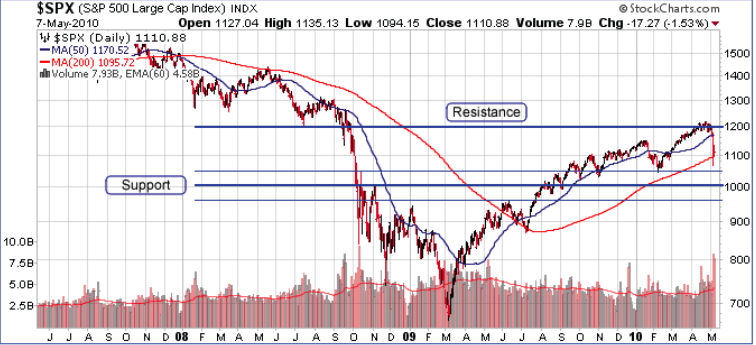
The S&P 500 managed to get through 1200 on a short-term basis and then turned down. The 1200 is now resistance. The next level of support is 1050, with major support at 1,000. The market is currently oversold and could have a bounce, depending on developing Eurozone problems. Regardless further weakness is expected over the next few months. Investors should be very cautious if the market does break through the 1,000 level on strong volume.
….read Brooke’s 5 pages on Seasonal Market conditions HERE
Market Buzz – Thursdays “Fat Finger” Freefall
We would be re-miss if we did not comment on Thursday’s trading action and its effects on the market’s mood going forward – even if the powers that be have yet to identify the root cause and we are left to speculate in this regard.
In case you missed it (and many did, as much of the incident was over in less than 30 minutes), this past Thursday, according to regulatory officials, “a huge, anomalous, unexplained surge in selling” happened at about 2:45 p.m. New York time, setting off trading based on computer algorithms, thus amplifying the fall.
The Dow ended Thursday’s session down 3.2 per cent at 10,520.32, after being down as much as 998.50 points earlier, the index’s biggest intraday drop on record.
Dow Jones Industrial Average

In one of the most dizzying half-hours in stock market history, the Dow plunged nearly 1,000 points before paring those losses—all apparently due to a trader error. According to multiple sources, a trader entered a “b” for billion instead of a “m” for million in a trade possibly involving Procter & Gamble, a component in the Dow. “Sources” say the erroneous trade may have been made at Citigroup.
Amid the sell-off, Procter & Gamble shares plummeted nearly 37 per cent to $39.37 at 2:47 p.m. By the end of the session however, P&G had recouped much of the losses and traded back to the $60.75 level.
The Procter & Gamble Company (PG:NYSE)

The New York Stock Exchange is investigating the cause of the possible erroneous trades.
But tech problems alone are not to blame for the whole of the collapse. As we suspected, the markets have been looking for an excuse to sell-off or take profits. Global equities have rallied 79.9 per cent in a scant 13 months through April, so it would be only natural to go through a correction of around 10 per cent or 20 per cent at some point, if not a sustained period of consolidation.
Amid the panic and confusion, there was good news from K-Bro Linen Income Fund (KBL.UN:TSX), long a favourite in our Canadian Small-Cap Universe. The company is the largest owner and operator of laundry and linen processing facilities in Canada with seven processing plants in six Canadian cities including Toronto, Edmonton, Calgary, Vancouver, Victoria, and Quebec City.
Revenue for the three months ended March 31, 2010, was $23.9 million, an increase of 11.3 per cent over the comparable 2009 period.
A full update and current rating in light of these results will be released to our clients and posted on www.keystocks.com this coming week.
Looniversity – Of Crashes and Bubbles
A bubble is an investing phenomenon that demonstrates the influence human emotion has on investing. A bubble begins when investors put so much demand on a stock that they drive the price beyond any accurate or rational reflection of its actual worth, which should be determined by the fundamental performance of the underlying company. Like the soap bubbles a child likes to blow, investing bubbles often appear as though they will rise forever, but since they are not formed from anything substantial, they eventually pop. When they do, the money that was invested into them dissipates into the wind.
A crash is a significant drop in the total value of a market, almost invariably attributable to the popping of a bubble, creating a situation where in the majority of investors are trying to flee the market at the same time and consequently incurring massive losses. Attempting to avoid more losses during a crash, investors resort to panic selling, hoping to unload their declining stocks onto other investors. This panic selling contributes to the declining market, which eventually crashes and affects everyone. Typically crashes in the stock market have been followed by a depression.
The relationship between bubbles and crashes is similar to the relationship between clouds and rain. You can have clouds without rain but you can’t have rain without clouds, bubbles are like clouds and market crashes are like rain.
Put it to Us?
Q. Why do companies choose to “go public” or list their shares on a stock exchange?
– Phillip Bennett; Red Deer, Alberta
A. Well, Phil, there are a number of reasons or motivations for a company to “go public,” but the primary one surrounds access to capital. Going public raises cash and usually a great deal of it. Being publicly traded also opens many financial doors:
- Because of the increased scrutiny, public companies can usually get better rates when they issue debt.
- As long as there is market demand, a public company can always issue more stock. Thus, growth through mergers and acquisitions is much easier to accomplish because stock can be issued as part of the deal.
- Trading in open markets means liquidity (ease of buying and selling stock in this case). This makes it possible to implement things like employee stock ownership plans, which help to attract top talent.
KeyStone’s Latest Reports Section
- Alternative Financial Services Provider Posts Solid Q3 2010 Revenue & EPS Growth, Aggressive Growth Plan Intact, Stock Gains Over 152% in 10 Months – Near-Term Rating Change (Flash Update)
- Diversified Mining & Environmental Drilling Company Posts Resilient 2009, Solid Fundamentals Relative to Peers, Produces 74% Share Price Gain in Eight Months – Long-term Rating Upgraded (Flash Update)
- Canada’s Leading Industrial Services Firm Posts Solid Q1 – Rating Maintained (Flash Update)
- Pull-back in China-Based Stable Good Manufacturer Presents Opportunity – Rating Change (New Buy Report)
- Specialty Paper Manufacturer Shares Hit New All Time High, Up 134% in 3-months, Announce Acquisition – Rating Change (Flash Update)
Stockscores.com Perspectives for the week ending May 8, 2010
In this week’s issue:
Weekly Commentary
Strategy of the Week

As a trader, I prefer to focus on the stocks that are detached from the overall market. Most stocks, most of the time, will move with the market’s gyrations. However, when you can find stocks that are trading with abnormal volume and price volatility, you have an opportunity to beat the market. These stocks are trading on their own story and not with the mood of stocks in general.
But what do you do when the overall market is abnormal like it was last week? When the stock market makes very abnormal price moves on very heavy volume, it is highly unlikely that you will find stocks that are not influenced by the market’s direction. If the market drops 500, expect just about every stock to fall with it.
When the market is abnormal, I trade the market. The easiest way to do that is to focus on the Exchange Traded Funds that represent different market indexes. At the most basic level, you have the SPY, DIA, QQQQ and T.XIU which represent the four major North American stock indexes (S&P 500, Dow 30, Nasdaq 100 and TSX 60).
Since these ETFs move much slower than stocks (because they represent a large basket of stocks), you can also consider leveraged ETFs like QID, QLD, SDS, SSO, DDM and DXD. In Canada, T.HXD and T.HXU. However, exercise caution when trading these leveraged ETFs because they have to be rebalanced at the end of each trading day so that they will reflect a 2 to 1 leverage on the overall market. Over time, that rebalancing erodes value if the position is trading against you. I only consider these ETFs for day or swing trading.
An easy way to trade Gold is through the GLD ETF or with leverage by trading T.HGD or T.HGU (one is a short gold fund, the other long). Oil can be traded through the USO or with T.HOD or T.HOU. These TSX listed ETFs that start with an H are leveraged funds in the Horizon Beta Pro family.
It is also possible to simply bet on expected price volatility. In the options market, an important determinant of option prices is price volatility; the more price volatility is expected to be, the higher the price of the option. There is an index called the VIX that is based on this implied price volatility of options and you can trade an ETF based on this, it trades with the symbol VXX. I recommended it on April 27th, it closed Friday up 43% in that very short time period.
When trading these instruments, remember a simple rule. You make money by predicting what will happen, not by reacting to what has happened.
- Get the StockSchool Pro Free


DisnatDirect named the number one Canadian brokerage for Traders by Surviscor! Open and Fund a brokerage account with DisnatDirect and receive the StockSchool Pro home study course free, including special Pro level access through the DisnatDirect client website. Offer only available to Canadian residents. For information, click HERE
- Get the StockSchool Pro Free
Buying the VXX today is not a good trade since it has already gone up a lot. You have to enter these when they are showing signs that they are starting to go up. If the trade looks like a sure thing, it probably is not. The best trades are the ones that are hard to do, one where you feel you are taking a risk. I like to say, you have to buy the risk, not the reward.
Most days, I would never trade the overall market. There was a time when I traded the S&P 500 Futures but I never did great at it. This is a very efficiently priced market that is hard to make money at most of the time. However, when the overall market becomes abnormal, it is a great place to trade. The liquidity is amazing and the price moves can be very profitable.
Looking back at the last year, there were only about 10 days that I would consider the general market to be abnormal enough to trade. Interestingly, most of those days were sharp downward moves. This points to another rule to put in your book; trade stocks on the way up, trade the market on the way down.
The market has been very crazy this week, but the signs of weakness were there. First Goldman scared the market and we broke the 60 day, 60 minute chart upward trend line. Then concerns about European debt started to grab attention and we broke the upward trend line on the daily chart. Now, you have a lack of confidence in the trading systems as a result of the 1000 Dow point drop on Thursday and we are breaking a more important long term trend line.
As long as you listen to the market and go to where the abnormal activity is, you can do well in any environment.

The past few days have been unusual, to say the least. In 20 years of trading, I have never seen anything like the price drop that occurred briefly on Thursday. The computers took over and they did irrational things. Hopefully it serves to wake up regulators who, I believe, have let computers play too big a role. Technology has got to a point where, in the time it takes to tap your finger on the table, 10,000 to 20,000 trades can be executed by one algorithmic trader. That is a difficult thing to control and needs to be changed.
Trading the market over the past few days has only been appropriate for those who can watch the market very closely, and even they would have had trouble on Thursday. Until the market itself goes back to normal trading volumes and price volatility, I recommend sitting on the sidelines.
If you are an active trader, there are some great trading opportunities, particularly with some of the ETFs that benefit from the volatility. Nimble traders should enjoy these instruments and the rest should wait patiently for the dust to settle. No new position trading features this week.
References
Get the Stockscore on any of over 20,000 North American stocks.
Background on the theories used by Stockscores.
Strategies that can help you find new opportunities.
Scan the market using extensive filter criteria.
Build a portfolio of stocks and view a slide show of their charts.
See which sectors are leading the market, and their components.
Click HERE for the Speaker Lineup and to Purchase the video if you want to learn from some of the worlds best traders including Tyler Bollhorn.

Tyler Bollhorn started trading the stock market with $3,000 in capital, some borrowed from his credit card, when he was just 19 years old. As he worked through the Business program at the University of Calgary, he constantly followed the market and traded stocks. Upon graduation, he could not shake his addiction to the market, and so he continued to trade and study the market by day, while working as a DJ at night. From his 600 square foot basement suite that he shared with his brother, Mr. Bollhorn pursued his dream of making his living buying and selling stocks.
Slowly, he began to learn how the market works, and more importantly, how to consistently make money from it. He realized that the stock market is not fair, and that a small group of people make most of the money while the general public suffers. Eventually, he found some of the key ingredients to success, and turned $30,000 in to half a million dollars in only 3 months. His career as a stock trader had finally flourished.
Much of Mr Bollhorn’s work was pioneering, so he had to create his own tools to identify opportunities. With a vision of making the research process simpler and more effective, he created the Stockscores Approach to trading, and partnered with Stockgroup in the creation of the Stockscores.com web site. He found that he enjoyed teaching others how the market works almost as much as trading it, and he has since taught hundreds of traders how to apply the Stockscores Approach to the market.
Disclaimer
This is not an investment advisory, and should not be used to make investment decisions. Information in Stockscores Perspectives is often opinionated and should be considered for information purposes only. No stock exchange anywhere has approved or disapproved of the information contained herein. There is no express or implied solicitation to buy or sell securities. The writers and editors of Perspectives may have positions in the stocks discussed above and may trade in the stocks mentioned. Don’t consider buying or selling any stock without conducting your own due diligence.
If you haven’t already seen this table you might want to pit your wits against the some of the best in the industry in terms of forecasting gold prices for the year of 2010. The first chart tabulates the people and which organisation they represent and the second chart shows their predictions for the year, the high, the low and the average price for gold.
…..read the forecasts HERE
“Inflation is the one form of taxation that can be imposed without legislation.” – Milton Friedman
Today, I’m going to tell you how to make a lot of money.
If you are (a) not happy with the 0.5% return you are getting from your bank account, (b) worried about inflation, or (c) uncertain about the future value of your stocks and bonds, pay attention.
In fact, you might want to keep this issue of the Journal around so you can thank me later.
Despite what Timothy Geithner and so many of the other media and government squawkers are saying, the U.S. economy is not returning to health. Businesses will continue to go bankrupt, homeowners will continue to lose their homes, and unemployment will continue to rise.
The financial markets are becoming more precarious. Stock market indexes are up since March of 2009, but PE ratios are now standing at about 24 — which means that most stocks are 40% to 50% overvalued. The bond market is overvalued too.
It’s enough to make you want to stay in bed all day.
But today, I am going to give you a user-friendly game plan for financial success. It is a three-part strategy for protecting whatever wealth you have left and building wealth, starting immediately, over the coming decade.
It is a program that is based on demonstrable logic and proven business experience.
I’m not going to charge you for this plan. You are getting it for free.
If you decide to follow through on my suggestions, I will recommend some additional sources of information that will help you succeed. Buying them will be optional. But the strategy itself will still be free.
How to Protect Against the Threat of Inflation
The biggest single threat to your wealth is not the overvalued stock and bond markets but the very likely probability of a sudden and ruthless period of inflation.
You don’t have to be an economist to understand why.
Inflation means rising prices. When the stock market went up from below 700 in March 2009 to 1,200 in April 2010… that was stock inflation. When home prices rose by 80% from 1997 to 2006… that was real estate inflation.
You can make a lot of money during inflationary periods if you buy early (while prices are low) and sell later (when prices are high). But you can get killed if you wait too long and buy late (when prices are high) and then are forced to sell (when prices are low).
So the trick to profiting from inflation is to understand the trend. Getting in early and getting out early.
Pretty simple so far, eh?
The reason the smartest moneymakers in the world are expecting inflation now is because the government has been spending trillions of dollars to try to keep the banks and brokers and insurance companies from going out of business — even though those same banks and brokers and insurance companies are responsible for inflating the economy to begin with.
The government will never, ever allow these institutions to “fail.” Because if they do, we will be in a real Depression… and then all the politicians we voted into office will worry about losing their jobs. Since their cushy jobs (and amazing expense accounts) are their primary priority, they will always approve these huge bailouts — even though they know that, eventually, they will destroy the value of the dollar.
It doesn’t matter what party they belong to. The Republicans started the bailout programs and the Democrats extended them. They fight about spending on health care, but they don’t fight when it comes to the big financial institutions.
The government didn’t actually have the trillions of dollars they spent on bailouts. They had to borrow it from the U.S. Treasury.
And how do they pay back the U.S. Treasury? There are only two ways. One is by raising taxes; the other is by printing more dollars.
Countless economic studies have shown that there is only so much money the government can get by raising taxes. If they tax people too much, the economy slows down. And when the economy slows down, there is less wealth to tax… so the government’s income actually drops rather than rises.
Obama knows that he probably wouldn’t be able to raise taxes enough to pay off the debt incurred by the bailouts. Still, he is going to try to tax Americans as much as he possibly can.
Where will the rest of the money come from?
Obama also knows — as does every other smart politician — that there is a sneakier and less risky way to pay back the Treasury. And that is to let the dollar collapse.
Here’s why: When the dollar depreciates (gets less expensive), it becomes easier to pay off big debts. Who wouldn’t want to be using today’s dollars to pay for gas that went for $1.50 10 years ago? Or to pay for houses that went for $75,000, on average, 20 years ago? Well, that’s what the government will be doing 10 years from now: paying off a debt that won’t seem nearly as big as it does now because they’ll be paying with inflated dollars.
My Three-Point Plan
Traditionally, there are three types of assets that appreciate during periods of inflation. One is real estate. Another is precious metals. And the third is stocks that are related to commodities.
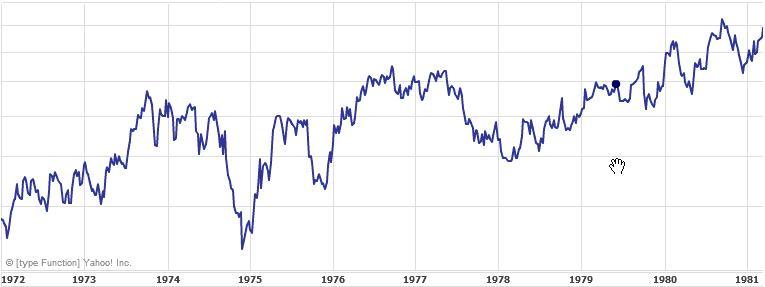
From 1972 to 1981, Alcoa’s Stock More Than Doubled
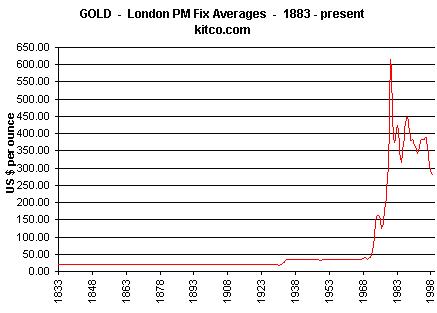
And gold’s best decade of the 20th century is no contest. It spiked during the hyper-inflationary 1970s, as you can see in this chart…
Since I don’t have the space to go into detail on all three parts of my inflation-beating strategy today, I’ll focus on the real estate opportunities. I’ll talk about precious metals and commodities in a future issue.
Real estate is a good place to start. Hundreds of billions of dollars will be made in real estate by the smart money in the next five to 10 years. My cut of that should be at least $10 million. Perhaps you’d like to join me.
Your Real Estate Plays
It’s no secret that half of the world’s richest entrepreneurs built their fortunes through real estate. What is less commonly known is that most of their great fortunes were made during inflationary periods… like the one we’re facing right now.
Opportunity #1: Taking advantage of real estate prices that are as low as they’ve been in 20 or 30 years
It is impossible (and foolish) to try to predict the bottom (or top) of this (or any) market. But, by any measure, we have just gone through one of the biggest real estate recessions in the history of the United States.
In South Florida, for example, you can find properties for less than half of what they were selling for at the peak of the market. More important, you can buy these properties with 20% down and start enjoying positive cash flow from month one. (Four and five years ago, you couldn’t get positive cash flow out of rental units with 50% down.) So today’s prices make sense from a businessman’s perspective.
My real estate partner Peter and I have been buying homes in the $120,000 to $130,000 range (after closing costs and renovations). We are getting monthly rents of $1,300 to $1,600 on these. I am financing our deals at 4% (which is good for me). At that rate, we are making about 6% to 8% on our money, not counting appreciation.
My brother is buying up residential properties and apartment complexes in lively downtown areas, beach areas, and areas targeted for “stimulus money” renovation. He is buying at such deep cash flow prices that he is able to pay his investors (including me) minimum guaranteed yields of 7.5% plus equity participation. Because of this, he has raised a considerable amount of money in the last few months, and he is using the money to do some very impressive deals.
He just bought a 14-unit building across the street from the beach for $725,000! Think of that. Each beach-view, one-bedroom unit cost him only about $50,000 — and this apartment complex could be worth several million in the not-too-distant future. He also now controls three properties in the heart of a rapidly growing downtown, zoned commercial and residential. And even though they’re in a prime spot, he is generating yields of over 8%.
Whether with Peter, through my brother, or by myself, I will continue to invest in real estate so long as prices are low. If they go down further, I’ll buy more aggressively. I have no risk of losing money, because all the properties I’m investing in are making money on a monthly basis. Even if rents drop, I won’t be losing money. The 4% to 8% yield I’m enjoying will cover me even if rents go down another 25%, which is highly unlikely.
I get immediate income from these deals. Instead of getting 0% on my cash, I’m getting a minimum of 7.5% fully secured guaranteed yields by loaning it to my brother, and additional yield from the “after-debt” cash flow.
But the real opportunity is in the appreciation potential. As I said, I fully expect to make an extra $10 million in appreciation in the next five to 10 years as inflation pushes up real estate prices. I might make as much as $30 million, but I’m trying to be conservative.
There are some who say that real estate prices won’t inflate with the rest of the economy, but I think they will. Here’s why. Buildings are built with core commodities… lumber, copper, aluminum, concrete, steel. Labor is another big expense. You can’t have inflation without a rise in those costs.
Plus, as my brother points out, properties in many areas are selling for less than replacement value. In some cases, even if you got the land for free, you couldn’t build these homes for what you can buy them for today. That’s even after taking depreciation into account.
Last but not least, in many instances, it’s already far cheaper to buy than it is to rent. Eventually, this will turn the tide toward buying. It’s just a matter of time.
So that’s my first inflation-beating recommendation: Start buying undervalued, quality rental properties now. Don’t wait for the market to bottom. Just find properties that will give you a net cash flow of at least 4% to 9% after all expenses (including property taxes, maintenance, fees, etc.).
…..read Opportunity #2 and #3 HERE
-
I know Mike is a very solid investor and respect his opinions very much. So if he says pay attention to this or that - I will.
~ Dale G.
-
I've started managing my own investments so view Michael's site as a one-stop shop from which to get information and perspectives.
~ Dave E.
-
Michael offers easy reading, honest, common sense information that anyone can use in a practical manner.
~ der_al.
-
A sane voice in a scrambled investment world.
~ Ed R.
Inside Edge Pro Contributors

Greg Weldon

Josef Schachter

Tyler Bollhorn

Ryan Irvine

Paul Beattie

Martin Straith

Patrick Ceresna

Mark Leibovit

James Thorne

Victor Adair