
Daily Updates
$3,000 gold?
Better than paper money
Gold looking good
Time to pay the piper
Hearing the sound of war drums
The dam about to burst? (below)
The gathering revolt against government spending
This month three members of Congress have been beaten in their bids for re-election — a Republican senator from Utah, a Democratic congressman from West Virginia and a Republican-turned-Democrat senator from Pennsylvania. Their records and their curricula vitae are different. But they all have one thing in common: They are members of an Appropriations Committee.
Like most appropriators, they have based much of their careers on bringing money to their states and districts. There is an old saying on Capitol Hill that there are three parties — Democrats, Republicans and appropriators. One reason that it has been hard to hold down government spending is that appropriators of both parties have an institutional and political interest in spending.
Their defeats are an indication that spending is not popular this year.
…..read more HERE
“We’re seeing gold actually rise in all currencies. That seems to be a reflection of the concern and distrust for central bank authorities, political authorities and what’s going in the world that we’re living in,” says Doug Groh, senior research analyst with the Tocqueville Gold Fund in this exclusive interview with The Gold Report. The fund is almost 10% bullion, which Groh says dampens the volatility of the fund’s other holdings. He holds gold and thinks you should, too.
The Gold Report: Gold is trading above $1,200 as financial markets across the world retreat. In several currencies, gold is trading at historic highs. Gold investors are declaring that gold is the only safe haven. What’s your view of the current situation?
Doug Groh: What we’re seeing in the world is really quite dramatic, isn’t it? I think people are beginning to recognize that there’s a lot of uncertainty in the future for financial markets. The attraction that gold presents is that it is a hard asset. It’s valued on the minute and on the second. There’s been a lot of distrust in the marketplace regarding the paper that’s been issued, whether that’s equity paper or bonds or currency. I think investors are looking to something that really sustains and exhibits value on a moment-to-moment basis.
TGR: What do you think the near-term effect of the sovereign bailout of Greece is going to have on gold?
DG: From day to day, there is a lot of uncertainty as to what’s going on with Greece and in Europe. We’re seeing the euro correct. We’re seeing the dollar strengthen, but I think what’s really noteworthy is that gold is holding its own. In prior markets, you would typically see that when the dollar strengthens gold comes off. Now we’re seeing gold actually rise in all currencies. That is a reflection of the concern and distrust for central bank and political authorities, and what’s going in the world that we’re living in. The markets are reflecting their concern about inflation. To resolve the Greece problem, its debt probably needs to be restructured if not go into default. That probably means a greater issuance of credit, which in the end is inflationary. Debasing the currency is what you’re going to see. In that regard people are concerned and focused on maintaining and holding on to whatever value they can, and gold is becoming that much more attractive.
TGR: There is talk that Greece will no longer be allowed to use the euro. Is this crisis coming to the U.S. in a big way?
DG: We’re learning and understanding that all global markets are very interconnected; contagion will probably affect us somehow, but to what degree and in what capacity? I really don’t know. However, one has to think that international banks operating around the world are going to be affected.
TGR: How are investors getting exposure to gold?
DG: What we’ve seen over the last several years is investors seeking gold through ETFs. The gold ETF has done a fantastic thing for the gold market. It’s made gold more accessible, not only to institutional investors, but also to the individual investor. As a result, more people are embracing and adding gold to their portfolio. It’s been a good diversification position for investors. Gold’s success over the past ten years has basically reinforced the notion that gold is a legitimate investment vehicle. In the past, I think investors thought of gold as something you go to only during times of distress or inflation or geopolitical concerns. And while that is likely to continue, gold has also demonstrated that it is a good diversifier among other portfolio holdings. The performance of gold over the last 10 years has really demonstrated that it should be an important component in portfolios.
TGR: About 9% of your $1.3-billion fund is physical gold. That’s the largest holding in your fund. By comparison, the Sprott Gold and Precious Metals Fund doesn’t list any physical gold among its top-10 holdings. Please expand on your strategy in holding so much actual bullion.
DG: We have about $11 million of gold, which makes up about 8%–9% of the fund. That’s a position we’ve had for some time. Our average cost is about $450 an ounce for the gold we hold. We built up that position some time ago. As we were getting cash in-flows, we were deploying cash to bullion as we felt some of the equities were overpriced. That has worked out well. The position acts as a balance. The majority of our fund, 80%-85%, is gold mining equities. There is almost twice as much volatility in gold mining equities as in gold. The fact that we have bullion in the fund somewhat dampens that volatility. Bullion acts as a ballast, of sorts, which reduces the risk in terms of investing in the fund.
TGR: Have you noticed that happening over the last month or so?
DG: That was the case this past year. We’ve seen days when the gold price is up and sometimes the equities are down. We’ve actually had nice relative performance from that type of activity where sometimes we’ll see the equities down but bullion up . There are days when gold seems to be the attraction and people are really looking for that direct exposure to gold bullion. It’s been a nice balance to the fund, and has really added a lot of value in terms of relative performance.
TGR: What sets your fund apart?
DG: I think it’s the smaller names that may not have as much public information out there. That’s really where we focus. You could say that we have a small cap value bias concentrated in global gold mining equities. We focus on precious metal companies that are making discoveries and growing that way or that are expanding either their assets or production. Typically, those companies require a little bit more due diligence and fuller understanding. They are quite dynamic. It’s really something that I think is not easily understood unless it’s something you do on a regular basis. The gold mining sector is very information-intensive and it becomes imperative that, as an investor, one stays in the flow of information. That’s a full-time job for the all the companies we own and track.
TGR: In terms of your asset mix, you have roughly 10% bullion and the rest is gold equities. Investors may look at your fund and think they should employ a similar strategy. Is that a mix that regular investors should be looking at?
DG: I think that’s a good approach. If you’re looking at exposure to the gold market, I think it’s appropriate and wise to have direct exposure to gold. In owning a gold mining equity you get optionality on the gold price. You get a higher level of risk return. As we discussed, direct exposure to gold bullion will allow one to have direct exposure to the gold price and yet owning gold mining equities, which are more volatile, allows one to gain exposure to pricing and asset leverage. A bullion position will dampen down volatility a little bit. Then, if you are exposing yourself to gold mining equities, I think it’s appropriate to spread your risk across a number of names—in particular to different segments of the gold mining industry —those being explorers, developers and producers.
The explorers tend to be a little bit riskier but can offer some good upside as they add value through discovery. The developing companies that are growing tend to appreciate in value as they realize their growth objectives, but they do present some risk, since their growth is uncertain. Then, of course, there are the big producers who, to a large extent, really offer price optionality on gold.
TGR: Can you tell us about some of the bigger gold equities in your top 10, like IAMGOLD Corporation (TSX:IMG;NYSE:IAG), Newmont Mining Corp. (NYSE:NEM) and Goldcorp Inc. (NYSE:GG ;TSX:G)?
DG: Those are major producers that are actually producing gold and generating cash flow. They offer price optionality or leverage to the gold price. Generally speaking, a move in the gold price is going to directly affect their bottom line. If the gold price goes from $1,200 to $1,300, that $100 of movement in the gold price is going to fall right to their bottom line and the market is going to revalue that profit directly into the stock. Typically, you get a 2% performance in gold equities relative to a 1% performance in gold bullion. So that’s the kind of optionality you get in the major names, such as IAMGOLD.
IAMGOLD has a great balance sheet. It has a number of different operations around the world. You have some really nice diversification there. It is building some mines, which will add to its production profile, so you’re getting some growth too.
TGR: Are you talking about Essakane in West Africa?
DG: Yes, the Essakane project in Burkina Faso should be coming onstream in the next year or so. Commercial production at the Westwood project in Quebec is expected in 2013. In South America, they have developing projects in Guiana and in Ecuador, which will add to their profile in time. Newmont doesn’t have the same type of growth profile as IAMGOLD. It is a larger producer and is really more tied to price optionality. However, Newmont’s balance sheet is improving significantly and it holds a lot of cash. It’s likely to be an acquirer of assets in order to do two things: grow and replace depleting resources.
TGR: And Goldcorp?
DG: Goldcorp has had a nice string of success with not only the assets they’ve acquired but the ones that they are developing. They have a very dynamic growth profile. I think they are in a very strong position to use their balance sheet and their valuation to continue a growth profile well into the decade.
TGR: Are you talking about Peñasquito in Mexico?
DG: Peñasquito and some of its assets in Canada at Red Lake and the Éléonore project in eastern Canada. They have quite a diverse mix of assets, which really gives them a lot of flexibility.
TGR: Other than Osisko Mining Corp. (TSX:OSK), which makes up about 5% of your fund, what other precious metals juniors do you like?
DG: We have a sizeable position in International Tower Hill Mines Ltd. (TSX:ITH;NYSE.A:THM). It’s a similar story to Osisko in a way, and yet it’s maybe several years behind the development that Osisko is undertaking. International Tower Hill has a project in Alaska in the Livengood district—a former gold-producing area in central Alaska. The people running International Tower Hill are from Cardero Resources Corp. (TSX:CDU, NYSE.A:CDY, Fkft:CR5) and AngloGold Ashanti Ltd. (NYSE:AU;JSE:ANG;ASX:AGG;LSE:AGD).
TGR: What’s Tower Hill’s story?
DG: Basically they’ve gone back into this historic producing district, redefined the geology and identified a much larger deposit of relatively lower-grade gold but in high volume. It’s interesting because majors like Newmont or Barrick Gold Corp. (NYSE:ABX;TSX:ABX), which are producing 5–8 million ounces a year, need to replace that production. International Tower Hill has found a sizeable project that could potentially be part of a major. AngloGold is already a sizeable investor in International Tower Hill and that’s something we’re rather excited about. The fact that it’s in the United States gives us that comfort of knowing it’s not in a jurisdiction that could be a little bit more politically sensitive.
TGR: What other juniors are you following?
DG: We have a major position in Ivanhoe Mines Ltd. (NYSE:IVN; TSX:IVN). The attraction there is it has a sizeable world-class project in Mongolia, which is not only gold but also copper. The Oyu Tolgoi project has attracted interest from Rio Tinto Ltd. (LSE:RIO;NYSE:RTP;AUS:RIO) as an investor in Ivanhoe. Rio Tinto can take its equity interest up to a higher level over time by providing more capital. What’s interesting is that it’s in a part of the world where copper and gold is in demand, particularly from China. So you have an active and demanding market for the copper. Clearly, the fact that there’s gold there adds value to the deposit and makes it easier and cheaper to mine the copper.
TGR: It seems that gold companies are looking more frequently at copper-gold porphyry projects because of the boost they get from the copper. For example Northern Dynasty Minerals Ltd. (NYSE.A:NAK;TSX:NDM) owns the Pebble project in Alaska that contains billions of pounds of copper, as well as around 40 million ounces of gold in all categories. Are majors more likely to acquire projects that are copper-gold porphyry deposits now than straight gold deposits?
DG: I think there’s been developing interest over the last year or so toward what’s called copper-gold porphyries. The reason for that is that having a byproduct metal can help reduce the cost or generate greater revenues, which helps justify a project’s economics. That’s certainly an important element. I think the other aspect is that clearly the copper price has been quite strong at over $3 a pound, and copper is not to be ignored. There’s a lot of demand for copper. That’s likely to continue. I also think—and this might be the key element that’s not that well discussed—but typically and generally speaking, copper-gold porphyry deposits are large in scale and there’s a lot of metal in them. As these major companies need to replace their resources, they’re looking for a project that will provide them a long-life of output. Generally, it seems as though you’re finding that in copper-gold porphyry style deposits; epithermal deposits can also have high volumes but maybe not quite as large and the same could be said about volcanic massive sulphide deposits or sediment hosted deposits.
TGR: Obviously the market cap of a company like Northern Dynasty is quite substantial now that they’ve outlined a significant resource. What about something on the edge of a play like that, such as Kiska Metals Corp. (TSX.V:KSK)?
DG: I think that’s where you want to go to find some exciting value opportunities. If you look at the life cycle of a mining stock from exploration to development to production, the greatest value generation is during exploration. Certainly, there’s value created during development as a company goes through the process of permitting and financing and building a mine. A company like Kiska, which is also operating in Alaska, is really at the front of the curve here in terms of exploring and identifying a significant deposit. For a small company to find a deposit, the value-add can be tremendous.
TGR: Tell me about its Whistler project?
DG: Kiska’s Whistler project has a lot of upside. It has a huge land position that really has not been fully explored. There’s a lot of opportunity to make a sizeable discovery there. The reports they’re coming out with so far are really quite encouraging, and we’re going into the drilling season as we get into the summer months. A company like Kiska, which is somewhat limited in terms of its ability to operate throughout the year because of weather conditions, is going to benefit the most during the spring and summer drilling seasons and into the fall as they go out and do the things they do best—exploring and identifying deposits. Whistler is a very exciting deposit; Rio Tinto is involved in that, too. When you see a major company like a Rio Tinto involved in a project, it should give you an indication that there’s something very significant because large companies aren’t usually paying attention at this stage of an exploration program unless they think there’s something of significance.
TGR: Great. This has been very informative, Doug. Thanks so much for talking with us today.
Doug Groh has 25 years’ investment experience. Before joining Tocqueville in 2003, he was Director of Investment Research at Grove Capital from 2001–2003. Between 1992–2001, as a senior sell-side analyst for JP Morgan and Merrill Lynch, he was recognized as a ranked analyst by Institutional Investor Magazine and The Wall Street Journal for his coverage of basic material stocks in the non-ferrous metals, chemicals and paper and packaging industries. He began his career as a mining analyst and worked as a precious metals portfolio manager at U.S. Global Investors and American Express Financial Advisors in the 1980s and early 1990s. He holds an MA in Energy & Mineral Resources from the University of Texas at Austin and a BS in Geology/Geophysics from the University of Wisconsin—Madison.
Want to read more exclusive Gold Report interviews like this? Sign up for our free e-newsletter, and you’ll learn when new articles have been published. To see a list of recent interviews with industry analysts and commentators, visit our Expert Insights page.
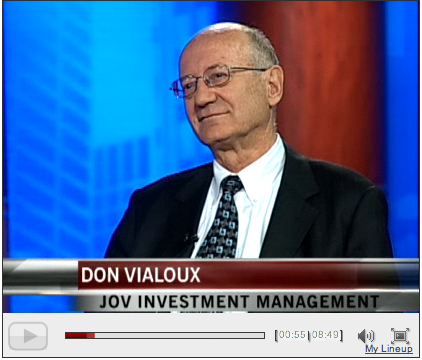
Amid some of the greatest stock volatility in decades, BNN takes a technical look at the markets with Don Vialoux, research analyst, JOV Investment Management……click on the image to watch. Don Vialoux reviews 45 Charts and gives his Bottom line below:
The Bottom Line
Look for a brief recovery rally from a deep short term oversold level during th e next two weeks. However, strength offers an opportunity to reduce equity positions.
……view Don’s review of 45 charts HERE
Good day… And a Marvelous Monday to you! The last week of May! Can you believe that? This weekend is Memorial Day Weekend, and Summer is here! (I know, not officially, but to me, Memorial Day marks the beginning of Summer, and always has!) Summer heat arrived here this weekend… Man, did that hot sun feel good! It was 60 for a high on Thursday, and 90 yesterday… If you don’t mind change, then you’ll love St. Louis weather!
Well, the heat returned to the euro overnight… After enjoying a couple of days in the sun, rising from the ashes due to a short squeeze last week, it appears to me as though that sun bathing for the euro is over… Yes, it looks like the selling will return this week, I mean I may only have one eye, but I can see a reversal when there is one! The euro began the overnight sessions climbing to 1.2587, and then turned on a dime! The single unit is now grading below 1.24… Do you see the reversal?
The heat is also back on the GIIPS, for those of you new to class, that’s short for: Greece, Italy, Ireland, Portugal, and Spain… I had the Bloomberg TV station on here in the office this morning, (Robin Meade is on vacation!) and I saw them bring up charts on the percent GDP is taken up by debt from these countries… It’s not good… Not at all… BUT! Where was the chart of the U.S.’s debt, or Japan’s debt?
I saw an article in the Economist this past weekend, that was pointing out this huge omission like have been doing for months now. (Glad to see you on the ball, well, at least sort of, Economist Magazine!)
The Big Boss, Frank Trotter, has a slide he uses in his presentations, of which he just did one in Montreal last week, and it’s called the “Ring of Fire”… And it takes into consideration all the countries and their fiscal positions… It’s pretty amazing just how many countries have gone down this road to ruins… The thing to think about here folks and always keep in mind, is that you could add all these debt ridden countries together, and they still wouldn’t compare to the debt problems in the U.S. or Japan…
At least in Japan, they have a trade Surplus, and, a very high consumer savings level… Here in the U.S.? No Trade Surplus… And… Guess what? Consumers are spending more than they make again here in the U.S!
Oh… And I didn’t mean to leave out the U.K.! Their debt problems are HUGE! So, throw them in with the U.S. and Japan!
Well… The U.S. Treasury Sec. and the Sec. of State are in China… They are there to give the Chinese some advice on how to run their economy… Sort of like consultants… I remember hearing a line about the guy that asks to borrow your watch so he can tell you what time it is… What I’m trying to get to here is that the old words ring pretty true in this case… These two U.S. officials will get nowhere with the Chinese, but they sure are going to give them their “advice”… Of course, if I were in the Chinese official’s shoes, I would ask the U.S. Treasury Sec. just what happened in the U.S. financial meltdown, and watch him squirm…
Any way… China, being China, smiled at the U.S. officials, and said that they would continue to “steadily advance” reform… And all that jazz… One more time, I’ll send a memo to U.S. officials, and tell them to not waste tax payers money traveling to China, for China will do what’s best for China, and no amount of pressure by the U.S. or Europe for that matter is going to change their plans… The renminbi will eventually gain VS the dollar again, and might even get revalued, but it will be on China’s timetable, not ours…
Well… Gold is hanging a positive number on its value this morning for the first time in a week… The shiny metal is up $8 this morning. The Commodities are not faring well, so it’s not a reversal to speak of in Commodities. Gold sellers last week probably figured that “that was enough” and it was time to buy again…
Speaking of Commodities… I see that the price of Oil is still on the slippery slope, and I was somewhat happy with that as I filled my gas tank of my car yesterday! I’m really surprised that the price of Oil has found itself on this slippery slope down, given the thousands of gallons of oil that continue to spill into the Gulf every day. You would have thought that Oil Traders would have used that excuse to mark up the price of Oil…
The data cupboard here in the U.S. will contain mostly housing data this week, and that’s about it, going into a 3-day weekend, that will see the bond market close at noon on Friday, as the “boys” head to the Hamptons…
For instance, today we’ll see Existing Home Sales for April, which will include the “rush to get Gov’t money” tax refunds for buying homes, that ended at the end of April. Let’s see just how good this report looks when it prints next month… (Oh, and “Gov’t money”, doesn’t exist… It’s taxpayer money, because the Gov’t doesn’t have money unless it steals it from us… Oops, did I say “steal it” out loud?)
There’s a rumor going round, that someone’s underground, no wait… There’s a rumor going around that Eurozone that the euro is now being added to the currencies that are used to finance carry trades…
For those of you new to class, the Carry Trade, is a “risk trade” that has the investor selling “short” a low yielding currency, and taking the funds to purchase a high yielding currency… The list includes the most famous financing currency, Japanese yen… But has also recruited the Swiss franc, and the U.S. dollar along the way.
The key is to make certain that the currency you “short” / sell, remains weak, for if it begins to get strong, you will lose more than you make on the interest rate differential in the Carry Trade… You’ll also want to make certain that the currency you go “long” remains strong… Oh! And that interest rates in the short currency don’t go up, and finally… The “short” currency has to be very liquid, so that there are enough buyers and sellers…
So… With the “crisis” in the Eurozone, and with the euro, interest rates aren’t going higher for awhile, and most people think the euro will get even weaker than it was last week, so it sure qualifies, eh?
You would think that if the Carry Trade is going to return, the high yielding currencies like Aussie, Brazil, South Africa, and then not so high, Norway, and New Zealand, would be seeing buying… But from the performance I’m seeing overnight in these currencies, there hasn’t been any buying that is evident.
Then there was this… There I was on Saturday morning, reading the local business section, and I came across a story that caught my eye… The 2010 yearbook, for the World Competitiveness came out with their rankings, and for the first time since 1993, the U.S. wasn’t number 1… It wasn’t number 2 either! Singapore and Hong Kong were found to have done to be competitive than the U.S. I’m sure it doesn’t count for a hill of beans, but, to me, I read… The need for a weaker dollar…
To recap… The short Squeeze in the euro is over, and short positions are being put back on with the single unit falling almost 2-cents overnight. There are rumors that the euro is now being used as a finance currency for the Carry Trade. That does not bode well for euro strength in the near future. The price of Gold is rising this morning for the first time in about a week, and the data cupboard is going to have mostly housing data this week, before the “boys” head to the Hamptons before the 3-day Memorial Day weekend…
Currencies today 5/24/10: American Style: A$ .8280, kiwi .6720, C$ .9430, euro 1.2390, sterling 1.4360, Swiss .8635… European Style: rand 7.8685, krone 6.5315, SEK 7.90, forint 225.25, zloty 3.2330, koruna 20.70, RUB 31.08, yen 90.10, sing 1.4075, HKD 7.8010, INR 46.97, China 6.8287, pesos 13, BRL 1.8525, dollar index 86.29, Oil $69.77, 10-year 3.17%, Silver $17.80, and Gold… $1,183.30
That’s it for today… Got to get out to the ballpark again yesterday to sit in the hot sun, and watch my beloved Cardinals put out a win from the Angels… It’s the last week of school for my little buddy, Alex… Next year… High School! WOW! How did that happen? It doesn’t seem that long ago that he would sit on my lap, and help me write the Pfennig in the morning… His typing would look like this… 0879d)&()*… But it was cute… I have no Jen to help me with trading this week, so I’ll have to recruit Kristin! (she’ll find out about it when she reads this!) There’ll be longer days this week, UGH! But, I’ll survive, and look forward to Memorial Day! I hope you have a Marvelous Monday and a Wild and Wacky Week!
Chuck Butler
President
EverBank World Markets
1-800-926-4922
1-314-647-3837
Quotable
“The biggest category of contingent debt is made up of the various guarantees the eurozone has been handing out in the last couple of years. European Union governments have effectively guaranteed the liabilities of their entire banking sectors. They have guaranteed all bank deposits up to a certain limit. The eurozone member states have guaranteed Greek debt for three years, and they extended the scheme to the rest of the eurozone. And those guarantees will probably have to be doubled again.” – Wolfgang Münchau
FX Trading – Finally we are getting some real company on our dollar call
- The dollar will probably become a “growth currency” during the next 10 years, shedding its haven status of the past decade, as the U.S. economy outperforms Europe and Japan, according to UBS AG. (Bloomberg)
Comment: Welcome to the club, UBS. We have been singing this song since late last year. In fact, a multi-year dollar bull market call, which we have shared here, is one we saw as very similar to the 1992-2002 US dollar bull market.
….read more HERE
-
I know Mike is a very solid investor and respect his opinions very much. So if he says pay attention to this or that - I will.
~ Dale G.
-
I've started managing my own investments so view Michael's site as a one-stop shop from which to get information and perspectives.
~ Dave E.
-
Michael offers easy reading, honest, common sense information that anyone can use in a practical manner.
~ der_al.
-
A sane voice in a scrambled investment world.
~ Ed R.
Inside Edge Pro Contributors

Greg Weldon

Josef Schachter

Tyler Bollhorn

Ryan Irvine

Paul Beattie

Martin Straith

Patrick Ceresna

Mark Leibovit

James Thorne

Victor Adair