
Daily Updates
Michael Campbell: I just love this chance to Martin Murenbeeld, Chief Economist of Dundee Wealth because of course there is so much drama that is impacting directly the investment markets, Greece, Italy, Spain and the bond rates etc. . What does that mean to investors and why should we care about these stories?
Martin Murenbeeld: Oh gosh! The big issue is if Europe goes into a very significant recession, or heaven forbid a mild depression, we are going to have ramifications right around the world. Certainly companies in Canada and the United States that have an exposure or are selling into Europe are all going to be affected. You also have the bank side, the exposure of the US banks to Europe is not very high when you compare it with the exposure of European banks to Greece and Italy but there will still be linkages there and there will also be some very minor linkages between the Canadian banks and the European financial sector. Bottom line, nobody will really escape an implosion in Europe.
Michael: Let me just say I have not been this pessimistic in quite a while. In terms of societal dislocation, a lot of disruption and I think its going to be with us for a while. I don’t see a way out of the Italian problem that doesn’t spell some pretty negative consequences, some worse than others, and I’ve looked at their numbers. Can you manage the dislocation or is it just sort of jump all over us?
Martin: Well yes, the solutions that are being presented are sort of coming down to two, and probably the second one is not a solution. The first one as you are probably aware the French have began to insist that the European central bank should step into the market in massive amounts to buy Italian debt, Greek debt, French debt, Spanish dept and so forth to keep those interest rates down some what because as you know, the higher the interest rates get for those countries, the more it taxes and the government fiscal position and a larger amount of money in the budget ends up debt servicing and it gets to the point where the the countries cannot support it.
Michael: It’s a pretty straight forward thing. Nobody wants to lend those countries any money. I mean the major private clientele around the world would think you are nuts if you said, ‘Hey I got an idea. Let’s go buy some government debt out of Italy or Spain. Nobody who has a choice wants to lend these people money so hence, they’ve got to go to other bodies like the International Monetary Fund, the European central bank or some other entity, hey just simply won’t get private investors interested at this point.
Martin: Well that what the rise in interest rates is all about, the higher the interest rates go the hope is of course the more it encourages the private sector invest, but you’re absolutely right the private sector is balking. I overheard somebody saying on business network the other day, the fellow said ‘you know I think Italy will make it’ and then pause ‘but not with my money.’ That’s the situation we are in. Somebody has got to buy the debt otherwise interest rates just keep rising and rising and rising. Greece is already putting a haircut on the debt it owes and at some point Italy will say ‘listen, we cannot pay these interest rates, we cannot pay the debt.’ It comes down to somebody having to buy debt, if it isn’t the private sector its going to be the ECB which is what the French proposal is. The Germans are aghast to this proposal, they do not want the ECB to go in and buy debt from these various governments so if we follow the German model which is the model we are currently on, I have almost no doubt at all that we are going to have a breakup of the Euro.
Michael: One of the things I love about your research is you always put out probability scenarios of which way we are going. If the euro breaks up and it’s a sudden shift, you know how fast it can overcome us like bottom line is that if the European central bank doesn’t want to lend any money and individual investors don’t want to lend any money then you get the Greece like situation that is not doable. So with the euro, what would it look like and what are some of the scenarios if the euro just can’t keep going the way it is.
Martin: Well there are different ways that the euro could split up. My preferred way, lets start with the nicest way, is where the northern European countries, the triple A rated countries, the countries that don’t have these massive debts, the countries that can service their debts they leave the euro. Not that Greece leaves, but the Germans and the Dutch leave. And the reason for that is what is left is what we call the Latin block or the Southern European block and that block retains the euro. So that Southern Block keeps all the debts of those countries, denominated in euros which they by in a large owe to the northern half of Europe.
Okay now obviously what will happen when the northern half breaks away, they will have their own currency, will call it the Deutsche mark or the North Euro it doesn’t matter and that currency is going to rise against the southern euro. But from an accounting point of view, everything kind of stays the same, the debts that Italy owes to the German banks and so forth and to the French banks will all remain denominated in euros. A German Bank operating under the north Euro block now, will obviously get paid back in Euros which will be less than north Euros, so they loose but they are going to loose anyways.
At this point and time, the northern countries are going to loose big time no matter what happens, that’s the nicest way. The worst way things will break up is that you get some kind of a rogue withdrawal of Greece and possibly even Spain and Italy and that will then immediately shock the system. You and I will do exactly like the fellow I just quoted, we are not going to lend any money to anybody over there because we don’t know where the rot will go. Remember after Lehman went under general electric had trouble rolling over its short term paper and you wonder what the heck is general electric got to do with Lehman? But the point is, you and I will not be lending and that then spells a disaster.
Michael: With all the uncertainty that’s in Europe about who can pay their debts, whose going to do it, if they can resolve it. Do you see this as a scenario though that could be very positive for gold or for the US dollar as examples.
Martin: I think generally speaking yes. I mean it will be, at the moment as we speak you know that the gold market has been a little bit rocky because you know there is always the other things at play in the gold market. Suppose we go into recession or God forbid a mild depression in Europe that’s going to shock the international economy and so the international economy gets dragged down a little bit so that’s the other side. That could pull gold down a little, down somewhat. But you know if the world goes in that direction then there is no doubt in my mind that within relatively short order you are going to see a significant amount of fiscal and monetary stimulus certainly in the United states. In Canada too, I mean the bank of Canada has said a number of times it stands ready to put liquidity in the system if and when its needed. However it happens in Europe, whatever currencies are working in Europe the central banks behind those currencies will also be printing to curtail the negative drag in economic activity and all of that will be very, very beneficial for gold. In fact I could see gold breaking the $2,000 barrier in that sort of a scenario.
Michael: I could see a scenario where major pools of capital that don’t have a lot of choices to move to go the the US Dollar, or the Yen, especially on the short term.
Martin: Yes absolutely, I mean there has been some attempts for money to move into the Yen, and you saw the bank of Japan did. They basically said hey we don’t want the Yen to go up and they started intervening heavily. The same thing was happening to the Swiss Franc which probably if you are sitting in Europe that would be your first move. You’d move your Euros over to Switzerland and you probably wouldn’t keep it in Euro’s because you are not entirely sure that there is going to be a Euro a year from now. So you convert them to Swiss francs. and the Swiss franc was going crazy against the Euro so the Swiss national bank has come into the market and said “hey enough is enough” and it’s time to suppress the Swiss franc. So you are right in that regard that large money you know will move to the US dollar.
We are also getting reports that there is quite a bit European buying of high priced property in London. I mean basically money is moving to where it can go, where the markets can absorb it and its driving the prices of those things up and that includes the US dollar. You know I’m gold friendly but frankly if you want absolute safety, you buy US treasury bill. That’s the only thing that I can guarantee you are going to get exactly your full amount of money back. You put a $100 in US treasury bills you are going to get a $100 back.
Michael: If money is going to be flooding in to the US and Canada does this mean that interest rates will stay low in our neck of the woods for quite a while?
Martin: Oh absolutely yes there is no doubt in my mind and for several reasons. First off the fed is more or less promised that they are not going to raise interest rates before the middle of 2013. I don’t see the bank of Canada raising interest rates in fact there is a reasonable probability the bank will be lowering interest rates a little bit. Interest rates here are going to stay low. If I were to think outside the box a little bit on this one you could conceivably come up with a scenario where by the Chinese are encouraged to support European paper.
So let’s say the Chinese start to buy Italian debt because they have, 3.2 trillion in reserves right so they could do that, but then the question is where does that money come from because it isn’t sitting around, its invested. So then the Chinese would have to sell off US treasuries to go and buy Italian paper, but those are very low probability sort of scenarios.
Michael: Low probability but it’s a reminder for investors that one of the reasons we have such huge volatility today is because of these major pools of capital and what if they move. It’s a level of uncertainty because I agree with you it’s a low probability that the Chinese decide to bail out the Italians but it is possible and they sure aren’t going to be phoning me or any other analysts before they make the move.
Martin It will be an announcement and that will change the whole ball game.
Michael: Lets go to back to volatility, as an investor we are sitting trying to determine if its a buy day, a sell day, you know there such major moves.
Martin: You know for an economist it’s a great time. On Monday my left hand is right and on Tuesday my right hand is right, I mean it can get better. I can have whatever scenario and I’m likely to be right one or the other day, it’s that kind of a crazy world at the moment.
Michael: But tough for an investor.
Martin: Its very, very difficult for an investor so you play this very safely. I encourage investors to have some gold exposure because at the end of the day no matter how this all unfolds there will be loose money printing, in other words central banks buying government debt. That’s what we call money printing. There will be some of that going on and gold is very sensitive to that. So I’d want investors to have some gold in the portfolio, Obviously we have some products at Dynamic that we think we are interesting but you know don’t want to make a plug for that. that, I think Other stuff that I like are very good companies that are good dividends payers.
Michael: That’s great advice and I think again people want it to be simple but its not, its complex. I’s uncertain out there. So I think your money has got to reflect that, that’s something I’m always saying Martin, is when uncertainty raises I’m worried about preserving my capital. Also I couldn’t agree more with you if you got some high quality companies that pay off some dividends.
Martin Murenbeeld chief economist of Dundee Wealth Management always terrific to talk to you.
Right now, natural gas prices are currently languishing at $3.80 per Mcf. Multiply by six, and you see that it costs less than $25 to get an equivalent amount of energy from natural gas as you get from a barrel of oil. So on an energy-equivalent basis, natural gas is roughly one-fourth the cost of oil.
Natural gas isn’t just readily available at a 10% or 20% discount to oil — but more than 75%. These economics are simple but powerful. It’s hard to justify paying $1 for an energy source when you can buy something comparable for $0.25.
And in fact, we’re already starting to see a major shift toward the use of natural gas.
For the first time in 15 years, there’s currently an expansion wave in petrochemical manufacturing (which uses natural gas as a feedstock). We’re also beginning to see many fleet owners convert their cars and trucks to vehicles that run on compressed natural gas (CNG) transportation fuel — which is about $2 cheaper per gallon than ordinary gas or diesel at the pump.
And as for electricity, the U.S. Department of Energy is forecasting that natural gas will fuel 90% of the additional power-generating capacity scheduled to be built in the next two decades.
But the real opportunity for energy investors rests in something called liquefied natural gas (LNG).
By chilling natural gas to -260 degrees Fahrenheit, production companies can liquefy and compact the energy source, making it economically feasible to ship large quantities overseas.
Now U.S. oil and gas companies can ship their excess natural gas as LNG to foreign markets — where natural gas is scarcer and widely commands prices of $10 to $15 per Mcf, and in the case of Japan, nearly $20 per Mcf.
Events have already been set in motion to allow our cheap shale gas to be liquefied and sold abroad. Needless to say, selling billions of cubic feet of gas for triple the price they might get here in the U.S. has major producers like Chesapeake Energy (NYSE: http://www.streetauthority.com/stocks/CHK” href=”http://www.streetauthority.com/stocks/CHK”>CHK) seeing dollar signs. And there are plenty of hungry customers out there.
Just a few years ago, only 17 countries imported LNG worldwide. Today, this number has risen to 25 — not counting Poland, El Salvador, Costa Rica and many others that are planning to build LNG import terminals.
As a result, global annual LNG production has spiked 60% since 2005. And with an estimated $200 billion in capital being poured into expansion projects worldwide, this trend isn’t stopping anytime soon. Case in point: global giant Chevron (NYSE: http://www.streetauthority.com/stocks/CVX” href=”http://www.streetauthority.com/stocks/CVX”>CVX) recently pledged to put 40% of its investment capital into new LNG projects in the next decade.
I expect the use of LNG will become more widespread. There’s already been a flurry of headline-grabbing deals as savvy industry execs wake up to the potential.
Action to Take –> Keep your eyes on what’s going on in the energy patch. Right now, the price of natural gas relative to oil is way too cheap to ignore… and the growth in LNG is still in the early stages. It’s only a matter of time before more and more investors start to catch on.
[Note: This new trend in natural gas is bound to be one of the biggest energy stories for some years to come. In fact, I dedicated the inaugural issue of my http://web.streetauthority.com/m/ei/EI01/ei-sample.asp?TC=EI0041” href=”http://web.streetauthority.com/m/ei/EI01/ei-sample.asp?TC=EI0041″ target=”_blank”>http://web.streetauthority.com/m/ei/EI01/ei-sample.asp?TC=EI0041″>Energy & Incomehttp://web.streetauthority.com/m/ei/EI01/ei-sample.asp?TC=EI0041″> advisory to the topic — including analysis of one stock in the field paying a http://www.investinganswers.com/financial-dictionary/income-dividends/dividend-yield-361” href=”http://www.investinganswers.com/financial-dictionary/income-dividends/dividend-yield-361″ target=”_blank”>dividend yield of more than 6.5%.
http://web.streetauthority.com/m/ei/EI01/ei-sample.asp?TC=EI0041″>
For more information about my advisory, http://web.streetauthority.com/m/ei/EI01/ei-sample.asp?TC=EI0041” href=”http://web.streetauthority.com/m/ei/EI01/ei-sample.asp?TC=EI0041″ target=”_blank”>you can watch this presentation http://web.streetauthority.com/m/ei/EI01/ei-sample.asp?TC=EI0041” href=”http://web.streetauthority.com/m/ei/EI01/ei-sample.asp?TC=EI0041″ target=”_blank”>here].
Disclosure: Neither N. Slaughter nor StreetAuthority, LLC hold positions in any securities mentioned in this article.
http://web.streetauthority.com/m/ei/EI01/ei-sample.asp?TC=EI0041″>This article originally appeared at http://www.streetauthority.com/” href=”http://www.streetauthority.com/”>www.streetauthority.com.
With the worsening Eurozone crisis and the failure of government to manage the U.S. debt responsibly, markets are fearful of a meltdown. Traders are driving prices down in the knowledge that many positions are geared [leveraged] and exposed to margin calls. Other positions are protected by ‘stop loss’ instructions, so can be triggered by prices moving down through support levels. Potential buyers are in no hurry to enter the market, either because they feel there is further to fall or because the volumes dictating price moves are too thin to get the sort of positions they want. Overall, the investment climate is very wintery from the bottom of the financial structures right up to the markets themselves.
In this investment climate, the market forces that should prevail are not doing so. The rational approach has been sidelined as markets are blown this way and that by emotions, fears, and knee-jerk reactions. This has always proved to be short-lived with investors kicking themselves afterwards because they did not act rationally. Falls become too extensive just as price ‘spikes’ do so too. Hindsight is an exact science but useless when looking forward. Now, we have to look forward. The way we do that is to look at the forces in play beneath the surface and see their direction. Take a point in the future and see what should happen if these forces keep going in that direction. What place are they taking us to?
The ‘Big’ Picture
The long, slow process of the globe’s wealth moving from the west to the east has been going on for years now. There is no sign that this will change in the next decade. China and India have low-paid, highly intelligent people who will continue to do the job cheaper than, and as well as, in the west. Capitalism, by its nature, takes work to the lowest cost place it can. So the west is directly helping this process along. The first to suffer from this process is the developed world workers who are seeing their jobs go east. The U.S. and European (with the exception of Germany, so far) unemployment figures testify to that.
With growth fading fast in the developed world, the days of live now, pay later have come to an end. Now it’s pay now and live later as the developed world looks at the debts it has incurred and the falling cash flow with which to repay them. As with individuals, when you have to repay debt, you don’t spend, so the economy must lower its performance levels until the process is over. It is naïve to think that you can have growth and repayments when economies rely so heavily on consumer spending. It’s with horror that the developed world sees just how much their borrowings have overshot acceptable levels.
Hence the traumatic situation the U.S. and the E.U. find themselves in. We may well be looking at a battle to save the euro itself as France as well as Greece, Spain, Portugal, Italy and Ireland see the yields on their government bonds shooting up to unacceptable and unsustainable levels. It’s a little better across the Atlantic where the U.S. has the advantage of fiscal union (which we do not believe the E.U. will be capable of achieving) and one overall government supposedly capable of correcting debt levels. The single government and federal financial structure was supposed to have relieved much of the trauma in the U.S., but the failure of the super-committee to lower debt voluntarily bespeaks a deeper malaise that goes to the heart of the mix of democracy and financial management. It’s becoming apparent that the U.S. government will not be able to function properly until the next election in a year’s time and then only if the elections produce a government with a dominant majority.
As a consequence, the currencies of the developed world have a time limit on their global dominance. It is unavoidable that if China continues on its path to power and wealth, that its currency will become a global reserve currency with the dollar and the euro moving into second place, or alongside it. When it suits China, the Yuan will be thrust into the global scene and bring tremendous uncertainty to the monetary system. It is unlikely that China will cow-tow to the developed world then. Whatever the pressure placed on the monetary system in the future, the level of uncertainty in values will grow. The current climate of volatility will worsen as the current accord between the E.U. and the U.S. on currency matters will diminish as another global power brings far less cooperation and much more self-interest to the system.
By extrapolating these currents, we see a picture of greater uncertainty and instability than we see now. Along the way we will see dramatic casualties, which may undermine the ability of the E.U. and possibly the U.S., to influence matters. We may well see either minor or major financial accidents before China shares monetary power with the west.
The Present Situation
The current market falls are not just the result of a single event, such as Spain’s debt costs moving above 7% or the super-committee’s failure to cut spending agreeably. These are symptomatic of the big picture. Fears of the collapse of the euro and the eventual E.U. are very real now. If Greece gets its bailouts, then other nations cause fear to remain high. France has now joined the ranks of nations having to pay to borrow. It’s the underlying undermining of the value of the monetary system that’s causing one symptom after another to burst on the scene on an ongoing basis.
Tragically, the governments of the developed world are looking to protect their power. Junker of the E.U. put it this way, “We know what to do, the problem is being re-elected after doing it.” The fear not growing is that democracy is not capable of putting financial matters right because of the unpopularity it will bring. This is equivalent to taking the rudder out of the water. The drift towards financial accidents appears inevitable.
The interconnectedness of the global banking system – It appears that the debt events of the last 18 months in the developed world are moving almost osmoticaly to a banking crisis as banks fear to lend to one another, uncertain of the sovereign debt values and the holding of those debts by the banks they would normally lend to. This is threatening to freeze up the banking system and not simply that of the E.U.
The fall in the gold and silver prices may well appear inconsistent with its preserving qualities, but when one takes into account the need for immediate liquidity to protect the investor, it is consistent. Once the immediacy of finding liquidity is satisfied, then we see investors returning to the precious metals as they did after the first strike of the credit crunch in 2007. This time round, liquidity needs are not so pressing as then.
The threat of a fall in the gold price to $1,500 appears real at the present moment. Because the fall is being driven by short-term traders and the triggering of stop loss positions with buyers waiting for new support, the situation is a short-term one not affected by the fundamentals of the precious metals markets, which remain excellent. Just as we can have a ‘spike’ to the upside, so we can have a ‘spike’ to the downside. Right now we have see falls from the $1,900 area back to around $1,677 a fall of around 12%. A fall to $1,500 is a fall of 21%, which would be justified if the market fundamentals had deteriorated. But they haven’t. If investor meltdown becomes severe in the precious metal markets to the extent of a fall to $1,500, then it implies the same to the entire global financial markets. Investor meltdown will affect all markets as it has done recently and in 2007. This would paint a disastrous picture for global equity markets for sure. This is possible!
But in the last few days, we’ve seen good buying of gold into the U.S.-based SPDR gold ETF as well as a flight to U.S. Treasuries as last resort paper –if the U.S. bonds sink then everybody’s bonds will sink. Russia has just reported an 18.6 tonne purchase of gold in October as part of its ongoing gold buying. Several other central banks are following their path. This confirms the excellent fundamentals of gold. Even in the current deteriorating global financial scene, expect investors to soften their flight to Treasuries with expedient buying of gold as we are currently seeing. Will this hold off the fall from reaching $1,500? We feel it would be foolish to specify a specific price having seen so many such forecasters prove wrong when they do this. While it is possible, if it does go there it will be only briefly, but more likely by then the tide of investment into gold that we have seen in the last decade will return to gold before it does. But we will have to wait and see.
Member’s Only
Gold, Silver Price in the Next Few Days, Weeks
Get the rest of the report. Subscribe @
Legal Notice / Disclaimer
This document is not and should not be construed as an offer to sell or the solicitation of an offer to purchase or subscribe for any investment. Gold Forecaster – Global Watch / Julian D. W. Phillips / Peter Spina, have based this document on information obtained from sources it believes to be reliable but which it has not independently verified; Gold Forecaster – Global Watch / Julian D. W. Phillips / Peter Spina make no guarantee, representation or warrant
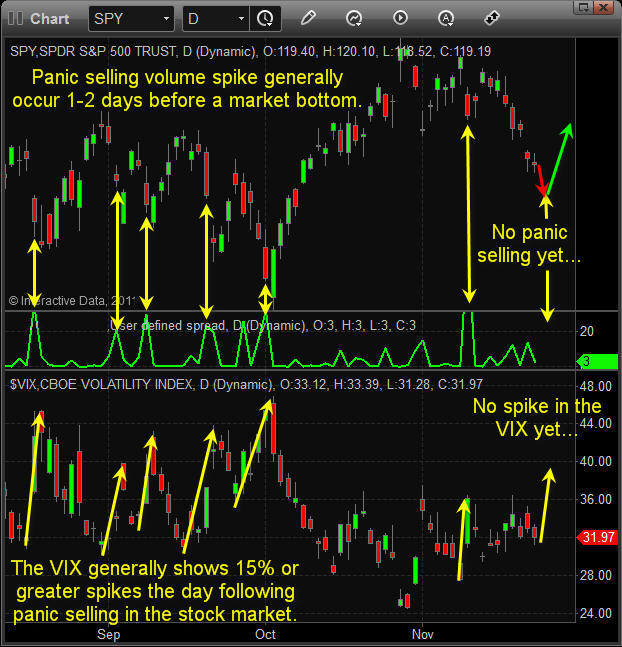
The months of November and December are the second strongest back to back months for the financial markets. Many traders and investors use this time of the year to reap big gains as they close the year out. The fact that most traders and investors are sitting in cash and underweight stocks in their portfolio’s leaves me to believe a Santa Clause rally is just around the corner. Reason being is everyone has cash on hand to buy stocks because they are selling their positions in this pullback we are in right now. I know traders well enough, they will buy back into the market trying to catch the holiday rally in the coming weeks.
Take a look at the SP500 & Volatility index below:
Just Click Here to visit Chris’ site and get his Index, Commodity and Currency Trading Alerts
With fiscal time bombs ticking in both Europe and the United States, the pertinent question for now seems to be which will explode first. For much of the past few months it looked as if Europe was set to blow. But Angela Merkel’s refusal to support a Federal Reserve style bailout of European sovereigns and her recent statement the she had no Hank Paulson style fiscal bazooka in her handbag, has lowered the heat. In contrast, the utter failure of the Congressional Super Committee in the United States to come up with any shred of success in addressing America’s fiscal problems has sparked a renewed realization that America’s fuse is dangerously short.
Chancellor Merkel has been emphatic that European politicians not be given a monetary crutch similar to the one relied on by their American counterparts. Her laudable goal, much derided on the editorial pages of the New York Times, is to defuse Europe’s debt bomb with substantive budget reforms, and as a result to make the euro “the strongest currency in the world.” Much has been made of the poorly received auction today of German Government bonds, with some saying the lack of demand (which pushed yields on 10-year German Bonds past 2% –hardly indicative of panic selling) is evidence of investor unease with Merkel’s economic policies. I would argue the opposite: that many investors still think that Merkel is bluffing and that eventually Germany will print and stimulate like everyone else. It is likely for this reason that yields on German debt have increased modestly.
In contrast, the U.S. is crystal clear in its intention to ignore its debt problems. With the failure of the Super Committee this week it actually became official. American politicians will not, under any circumstances willingly confront our underlying debt crisis. While the outcome of the Super Committee shouldn’t have come as a great surprise, the sheer dysfunction displayed should serve as a wakeup call for those who still harbor any desperate illusions. Some members of Congress, such as John McCain, have even come out against the $1.2 trillion in automatic spending cuts that would go into effect in January 2013. Expect more politicians of both parties to cravenly follow suit.
Over the next decade, the U.S. government expects to spend more than $40 trillion. Even if the $1.2 trillion in automatic cuts are allowed to go through, the amount totals just 3% of the expected outlays. In a masterstroke of hypocritical accounting, $216 billion of these proposed “cuts” merely represent the expected reductions in interest payments that would result from $984 billion of actual cuts. These cuts won’t make a noticeable dent in our projected deficits, which if history can be any guide, will likely rise by much more as economic reality proves far gloomier than government statisticians predict. Finally, the cuts are not cuts in the ordinary sense of the word, where spending is actually reduced. They are cuts in the baseline, which means spending merely increases less than what was previously budgeted.
In the mean time, the prospect of sovereign default in Europe is driving “safe” haven demand for the dollar. So contrary to the political blame game, Europe’s problems are actually providing a temporary boost to America’s bubble economy. However, a resolution to the crisis in Europe could reverse those flows. And given the discipline emanating from Berlin, a real solution is not out of the question. If confidence can be restored there, each episodic flight to safety may be less focused on the U.S. dollar. Instead, risk-averse investors may prefer a basket of other, higher-yielding, more fiscally sustainable currencies.
The irony is that Europe is actually being criticized for its failure to follow America’s lead. This misplaced criticism is based on the mistaken belief that our approach worked. It did not. Sure, it may have delayed the explosion, but only by assuring a much larger one in the future. In the mean time, many have mistaken the delay for success.
However, if Merkel’s hard line works, and real cuts follow, Europe will be praised for blazing a different trail. As a result the euro could rally and the dollar sinks. Commodity prices will rise, putting even more upward pressure on consumer prices and interest rates in the United States.
Any significant reversal of the current upward dollar trend could provide a long awaited catalyst for nations holding large dollar reserves to diversify into other currencies. My guess is that Merkel understands the great advantage the U.S. has enjoyed as the issuer of the world’s reserve currency. I believe she covets that prize for Europe, and based on her strategy, it is clearly within her reach.
There is an old saying that one often does not appreciate what one has until it’s lost. The nearly criminal foolishness now on display in Washington may finally force the rest of the world to cancel our reserve currency privileges. The loss may give Americans a profound appreciation of this concept.
New Special Report
: For an in depth look at the prospects of international currencies, download Peter Schiff’s and Axel Merk’s Five Favorite Currencies for the Next Five Years.
Subscribe to Euro Pacific’s Weekly Digest: Receive all commentaries by Peter Schiff, John Browne, and other Euro Pacific commentators delivered to your inbox every Monday
Peter Schiff C.E.O. and Chief Global Strategist
Euro Pacific Capital, Inc.
10 Corbin Drive, Suite B
Darien, Ct. 06840
800-727-7922
www.europac.net
schiff@europac.net
For a great primer on economics, be sure to pick up a copy of Peter Schiff’s hit economic parable, How an Economy Grows and Why It Crashes.
Mr. Schiff is one of the few non-biased investment advisors (not committed solely to the short side of the market) to have correctly called the current bear market before it began and to have positioned his clients accordingly. As a result of his accurate forecasts on the U.S. stock market, commodities, gold and the dollar, he is becoming increasingly more renowned. He has been quoted in many of the nation’s leading newspapers, including The Wall Street Journal, Barron’s, Investor’s Business Daily, The Financial Times, The New York Times, The Los Angeles Times, The Washington Post, The Chicago Tribune, The Dallas Morning News, The Miami Herald, The San Francisco Chronicle, The Atlanta Journal-Constitution, The Arizona Republic, The Philadelphia Inquirer, and the Christian Science Monitor, and has appeared on CNBC, CNNfn., and Bloomberg. In addition, his views are frequently quoted locally in the Orange County Register.
Mr. Schiff began his investment career as a financial consultant with Shearson Lehman Brothers, after having earned a degree in finance and accounting from U.C. Berkley in 1987. A financial professional for seventeen years he joined Euro Pacific in 1996 and has served as its President since January 2000. An expert on money, economic theory, and international investing, he is a highly recommended broker by many of the nation’s financial newsletters and advisory services.
-
I know Mike is a very solid investor and respect his opinions very much. So if he says pay attention to this or that - I will.
~ Dale G.
-
I've started managing my own investments so view Michael's site as a one-stop shop from which to get information and perspectives.
~ Dave E.
-
Michael offers easy reading, honest, common sense information that anyone can use in a practical manner.
~ der_al.
-
A sane voice in a scrambled investment world.
~ Ed R.
Inside Edge Pro Contributors

Greg Weldon

Josef Schachter

Tyler Bollhorn

Ryan Irvine

Paul Beattie

Martin Straith

Patrick Ceresna

Mark Leibovit

James Thorne

Victor Adair