
Daily Updates
“This has been a popular theme in the last couple of years as quite a few investment luminaries, including Barton Biggs and Marc Faber, have commented on it. Jimmy Rogers says that soon it will be the farmers driving Ferraris, not investment bankers.” – Roger Nussbaum
Cash Crops: Buying Farmland for Income
Investors nervous about the stock market and in search of better returns than a money-market fund might consider plowing cash into farmland, say some financial planners.
….read more of Cash Crops: Buying Farmland for Income
And It’s Just Getting Started
Few investors realize that one sector of the heavy oil market is the most profitable oil in all of North America – it’s called cold flow heavy oil. Think of it as light heavy oil, thick and gooey enough that it needs a pump to get out of the ground, but no so thick that it needs expensive heating to make it flow – hence the name cold flow.
And the recent BP disaster in the Gulf of Mexico will only help Canadian heavy oil prices. If production from the Gulf is slowly curtailed, US refineries will look to Canada even more for supply.
When I say cold flow heavy oil is the most profitable, I mean that producers get more dollars of profit out for every dollar they put in to get the oil, than from other types of oil. For every dollar producers put in the ground to get the oil, they get anywhere from $3-$7 back (or more) – compared to $2-$4 for most light oil, generally speaking.
(This is called the Recycle Ratio – the netback over the finding and development costs. Investors should always ask the management teams what their recycle ratio is on their production!)
This profitability is due to two factors:
- The heavy oil in Canada is shallow so it doesn’t cost much to get out
- US refineries love Canadian crude as Mexico and Venezuela heavy oil production declines, and that strong demand – even before BP’s disaster – is keeping heavy oil prices in Canada strong
And Canada has more of this oil than anyone else in the world. There is thought to be enough heavy oil and bitumen in North America to rival Saudi Arabia – estimated at more than three Trillion barrels1. Now, cold flow oil is only a small part of this number, but the graphic below gives investors a sense of the immense value in the ground…
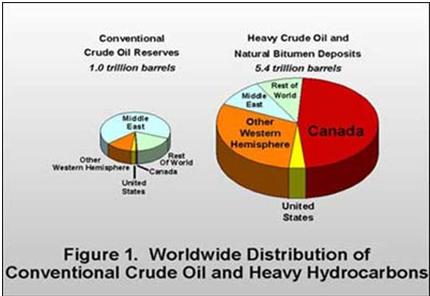
Yet only a few junior and intermediate producers focus on cold flow heavy oil. I think that will change.
Like liquid rich or wet gas stocks I wrote about earlier this month, this sector of the energy market is not well understood or recognized by retail investors. But unlike those stocks, heavy oil stocks are not unloved. The analysts and funds have discovered their high profitability, and these stocks are rarely cheap on a valuation basis. But they do get rewarded quickly for their growth.
As well, new technology is continually lowering costs and increasing profit margins; even a small per barrel savings will leverage into huge profits because of the colossal size of these deposits.
Investors will see many new opportunities for profit for many years as this massive Canadian resource gets developed.
My subscribers just received a 12 page report detailing the opportunity, along with three junior producers who are growing their profitable heavy oil production quickly. You can subscribe HERE
About the Author
Hello, this is Keith Schaefer, editor and publisher of The Oil & Gas Investments Bulletin. I started my subscription service in mid-2009 because I could see there was no place where retail investors could go to easily find which oil and gas companies were creating huge shareholder wealth by using exciting new technologies, such as horizontal drilling, fracing and 3D seismic.
These companies are increasing cash flows – and stock prices – by finding ways to get more oil and gas out of the ground. And junior and intermediate producers – $2-$20 stocks – are leading the way.
I find the leaders in the new plays that are using these technologies. My research is finding higher and higher flow rates from new wells in old formations as management teams fine tune their use of these new technologies.
It’s amazing how technology is lowering operating costs – and increasing profits – for many publicly traded energy companies.
I find the ones who have the capital and the knowledge to be the fastest growing in their area – this usually means they have a large undeveloped land position in an area where either production costs are very low or production rates can be very high. They are covered by several research analysts, so there is research support and institutional money flow behind them.
And my subscribers and myself are making money from my research. I eat my own cooking and buy all the stocks I research for subscribers.
- Golden Idea #1: Gold Bullion ETFs
- Golden Idea #2: Gold Mining ETFs
- Golden Idea #3: Leveraged Gold ETFs
Golden Idea #1: Gold Bullion ETFs
This category of ETFs is directly tied to the gold price. You put your money into the fund and the manager uses it to buy gold bullion, which is then stored in a vault.
The first such ETF was SPDR Gold Shares (GLD), which came out in late 2004. This was the first time U.S. investors had access to gold in this way, and GLD was an instant success. A few months later iShares jumped in with the very similar iShares Comex Gold Trust (IAU).
Thanks to being first — and maybe because of a more memorable ticker symbol — GLD is today far larger than IAU. Both are huge, liquid ETFs and have achieved their objective of closely tracking the daily changes in gold prices.
Some people dislike the idea of an intermediary coming between them and their gold, or they wonder if the gold is really there. If this describes you, then my answer is simple: Don’t buy a gold ETF. Buy your own gold coins or bars, and store them in a place you think will be safe.
A new ETF, however, tries to address some of these concerns …
ETFS Physical Swiss Gold Shares (SGOL) came out back in September 2009. This fund works very much like GLD and IAU. The main difference is that the gold is stored in bank vaults in Switzerland. GLD and IAU store their gold in London and New York.
So if having your gold in Switzerland makes you feel better, then you might prefer SGOL over the two larger alternatives. And you wouldn’t be alone! The sponsors of SGOL appear to have tapped into a niche market, having attracted about $500 million and decent trading volume.
Another way to take advantage of a gold bull market is through gold mining stocks …
Golden Idea #2: Gold Mining ETFs
The companies that explore, develop and operate gold mines are highly leveraged to gold prices. This is because their operating costs are largely fixed. Once you’ve located the gold deposit and built the facilities to extract it, almost every additional dollar you get for it goes straight to the bottom line.
There is a problem with gold stocks, though: They are still stocks. This means they respond not only to the gold market but to the stock market as well. When stocks enter a downtrend, gold stocks often fall right along with everything else.
Does this mean gold stocks are a bad idea? No, not at all. It just means they are a different kind of investment in gold. They can be a great idea if you know what to expect.
Unfortunately, you might not get any gold stocks by simply buying an ETF that represents “mining” or “materials” or “natural resources.” In most cases, these funds will have little or no gold company exposure. They tend to be more involved in base metals, steel, coal, and other such things.
If you want an ETF that focuses purely on gold mining stocks, here are three you can consider:
- Market Vectors Junior Gold Miners (GDXJ)
- Market Vectors Gold Miners (GDX)
- PowerShares Global Gold & Precious Metals (PSAU)
As the names suggest, GDXJ concentrates on smaller gold mining companies while its big brother GDX owns the major large-cap gold stocks. Both can be a good choice. PSAU has performed well but is lightly traded.
Golden Idea #3: Leveraged Gold ETFs
If you want to get really aggressive, there are ETFs that offer leveraged exposure to gold. Leverage is a two-sided sword — it gives you magnified gains on the upside and magnified losses on the downside. Additionally, the daily reset of the leverage on these funds means that long-term performance will not be an exact multiple of gold prices.
If you understand how leverage works and are prepared to manage the risk, then here are two ideas to consider:
- PowerShares DB Gold Double Long ETN (DGP)
- ProShares Ultra Gold (UGL)
Both products provide 200 percent exposure to the daily moves in gold and gold futures. DGP has slightly better performance while UGL is structured as an ETF and does not have the exchange-traded note (ETN) unsecured debt structure of DGP.
Are you ready to be a gold bug? If so, this week I’ve given you three golden ideas how!
Best wishes,
Ron
Ron Rowland is president and a founder of Capital Cities Asset Management. Mr. Rowland is widely regarded as a leading ETF and mutual fund advisor as well as a sector rotation strategist. In addition to his roles of President and Chief Investment Officer of CCAM, he is Executive Editor and Publisher of the All Star Fund Trader, a highly regarded investment newsletter in its 18th year of publication.
This investment news is brought to you by Money and Markets. Money and Markets is a free daily investment newsletter from Martin D. Weiss and Weiss Research analysts offering the latest investing news and financial insights for the stock market, including tips and advice on investing in gold, energy and oil. Dr. Weiss is a leader in the fields of investing, interest rates, financial safety and economic forecasting. To view archives or subscribe, visit http://www.moneyandmarkets.com.
Commentary below from TIMER DIGEST’s #1 Intermediate Market Timer for the 10 year period ending in 2007 – Mark Leibovit

STOCKS – ACTION ALERT
The market fell sharply yesterday at exactly 10 a.m. after an extremely weak new home sales report with the Dow down 66.28 at its worse level. The market recovered those losses, then rallied to its highest level after the Fed left interest rates unchanged, with the Dow up 74.52 at its best level. The market finally closed little changed in a day of back-and-forth trading. The Dow gained 4.92 to close at 10298.44, but the S&P fell 3.27 to 1092.04 and the NASDAQ declined 7.57 to 2254.23. Breadth was negative on both exchanges and volume was up slightly, but still at low levels.
So how did the market finish little changed yesterday in the face of record low new home sales and a bleak outlook from the Fed (see economic news section below)? Cheap money!!! The Fed also noted that inflation is of little concern and interest rates fell. Easy money and low interest rates certainly helps the consumer and Consumer Staples rose (XLP +0.65%) while Consumer Discretionary (XLY -0.06%) fell only slightly.
A number of indexes (Russell 2000, S&P 400, NASDAQ Comp) found support at their 200 day moving averages. But the more closely followed indexes (S&P 500 and Dow Industrials) are already below their 200 day moving averages. Another thing to watch on the charts: the 50-day moving averages are quickly approaching their 200-day moving average. This negative crossover is considered very bearish by many technical analysts. It has lost some strength recently because everybody sees the crossover long before it occurs, but that just leads many to front run the signal.
Despite all the negatives, both economically and technically, and you know I am bearish here, I must admit that yesterday’s flat trading amid all the negative news was quite impressive. I suspect it is just a short term delusion, but I am on the sidelines for now. Remember, we were short for Tuesday’s big decline and ready to go short again if the situation presents itself. For weeks we’ve been playing the short side only. Yes, we missed some rallies, but we were smart enough to close out our positions before each of those rallies. We’ve also been sitting on the sidelines for most of the days where the market does nothing. However, we’ve caught just about every down move recently and, as you’ll see in the portfolio section, we have a long string of winners dating back to May.
Looking at the S&P 500, we have defined a broad (nearly 100 point) range between 1042 and 1131. My guess is that a breakout or breakdown on either side of this range will define the near-term market between now and the next critical cyclical time period in mid to late August. Afterwards, regardless, in my opinion, we’re headed south, possibly BIG TIME! Could we take ut 1131 and trade higher first? Sure, we could. We have an election in the fall and the Plunge Protection Team could be busily at work trying to goose up this market first. We generally don’t see market crashes during the summer barring some external negative trigger.
The play is to to short big rallies when a top is confirmed and to buy following the next big crash. In the interim if I see a long trade confirmed by volume, I will consider taking it. As you know, I try to catch the swings when I can WHEN THEY CONFIRMED WITH VOLUME. If they are not, I will pass.
For a trial Subscription of VR Platinum Newsletter covering Stocks, Bonds, Gold, US Dollar, Oil CLICK HERE
Key News
- Exports to fast-growing Asia including China, which accounts for more than half of Japan’s total shipments, rose 34.4 percent from a year earlier, slowing for the fourth consecutive month after they jumped a record 68.3 percent in January (Reuters)
- South Africa’s rand weakened over 1.2 percent against the dollar on Thursday, some of the losses coming after official data showed the current account deficit widened in the first quarter of this year. (Reuters)
- The World Bank on Wednesday urged the Group of 20 major economies to agree on steps to safeguard the global recovery warning that setbacks will further strain resources in poorer countries. (Reuters)
Quotable
“Whether it’s the late twenties or two thousand and five
Booming bad investments, seems like they’d thrive
You must save to invest, don’t use the printing press
Or a bust will surely follow, an economy depressed
“Your so-called “stimulus” will make things even worse
It’s just more of the same, more incentives perversed
And that credit crunch ain’t a liquidity trap
Just a broke banking system, I’m done, that’s a wrap.”
F.A. Hayek, Fear the Boom and Bust
FX Trading – Crying Wolf: The F-Word is Like a Prescription Drug.
Martin Wolf of the Financial Times recently referenced a paper that made the case that fiscal contraction will actually stoke consumer confidence and induce consumer spending that is necessary towards achieving a healthy recovery. Cut spending and taxes, so the argument goes.
That’s a very interesting idea. Wolf went on to propose some reasons, however, that that idea won’t work in this environment. Perhaps the main reason: consumers are still in deleveraging mode, unwilling to spend much. Duly noted.
And that reason alone might be enough to justify sustained fiscal spending … at least for the fiscal spenders among us. In which case we’re still right smack where Jack mentioned yesterday: “Keynesian money pumping isn’t working! (Unfortunately given the pathetic state of politics here and everywhere, we will never get a real test of just “letting the market cleanse itself” which requires government getting out of the way.)”
No – spending is the way to go; tax cuts are not. Get that in your head. We’ll never (completely) know just how unnecessary and unproductive fiscal spending may be; and we’ll never (completely) know just how much more effective substantial tax cuts may be at fortifying and stimulating US consumers and investors.
Government spending is like a prescription drug – it aims to solve short-term illnesses while the rest of the body recovers. But just like so many drugs out there today, they slowly do long-term harm to your body in some way, shape or form even if they appear to cure you in the here and now.
The long-term harm is starting to show up on the charts. Paging doctor Hayek.
The Federal Reserve yesterday made no changes to interest rates but did sound off a sobering note regarding the US economic recovery. Among all the analysis was a brief mention of inflation, which they noted as trending lower. This is likely one of their larger concerns as it seems the Fed is scared of any face-off with deflation.
The Fed’s easy monetary policy goes hand-in-hand with the inclination towards fiscal spending. And it’s a combination that may make their worst nightmare come true: Japan.
They’re afraid of falling into Japanese-style, decade-long deflation. But what they fail to recognize is that they’re grabbing on to a similar strategy that didn’t help Japan skirt deflation.
The natural prescription, assuming a free-market stance, is to find an appropriate level for interest rates and let the public and private sectors deleverage until the malinvestments wither away and savings build. At which point the incentives to invest and spend will be less perverse, if not sensible.
Going back to Martin Wolf again, my emphasis:
“Premature fiscal tightening is, warns experience, as big a danger as delayed tightening would be. There are no certainties here. The world economy – or at least that of the advanced countries – remains disturbingly fragile. Only those who believe the economy is a morality play, in which those they deem wicked should suffer punishment, would enjoy that painful result.”
Mr. Wolf, you’ve got a career of bigger and better things ahead of you. Typically spin like that is reserved for corrupt bureaucracies.
The economy is a morality play; everything is a morality play. But your qualifier is backwards, twisted. Those moral types don’t deem anyone wicked, and they do not wish punishment on anyone who is not deserving of punishment. Yes, it would be a painful result that surely is not enjoyable, despite being the best option. Spreading the pain around, however, makes everyone suffer punishment, even those who do not deserve it.
Austerity is the word in Europe; and it is likely going to create some additional struggles before problems become solved. Based on the social mood over there, much of the area’s citizens appear frightened and unwilling to accept austerity.
The mood is a bit different in the US, where citizens seem fully ready to accept austerity, to have the government stop spending, to have their hard-earned money stay their hard- earned money. It may take a couple years of high unemployment, but maintaining the American spirit and economic prosperity over the long-haul is worth it.
John Ross Crooks III
Black Swan Capital
www.blackswantrading.com
-
I know Mike is a very solid investor and respect his opinions very much. So if he says pay attention to this or that - I will.
~ Dale G.
-
I've started managing my own investments so view Michael's site as a one-stop shop from which to get information and perspectives.
~ Dave E.
-
Michael offers easy reading, honest, common sense information that anyone can use in a practical manner.
~ der_al.
-
A sane voice in a scrambled investment world.
~ Ed R.
Inside Edge Pro Contributors

Greg Weldon

Josef Schachter

Tyler Bollhorn

Ryan Irvine

Paul Beattie

Martin Straith

Patrick Ceresna

Mark Leibovit

James Thorne

Victor Adair