
Daily Updates
Attention Shoppers: There are some amazing values currently available at bargain prices in the energy department. That’s pretty much what Chen Lin told us in this exclusive interviewThe Energy Report. The current level of risk aversion by most investors has left the doors wide open for those who are willing to see real values and major potential in oil and gas producers.
The Energy Report: You last spoke with us in early June. What has transpired in the oil and gas markets since, and has it altered your investment thesis?
Chen Lin: The oil price has been going up and down because a lot of traders are mispositioned and are scrambling around. That makes the market very volatile. However, WTI is around $100 again, which is quite surprising because we are still in the middle of a recession. World oil demand is still there, and whenever there’s a drop in the oil price there’s a lot of buying. I’m quite surprised that oil is still around the $100 mark. Personally, I would like to see it in the $80 to $90 range. That’s actually good for the oil consumers. If gasoline is below $3.00 that really helps the U.S. consumer.
TER: Domestic natural gas prices, on the other hand, have been in a continuous downtrend since June. It seems shale gas has created a glut. What’s your assessment of that situation?
CL: There’s so much natural gas being produced in the U.S. that we can’t consume it and, then there are no facilities to export it. The oil/natural gas price ratio may go up further. It really depends on how much gas is produced. If you want the market to really work you need to create more natural gas demand with export facilities or a policy to make cars run on natural gas. Then drivers can enjoy $1/gallon equivalent in gas. That would be a huge demand boost and would make natural gas prices go higher. Without those on the horizon, the natural gas price may come down further.
TER: So, what do you think would happen to the oil market if the Eurozone situation deteriorates further?
CL: It would be negative for the oil market; that’s for sure. Globally, investors must take into account the demand disruption in Europe versus the demand increase in developing countries, which is still an ongoing trend. If there is a depression in Europe, of course oil will go down, probably as far as it did in 2008. If Europe can avoid a depression, we may see an even higher oil price.
TER: How has your energy stock portfolio performed since we spoke in June?
CL: Last June, I was in the process of reducing energy stocks because of the European crisis threat. In the past few weeks, I started to increase oil exposure substantially because there are a lot of very cheap energy stocks. You can buy your oil stocks for pennies on the dollar. Also, energy stocks, even though they are very capital intensive, are not as capital dependent as mining stocks. Energy companies can drill a well and then pump the oil and sell it. Then they can use the capital to finance the next well, whereas mining companies need to keep raising money to maintain production. That is why I like oil producers. With $70 -$80 oil, they can make good money, and $100 oil is really great money. They will have a lot of capital to deploy and enjoy a lot of cash flow.
TER: You get a pretty immediate payout and don’t have to sit around for years waiting for approvals and licenses and building. So, there’s definitely that advantage.
CL: Exactly.
TER: In June you mentioned that your biggest holding, at that point was Mart Resources Inc. (MMT:TSX.V). Is that still the case? What’s been going on with the company since then?
CL: That’s still the case. I’m holding a lot of Mart Resources. During the summer when the market turned south, I was still holding the stock because I really believe in this project. I heard the company was making presentations at conferences where it was talking about the potential for very large dividend payouts, starting next year. Right now it’s trading about one times after-tax cash flow, according to the management. So, it can basically pay out any dividend it wants. It will probably start low—maybe $0.05 or $0.10. A $0.10 dividend is almost a 20% yield at the current share price. Then it will start going higher because it is going to accumulate so much cash from its oil drilling program. Every well in this year’s drilling program is a successful well—every well! I think two are around 10,000 bpd. One is 6,000–7,000 bpd. In North America, if you have 600 or 700 barrels, it’s a very good well. These are much bigger. So, Mart is just waiting to reach a deal with the pipeline company so it can start pumping more oil out. It’s supposed to be very soon. Once it reaches that stage, it will be cash-flowing at one times market cap. That will be a huge catalyst. Plus, the dividend payout will be another big catalyst. I’m looking for a much higher stock price.
TER: This is Umusadege Field in Nigeria you’re talking about, is that right?
CL: Right. Mart just found an amazing amount of oil. Its well production in the past 2–2 ½ years has shown no decline. In North America, after a month or two it could drop in half, like in the Bakken. The steady production means the company is sitting on a much larger pool than people can imagine. The next catalyst will be its reserve calculation. With all the production it’s had and all the successful drilling, this year’s reserve will be much higher than last year’s. With last year’s reserve, if I remember correctly, the 3P net asset value (NAV) of 2010 is way over $1.00 per share. This year it could easily double that, maybe even more. Meanwhile the stock is still at $0.64. That tells you how much upside it has just from the NAV. Then you can look at it from cash-flow side and the dividend side and you can see that the stock is very, very undervalued.
TER: So, what’s the market cap for the company at this point?
CL: I think it’s about $200 million (M) and they will probably cash-flow more than $200M.
TER: Boy, that is a real bargain, isn’t it?
CL: I’ve been holding this as my largest position because I feel so compelled. It’s been undervalued for a long time. Partly it’s because the market was very bad this year. Nobody really paid attention. In the meantime, the company has had one drilling success after another. Not just successful but very successful. The market has shown no response to that. But the company can immediately sell the oil and get into cash-flow. So, if the market doesn’t respond now, it will respond later. That’s why I was holding it as my largest position throughout the turmoil this year.
TER: Do you think is the project’s location in Nigeria might make some investors wary?
CL: That could be the case. The Nigeria situation is a little bit volatile. But, again, this is an OPEC nation and Mart exports through its standard pipeline. It has some interruptions from time to time, but management has already factored that into its cash-flow calculations.
TER: What do you think the chances are that the company will get bought out by a major with this kind of production?
CL: It could be. There was another Nigerian company that was bought out by a Chinese company for $7 billion (B) last year. Mart will likely be producing at that level in a year or so. Right now it only has a $200M market cap. So, you can see the upside is huge. Furthermore, the company does not need to come to the market to raise money. That’s why it’s in an ideal situation and why I like it.
TER: Another one that you were quite positive on last time was Harvest Natural Resources (HNR:NYSE). You said that you thought that it might be up for sale. What has transpired with that one?
CL: Its Venezuelan project is still for sale. That project is actually generating very nice cash flow. The company has about $3–$4.00 cash on its balance sheet. So, it’s pretty well cashed up. It is producing oil from its oil field in Venezuela and it is paying dividends. It uses the money to drill wells elsewhere. The stock had a little bit of a setback when the company hit a well in Indonesia and the first part of the well was not as good as people expected. But it hit a very good well off of Gabon in Africa and then it will drill another well in Oman. Plus, it is continuing to drill in Indonesia. So, it has a lot of excitement coming. The company is still trying to find a buyer for its Venezuelan asset and probably a Chinese or Russian company that is closer to the government that might buy it.
TER: So, the upside still looks pretty good for that one as far as you’re concerned.
CL: Yes, the upside is big. It’s just that the market has not put all the pieces together yet and calculated how much the company’s assets are potentially worth.
TER: Maybe that’s because Harvest is spread out geographically and people have a hard time understanding it versus if it were all in one country or one location.
CL: Exactly. That’s also a big issue.
TER: Another one you talked about last time was Porto Energy Corp. (PEC:TSX.V). It had a new gas discovery in Portugal. At that point, the value of that was much greater than the price of its stock. What’s going on with that one and where do you think it is going?
CL: Right now the market is so afraid of risk that investors seem to be getting rid of any company that’s associated with risk. Porto is a perfect example. It already has a natural gas discovery and is trying to expand and bring that into production. The natural gas pipeline runs through its property. The company was IPO-ed earlier this year at $1/share. Right now it’s about $0.25. It’s getting close to the cash it has on hand and it can generate immediate cash-flow. The Portuguese government is extremely supportive of what the company is doing because the nation wants the tax revenue and the jobs. Portugal’s government is trying to help Porto anyway it can so production can come online.
TER: So that one is definitely undervalued, compared to where it was in June, with a lot more upside potential.
CL: Exactly. There are a lot of companies, both in energy and in mining, that have been hit hard. If you are willing invest with a little bit of risk appetite, you can find a lot of very undervalued stocks that can go up very significantly once the market stabilizes. I’m still trying to stay with companies that have strong cash flow, and good balance sheets so that they don’t need to come to the market to raise money. That can help you weather the storm.
TER: Are there any other companies that you might want to mention at this point?
CL: I’ve been taking a position in quite a few energy companies, some quite aggressively. One is Pan Orient Energy Corp. (POE:TSX.V). I had the stock before. It’s at $2 recently from $6 earlier this year. The company raised money at more than $6 earlier this year, so it has a very strong balance sheet with about $1/share on its balance sheet. It drilled two wells in Indonesia. One was a failure. The second one was non-conclusive. The company couldn’t finish it. So, it stopped and tried to find another driller. It will start drilling, I believe, this month. In the meantime, the market hit the stock hard. Pan Orient has a producing oil field in Thailand, which is producing a lot of cashflow (It is trading at about 2 times cashflow). It also has an oil sand property in Canada. In addition, it will be drilling this big potential well in Indonesia. Can the stock go lower? It’s possible. But, I feel it’s so undervalued that I started buying it quite aggressively.
Another stock I bought quite aggressively recently is PBN, PetroBakken Energy Ltd. (PBN:TSX). It is paying a 10% dividend right now and the stock is less than $10.00. You get a monthly $0.08 per share dividend. The stock was hit very, very hard because it missed its earning guidance in the past few quarters. In addition, it has a sizeable debt. So investors are worried about that, which has caused rounds of selloffs. It sold down to where it was paying a 15% dividend. So, I picked it up not long ago at a slightly lower price. It had very good production in the recent quarter and seems to have hit its targets. Management has indicated it has no problem paying all the dividends as long as the oil price doesn’t crash. So, basically you’re getting paid a 10% dividend while you wait for the stock to appreciate, which it is.
TER: How do you think energy investors should plan for the coming year, given the turmoil in Europe, the world and domestic economic situations and the 2012 elections?
CL: I’m just looking at global production, supply and demand. Investors should know that India has no strategic oil reserves and it is a very important oil user right now. China is still expanding and building its strategic oil reserves. Last time I checked, China’s oil reserves can last only one-third as long as U.S. reserves. China will likely fill up more of its tanks on any dip in the oil price. There should be good demand for oil in the current market unless we have a complete breakdown of the euro.
On the investment side, I like to invest in land-based oil producers because sea-based oil production has high capital requirements. I also prefer oil producers versus natural gas producers in North America because these kinds of companies tend to perform better in this market.
TER: Do you expect the year-end tax loss selling season to present some good buying opportunities?
CL: Oh, yes, absolutely. For example, on Pan Orient, one of my plans was to wait until tax-loss selling in December to buy, but in November it already dropped to below $2.00. I said, “Okay, let’s buy it right now, right here.” There could be more tax-loss selling coming, but these are very good opportunities to buy—especially companies with very strong balance sheets and good cash flow, which don’t need to raise money. The dip will, most likely, be temporary and there will be very good buying opportunities for a lot of these stocks.
TER: So, we’ve got another few weeks to pick up some bargains before the end of the year.
CL: Yes. I do want to mention that, generally, the oil market bottoms in the winter and then goes up in spring all the way to summer. So, we’re coming to a very strong part of the seasonal oil price cycle.
TER: That’s a great suggestion. Thanks for taking the time to talk to us today.
CL: Thank you for the opportunity.
Chen Lin writes the popular stock newsletter What Is Chen Buying? What Is Chen Selling?, published and distributed by Taylor Hard Money Advisors, Inc. While a doctoral candidate in aeronautical engineering at Princeton, Chen found his investment strategies were so profitable that he put his Ph.D. on the back burner. He employs a value-oriented approach and often demonstrates excellent market timing due to his exceptional technical analysis.
Want to read more exclusive Energy Report interviews like this? Sign up for our free e-newsletter, and you’ll learn when new articles have been published. To see a list of recent interviews with industry analysts and commentators, visit our Exclusive Interviews page.
DISCLOSURE:
1) Zig Lambo of The Energy Report conducted and edited this interview. He, personally and/or his family, own shares of the following companies mentioned in this interview: None.
2) The following companies mentioned are sponsors of The Energy Report: Mart Resources Inc.
3) Chen Lin: I personally and/or my family own shares of the following companies mentioned in this interview : Every stock. I personally and/or my family am paid by the following companies mentioned in this interview: None. In early 2010, when Porto Energy was a private company, Chen Lin received shares from the company to introduce it to hedge funds.
1. We have written much recently on the dichotomy between the economic futures of the Western and Emerging worlds. In truth, nobody can reliably predict the outcome in the Euro Zone, for instance, but we think one thing will remain constant throughout the world – the need for access to reliable and affordable electricity.
The future “mix” of energy will no doubt take many forms and not be dominated by one source. Coal has been a reliable generator of electricity for decades due to a number of factors including its energy density and ubiquity in the earth’s crust.
2. During a recent trip to Europe with Zimtu Capital to meet with institutional investors, Chris sat down with freelance journalist Lars Schall with Matterhorn Asset Management to discuss a wide range of topics including the future for gold and silver, the state of the rare earth space, his bullishness on potash, as well as a number of thoughts on various geopolitical topics. Coal:
With that in mind, we offer our latest research report on an emerging coal exploration story in an emerging part of the world: Challenger Deep Resources (CDE:TSXV).
CDE is focused on exploration of high quality thermal coal in Indonesia for export to other Asian countries and Management has demonstrated the ability to achieve success with this business model by putting together coal resources in other parts of the world (Mongolia).
The report can be viewed here: http://house-mountain.com/wp-content/uploads/downloads/2011/12/CDE-Research-Report.pdf
The interview with Lars Schall with Matterhorn Asset Management
can be found here:
Amid a chorus of gold mining pundits yelling for investors to snap up cheap gold equities is Ian McAvity, a 50-year veteran of the markets, telling investors to wait. In this exclusive interview with The Gold Report,McAvity, who produces Deliberations on World Markets, explains why historical cycles lead him to believe the market is in for some new lows and what that means for the gold price and the juniors seeking out that shiny metal.
The Gold Report: Ian, you have been involved in the markets for 50 years. How much of today’s market is a repeat of a cycle you’ve seen before and how much is unique?
Ian McAvity: Cyclical and secular trends haven’t really changed, but each one has slightly different characteristics. From 1982 to 2000, there was a powerful secular uptrend in the S&P 500. Since 2000, there’s been a secular bear trend, sideways or downtrend not dissimilar to 1966–1982 or 1932–1949 that may run through 2016 or 2018.
The big change has been the utter corruption of Wall Street and that nearly 80% of the trading on the New York Stock Exchange now is being done by high-velocity computers. When an investor puts in an order, it’s basically one computer versus another computer operating in nanoseconds. That’s why all of a sudden the volume is up or down 10 to 1 and you get a couple of hundred points added on or taken off the Dow in minutes. To me that’s a corruption of the process. “Ethics” and “Wall Street” are words you never use in the same sentence.
The trading mechanism is broken down. Leveraged exchange-traded funds (ETFs) are designed to consume the client’s capital in leveraging and rebalancing premiums. The high velocity traders literally get the opportunity to “front-run” public orders as the order flow to “the market” is available to them for a fee. It’s outrageous in the sense that they’ve legalized front running for those who pay up for the high-speed data feed. And then there’s the initial public offering (IPO) business. Anytime the public can get shares in an IPO, they don’t want it. If they can get some, it’s only because it’s not going to be that good a deal.
TGR: Is it the corruption of Wall Street or the development of Wall Street through technology?
IMcA: It’s the culture of greed coming out of the banking system. The Street always wanted to make money. That’s never gone away. But there was a time when good clients were actually respected by a firm. A firm wanted to do well for a good client because it wanted to keep the family assets in the firm. These days a client is considered to be a mark. The system is designed to convert the client’s capital into their fees and income as quickly as possible. The public is being chased out. There have been persistent outflows from domestic equity mutual funds since 2007. A lot of people justifiably don’t trust it.
TGR: Or perhaps the public just doesn’t have the tools and the speed to become an influential member of the market?
IMcA: Let me give you an example. The average daily turnover for one gold mining junior ETF is $100 million (M). Probably $80M is day trading where there is no net investment. To call moment-by-moment trading “investment” to me is a sacrilege. There’s no way that people are making a rational investment decision in that sense. I’d rather go to Vegas where they’ve got pretty girls serving you a drink while you gamble.
TGR: Aren’t day traders just playing nagainst each other? Someone bets it goes up. Someone else bets it goes down. They wait a very short period. Ultimately, it just evens out.
IMcA: In theory it works itself out, but it creates an illusion of growth that distorts trends because it injects volatility. The majority of the billions of dollars that are trading every day is intraday noise. All the computers scalping each other for as little as a tenth of a cent.
TGR: The market was up the other day in reaction to the debt plan that came out of Europe. Is this a real increase or just more intraday noise?
IMcA: One batch of traders shorted at the opening burst, but that afternoon it didn’t sell back. All the guys that shorted in the morning got their clocks cleaned and had to cover in the afternoon. That’s why there was a second rush into the close. That trading activity is symptomatic of what’s wrong with this market. Markets are being driven by headlines. Plus, the headlines are being misinterpreted most of the time. At first, it appeared that Europe had a perfect solution for everything. Then, by the end of the day, we were discovering that there were a lot of details missing and it was unclear how many parliaments have to approve the plan. Every day there’s a leak of some unsubstantiated “plan” and later it’s denied but the cheerleaders at CNBC seem to take every wiggle as gospel.
TGR: Is it driven by headlines or the 24/7 news cycle?
IMcA: I wish the news cycle was as slow as 24/7. When people are trading on one-minute and five-minute charts, a 24/7 news cycle can’t keep up with it. It’s not healthy to have this much liquidity. What it reflects is that the bailout of the banks has flooded the system with liquidity, but none of that is trickling down to Main Street or out into the real world. It’s just sloshing around in the financial markets. The velocity of trading reflects that the system is swimming in liquidity and nobody is feeling sufficiently brave to take any risk home overnight. We’ll churn the daylights out of it, but flatten the position before lunch or the close.
TGR: How does an individual investor operate in this environment?
IMcA: Basically hide. A number of people have told me that they’ve become day traders and I ask them how they’re doing and they say, “Well, I’m not quite there yet. I know I can make money doing it.” I tell them not to blow all of their capital while they try to learn. It’s an exploitable game for somebody that has the self-discipline. But it requires a degree of self-discipline that 90% of the people that try it will never acquire.
TGR: At The New Orleans Investment Conference where you spoke in late October, many speakers talked about how junior gold stocks are essentially on sale, inferring that this is the time to buy. Should investors run and hide from a corrupt and frothy market, or go out and buy?
IMcA: You’ve got to watch the inter-market relationships. The gold stocks have been very poor performers relative to the gold price. In the last 12 months, the junior gold stocks have been particularly bad even relative to the senior gold stocks. That is creating an undervalued situation. But undervalued doesn’t mean go out and buy it tomorrow morning. Yes, there was a marvelous October rally after five down months in the S&P. However, I believe that the S&P is going to go back down and at least probe the last lows, if not break them by year end or March. The junior gold mining shares will test their recent lows and then start to show relative performance where they’re not falling as much as the stock market. I’m watching for that type of relative strength and that’s when I would be looking to buy them. I wouldn’t be surprised if the gold price came back down to $1,650 an ounce (oz) as well.
I’m looking for a point where I want to buy, where for several months I was saying I wouldn’t even think about it. A lot of the excesses have been wound out, but the best buying opportunity still lies ahead. Year-end tax loss selling and a sharp down turn in the S&P where everyone is looking for a year-end rally could provide a great buying opportunity for the juniors soon.
TGR: You’re a technical analyst who relies on a lot of charts. What are you seeing in charts that make you believe that the S&P is going to pull back to its lows?
IMcA: I’m basing that on cyclical analysis within secular trends of the Dow Jones Industrial Average. I believe the top this year goes back to February as the cyclical top of the rebound off the 2009 lows, while the S&P made its actual peak in May. On a secular basis, I view this as the second half of the bear market that started in 2007. The first half of the financial bubble was undone from 2007 to 2009. The second half will run through 2012. There could also be a final low that may be as far out as 2016.
The undoing of the debt bubble over the last three decades is not a short-term affair. It’s going to take a long time to work off. The housing market has not seen its bottom. Job numbers are going to get worse. Everything that they are doing in Washington just says that they are looking for new ways to screw it up.
TGR: You’re expecting a double-dip recession.
IMcA: It will be called a double-dip only because they’ve engineered what appeared to be a recovery, but there hasn’t really been a recovery that restored many lost jobs or did much more than temporarily slow the pace of decline in the housing market. All of the money and the liquidity that they threw into the market tweaked a few of the numbers in the gross domestic product to create the appearance of a recovery, but barely a penny of it ever got to Main Street.
TGR: Main Street is starting to spend a bit more.
IMcA: That’s like saying there is a housing recovery because housing starts went up from 420,000 to 425,000. Housing starts used to be 1 million.
TGR: When will the economy get through this mess and start on a real recovery?
IMcA: It’s going to take several years. It might start to show some signs of recovery in 2013 or 2014, or perhaps as late as 2016.
If the S&P is below 1,258 on Dec. 31, 2011, it will be the first down pre-election year since 1939. Election years don’t have as bullish a record as pre-election years. But how much fun has this year been so far? The market’s going to find a bottom for bear market rally bounces. Ned Davis Research Group created a model that I’ve modified that projects a decline in the Dow to a prospective cyclical bottom between 8,200 and 8,400 in August or September 2012 if we experience only an “average” bear market. I fear that it could be a lot worse than “average” given the geopolitical uncertainties as a backdrop.
TGR: Wow, that’s a claim.
IMcA: It’s interesting to see a cyclical decline projected through an election year. It’s not unprecedented, but it’s quite unusual.
TGR: You said earlier that you expect the gold price to pull back again. Do you expect it to pull back below its 200-day moving average?
IMcA: No. The market has come back and tested the $1,600/oz level twice. The last bounce off the $1,600/oz level was pretty credible. I’d be surprised if $1,600/oz is broken now.
TGR: You don’t believe that gold is a bubble then?
IMcA: Whenever somebody talks about gold being in a bubble, I tell them to look at the credit and stock markets. If the gold price is at $1,900/oz, it’s 2.2 times the high in 1980. However, debt in the U.S. is 12 times its early 1980 level. The S&P is trading at 10 times its 1980 level. The credit market and the stock market are about five times ahead of the gold price. I don’t forecast that the gold price will reach five times its 1980 highs, but it might. If it gets there then you can start talking about a bubble.
TGR: Do you believe that gold will replace fiat currency?
IMcA: I don’t know that it will ever replace fiat currency. The leadership of the G13, China, Brazil, and India, are probably going to push the old world to go back to some sort of a central discipline, such as indexing to a basket of commodities. It’s too cumbersome in the modern world to return to a gold standard. But I can envision an international governing body being proposed to push for some discipline such as the Bretton Woods Agreement after World War Two.
TGR: What’s in the basket?
IMcA: Gold, silver, oil, copper and conventional food.
The problem is no central banker ever wants to surrender sovereignty to some other body. The U.S. government is always going to want to call all the shots. But the U.S. government isn’t what it once was. The rest of the world is increasingly going to communicate that message. At some stage, the world needs a globally accepted common denominator. China, Brazil, India and the G13 have nearly $7 trillion worth of the debt of the old world. There comes a point where the creditor will dictate the rules.
TGR: That’s how the U.S. got to the position it’s in.
IMcA: Exactly, exactly.
My biggest concern is increasing geopolitical risk for those that are exploring all over the world, the most recent example being the Argentinean government putting in a new set of rules. The same thing could happen in African countries. If the gold price gets much higher, the South African government will be talking about nationalizing. Too many of those countries will love you while you are bringing money in, but once cash flow begins to flow out, the politics of greed and envy takes over, typically under the guise of economic nationalism.
Politically stable jurisdictions are my preference. I am most attracted to seeking deposits in conventional mining districts in Canada or the U.S. where mining laws and practices are understood and respected. Even South Carolina is coming back again. I remember the previous go-around on it.
TGR: What happened then?
IMcA: It didn’t work out because the gold price went down, as best I recall.
TGR: Any other last thoughts you’d like to leave our readers?
IMcA: The big contrast with this gold cycle and that of the ’80s and ’90s is that we haven’t really seen a big discovery that excites the world. In that last cycle there were about a half-dozen companies built on new deposits that are already mined out and gone now. Names like Echo Bay, Hemlo, Amax Gold, FMC Gold, Pegasus and several others were launched and became the darlings of the last cycle, and they have already gone from the scene by the time gold got above $1,000/oz this time around.
At some stage somebody’s going to make a discovery that’s going to turn the lights on to get the speculative juices flowing, one good, exciting discovery in a prospective new camp. It looked like that might be taking place in the Yukon with the takeover of Underworld Resources Inc. (UNDWF:OTCQB). Will there be a sequel discovery up there? One solid drill hole can transform a junior explorer, but it does need to deliver follow-up success pretty quickly to build on it.
That’s the nature of the drilling beast and discovery cycles. Others will remind you what the odds are. It’s a very high-risk and capital intensive business. That’s why I’m more attracted to the companies that are in that process of creating value out of the ground as opposed to having the political experience of dealing with environmental permitting and other regulatory impediments to getting a new mine into production. My idea is if you can make a discovery then God bless you and let somebody else have those future political and bureaucratic joys for the right price.
TGR: Ian, thank you for your time.
Ian McAvity has been involved in the world of finance for more than 50 years as a banker, broker, independent advisor and consultant. He has produced his Deliberations on World Markets newsletter since 1972. He specializes in the technical analysis of international equity, foreign exchange and precious metals markets, and has been a featured speaker at investment conferences and technical analyst society gatherings in the U.S., Canada and Europe over the past 40 years.
Want to read more exclusive Gold Report interviews like this? Sign up for our free e-newsletter, and you’ll learn when new articles have been published. To see a list of recent interviews with industry analysts and commentators, visit our Exclusive Interviews page.
DISCLOSURE:
From time to time, Streetwise Reports LLC and its directors, officers, employees or members of their families, as well as persons interviewed for articles on the site, may have a long or short position in securities mentioned and may make purchases and/or sales of those securities in the open market or otherwise.
Michael Campbell wanted Greg Weldon to boil all the current turmoil down to its essence. What’s happening, and what to do about it. Greg’s delivered, which is why he is one of Michael’s favorite analysts. Here’s what he said:
1. The whole sovereign debt issue is dramatically ending the welfare state as we know it in the West.
2. Current times are more interesting, and circumstances in the market more frustrating than its ever been in his 30 years in the business. “It’s about as wild as it gets and it’s going to get wilder.”
3. The EU fiscal crisis is a global problem.The debt deficit debacle in Europe will effect everybody. 25 out of 27 EU nations are in violation of European rules on debt and deficits, the countries can’t bail each other out and the near term dynamic of these countries trying to roll over their debt puts all countries at risk. “They are competing with one another which is one of the things that puts the US at risk if we have to sell all this debt that we have.”
4. The differences between now and the 2008/2009 crisis is that things have intensified. The debt is now coming due and that is the reality we really didn’t face two years ago. With the competition for capital rates rise everywhere, and with the amount of debt we have to sell this is problematic in terms of crowding out the private sector and really putting the clamps down on the global economy
Action Items:
1. Borrowers: If you are a borrower, rates are going to rise everywhere, so fix your rates here while they are still pretty low.
2. Bonds: If you invest in interest bearing securities its much more difficult. “Right now protection is really the buzz word”. Rates are rising, “There doesn’t seem to be any place to hide there right now.”
3. Commodities: “Its almost dare I say kind of a perfect storm brewing here. So I mean we are short on commodities frankly.” “I see trouble in the next six months and I see a lot of opportunities on the short side of commodities and stocks and currencies.”
4. Safety: “It very difficult to try and find a place to be comfortable. I don’t see one right now, I really don’t.”
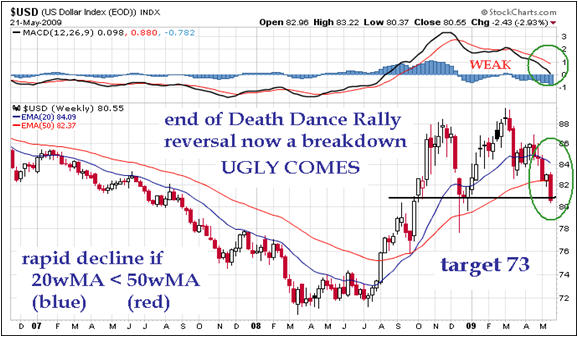
5. US Dollar: Playing the dollar up move to me is one of the more clear cut moves right here and in doing that I think it also allows investors take advantage of this broader scope. I mean if you are long the dollar its just like being short stocks, commodities, it’s the same trade so I think its a great idea, I like it. You know ETF’s allow individual investors to operate more like a commodity trading advisor; to be short, to be long, to be flexible. To have access to areas that they didn’t necessarily have access to before. The [UUP] is the dollar ETF, that’s certainly a good one in my opinion right here.
6. Gold: “I don’t like gold right here, I am short as a trader. I do look for a deeper correction in gold. I think gold has scoped down to the $1,300 zone. It’s a pretty significant decline yet that would only represent a 50% retracement of $1,192 move from the 2008 low. Without a central bank that’s pumping a trillion dollars or more on some kind of regular basis, it’s difficult to see where the inflation trend is going to be maintained and that applies to gold as well.
What’s really amazing Michael is I get calls, everyone wants to hear something bullish on gold. I think that that shows some people are becoming maybe a little too emotionally attached to this trade. They don’t want to give up the gold and they are out there groping, searching, dying, hoping for someone to tell something bullish and I think that’s a little troubling as well.
Weldon Financial Global Macro Research & Money Managent: produces global macro research for the sophisticated investor/trader and offers investment management solutions that capitalize on global market trends. Greg Weldon is the founder and sole producer of all the research and money management services.
Weldon’s Money Monitor offers a very unique, objective view of the global economic landscape from a top down macro-market and bottom up technical perspective. Greg also publishes The Metal Monitor and The ETF Playbook offering specific focus on the metals markets (Gold, Silver, etc.) and the world of Exchange Traded Funds, respectively. He has a creative and captivating writing style and his market calls are ‘spot on’ (sometimes early).
The Global Macro-Discretionary Program manages money for individuals, joint, trust, corporate and partnership accounts. Mr. Weldon approaches his investment selections from a top-down macro-perspective and then applies his quantitative discipline from the bottom-up to execute his methodology, seeking to produce an absolute return while focusing on risk management. This program invests in a diverse range of futures contracts across the commodity, currency, global stock index, and global fixed-income sectors.The Commodity Long-Short Program takes a more quantitative approach, using our proprietary trend-momentum indicators, and invests strictly in the strongest ‘bullish’ and ‘bearish’ commodities.
Weldon’s research products are explained in more detail in the Research section above including an invitation to sign up for a free trial for thirty days.
-
I know Mike is a very solid investor and respect his opinions very much. So if he says pay attention to this or that - I will.
~ Dale G.
-
I've started managing my own investments so view Michael's site as a one-stop shop from which to get information and perspectives.
~ Dave E.
-
Michael offers easy reading, honest, common sense information that anyone can use in a practical manner.
~ der_al.
-
A sane voice in a scrambled investment world.
~ Ed R.
Inside Edge Pro Contributors

Greg Weldon

Josef Schachter

Tyler Bollhorn

Ryan Irvine

Paul Beattie

Martin Straith

Patrick Ceresna

Mark Leibovit

James Thorne

Victor Adair