
Daily Updates
Let’s see if we understand yesterday’s earth-rumbling response to China’s 25 basis-point increase in a yuan lending rate. For starters, the dollar had its biggest one-day rally since August (which, to remind you, went nowhere; the dollar wafted slightly higher, then scuddled sideways for nearly a month before resuming its long-term bear market).
| Chris Mayer |
“I think we have a food crisis right now.”
– Hussein Allidina, head of commodities research, Morgan Stanley
The leaves have turned all shades of red and gold. The air is crisp and cool. The fall beers are tapped. The brats are on the grill. It’s autumn. That means it’s time to talk about the harvest, in particular for corn.
Corn was the big news in markets on Friday. What some called a “harvest shocker” sent corn up 6% on the day. The USDA cut its harvest projections by nearly 4%, which took the market by surprise. And that’s just one of the reasons why the corn price has soared to $5.30 a bushel from $3.30 a bushel last July.
The shares of most ag-based companies are responding in kind. Fertilizer stocks are soaring, for example, as are the shares of irrigation equipment companies like Lindsay (NYSE:LNN). By contrast, the market has been hammering the stocks of meat producers. Tyson Foods has been falling on the theory that higher prices for corn means higher feed prices to fatten up those chickens, cows, sheep and pigs.
By historical standards, the US corn harvest is still a mighty pile – 12.7 billion bushels. It’s the third largest ever. But demand is also near record levels. And that’s why supplies are still tight.
The USDA said that US corn held in reserve will fall 47%. This means the US will have the tightest reserves since the mid-’90s. However, the US also has a lot less idle farmland than it did then, which means it’s not going to be as easy to replenish lost reserves through US production.
Of course, there are spillover effects, too. This doesn’t affect just corn. Soybeans jumped nearly 7%, and wheat was up 9%. What affects one crop affects others. They all compete for arable land and the farmer’s investment dollar. If more farmers plant corn, that could mean fewer farmers plant soybeans.
Also, in the shadows lingers the possibility of another 2008 food crisis. Some think it’s already here. Some of the largest grain exporters, like Russia and the Ukraine, have imposed export restrictions. Meanwhile, many of the chronically large grain importers in the Middle East and North Africa are starting to hoard supplies. This drama resembles the one we saw in 2008.
So I think we’ll see a mega-corn planting for next year. That will be good for fertilizer and ag equipment stocks, as farmers load up on what they need. But from this point, the best-performing stocks might be the ones getting mauled today.
The old saw in the commodity pits reminds us that the cure for high prices is high prices. The market will bring us a lot of grain next year. My guess is that corn will be cheaper in the spring than it is today.
Meat prices will continue to rise, too, and are already climbing this year. Beef prices are already the highest in a quarter-century. In this scenario, the best plays would be the beaten-down Tyson Foods of the world that turn the world’s grain into meat.
In the meantime, it’s worth noting that agricultural commodities are not the only ones rising. Metals also helped the benchmark index for raw materials hit its highest level in two years on Friday. Tin hit an all-time high of $26,780 a tonne. Copper hit a two-year peak of $8,349.50 per tonne.
Beyond the industrial metals, precious metals are also soaring. Gold hit a new all-time high of $1,364.60 an ounce. All the big gold producers are closing their hedge books. Meaning, they think the price of gold will go higher. So rather than sell gold forward at today’s prices, they will take their chances. AngloGold Ashanti was the latest to do this.
On top of this, central banks around the world keep buying gold. Overseas, governments are actually encouraging their citizens to own gold. Most recently, the Vietnamese central bank said it was thinking about lifting a ban on gold imports, which has been in place since May 2008. The market took this as bullish, because Vietnam is one of Asia’s largest consumers of gold.
Silver is putting in 30-year highs.
When all these commodities start hitting their highs together, something greater is at work than just supply and demand issues.
As the FT notes: “Investors are pouring money into commodities as fear intensifies that competitive currency devaluations and quantitative easing – in effect, pumping money into the economy – by the world’s central banks will lead to the debasement of paper currencies and to runaway inflation.”
This is exactly it. Investors are not as dumb as they sometimes seem. They see the world’s governments fighting over currency issues. They see that the likely outcome is that these governments weaken their currencies. As one does it, the other weakens in response. Then the other weakens it more. And so on and so forth.
And before you know it, you need a $20 bill to buy a cup of coffee.
Commodities trade on world markets – at least the major ones do. Prices adjust to the fall in currencies. So as the dollar weakens, the price of gold or oil ought to rise in dollar terms, everything else being equal.
Companies that produce these commodities could do even better, because their costs – such as for labor – don’t rise as fast. When you get your annual raise – if you are a salaried worker – inflation may well have already chomped 10-15% of your purchasing power.
Also, commodity producers who have already spent the large dollars to get a project up and running will find they have a big advantage over new projects. Inflation will make new projects much more expensive by comparison. This also stimulates the merger and acquisition activity we’ve seen.
Management teams will sit in their backrooms and do the math on a white board. They will see that it is often cheaper these days to buy what they want in the stock market, rather than build it themselves. This is what BHP decided when it bid for PotashCorp; it’s what Robbins & Myers did when they decided to bid for T3. So my advice is to stay with tangible assets that won’t lose value as currencies depreciate.
For the last few years, I’ve been recommending the shares of tangible asset companies like PotashCorp and T3 to the subscribers of Mayer’s Special Situations. Most of these recommendations have performed very well. But I think there’s still a lot more investment success to be had by buying into the companies that feed and power the world.
Regards,
Chris Mayer,
for The Daily Reckoning
Joel’s Note: Did you catch Mr. Mayer’s newest presentation yet? Last week Chris released a video detailing how the spectacular crash of a nuclear-armed, American B-52 bomber over Greenland half a century ago has handed one tiny penny stock company the opportunity to deliver up to 2,000% profits. It’s a truly fascinating tale. If you haven’t yet given this presentation a listen, you can hear the entire story here. (Don’t forget to turn on your speakers.)
(Peter Schiff will be speaking at the MoneyTalks Precious Metals conference October 23rd)
Peter Schiff is known for his justified criticism of the Federal Reserve and the disastrous policies they’ve enacted which is the destroying the economic life of the United States and its citizens, and ultimately affects nations around the world.
Although he sees a disaster coming if they don’t change course, there are things people can do to protect themselves against the addictive Federal Reserve policy of printing money, which is another way of saying inflating.
Today they’ve attempted to change the name to quantitative easing to make it sound like they’re doing something different. But it’s the same thing.
While Schiff sees hope, he doesn’t think the government and the Federal Reserve will do the right thing, and they’re going to keep on inflating. Which means they’re going to print money to acquire bonds. It’s only a matter of how much they’re going to buy, not whether or not they’re going to do it.
The result of all this will be gold prices and many other commodity prices continuing to rise, the U.S. dollar continuing to collapse, and inflation in other areas soaring.
Schiff says the government will attempt to hide the amount of inflation they’re creating, but the ongoing rate of unemployment will force them to continue to print money

, which will eventually reveal the monster they’ve created, as they acquire an enormous amount of bonds with each round of quantitative easing.
Another possible scenario, says Schiff, is he sees the possibility of Treasury yields being held back by the Federal Reserve. At that time corporate and municipal bonds would probably surge, which could woo the Fed into acquiring them too. If that happens, in Schiff’s view, he sees the potential complete collapse of the U.S. dollar.
Probably the best hedge against all of this happening, or even part of it happening, is to hold gold.
Schiff says he believes gold and the Dow will eventually move to a 1-to-1 relationship. He has no idea what that number will be, but if the Dow were to move to 10,000, he sees gold moving to $10,000. If the Dow is at 3,000, he sees gold at $3,000 an ounce, etc.
According to Schiff, he sees a correlation between the bear markets of 1930s and the 1970s. In 1932 said Schiff, an ounce of gold equaled the value of the Dow. The same happened in 1980 after the bear market of the 1970s.
When the Dow shrinks in value, it tends to line up with the price of an ounce of gold.
If we end up entering into a period of hyperinflation, all bets are off there as far as the value of the dollar, which could lost almost all its value, according to Schiff.
Besides gold, Schiff likes the agricultural sector, energy, commodities in general, and China.
Everyone should own at least some gold says Schiff.
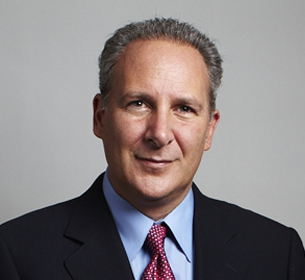
Peter Schiff: In his 2007 book, Crash Proof, Schiff writes that the current United States economic policies are fundamentally unsound, and predicts that in the future the United States dollar will lose much of its value.
Schiff feels that the imbalance between the amount of goods the U.S. consumes and what it produces will eventually lead to problems for the U.S. economy. As a remedy Schiff favors increased personal savings and production which he says will stimulate economic growth. Schiff cites the U.S.’s low personal savings rate as one of the causes of the its transformation from the world’s largest creditor nation in the 1970s to the largest debtor nation in the year 2000. Schiff attributes the low savings rate to higher inflation and the artificially low interest rates set by the Federal Reserve.
In a 2002 interview with Southland Today, Schiff predicted that the economic downturn triggered by the bursting of the stock market bubble would lead to a bear market likely to last “another 5 to 10 years.” In November 2002, US stocks began a bull market uptrend which held steady for at least five years, until reversing course in 2008, when the Dow, NASDAQ, and S&P 500 began a decline to less than half of their peak 2008 values, followed in 2009 by the Dow climbing 61% from its low point over the following year. After interviewing Schiff in 2009, journalist and finance author Eric Tyson, referenced various Schiff predictions during the 2000s and stated that “On all of these counts, Schiff wasn’t just wrong but ended up being hugely wrong.” Schiff later released a video stating that, “When I gave that interview in 2002, I had no way of knowing how irresponsible the Fed was going to be … But I recognized that early: back in 2003 and 2004 I changed my forecast … if you look at what happened to the Dow in terms of gold [and not U.S. dollars], my forecast was extremely accurate.”
In an August 2006 interview he said: “The United States economy is like the Titanic and I am here with the lifeboat trying to get people to leave the ship… I see a real financial crisis coming for the United States.” On December 31, 2006 in debate on Fox News, Schiff forecast that “what’s going to happen in 2007” is that “real estate prices are going to come crashing back down to Earth”.
As part of these exchanges on Fox News and his repeated appearances on financial news network CNBC, Schiff had mentioned factors such as speculators and “the absence of lending standards” which are now seen by many to indeed be contributing factors to the housing crisis of 2007-2009. On December 13, 2007 in a Bloomberg interview on the show Open Exchange, Schiff further added that he felt that the crisis would extend to the credit card lending industry. Following this observation, it was soon reported on December 23, 2007 by the Associated Press that “The value of credit card accounts at least 30 days late jumped 26 percent to $17.3 billion in October from a year earlier at 17 large credit card trusts examined by the AP… At the same time, defaults — when lenders essentially give up hope of ever being repaid and write off the debt — rose 18 percent to almost $961 million in October, according to filings made by the trusts with the Securities and Exchange Commission.”
Since 2007, Schiff has stated many times that if the government doesn’t change course there will be hyperinflation in the US. Schiff is one of a minority of economists credited with accurately predicting the financial crisis of 2007–2010 while “nearly all [macroeconomists] failed to foresee the recession despite plenty of warning signs”. In his book Crash Proof, he described several aspects of the U.S. economy that would lead to a recession.
Read This Before Your Next Trade
Stockscores.com Perspectives for the week ending October 15, 2010
In this week’s issue:
Weekly Commentary
Strategy of the Week
Stocks That Meet The Featured Strategy

Trading is simple, but it is not easy. Let me begin with the simple part, here are some rules to help you make profitable trades:
1. Buy stocks that the buyers are in control of. Short stocks that the sellers control. If the bottoms on the chart are rising from left to right, the buyers are in control. If the tops are falling from left to right, the sellers are in control. Look at a one year chart to see the tops and bottoms but make the judgment of who is in control by focusing on the last two months of trading.
2. Understand the reward of the trade. The distance from your entry up to the next level of resistance is the reward potential, although there are no guarantees that prices will get to that level or stop at that level. Resistance is defined by the tops on the chart, the point in the past where the stock stopped going up and started to go down. For short sell trades, reverse everything.
3. Understand the risk of the trade. The distance from your entry down to the next level of support is the risk potential, although there is no guarantee that the stock may not gap through the support price leaving you with a bigger loss than expected. Support is defined by the bottoms on the chart, the point where the stock stopped going down and started going up. For short trades, reverse everything.
(continued below)
- Get the StockSchool Pro Free

Open and Fund a brokerage account with DisnatDirect and receive the StockSchool Pro home study course free, including special Pro level access through the DisnatDirect client website. Offer only available to Canadian residents. For information, click HERE
4. Only take trades where the expected value is positive. If the reward potential is twice the risk and the probability of succeeding is 70%, then you have a trade with a positive expected value. A trade that only has a 10% chance of working could still have a positive expected value if the reward potential is 10 times what the risk is.
5. Always exit losing trades when the market tells you to.
6. Only exit winning trades when the market tells you to.
7. Never add to a losing trade. If you are losing, it means you did not interpret the market’s message properly.
8. Don’t chase trades that are running away from their trend lines.
9. Write down a trading plan so you have a set of rules for entry, exit and managing risk.
10. Never think that you are smarter than the market, the market will take your money whether it is right or wrong.
Despite the apparent simplicity of trading well, we somehow find a way to make mistakes. It is part of being human to feel emotions that cause us to break our rules and deviate from our plan. Here are some of the reasons we complicate the simplest of trading plans.
1. Fear of losing money – it is natural to want to avoid losing money in the market since we are each programmed to avoid the pain of loss. However, since the stock market cannot be predicted 100% of the time, it is inevitable that we will make losing trades. If we avoid crystallizing those losses when the market tells us that we are wrong we often see manageable losses grow in to losses that overwhelm our portfolio’s overall return. Good traders know when the market has proven them wrong and takes the loss.
2. Fear of missing out on opportunities – it is easy to remember the trade that got away, that trade that we thought about entering which then went on to be quite profitable. The pain of missing out on a winner makes us worry about feeling that pain again and makes us more likely to take marginal trades, those that really don’t fit our trading plan. Instead of trading what is probable, we trade what is possible.
3. Focus on information that makes us happy – there is a tendency to filter out information based on what our emotional response is. A trader who owns a stock will focus on the positive news, the positive signals in a stock chart and often miss out on the signs that tell them the trade is destined to be a loser. It is best to always consider the other side of the trade and what is motivating people to sell when you are buying and buy when you are selling.
4. Desire to prove our intelligence – most people want others to think they are smart. As traders, there is a risk of trying too hard to make an intelligent and insightful argument for why a trade is worth taking. The market often acts in illogical ways but no individual can convince the market with intellect that is wrong.
5. Desire to escape from pain – it is not fun to lose money in the market and the pain that we feel when that happens can affect our future decisions. We want to get rid of the painful feelings and may take marginal trades to try and gamble our way out of our losing positions. You must avoid taking trades motivated by the desire to erase previous losses.
6. Greed – money may not be able to buy happiness but it certainly helps. It is easy to think about the freedom that money affords and what it can buy and let those desires determine their trades. It is important to make decisions based on your trading plan and not on what you want.
7. Myopic outlook – it is natural to only look at the last trade or what is happening now in the market. Good traders look at the big picture, both in terms of what is happening in the market but also in their own performance. Do not judge your success one trade at a time.

This week, I ran what I consider to be the best Market Scan for finding good chart patterns, the Stockscores Simple. Once I have run the Market Scan on Stockscores.com, I go through all the charts with the Gallery chart viewer in search of good pattern set ups. Here are a couple that I found from Friday’s trading action.

1. ABVT
ABVT breaks from an ascending triangle pattern with good volume supporting the break. Resistance is not until $63, with support at $52, that means there is $2.50 of downside for the potential of $8.50 of upside.

2. MYL
MYL is showing a good bottom fishing chart pattern set up as it breaks to the upside from a rising bottom pattern after breaking its downward trend line some time ago. Support at $18.85.

References
Get the Stockscore on any of over 20,000 North American stocks.
Background on the theories used by Stockscores.
Strategies that can help you find new opportunities.
Scan the market using extensive filter criteria.
Build a portfolio of stocks and view a slide show of their charts.
See which sectors are leading the market, and their components.
Click HERE for the Speaker Lineup and to Purchase the video if you want to learn from some of the worlds best traders including Tyler Bollhorn.

Tyler Bollhorn started trading the stock market with $3,000 in capital, some borrowed from his credit card, when he was just 19 years old. As he worked through the Business program at the University of Calgary, he constantly followed the market and traded stocks. Upon graduation, he could not shake his addiction to the market, and so he continued to trade and study the market by day, while working as a DJ at night. From his 600 square foot basement suite that he shared with his brother, Mr. Bollhorn pursued his dream of making his living buying and selling stocks.
Slowly, he began to learn how the market works, and more importantly, how to consistently make money from it. He realized that the stock market is not fair, and that a small group of people make most of the money while the general public suffers. Eventually, he found some of the key ingredients to success, and turned $30,000 in to half a million dollars in only 3 months. His career as a stock trader had finally flourished.
Much of Mr Bollhorn’s work was pioneering, so he had to create his own tools to identify opportunities. With a vision of making the research process simpler and more effective, he created the Stockscores Approach to trading, and partnered with Stockgroup in the creation of the Stockscores.com web site. He found that he enjoyed teaching others how the market works almost as much as trading it, and he has since taught hundreds of traders how to apply the Stockscores Approach to the market.
Disclaimer
This is not an investment advisory, and should not be used to make investment decisions. Information in Stockscores Perspectives is often opinionated and should be considered for information purposes only. No stock exchange anywhere has approved or disapproved of the information contained herein. There is no express or implied solicitation to buy or sell securities. The writers and editors of Perspectives may have positions in the stocks discussed above and may trade in the stocks mentioned. Don’t consider buying or selling any stock without conducting your own due diligence.
-
I know Mike is a very solid investor and respect his opinions very much. So if he says pay attention to this or that - I will.
~ Dale G.
-
I've started managing my own investments so view Michael's site as a one-stop shop from which to get information and perspectives.
~ Dave E.
-
Michael offers easy reading, honest, common sense information that anyone can use in a practical manner.
~ der_al.
-
A sane voice in a scrambled investment world.
~ Ed R.
Inside Edge Pro Contributors

Greg Weldon

Josef Schachter

Tyler Bollhorn

Ryan Irvine

Paul Beattie

Martin Straith

Patrick Ceresna

Mark Leibovit

James Thorne

Victor Adair