
Daily Updates
Gold and silver at last staged the expected correction necessary to unwind the extremely overbought condition that had persisted for weeks. Once the correction started we had figured it would take gold down to about $1300, probably with a 3-wave movement, and although it did drop to about $1316 at its lowest point intraday, the bullish action late last week makes a return to the $1300 area much less likely. However, as it looks too early to start another upleg to new highs at this point, what is thought likely to happen now is that a trading range develops over the next 2 or 3 weeks between the lows of about a week ago and the highs, with a lower probability of a third wave drop below the lows of a week ago. Such a trading range will serve to further unwind the medium-term overbought condition and also accords with the bullish implications of the action late last week.
A 5 chart sampling and the Bottom Line taken from the comment plus 45 Charts Don Vialoux analyses in this great Monday comment HERE
The Bottom Line
Use weakness into November as an opportunity to acquire attractive equities and ETFs. Please be patient and wait until technical indicators are showing signs of bottoming following a short term correction. Waiting until four major stock market moving events are over appears prudent unless you want to “roll the dice”. Preferred selections are economically sensitive sectors such as China, technology, consumer discretionary, materials, Canadian financial services, lumber and industrials.
also:
Large cash positions held by individuals and corporations remain on the sidelines and are likely to remain there until at least yearend. When the cash starts to move into equity markets, intermediate upside potential is significant.
Seasonal influences between now and at least next May are positive. The current quarter and the first two quarters of next year historically are the strongest three quarters in the U.S. Presidential cycle. In addition, November historically is a good month for equity markets.
The recovery in China is significant and important for the recovery in world equity markets during the next 12 months.
A selection of 5 Charts from Don’s
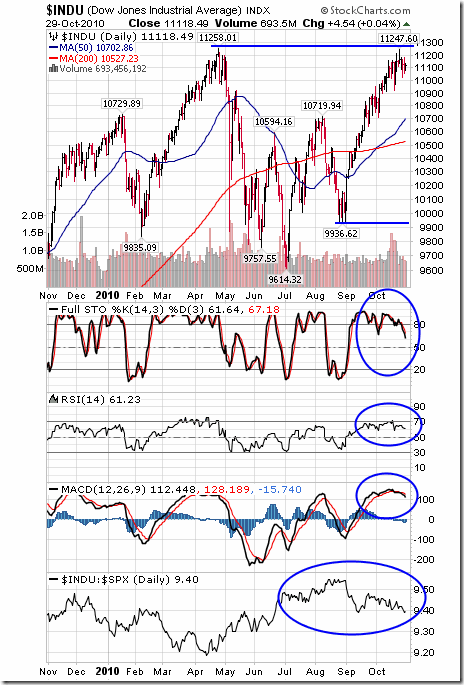
The Dow Jones Industrial Average slipped 14.07 points (0.13%) last week. Intermediate trend remain up. Support is at 9.936.62. Resistance at 11,258.01 was unsuccessfully tested last week. The Average is well above its 50 and 200 day moving averages. Short term momentum indicators are overbought, have peaked and are trending lower. Strength relative to the S&P 500 Index remains mixed. Intermediate downside risk during a correction is to its 50 day moving average currently at 10,702.86.
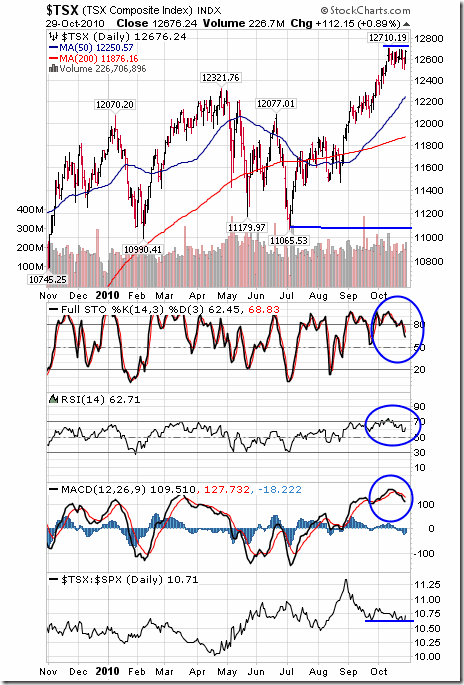
The TSX Composite Index added 75.06 points (0.60%) last week. Intermediate trend remains up. Support is at 11,065.53. Resistance may be forming at 12,710.19. The Index remains above its 50 and 200 day moving averages. Short term momentum indicators are overbought, have peaked and are trending down. Strength relative to the S&P 500 Index is mixed. Intermediate downside risk during a correction is to its 50 day moving average currently at 12,250.57.
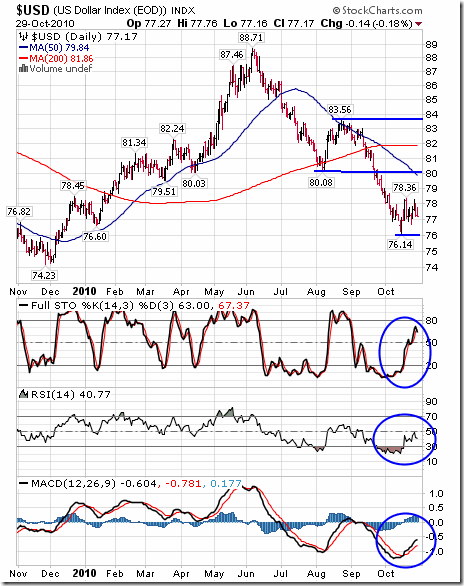
The U.S. Dollar slipped 0.29 last week. Importance of the outside reversal on October 15th remains intact. Support is developing at 76.14. Short term momentum indicators continue to recover from oversold levels. Short term upside potential is to the breakdown level and its 50 day moving average near 80. Intermediate trend remains down.
Crude oil slipped $0.24 per barrel last week. Resistance has formed at $84.62. Short term momentum indicators have peaked at overbought levels and are trending down. ‘Tis the season for crude oil to move lower.

Gold added $30 U.S. (2.3%) last week. Short term momentum indicators have changed from overbought to neutral. Gold has a history of recovering near the beginning of November and moving higher until the end of December.

…read more of the 45 plus Charts Don Vialoux analyses in this great Monday comment HERE
• While you were sleeping: the risk-on trade is on again; the catalyst, news that China’s manufacturing sentiment index rose in October
• A big week ahead in the U.S.: we have the mid-term election results on Tuesday, the Fed press release on Wednesday and October nonfarm payrolls on Friday
• Big money! Barron’s Big Money Poll shows that 62% of PMs in the U.S. see equities as the top performing asset class in the next 6-12 months, not only that, 70% see little chance of another economic expansion — this is otherwise known as the herd mentality
• Deflation, not inflation, is the primary risk in the U.S.
• Notice the NYT’s conclusion about 3M’s results and also the word “price cuts”?
• The retail investor shuns the new Fed-led bubble: despite the rally in the equity market in October, retail investors continue to pull money out of their equity mutual funds
• Problems re-emerging in France
• Canadian GDP a treat; however, we continue to believe that the economy faces many headwinds ahead
10 Steps to Beat the Market
Stockscores.com Perspectives for the week ending October 30, 2010
In this week’s issue:
Weekly Commentary
Strategy of the Week
Stocks That Meet The Featured Strategy

I believe that making money in the market requires doing what is hard. Often, when your emotions are telling you to take one course of action, you have to go the other way. Here are 10 hard, but necessary, things to do if you want to beat the stock market.
1. Take losses when you are wrong
No one likes to take a loss but losing is part of making money. You have to recognize that the stock market can not be predicted with 100% certainty and accept that being wrong is ok. When the market proves your decision wrong, take the loss!
2. Let profits run when you are right
Never be satisfied with a trade unless it returns you at least twice what you risked on the trade. Of course, more is better; one trade that returns 10 times your risk will pay for 10 losers. Our natural tendency is to fear letting our winners turn in to losers and so we are quick to sell our winners at the first sign of weakness. But realize that is what most people are thinking which means trends will start with a lot of back and forth moves because many investors lack commitment. It is only after a sustained trend upward that the fear diminishes and the trend really starts to accelerate. That is where investors can make the most money, if they stay in the stock long enough to enjoy it.
3. Buy when there is panic selling
The emphasis here is on panic selling, where the overwhelming pessimism has people accepting prices that make no rational sense. Don’t confuse a bear market with panic selling; weakness is not a reason to buy unless it is motivated by panic. Contrarian investing is only effective when emotion causes stocks to be mispriced and that comes with panic selling.
(continued below)
- Get the StockSchool Pro Free

Open and Fund a brokerage account with DisnatDirect and receive the StockSchool Pro home study course free, including special Pro level access through the DisnatDirect client website. Offer only available to Canadian residents. For information, click HERE
4. Sell when there is irrational buying
When the mass media is espousing the virtues of an investment, when people who know less than nothing about investing are dumping money in to the market, it is probably time to be a seller. If the upward trend goes from being linear to a curve, watch for signs of weakness as the upward trend is nearing its end. At this point, volume will often be much higher than normal and it will seem as though the stock can do nothing wrong.
5. Judge success in groups
Most of us judge our success one trade at a time. Trading is a probability game; you will not make money all of the time so why beat yourself up over a few losses? The only way to judge success is by the amount of money in your account over a large number of trades. Don’t even judge success by how often you are right, it is only about how much money you make over a large number of trades.
6. Test before you trade
To make money in the market, you need a strategy that has an edge. Don’t make investments on a hunch or what someone else tells you to do. Make investments based on a set of rules that you have tested and proven to be successful. Every great trader has a formula, what is yours?
7. Don’t follow the crowd
Average is what most people are doing; do you want to be average? It is only a small percentage of the population that has most of the money and they are making it from the largest group. If you want the money to flow your way, you have to be ahead of the crowd, do things before it is popular.
8. Avoid the headlines
The mainstream media seems to do their big features at or near market tops. If a media outlet has a large audience then their information is going to be priced in by a large number of people. Always remember that it is only a small number of people who beat the stock market which means if you are doing what the large numbers of people are doing, you are probably on the losing side. Going against the headlines will often be the winning strategy.
9. Don’t find comfort in the news
You buy a stock on a tip, based on a trading strategy or maybe after some in depth research. The stock goes down and the market tells you that you made a decision that was wrong. Rather than take the loss, you dig in to the news and find a reason to hang on. Perhaps it is that there are more results coming or that management has a proven track record. Any bit of fundamental information to justify holding the stock when the market tells you not to will help you avoid that negative feeling of taking a loss. Remember, the market never lies and the collective opinion of investors is based on all the information you are looking at. If what you are using to justify the hold is such good information, why are others selling?
10. Keep it simple
Investors have a tendency to get more sophisticated as they lose money. If there set of rules are not working, they add more rules. However, it is not usually the rules that are the problem; it is the application of the rules. People who make money keep it simple but work very hard at being disciplined and unemotional. Easy to say, hard to do.

I ran the Stockscores Simple Market Scan on Stockscores this week to uncover some good charts. This week, I not only wanted to see a good daily chart but also a good weekly chart (which I can view on Tradescores.com). The following stocks showed good breaks from predictive chart patterns on the daily and weekly charts.

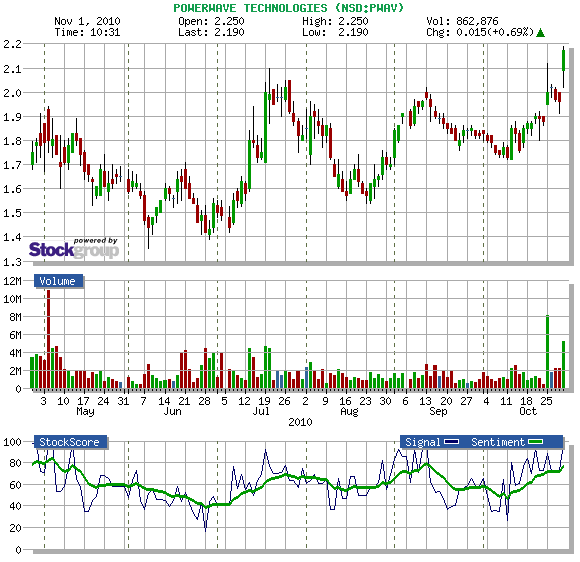
1. PWAV
PWAV breaks out from an ascending triangle pattern and has been trading higher than normal volume over the past few days. The stock appears to be reversing the long term weakness and starting an upward trend. Support at $1.95.
2. DDIC
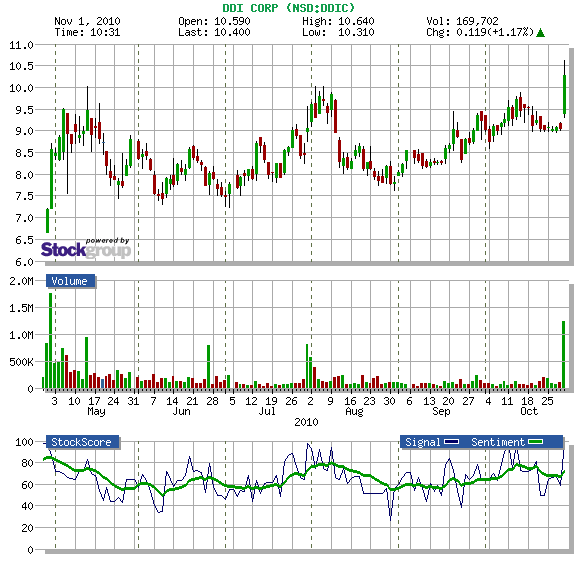
DDIC has been building an ascending triangle pattern since May and broke through resistance at $10 Friday with strong volume. This stock was featured in the dailly edition of the newsletter on Friday. Support at $8.95.
3. WSTG
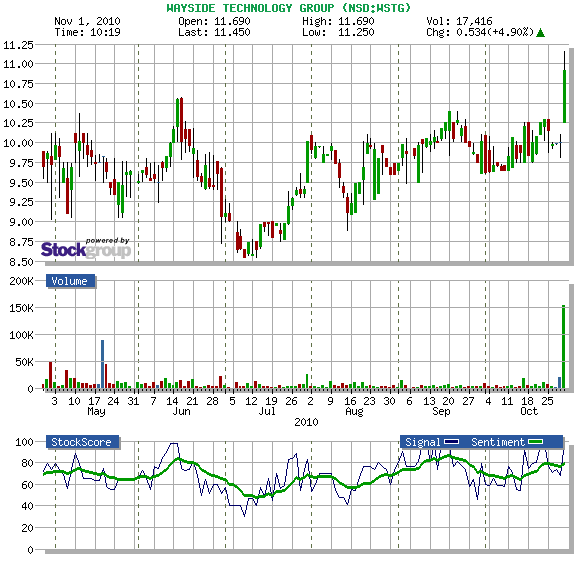
WSTG has been trading with low price volatility for a number of months but came to life on Friday as it broke through resistance on strong volume. The stock is building long term upward momentum with resistance at $16. Support is at $9.80.
References
Get the Stockscore on any of over 20,000 North American stocks.
Background on the theories used by Stockscores.
Strategies that can help you find new opportunities.
Scan the market using extensive filter criteria.
Build a portfolio of stocks and view a slide show of their charts.
See which sectors are leading the market, and their components.
Click HERE for the Speaker Lineup and to Purchase the video if you want to learn from some of the worlds best traders including Tyler Bollhorn.

Tyler Bollhorn started trading the stock market with $3,000 in capital, some borrowed from his credit card, when he was just 19 years old. As he worked through the Business program at the University of Calgary, he constantly followed the market and traded stocks. Upon graduation, he could not shake his addiction to the market, and so he continued to trade and study the market by day, while working as a DJ at night. From his 600 square foot basement suite that he shared with his brother, Mr. Bollhorn pursued his dream of making his living buying and selling stocks.
Slowly, he began to learn how the market works, and more importantly, how to consistently make money from it. He realized that the stock market is not fair, and that a small group of people make most of the money while the general public suffers. Eventually, he found some of the key ingredients to success, and turned $30,000 in to half a million dollars in only 3 months. His career as a stock trader had finally flourished.
Much of Mr Bollhorn’s work was pioneering, so he had to create his own tools to identify opportunities. With a vision of making the research process simpler and more effective, he created the Stockscores Approach to trading, and partnered with Stockgroup in the creation of the Stockscores.com web site. He found that he enjoyed teaching others how the market works almost as much as trading it, and he has since taught hundreds of traders how to apply the Stockscores Approach to the market.
Disclaimer
This is not an investment advisory, and should not be used to make investment decisions. Information in Stockscores Perspectives is often opinionated and should be considered for information purposes only. No stock exchange anywhere has approved or disapproved of the information contained herein. There is no express or implied solicitation to buy or sell securities. The writers and editors of Perspectives may have positions in the stocks discussed above and may trade in the stocks mentioned. Don’t consider buying or selling any stock without conducting your own due diligence.
…..read the Globe Editorial: Gordon Campbell’s intelligent appeasement
Michael Campbell comments: Reduced income tax does not necessarily translate to lower government revenues. When B.C. reduced income taxes by 25% in 2001 government revenues went up. B.C. and Alberta have had the lowest level of personal income tax and have also had the strongest economies. In the US a comparison between the nine states with the highest income tax rates and the nine with the lowest – shows that those with the lowest income tax rates have seen economic growth in the last decade increase over 45% more than their counterparts with the highest income tax rates. B.C. balanced its budget starting in 2003 with dramatically lower provincial income tax rates – they only entered deficit again during the massive economic downturn after the credit crisis.
Michael Campbell’s P.S. I hate to spoil a good political rant with facts but Vancouver has lost 5000 students since 2000 and now according to the Vancouver School Board there are 8000 excess spaces. Each of the schools that may be closed are more than 60% empty with three of the schools more than 70% empty. It has nothing to do with government finances and everything to do with declining enrollment.
Michael Campbell’s PPS B.C. – like every other province in the country is spending record amounts on healthcare according to the just released Canadian Health Institute Report.
….read other’s comments on the article Gordon Campbell’s intelligent appeasement
-
I know Mike is a very solid investor and respect his opinions very much. So if he says pay attention to this or that - I will.
~ Dale G.
-
I've started managing my own investments so view Michael's site as a one-stop shop from which to get information and perspectives.
~ Dave E.
-
Michael offers easy reading, honest, common sense information that anyone can use in a practical manner.
~ der_al.
-
A sane voice in a scrambled investment world.
~ Ed R.
Inside Edge Pro Contributors

Greg Weldon

Josef Schachter

Tyler Bollhorn

Ryan Irvine

Paul Beattie

Martin Straith

Patrick Ceresna

Mark Leibovit

James Thorne

Victor Adair