
Daily Updates
http://www.grandich.com/2011/02/update-28/
Half the time I am forced by point of a gun to listen to the D&G crowd lately, I keep waiting for the punch line, thinking this same story, now very long in the tooth, can’t actually encompass the depth of their analysis? There must be more. There must be something new. There must be something even the usual self-disrespecting scaremonger and self-promoting hack hasn’t already blared at us on their website, promotions, CNBC perch, or ridiculous webinars. There must be more!
But alas there’s no more!
Nothing new flows from the D&G crowd we didn’t already know for a while. But sadly much flows to our D&G heroes, which might help explain the tenacity of their views. Many of us are nothing more than investment lemmings who want our worn out views validated. What we may see as rationale analysis in retrospect seems nothing more than a quest for someone to validate our religion (faith in self-mutilation is strong among the investment lemming breed, I know from experience). Interestingly, what flows from this religious validation to the D&G promoters are those much despised Federal Reserve notes distributed most efficiently and effectively through the US banking system with the much dreaded Fed at the core of this payments system; a system that, despite the “massive government intervention,” works without flaw billions of times a day. We never hear the D&G crowd complain about the Fed’s complicity in these transfers of stores of value. Hmmm…
But Jack, haven’t you ridden in a tight formation with the D&G crowd in the past?
Currency Currents 16 February 2011
At a time when bullish investor sentiment has soared to extreme levels, we can see some storm clouds coming:
At a time when bullish investor sentiment has soared to extreme levels, we can see somestorm clouds coming. Yesterday’s market reaction to the +0.3% MoM print in U.S. retail sales attests to the view that a whole lot of growth is being priced in. Meanwhile, the real economic data are going to be deflated by a surging deflator — U.S. import prices of food has risen at a 30% annual rate in the past three months and fuels by a whopping 60%. That will surely cut deeply into spending power insofar as these costs get passed on. A flat reading in the NationalAssociation of Home Builders index at a depressionary 16 level confirms that the housing sector is going nowhere fast (see Banks Push Home Buyers To Put Down More Cash on the front page of the WSJ — median down payments are up to 22%!). If you are looking for real estate that is hot, it would seem as though the “ag” sector is in a full-fledged secular bull market (see Rising Crop Prices Lift Farmland Values on page A2 of the WSJ).
Meanwhile, U.K. inflation has already risen to a two-year high of 4% — double the Bank of England’s target. The central bank is caught in the box here because the run-up in inflation has occurred alongside a Q4 contraction in the economy. In fact, growth was surprisingly weak across the continent — a mere 0.3% inch-up in eurozone real GDP in Q4. The ongoing unease in the Mideast should also command a higher risk premium in the markets from a geopolitical standpoint (all the more so if the Muslim Brotherhood were to ever emerge victorious in Egypt).
Looking for an asset class with possibly way too much risk priced in? Try muni bonds — they are probably going to like to see more articles like this too — State Cuts Rattle Unions on page A3 of the WSJ and Minnesota Considers Top-Tier Tax Boost on page A5 (the Governor is aiming to boost the top marginal income tax rate to 13.95%, which would be the highest in the country).
….to read more items in this mornings dispatch register at Gluskin Sheff HERE
http://www.grandich.com/2011/02/interesting-interview/
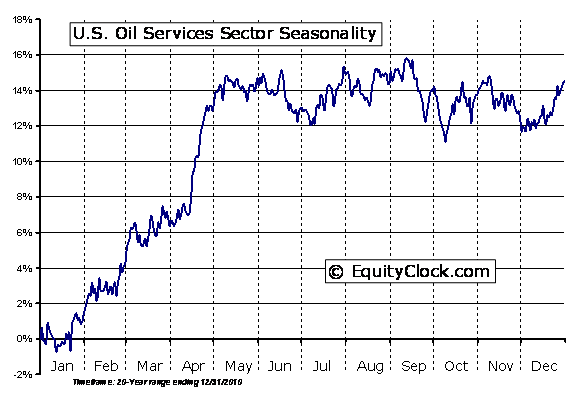
The U.S. Oil Services Sector: Drill, Baby, Drill
The U.S. Oil Services Sector has a period of seasonal strength from the end of January to the end of May. Will the sector move higher again this year?
The U.S. Oil Services sector as a sub-sector of the Energy sector has often been described as “The energy sector on steroids”. Share prices of energy stocks are amplified in the oil services sector. Both sectors have a history of moving higher from February to May. During the past 13 periods, the Philadelphia Oil Services Index has gained in 11 periods for an average gain per period of 15.4%. Seasonality in both sectors is influenced by rising crude oil and refined product prices during the February to May period.
Prospects for the oil services industry are exceptional this year. A recent Barclay’s survey of 402 oil companies showed that the oil industry is planning to spend $490 billion on projects in 2011, a gain of 11% over 2010. The planned increases reflect higher crude oil prices as well as higher costs of finding and extracting oil in harder to access areas. Large projects currently under development are located offshore Western Australia and the South China Sea. The largest project is located offshore Brazil. Petroleo Brasiliero SA has budgeted $28.2 billion for capital costs related to development of its deep water oil fields off Brazil’s Atlantic coast.
Demand for deep water rigs continues to grow despite the drilling moratorium in the Gulf of Mexico and despite another 25 new deepwater rigs that came on stream in 2010. Another 35 rigs are scheduled to be built in 2011.
New technologies in the industry are also driving revenue and earnings. Most notable has been the rising demand for rigs capable of horizontal drilling used to produce shale gas.
On the charts, the sector has been a stellar performer since last September. Intermediate trend remains up. The Philadelphia Oil Services Index trades well above its 50 and 200 day moving averages. Short term momentum indictors are overbought, but have yet to show technical signs of peaking. Preferred strategy is to purchase the sector on weakness in the month of February.
The easiest way to participate in the sector is to own Exchange Traded Funds (ETF) that hold a diversified portfolio of international oil service stocks. Oil Services HOLDRs (OIH) is the most actively traded ETF. Other liquid ETFs include Dynamic Oil and Gas Services (PXJ) and Oil and Gas Equipment and Services SPDRs (XES).
Jon and Don Vialoux are authors of free daily reports on equity markets, sectors, commodities and Exchange Traded Funds. Reports are available at www.timingthemarket.ca and www.equityclock.com Follow us on Twitter@EquityClock.
-
I know Mike is a very solid investor and respect his opinions very much. So if he says pay attention to this or that - I will.
~ Dale G.
-
I've started managing my own investments so view Michael's site as a one-stop shop from which to get information and perspectives.
~ Dave E.
-
Michael offers easy reading, honest, common sense information that anyone can use in a practical manner.
~ der_al.
-
A sane voice in a scrambled investment world.
~ Ed R.
Inside Edge Pro Contributors

Greg Weldon

Josef Schachter

Tyler Bollhorn

Ryan Irvine

Paul Beattie

Martin Straith

Patrick Ceresna

Mark Leibovit

James Thorne

Victor Adair