
Daily Updates
Michael: We are talking with Dr. Michael Berry of Discovery Investing who writes the Morning Notes three times a week.
There is a lot of areas I want to get to but one of the things I really want to do is sensitize our audience across the country to the severity of the US debt crisis. We hear the debt number but the big drama is this debt ceiling that they have to raise. Explain to our audience what’s the significance of that.
Berry: Well by law, congress can only allow the country to issue so much debt. We have a $14.33 trillion limitation on how much debt the country can issue and we’re at that ceiling now. So what is happening now is that there is no more borrowing legally allowed, so they are going to start to borrow from Peter to pay Paul so to speak. In other words they are going to look around at other kinds of programs and take from them to finance the country forward, and of course the issue really is if there is ever a payment of interest on the debt missed, that’s a default. that’s a sovereign default to and that would be a major issue. Now I am not predicting that, but I think there won’t be any agreement in congress for some time. We have until about August the 2nd and by August the 2nd this has to be resolved. Do we increase the debt ceiling? Do we cut spending? What do we do in the US? Right now congress is not cooperating, it’s very polarized.
Michael: You know what’s interesting is that going back a few weeks there was 10 or 14 Nobel Prize winners in finance and economics who were all warning about the debt ceiling. We had that debt commission that reported last November or December warning about this. It’s almost a bit embarrassing to see all the warnings about the deficit problems in the States and yet congress seems dysfunctional. Do they really have to get to the August 1st date before they take meaningful action?
Berry: That‘s a very good point you’re making. I do think it’s going to take some time. Actually down the road I think they will raise the debt ceiling, but I don’t know by how much. Everybody in Canada should know that the United States is an entitlement country. We have 185 entitlement programs and they run almost $2 trillion a year. The federal budget is 3.7 trillion. So over half the budget is entitlements so the question is do the Republicans allow for spending to be cut, do we raise taxes or do we do both? Of course the Democrats will want to raise taxes and not cut entitlement spending and the Republicans the reverse. So that’s the political issue and of course politicians are always worried about being re-elected. Therein lays the conundrum.
Michael: You’ve delivered your research and speeches to members of the Federal Reserve, what kind of response do you get there?
Berry: Well, it’s always a sobering experience. I have done 14 presentations at the Fed two and three levels down but I am not presenting to the FOMC, the policy makers. I am presenting to very senior people at the Fed, the FDIC and the OCC. Usually 100 people at a time and basically they all know that there are problems. These people who are in the trenches, out doing bank examinations and so on realize that there is significant problem that has to be solved and that problem gets worse every year. The problem is we keep borrowing to sustain the quality of life in this country and sooner or later the lenders are going to stop lending at these rates. That’s one of the few things that can happen in the next year or so.
Michael: That’s the key, interest rates are not going to be set by some central banker, we’re seeing that in Greece right now. They have 21% or 23% interest rates for two year borrowing from their government. They pay 14 percentage points more to borrow out of tenure than the Germans do; somewhere around 3% for the Germans for a tenure note and 17% for the Greece. Thats what happens when people simply say ‘I don’t want to lend you any more money unless you compensate for the extra risk.’ That’s the biggest risk I see for the interest rate market right now.
Berry: Yes, it’s a huge risk Michael. The yield curve and the treasury curve in the US out to about two years is a half a percent or something like that and it’s been falling. Even 30 year money now is 4.2% and it’s been falling every week. So what happens if that goes up? Well, what happens is that the interest on the debt becomes unsustainable, in other words you can’t pay it at 5 or 6% which is probably where it should be today. So there is no way in this country that they will raise rates. The Canadian situation is completely different from the situation down here. Almost every other country it tightening whereas the US can not afford to tighten at this time. Not going to happen.
Michael: What a great conundrum. They just seem to be delaying time from the inevitable day of reckoning. I talked about demographics earlier and how that’s going to drive up spending on healthcare, unfunded pensions and senior services. That’s on the horizon and it won’t matter in the US case whether it’s Democrat or Republican and in our case whether its Liberal, NDP, Bloc or Conservative. That’s going to be the wild card that we all know what is going to hit.
Berry: It’s a huge a demographic baby boomer tsunami rolling down the road. Here in the US for example, social security benefits will have to be reduced by up to 50% so it means slower growth. But to come back to a point you made so well, in this country the political solution has been to push everything down the road and hope that it takes care of itself instead of dealing with restructuring. Restructuring which we could have done a year or two ago that we’re going to have to do anyway. Just like the Greeks are going to have to do that. Instead of thinking maybe we can grow out of this mess, we can’t. So what this country will do relative to it’s currency for example, is allow it to depreciate and that will inflate away some but not nearly enough of the debt problem. It’s a very interesting problem that confronts the country now.
Michael: Before we get to the investment side I want to quickly move to housing in the US and your take on it at this point.
Berry: Very negative, I hate to be so negative. The housing problem has not gone away, it’s been pushed down the road. Banks have not restructured their bad debt situations yet so they are basically stuffing money back with the Federal Reserve to try and get interest rates. Right now almost 30% of all single family mortgage loansare under water in the US right now, and since the credit crisis began, the decline in real value to the economy is $6.3 trillion. You have cities like Phoenix where 50 or 60% of the homes have negative equity. These are all the statistics, I’m not making them up. So we have at least another 15 to 20% downside and we have the foreclosures that have been put off by the federal government the funding the HAMP program. The foreclosures will start to hit now and of course foreclosures beget lower prices so you have a ways to go down yet in housing.
Michael: Let me just jump over to Europe right now. I was just saying earlier if this was a nine inning ball game I think we have just done one inning. I just think this thing has not gone away in any way and it’s going to start really being prominent in the news again. We can guess at the implications but the Greek debt is owed to somebody and that somebody is a part of the European banking system. They’ll take a hit if Greece has to restructure and that looks like that is going to happen.
Berry: Yes, it does very much look like that now Michael. The Greek situation itself is not going away. When you have a bubble, a global bubble like this no mater where it started that doesn’t matter anymore. You have restructuring that has to happen and you have long time periods to get that done. So we have Greece, we have Spain and we have Portugal in the southern countries of Europe. There is a lot of exposure in the German banking system and in the European Central Bank. So somebody is going to take a big hit I as I believe there will be a restructuring of Greek debt. Greeks say no, that will not happen. But I don’t see how they can possibly grow out of it. Austerity is not popular in Greece or any of the other countries and unemployment is huge. So there will have to be a restructuring, there will have to be a write down of the debt and that’s going to affect all of Europe. One thing I couldn’t understand was when the European Central Bank raised rates. This is not the time to be rising rates and tightening as we don’t really see that much wage price inflation. We do see some price inflation but… I thought that was a mistake and we’ll see what happens. I was just in Zurich last week where I presented and I asked the Swiss why they did you not go with the Euro, they replied “you can see why”.
Michael: Let’s get to the investing side of this thing scenario and the implications. I find myself very cautious right now. There is a lot of stuff ticking and there is not going to be any easy solution. Every government wants to be Santa Clause but that isn’t going to happen. The day of reckoning is coming faster because driving that train is not only the debt crisis but it’s also the demographics. What’s your take and perspective on the investment side.
Berry: Yes, I am cautious. When I look at the US equity market for example I see a lot of weak chinks in the armor there. Clearly, they have done a lot of printing or money creation and so it’s the one area where people have felt sort of good so they piled into the US equity market since March of ’09. But I really think it’s topping out here and I think it’s also problematical. My view is that whatever happens in China we’ll be the determinant of what happens to things like the commodity market and the Canadian Junior Mining sector which I am heavily involved with on the discovery side. I think gold has performed extraordinarily well under the circumstances. Despite the government really trying to bring it down its back up to 1,537 so I think you have to own gold in this environment either in kind or in Canadian stocks and I think you have to be very careful with the financial end of the equity markets.
Michael: If the last say three to four years haven’t reminded people that it’s an international and a global world I am not sure what would. As events outside of our borders impact us what worries me is the Shanghai Index hasn’t shown much recovery. Also their government is raising reserve levels in the banks. I couldn’t agree more that China is dictating so much of what happens even in Canada because of the resource demand coming out of China. I am not that optimistic on the short term.
Berry: In the short term I am very cautious on what’s happening with China. Longer term I think China, Brazil, India and and the rest of the emerging world will grow. I think the western economies will definitely have a tough time for next five to seven years growing and undoing unemployment. d
Michael: There are places that investors should put on their radar screens and one that you have been pioneering is strategic metals.
Berry: Definitely. Finally our senate and the house tabled the bill I think on Thursday that’s called the critical metals bills and it devotes $106 million to the development of cobalt, helium, lead, lithium, phosphate, potash, and rare earths. Finally somebody in the US government is recognizing the fact that we need to develop these materials and I think their significance is all for Canada because many of these things are Canadian in source. I think it’s an extraordinarily important bill, I think it will pass and I think the president will sign it. These are strategic or critical metals we call them. I would add too graphite and vanadium that are being mined in Canada. I think this bill is very positive for the Canadian mining industry.
Michael: One of the challenges for individual investors though is in that area is that aren’t a lot of big players. If we were going to discuss the gold market everyone could agree on the list of the major players, the mid tier players and the junior producers. There doesn’t seem to be anywhere near that kind of scope when it comes to strategic metals.
Berry: True, absolutely true. But you know the Canadian scene is where a lot of these things get developed. Right now we’ve got two companies in Canada doing graphite and we have no graphite mines at all in the US. We have a couple of Canadian companies doing manganese and we have no manganese mines in the US. So yes they are small, they are juniors and I think there is a lot of wealth to be created there because we’re going to need these materials. I’d look to the Toronto and the Vancouver exchanges, they really provide an important source for investors. These juniors are risky there is no doubt about that. But with the push behind these critical metals it’s becoming more and more important.
Michael: How would you go about reducing your risk in this category of junior and speculative ventures. You can still do things better than others, what are the kinds of things you look for there?
Berry: We look for great management. I have 10 point grid that I published on my website and I used to manage money using this. So we have a 10 point grid, good management with good track record and who have their own investment money involved. They’ve got world class potential assets and really good high grade large tonnage type of a situation. Good balance sheet resources to cap it all.. There is about ten rules you follow and they’re not really complex to ascertain if the company has got a chance. Then you have to diversify because diversification cuts risk as well so it’s important.
Michael: That’s great advice for an area that’s very exciting and one to become more prominent as you’ve just outlined. Sooner if the legislation also passes in the States as it’s finally dawning on them that if China controls such a huge percentage of the strategic metal industry and we can’t rely on them as a supplier because they have their own needs. So I think you are going to see development in North America.
Berry: Canada is natural resource oriented that’s coming home to roost now. That’s the game the rest of the world is going to play and the US is just lucky to have a a neighbor like Canada who has got a lot of these critical metals. Saskatchewan is probably the best place. It’s pretty exciting and I am glad that the senate and the house have recognized this strategic or critical metal space and put money behind it.
Michael: Well, this is great stuff Dr. Berry we thank you so much for finding the time for us this weekend. It’s always a pleasure you’re insights are much appreciated.
Berry: It’s always a pleasure to speak to Michael. Thank you.
You can learn more about Dr. Berry at his website: www.discoveryinvesting.com
Sign up for his Free Morning Notes HERE
In our interview with Jeffrey Gundlach, the legendary bond manager said it’s good old paper cash that you want to have on hand. And not cash in the bank. More like cash under your bed, that you can pick up and carry (which you can’t do with gold… do you really think that you’re going to shave of flints from your goldbrick to pay for food at the store?). And if you really can’t stomach cash, even precious stones are better, since it’s much easier to carry a few million in gems around then a few million in gold, which is way too heavy. The discussion came after a broader talk about derivatives, which he sees as still posing potentially huge systemic risk to markets.
….more HERE
….full interview with EXCLUSIVE INTERVIEW With Jeffrey Gundlach, The Best Bond Manager In The World HERE
The Bottom Line
‘Tis the season to be cautious! Chances are high that equity markets on both sides of the border will move higher this week. However, strength provides another opportunity to take intermediate and seasonal profits. The period of seasonal strength for many sectors and markets recently ended. Selected sector trades such as agriculture, gold and energy are lining up as interesting possibilities this summer. However, timing of their entry is premature. They appear to be forming base building patterns for possible entry in July/August.
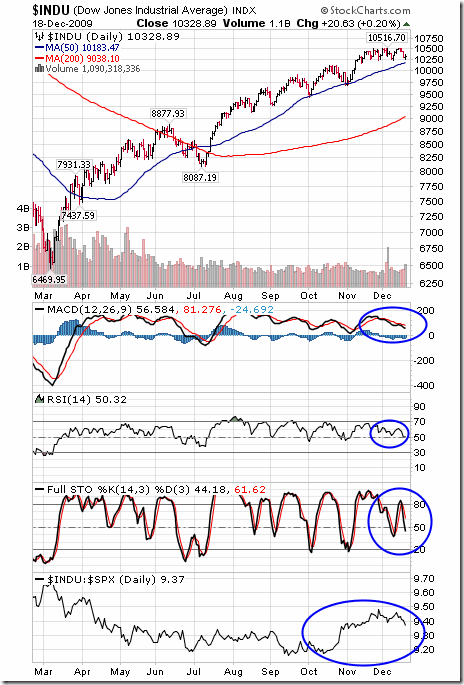
The Dow Jones Industrial Average slipped 70.46 points (0.56%) last week. Intermediate trend is up. The Average briefly moved below its 50 day moving average, but managed to recover above that level on Friday. Resistance exists at its May 2nd high at 12,876.00. Short term momentum indicators continue to trend down. Stochastics already are oversold and showing early signs of bottoming by recovering above 20% on Friday. Strength relative to the S&P 500 Index has turned from positive.
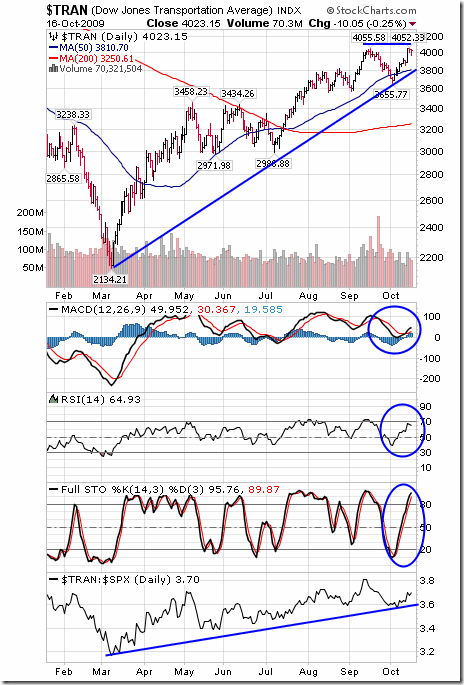
The TSX Composite Index gained 145.32 points (1.06%) last week. The Index remains in a four month trading range with support at 13,237.93 and resistance at 14,329.49. The Index briefly moved above its 50 day moving average on Friday. Short term momentum indicators continue to recover from oversold levels. StochastiFull report plus 45 Charts Analysed HERE
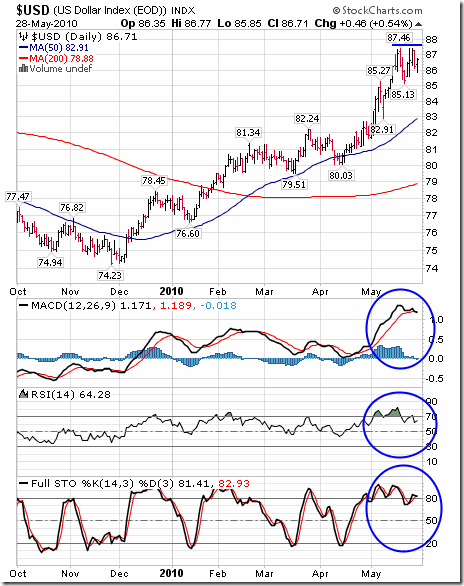
The U.S. Dollar Index fell 0.76 (1.00%) last week. Intermediate trend is down. The Index found resistance at 76.37, near a previous resistance level. The Index fell below its 50 day moving average on Friday. Short term momentum indicators have started to roll over from overbought levels. The “short cover” rally appears to be over and the intermediate downtrend has resumed. Weakness is short term positive for North American equity markets and commodities priced in U.S. Dollars.
Gold gained another $24.40 U.S. per ounce last week. Short term momentum indicators are recovering. Stochastics already are overbought, but have yet to show signs of peaking. Support is at $1,462.40. Resistance is at its all time high at $1,575.10. Weakness in the U.S. contributed to strength. Look for media talk this week discussing the possibility of gold reaching a new all time high (particularly if the U.S. Dollar Index continues to trend lower).

Full Report plus 45 Charts & Analysis HERE
The Summer Rally?
This is the time of year when the media start to talk about a Summer Rally. Mark Hulbert has done the research and confirms that the Summer Rally is a myth. Following is a link to his report released on Friday – HERE
Ed Note: Recently, Mark has gone from Bull to Bear now to Neutral in Stocks
TIMER DIGEST SIGNALS:
Stocks – Neutral –
Though there are plenty of reasons to be cautious on the markets ahead reverberating the ‘Sell May and Go Away’ cliche, the market is far from dead and may yet have a couple of upside surprises up its sleeve. A ‘Key Reversal’ to the upside Wednesday coupled with a decline in the U.S. Dollar and renewed strength in the Commodity markets were the triggers. We still have potential buyers here into the end of the month and into June, so let’s see which way the wind blows. That said, I wouldn’t call last week’s rally try anything to write home about, especially with regard to the statistical preference for a positive market around the U.S. Memorial Day holiday. And, it’s true markets sometimes move in the opposite direction of their short-term trend ahead of holiday weekends. What I have decided to do? I am neutral here and watching. Stepping back, I believe there will be a Plunge Protection Team shakeout and that shakeout will afford Ben Bernanke an opportunity to ignite a QE3 or some form thereof which will drive equity and commodity prices substantially higher in the next 6 to 18 months.
Gold – Bull –
Again, you have to watch the Dollar! Gold is within striking distance of a new all-time high, Platinum, Palladium and Copper are catching up quickly and Silver could easily see a retest of recent highs (if not new highs) simply because the weak sisters were shaken out. I am not discounting the risk that we could get a correction in all these markets as ‘seasonal’ factors kick in, but right now the tape is positive and most traders are cautious.
Bonds – Bullish –
Bonds should work higher this summer as money flees the stock market during an inevitable correction, but may also work higher as Ben Bernanke continues through June (and possibly longer) to prop up the bond market knowing full well its collapse spells doom for his hoped-for economic recovery.
The above is just a portion of Mark’sVRTrader. Much more analysis contained every day in Mark’sVRTrader Silver or Platinum Service Mark Leibovit’s Special Trial Offer: Use this month to kick our tires. Pay 50% for the first 30 days (No refund) and sample our Silver or Platinum service and then decide what works best for you. If you aren’t 100% ready to move forward, simply email us to cancel one week before your 30 day 50% off trial subscription ends and it will be canceled and you will not be charged ANY FURTHER, no questions asked. Just send an email to mark.vrtrader@gmail.com or call 928-282-1275 to cancel. You will receive an emailed confirmation of your cancellation at that time.
How You Can Find High-Probability Trading Opportunities Using Moving Averages
-
I know Mike is a very solid investor and respect his opinions very much. So if he says pay attention to this or that - I will.
~ Dale G.
-
I've started managing my own investments so view Michael's site as a one-stop shop from which to get information and perspectives.
~ Dave E.
-
Michael offers easy reading, honest, common sense information that anyone can use in a practical manner.
~ der_al.
-
A sane voice in a scrambled investment world.
~ Ed R.
Inside Edge Pro Contributors

Greg Weldon

Josef Schachter

Tyler Bollhorn

Ryan Irvine

Paul Beattie

Martin Straith

Patrick Ceresna

Mark Leibovit

James Thorne

Victor Adair