This Week’s Trading Lesson
“Anything worth doing is worth doing for money.” – Gordon Gecko, Wall Street
It is generally accepted that money is a motivator; if you link pay to performance, performance will improve. For that reason, many people’s salaries vary with their performance. This is most prevalent on Wall Street where bankers and traders receive most of their compensation in the form of incentive based pay.
In his book, “Drive”, Dan Pink considers whether pay for performance really works. Does dangling a carrot and threatening with a stick cause people to deliver better results? The research finds that this is not always the case.
For very mechanical tasks, incentive based pay does work. A brick layer who is paid by the brick will work more effectively than one who is paid by the hour. However, for tasks that require analytical thinking, performance is actually worse when it is linked to pay.
Pink cites research involving the solving of puzzles. The person who was told she would receive a financial reward if she solved the puzzle in the shortest time performed worse than a person who had no potential for financial reward if the puzzle was solved quickly. The person who was solving the puzzle for the sake of solving the puzzle did it quickest.
I have been teaching people how to trade the stock market for over ten years, teaching a lot of people from many different backgrounds. One constant that I have seen is those who perform the best as traders are those who don’t care about the money. They trade with a set of rules and the discipline to follow the rules, making the money irrelevant.
The market is a puzzle that we want to solve. Why does a focus on money make us ineffective traders, or puzzle solvers?
I am not a behavioral scientist and I have not done the kind of research necessary to really answer that question. However, I do have an opinion based on what I have learned from trading.
Money causes us to focus on something that is irrelevant to the problem. In doing so, it complicates the puzzle, making it more difficult to solve.
If we aspire to make money from the market, we should change our focus to find trading opportunities with a positive expected value. Money will be the determinant of success, but it will not be something that is part of the problem to be solved.
Suppose you buy a stock and it is showing you a profit of $1000. It is near to the end of the month and you need $1000 to pay your rent. There is a good chance you will sell the stock because of your need, regardless of what your analysis would tell you about the stock’s potential to move higher.
Money causes a greater problem to our trading when it comes to taking losses. A stock may remain a good hold despite the fact it is showing as a loss. The size of the loss often causes traders to exit the trade simply because the money, and the potential loss of more, causes them too much concern.
Not only can money bring an irrelevant condition in to our problem solving equation, it also tends to bring emotion which hurts our ability to make good decisions. Most people function poorly under stress and the fear of losing money brings stress. When we focus on the money, we trade with emotion and that means we make bad trades.
Every trader has to overcome their emotional attachment to money. Trades have to be based solely on the merit of the trade. Our pursuit must be on doing the right trade, doing good analysis. If we trade to make money, we will lose it! Our chances for success improve when we simply trade to solve the market’s puzzle.
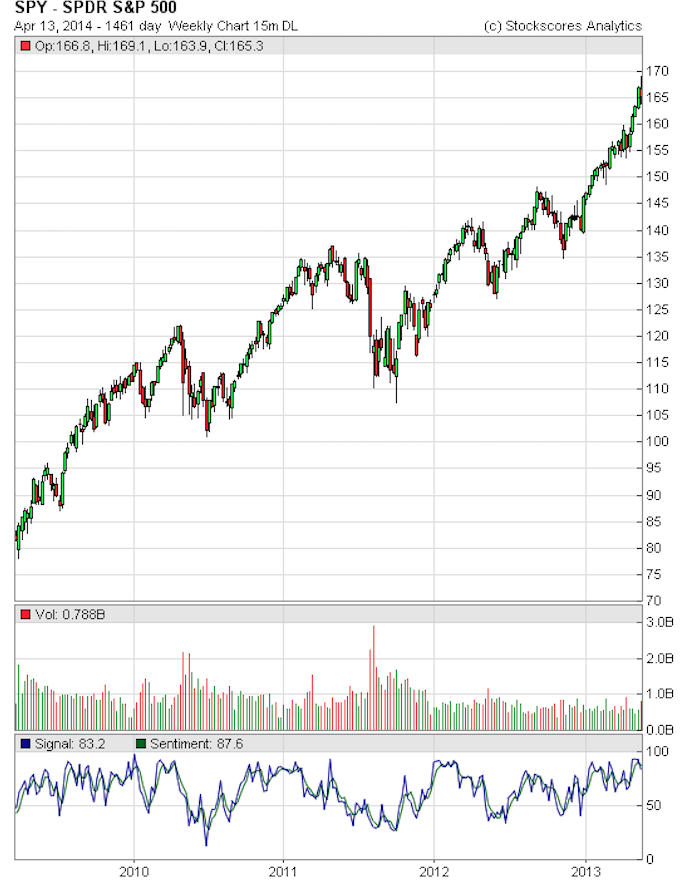
The US markets had a round of profit taking last week and appear likely to stall their upward trend in the short term. While the selling pressure mid-week rattled the confidence of the Bulls, it is not yet a strong signal of a trend reversal. Instead, it is likely the start of a pullback that will take some of the emotion out of the market.
Generally I remain Bullish on US stocks but I think some caution is warranted in the short term. We are at a point where the market has a good chance to go sideways but it is still pretty aggressive to short the market for anything more than a short term trade.
Canadian markets have underperformed the US markets but that also means they have less risk right now, simply because they don’t have far to fall until they hit support. Canadian junior, which tend to be speculative mining and energy stocks, have been dismal since early 2011 and should generally be avoided. However, the TSX Venture index is trying to make a rising bottom which could be the start of a turnaround. These stocks have lots of work to do but a glimmer of hope for the juniors.
Nothing to feature this week, I would like to see if last week’s selling pressure is the start of something bigger or just another speed bump in the long term upward trend.


References
- Get the Stockscore on any of over 20,000 North American stocks.
- Background on the theories used by Stockscores.
- Strategies that can help you find new opportunities.
- Scan the market using extensive filter criteria.
- Build a portfolio of stocks and view a slide show of their charts.
- See which sectors are leading the market, and their components.
Disclaimer
This is not an investment advisory, and should not be used to make investment decisions. Information in Stockscores Perspectives is often opinionated and should be considered for information purposes only. No stock exchange anywhere has approved or disapproved of the information contained herein. There is no express or implied solicitation to buy or sell securities. The writers and editors of Perspectives may have positions in the stocks discussed above and may trade in the stocks mentioned. Don’t consider buying or selling any stock without conducting your own due diligence.