
As a general rule, the most successful man in life is the man who has the best information
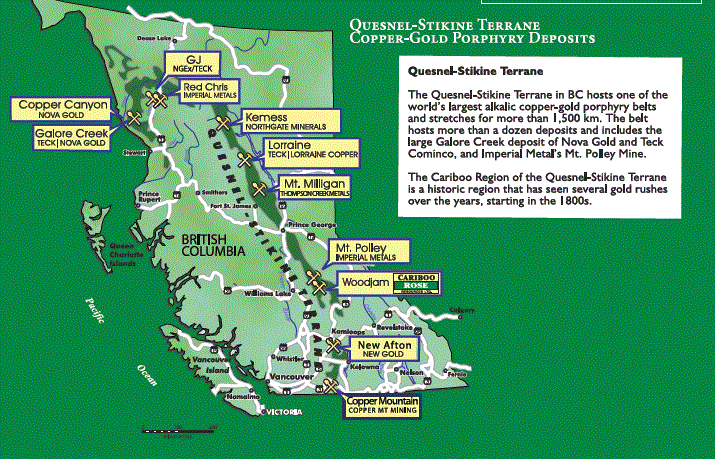
Quesnel–Stikine Terrane
The Quesnel–Stikine Terrane is a large regional depositional belt extending over 1500 kilometers through the central part of the province of British Columbia, Canada. It encompasses most of the operating mines in the province as well as most of the projects at the pre-feasibility and feasibility stages of development.

Used with permission from Cariboo Rose Res TSX.V – CRB
The lion’s share of exploration dollars in the province is being spent in this geological belt. The Quesnel–Stikine Terrane has become one of BC’s most sought after exploration/developmental targets.
In the central portion of the province there are currently two types of deposits attracting the lion’s share of interest:
- Porphyry copper/gold deposits
- Sediment Hosted Vein (SHV) deposit’s
Porphyry Copper/Gold Deposits
Porphyry copper/gold targets are becoming increasingly important in the global quest to replace declining copper and gold production.
Porphyry copper deposits yield about two-thirds of the world’s copper and are therefore the world’s most important type of copper deposit.
In Canada, British Columbia enjoys the lion’s share of this type of deposit, and they contain the largest resources of copper, significant molybdenum and 50% of the gold in the province.
Porphyry copper deposits are copper orebodies which are associated with porphyritic intrusive rocks and the fluids that accompany them. Porphyry orebodies typically contain between 0.4 and 1 % copper with smaller amounts of other metals such as molybdenum, silver and gold.
There are two factors that make these kinds of deposits so attractive to the world’s major mining companies – firstly by focusing on profitability and mine life instead of solely on grade your other inputs of scale/cost can offset the lower grade and this results in almost identical gross margins between high and low grade deposits. Low grade can mean big profits for mining companies – Copper-gold porphyries can offer both size and profitability.
The second factor affecting profitability of these often immense deposits is the presence of more than one payable metal ie for gold miners using co-product (copper) accounting the cost of gold production is usually way below the industry average. So not only are the traditional miners of these scarce and often immense ore bodies in competition for them but increasingly yesterdays gold only miners are becoming interested as well. These kinds of deposits are one of the few deposit types containing gold that have both the scale and the potential for decent economics that a major gold mining company can feel comfortable going after to replace and add to their gold reserves.
Sediment Hosted Vein (SHV) deposit’s
The term Sediment Hosted Vein (SHV) deposit is used for a family of gold deposits that consist of gold in quartz and quartz-carbonate veins hosted by shale and siltstone sedimentary rocks. These deposits occur throughout the world, but are most prolific in size and number in Asia. Most are poorly known to westerners because of their location in the former Soviet Union.
All SHV deposits have characteristics in common with each other:
- Tectonic setting
- Host rocks
- Alteration style
- Metal content
- Hydrothermal fluid chemistry
- Absolute and relative timing of formation
Attractive characteristic of SHV deposits are:
- They can be gold-only systems and therefore are metallurgically simple
- SHV deposits are associated with prolific placer gold fields if conditions are right for the formation of placer deposits
- Sulfide content is low for this type of deposit
- Type of setting is specific and identifiable among sedimentary belts of the world
- SHV deposits occur in groups, usually with one large deposit associated with numerous satellite deposits
Similar deposits are among the world’s largest gold sources, including Muruntau, Uzbekistan, Kumtor, Kyrgystan, and Sukhoi Log, Siberia, and Ballarat and Bendigo in Australia. Large placer gold fields are commonly found close to such deposits, as is the case in BC’s Cariboo region.
To read Rick Mills recommendation go HERE