
IMF Forecast: Can China Really Overtake the U.S. Economy by 2016?
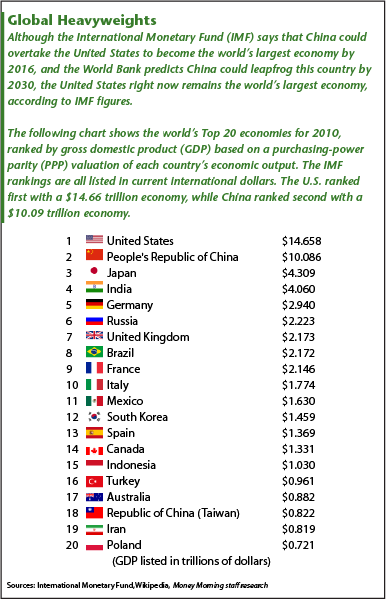
According to the International Monetary Fund (IMF) “World Economic Outlook,” China’s output will surpass that of the United States in 2016 – only five years from now.
But don’t worry. The IMF calculation is based on “purchasing power parity” (PPP), which does not reflect real money. It relies on projecting China’s stellar growth rates five years into the future. And it relies on Chinese official statistics, which are more than a little questionable.
(In fact, after the media storm that resulted, the IMF apparently even soft-pedaled its prediction that China would leapfrog the United States in just five years; in a subsequent interview, an IMF spokesman reportedly said that, by non-PPP measures, the U.S. economy “will still be 70% larger by 2016.” A recent World Bank forecast concluded that China could overtake the United States by 2030.)
This prediction – and the attention it continues to draw – serves a useful purpose, particularly if it’s given the scrutiny that it deserves.
For global investors with China-based holdings, it reminds us of that country’s long-term potential – and the fact that such potential is always tempered by near-term risk. For the rest of us, it reminds us that China’s ascendance is inevitable – in fact, is already happening – and will be with us for a long time, even if that Asian giant isn’t immediately going to overwhelm the rest of the world.
And for our elected leaders in Washington, the IMF report – false alarm or not – should serve as a wakeup call to attack and address the many problems that threaten this country’s global leadership.
IMF Report: A Closer Look
I had some problems with this prediction from the moment it hit the headlines.
Let’s start with the IMF statistics themselves. They measure gross domestic product (GDP) on the basis of “purchasing power parity,” rather than by market exchange rates.
That makes sense if you’re comparing living standards: If you are talking about what the typical China consumer can buy, he or she is about one-sixth as well off as his or her American counterpart, not one-twentieth.
However, the use of the PPP measure makes much less sense when looking at international trade or political power. That’s because individual purchasing power includes such items as haircuts, which are much cheaper in Beijing than in Boston (except, doubtless, at a couple of very overpriced salons in Shanghai or one of the other burgeoning financial centers) and cannot easily be traded internationally.
On the other hand, goods that are traded internationally are subject to global market forces and are generally about the same price everywhere they are sold. In fact, some of those goods may even be cheaper in the United States, since our distribution system is more efficient and our tariffs lower.
….read more HERE (scroll down to this image below)

….read more HERE (scroll down to this image above)